
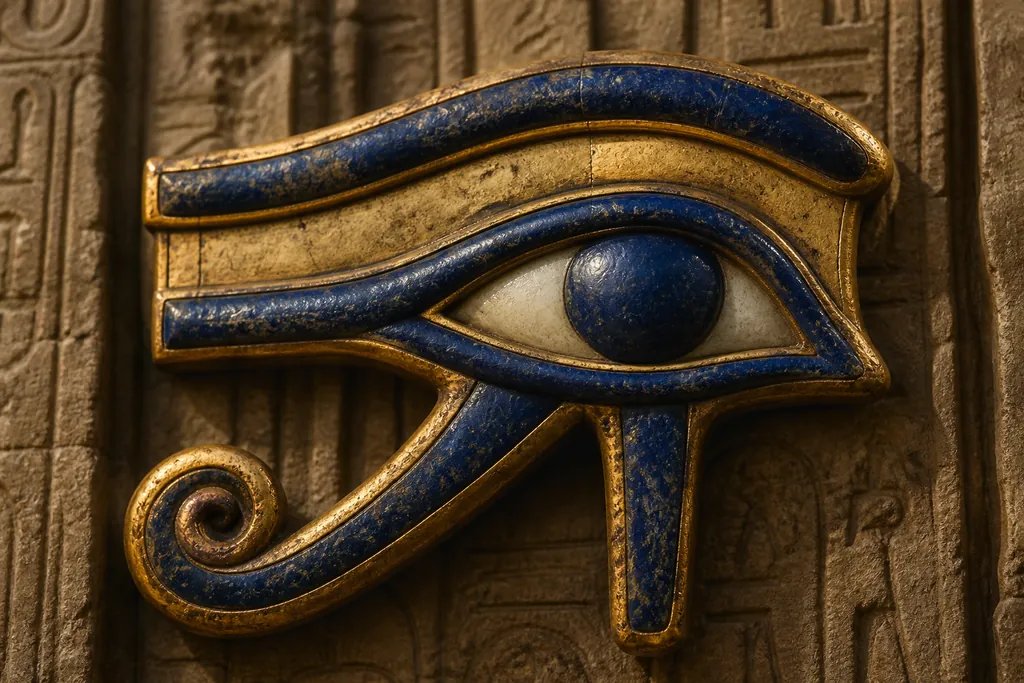
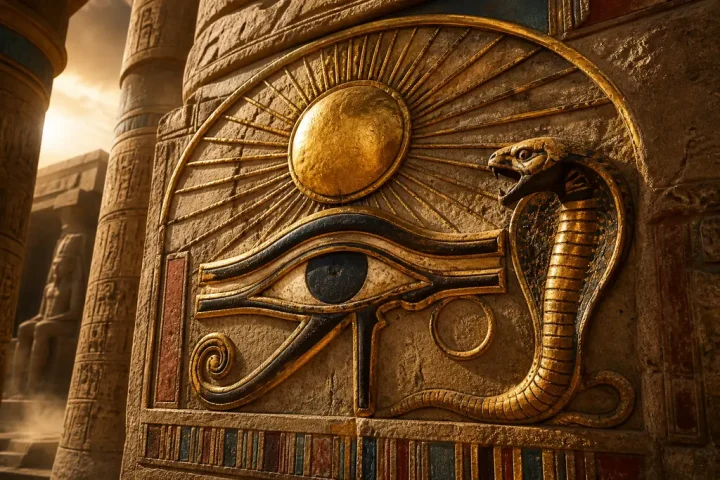
The Eye of Horus is one of the most recognisable symbols of ancient Egypt. It appears on amulets, coffins, temple walls, funerary objects, jewellery, and magical texts, carrying meanings that reach far beyond decoration. To the ancient Egyptians, the Eye of Horus was a sign of divine protection, restored wholeness, royal authority, healing, and spiritual sight.
Known in ancient Egyptian as the Wedjat or Udjat Eye, meaning “the whole one” or “the restored one,” the symbol is deeply connected to the myth of Horus and Seth: a story of violence, loss, restoration, and rightful kingship. Because of this mythic background, the Eye of Horus became a powerful emblem of survival after injury, order after chaos, and protection against destructive forces.
It was not merely a symbol to be admired.
It was a magical instrument.
Who Was Horus?
Horus was one of the most important gods in ancient Egyptian religion. Often depicted as a falcon or as a man with the head of a falcon, he was associated with the sky, kingship, divine vision, and the living pharaoh.
The eyes of Horus were often interpreted cosmologically:
The right eye was associated with the sun.
The left eye was associated with the moon.
Together, they represented cosmic balance: day and night, light and darkness, sovereignty and restoration.
Horus was also the son of Osiris and Isis. After Osiris was murdered by his brother Seth, Horus became the divine avenger who fought to restore his father’s honour and claim his rightful inheritance. This struggle between Horus and Seth became one of the great mythic dramas of Egyptian religion.
It is within this conflict that the Eye of Horus receives its deepest meaning.
The Myth of the Lost Eye
In Egyptian mythology, Horus fought Seth in a battle for the throne of Egypt. Seth represented disorder, violence, desert power, and disruption, while Horus represented rightful kingship, order, legitimacy, and divine continuity.
During their conflict, Horus lost one of his eyes. In some versions, Seth tears it out; in others, the eye is damaged or fragmented. The injury is not only physical. It is cosmic. The eye of a sky god is not an ordinary eye — it is a symbol of perception, power, and heavenly order.
The damaged eye is later restored, often through the intervention of Thoth, the god of wisdom, writing, mathematics, and magic. Once healed, the eye becomes the Wedjat: the restored eye, the whole eye, the eye made complete again.
This restoration is the key to the symbol’s meaning.
The Eye of Horus does not simply represent protection because it is powerful. It represents protection because it has survived damage and been made whole again.
The Meaning of the Eye of Horus
The Eye of Horus carries several important meanings within Egyptian religion and magical practice.
Protection
The Eye of Horus was one of the most widely used protective symbols in ancient Egypt. It was worn as an amulet by the living and placed among the dead to guard them in the afterlife.
The eye was believed to watch over the wearer, repel harmful forces, and preserve the body and soul from danger. Its power came from divine sight: the idea that nothing harmful could approach unnoticed beneath the gaze of Horus.
For this reason, the symbol appears frequently on coffins, mummy wrappings, funerary jewellery, and tomb objects. It served as a magical guardian, especially during the vulnerable passage from life into death.
Healing
Because the Eye of Horus was damaged and then restored, it became a symbol of healing and regeneration. It represented the return of health after injury, balance after disruption, and wholeness after fragmentation.
The restored eye was a sacred image of recovery.
In Egyptian thought, healing was not only physical. It was spiritual, magical, and cosmic. Illness, injury, and misfortune were often understood as disruptions of order. To heal was to restore harmony.
The Eye of Horus therefore became a sign of the body made whole, the spirit protected, and the damaged self returned to balance.
Royal Power
Horus was closely connected to the pharaoh. In life, the Egyptian king was often identified with Horus, while in death he became associated with Osiris.
Because of this connection, the Eye of Horus also symbolised royal legitimacy. It represented the right to rule, divine authority, and the restoration of order after conflict.
The myth of Horus defeating Seth was not only a religious story. It also reflected the Egyptian ideal of kingship: the ruler as the one who maintains Ma’at — truth, justice, order, and cosmic balance.
To wear or display the Eye of Horus was therefore to invoke not only protection, but also authority, clarity, and divine favour.
Spiritual Sight
An eye is naturally connected with vision, but in Egyptian symbolism, seeing was more than physical perception.
The Eye of Horus represented higher sight: the ability to perceive truth, recognise danger, and see beyond deception. It was the gaze of the divine, the watchfulness of the sky, and the awareness that protects the soul from hidden harm.
In modern occult interpretation, this aspect of the symbol is often connected with intuition, psychic perception, and spiritual awareness. Historically, however, its roots are firmly Egyptian: divine vision, celestial order, and the watchful power of Horus.
The Eye of Horus and the Moon
The damaged and restored eye of Horus is often associated with the moon. This connection is especially meaningful because the moon appears to diminish, vanish, and return. Like the wounded eye, it is reduced and then restored.
The lunar symbolism adds another layer to the Eye of Horus:
- Loss and return
- Darkness and renewal
- Wounding and healing
- Fragmentation and completion
- Decline and rebirth
This is why the Eye of Horus is not a static symbol. It is a symbol of process. It tells a story: something is broken, protected, healed, and made whole again.
The Eye of Horus in Funerary Magic
The Eye of Horus was especially important in Egyptian funerary religion. Death was not seen as simple disappearance. It was a dangerous transition requiring preparation, protection, ritual knowledge, and divine assistance.
Amulets of the Eye of Horus were placed on mummies to protect the deceased and assist them in the afterlife. The symbol guarded the body, strengthened the soul, and helped preserve the individual’s identity beyond death.
In funerary contexts, the Eye of Horus could also represent offerings. In Egyptian ritual language, “the Eye of Horus” was sometimes used as a symbolic term for offerings presented to the gods or to the dead. To give the Eye was to give something restored, sacred, and life-sustaining.
This made the symbol both protective and nourishing.
It guarded the dead, but it also fed them spiritually.
The Eye of Horus as an Amulet
The Eye of Horus was one of the most common amulets in ancient Egypt. It was worn by people of different social classes and used in many forms: faience, gold, stone, glass, and carved materials.
As an amulet, it was believed to provide:
- Protection against evil
- Healing from illness or injury
- Safety during travel
- Spiritual strength
- Defence against envy and harmful magic
- Support during transitions
- Protection in death and the afterlife
The eye’s power came from its mythic history. It had already been attacked and restored. Therefore, it carried the magical memory of survival.
To wear the Eye of Horus was to place oneself under the protection of a god who had endured violence and returned whole.
The Eye of Horus and Mathematics
The Eye of Horus has also been linked to ancient Egyptian systems of measurement and fractions. Parts of the eye were later interpreted as representing fractional values, especially in relation to grain measurement and offerings.
Although modern explanations sometimes exaggerate this connection, the association between the eye, measurement, and wholeness fits well within Egyptian symbolic thinking. The restored eye was an image of completeness, and completeness could be expressed through measured parts brought back into unity.
This gives the symbol another important meaning: order.
The Eye of Horus is not chaotic power. It is structured power. It is the eye restored piece by piece, the broken thing made whole through divine intelligence.
The Eye of Horus and the Eye of Ra
The Eye of Horus is sometimes confused with the Eye of Ra. While the two symbols overlap in some Egyptian contexts, they are not exactly the same.
The Eye of Horus is most strongly connected with healing, restoration, protection, and the myth of Horus and Seth.
The Eye of Ra is usually connected with the solar power of the sun god Ra. It can be protective, but also fierce, destructive, and punishing. The Eye of Ra often appears as an active force sent out to punish enemies or defend divine order.
In simple terms:
The Eye of Horus protects and restores.
The Eye of Ra burns, defends, and destroys chaos.
Both are powerful. Both are divine eyes. But their emotional and magical tones are different.
The Symbolism of the Eye
The Eye of Horus is visually distinctive. It combines the human eye with markings associated with the falcon, the sacred bird of Horus. The curved line beneath the eye resembles the facial markings of a falcon, linking the symbol directly to Horus in his bird form.
This combination makes the symbol both human and divine.
It is an eye that sees like a person, but watches like a god.
It suggests awareness, intelligence, vigilance, and sacred perception. It is not passive. It is alert. It sees danger before danger arrives.
This is why the Eye of Horus remains one of the strongest symbols of protection in the ancient world.
Modern Use of the Eye of Horus
Today, the Eye of Horus is used in jewellery, tattoos, spiritual art, occult practice, and modern magical symbolism. Many people wear it for protection, intuition, healing, and connection to ancient Egyptian wisdom.
However, its modern use should be approached with respect. The Eye of Horus is not simply a fashionable mystical image. It comes from a complex religious world in which symbols were alive with ritual meaning.
To understand the Eye of Horus properly, it is important to remember its ancient roots:
It belongs to the myth of Horus.
It is connected to the restoration of divine order.
It was used in funerary and protective magic.
It symbolised healing after injury.
It represented royal legitimacy and spiritual sight.
When used with knowledge, the symbol becomes far richer than a decorative charm. It becomes a reminder of resilience, sacred protection, and the power to return to wholeness after damage.
The Deeper Occult Meaning
In occult interpretation, the Eye of Horus can be read as a symbol of awakened consciousness. It represents the part of the self that sees clearly, even after suffering. It is the inner witness that remains intact beneath fear, confusion, trauma, or spiritual attack.
This makes the symbol especially powerful for protection work.
The Eye of Horus does not merely block harm. It teaches watchfulness. It reminds the practitioner to remain awake, centred, and aware.
Protection is not only about keeping danger away. It is also about seeing clearly enough to recognise what is harmful before it takes root.
The Eye of Horus therefore becomes a symbol of disciplined awareness.
It says:
I see.
I remember.
I restore myself.
I remain whole.
Why the Eye of Horus Still Matters
The Eye of Horus has survived for thousands of years because its meaning is universal. Every human being understands what it means to be wounded. Every spiritual tradition has some concept of protection. Every life requires moments of restoration.
The Eye of Horus speaks to all of these experiences.
It is not only the eye of a god. It is the eye that has been broken and healed. It is the eye that has passed through conflict and returned with power. It is the eye that watches over the living, guards the dead, and reminds the soul that wholeness can be restored.
For this reason, the Eye of Horus remains one of the great symbols of ancient Egyptian magic.
It is protection.
It is healing.
It is royal power.
It is the sacred gaze of restoration.
Continue Your Path
If you are drawn to the Eye of Horus, you may also be drawn to the deeper world of Egyptian magic, protective symbols, divine kingship, and sacred amulets.
On Occult World, continue exploring:
Horus – The Falcon God of Kingship and the Sky
Isis – Magic, Motherhood, and Divine Restoration
Osiris – Death, Resurrection, and the Afterlife
The Eye of Ra – Solar Fire and Divine Vengeance
Egyptian Amulets – Protection in Life and Death
Go Deeper with Occult World
Ancient Symbols, Living Power
Ancient symbols were never meant to be empty decorations. They were keys — keys to protection, power, ritual, healing, and spiritual transformation.
Inside the Occult World Mystery School, you can explore the hidden meanings of ancient symbols, magical traditions, gods, spirits, amulets, and sacred systems from across history.
Join the community to go deeper into protection work, symbolism, ritual practice, and the old magical languages that still shape the unseen world today.
If the Eye of Horus calls to you, do not stop at the symbol.
Learn what it protects.
Learn what it reveals.
Learn what it awakens.
Continue your path inside the Occult World Mystery School, where occult knowledge becomes study, practice, and transformation.





Follow