
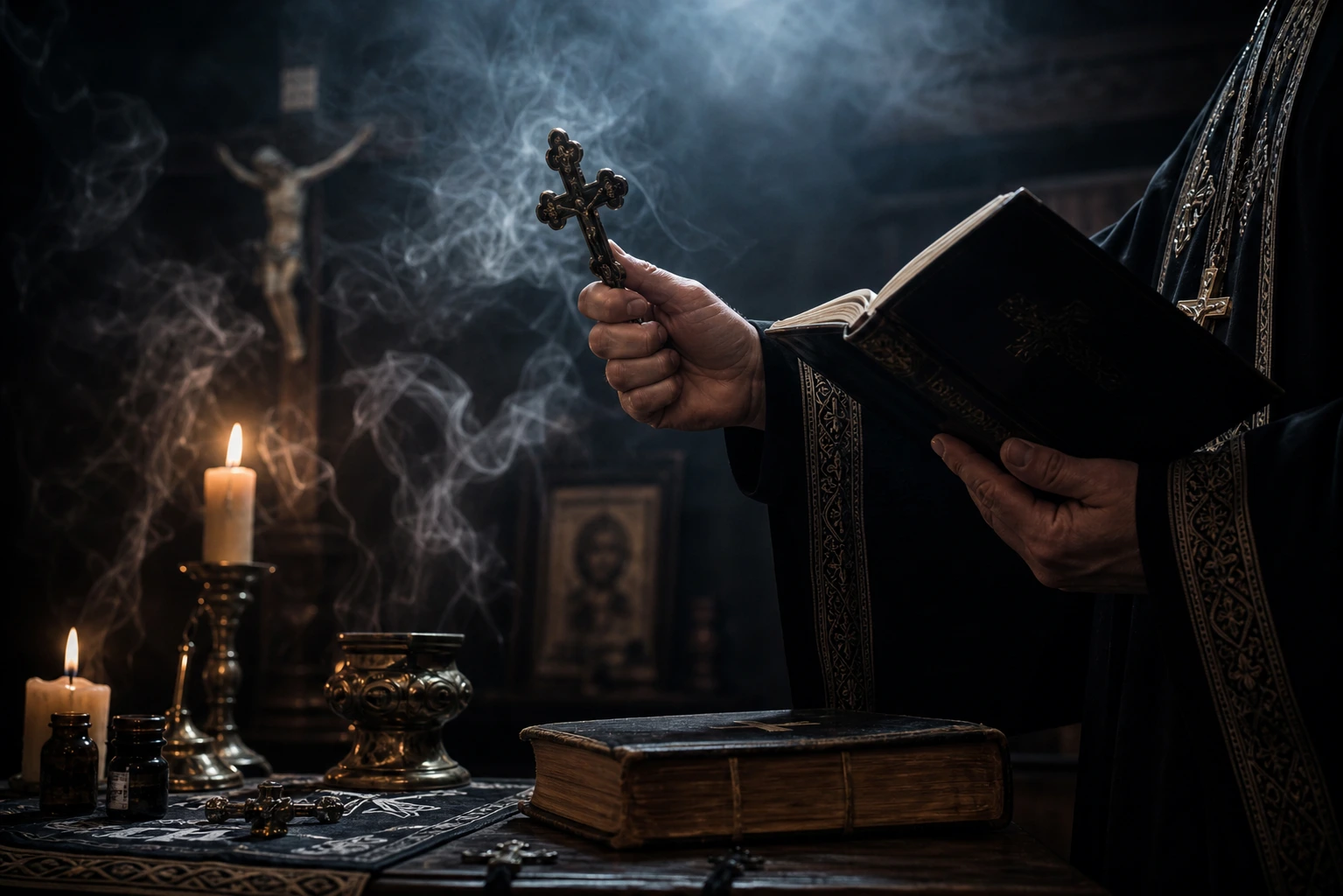
Exorcism is one of the oldest spiritual practices known to humanity.
Long before horror films turned it into spectacle, exorcism existed as a sacred act of restoration: the removal, expulsion, banishment, or containment of a hostile spiritual force believed to be disturbing a person, place, object, or community.
At its core, exorcism is not entertainment. It is not theatrical screaming, spinning heads, or dramatic battles between priest and demon. Those images belong mostly to cinema.
Real exorcism, historically and spiritually, is something far older, quieter, and more complex.
It is the ritual art of reclaiming order where something has become spiritually disturbed.
WHAT EXORCISM ACTUALLY MEANS
The word exorcism comes from the Greek exorkizein, meaning “to bind by oath” or “to command under sacred authority.”
This is important.
Exorcism is not simply “chasing away a demon.” It is an act of spiritual authority. The practitioner does not beg the spirit to leave. They command, bind, dismiss, purify, or separate the intrusive force from the person or place it has attached itself to.
In different traditions, exorcism may be described as:
• Driving out a demon
• Removing an evil spirit
• Cleansing spiritual pollution
• Breaking an attachment
• Banishing a hostile presence
• Restoring divine, ancestral, or ritual order
• Protecting the living from the influence of the unseen
Although the language differs, the deeper idea is remarkably consistent: something has crossed a boundary, and that boundary must be restored.
Exorcism is, therefore, not only about spirits. It is about borders.
• The border between the living and the dead
• The border between the human and the inhuman
• The border between sacred space and polluted space
• The border between the self and what does not belong to the self
WHY EXORCISM EXISTS IN SO MANY CULTURES
Exorcism appears across the world because almost every culture has recognised the possibility that human beings can be affected by invisible forces.
These forces may be called:
• Demons
• Spirits
• Ghosts
• Jinn
• Shades
• Larvae
• Parasitic entities
• Ancestral disturbances
• Hungry dead
• Malevolent energies
In ancient Mesopotamia, ritual specialists performed ceremonies to remove demons, curses, disease spirits, and harmful supernatural influences.
In ancient Egypt, magical texts invoked gods, names of power, amulets, and ritual speech to protect the living and repel hostile beings.
In Judaism, later traditions developed around the idea of the dybbuk, a wandering spirit believed to cling to the living.
In Christianity, exorcism became formalised through prayer, holy names, scripture, sacred authority, and ritual command.
In Islam, ruqyah may involve Qur’anic recitation, supplication, and spiritual cleansing against jinn, the evil eye, and harmful influences.
In Hindu, Buddhist, African diasporic, Indigenous, and folk traditions, we also find rituals designed to remove spiritual affliction, restore balance, and protect the individual or community.
This does not mean all traditions understand exorcism in the same way. They do not.
Some see the problem as demonic.
Some see it as ancestral.
Some see it as energetic imbalance.
Some see it as ritual pollution.
Some see it as a spirit that must be negotiated with rather than violently expelled.
But the pattern remains: spiritual disorder is diagnosed, addressed, and ritually corrected.
EXORCISM BEFORE CHRISTIANITY
Many people associate exorcism almost exclusively with Catholic priests, but exorcism is much older than Christianity.
Ancient cultures already had specialists who worked with spiritual affliction. These might be:
• Priests
• Shamans
• Healers
• Magicians
• Medicine people
• Ritual experts
• Temple officials
• Cunning folk
Their work often included:
• Identifying the troubling force
• Determining whether the cause was spiritual, magical, ancestral, or moral
• Purifying the body or space
• Calling upon divine or ancestral power
• Using sacred words, names, chants, smoke, water, herbs, amulets, or offerings
• Commanding, appeasing, binding, or expelling the force
• Restoring protection afterwards
This last part is crucial.
Exorcism was rarely just removal. It was followed by protection.
A door that has been forced open must be closed.
A disturbed space must be sealed.
A weakened person must be strengthened.
This is where many modern people misunderstand the practice. They focus on the expulsion, but not on the restoration that must follow.
THE DIFFERENCE BETWEEN EXORCISM AND CLEANSING
Not every spiritual disturbance requires exorcism.
This is an important distinction.
A cleansing removes stagnant, heavy, or unwanted energy. It may be used after an argument, illness, grief, visitors, nightmares, or a period of emotional heaviness.
A banishing removes a specific unwanted presence or influence. It is more forceful than cleansing and usually has a clearer target.
An exorcism is more serious. It is used when a force is believed to have attached itself, taken hold, invaded a person, dominated a space, or repeatedly interfered with normal life.
In simple terms:
• Cleansing clears the atmosphere.
• Banishing removes an intruder.
• Exorcism breaks a hold.
This is why exorcism should never be treated casually. It belongs to the category of serious spiritual intervention.
POSSESSION, OPPRESSION, OBSESSION, AND ATTACHMENT
The word possession is often used carelessly.
In serious spiritual language, possession usually refers to a condition in which an external spiritual force is believed to have entered, overshadowed, or taken partial or full control of a person.
But many traditions recognise lesser stages of disturbance.
Attachment
A spirit or force is believed to cling to a person, object, or place.
This may be experienced as:
• Feeling drained for no clear reason
• Feeling watched or followed
• Sudden heaviness in the body or home
• Emotional shifts that feel foreign or intrusive
• Recurring dreams connected to the same figure, place, or presence
Oppression
Oppression is more forceful than attachment.
The force is not necessarily “inside” the person, but it presses upon them. It may create a sense of spiritual pressure, fear, exhaustion, or emotional collapse.
Possible signs may include:
• A heavy atmosphere that does not lift easily
• Repeated nightmares or disturbing dreams
• A sense of being spiritually attacked
• Sudden aversion to prayer, ritual, or sacred objects
• Unusual hostility in a previously peaceful home
• Feeling weakened, watched, or surrounded
Obsession
Obsession refers to intrusive fixation.
The person’s thoughts may become unusually dark, repetitive, or consumed by fear of the entity. In religious language, this may be interpreted as temptation, influence, or mental harassment by an external force.
This is why discernment is essential. Fear can become a trap. The more attention a person gives to the disturbance, the stronger it may feel.
Possession
Possession is the most extreme category.
It refers to a condition in which a person appears to lose ordinary control, identity, voice, behaviour, or spiritual autonomy.
It must be said clearly: not every frightening experience is possession.
Mental health, trauma, grief, sleep paralysis, neurological conditions, substance use, and stress can all create experiences that feel spiritually intense. A responsible practitioner does not ignore these possibilities.
Serious spiritual work requires discernment.
THE EXORCIST AS RITUAL SPECIALIST
The exorcist is not merely someone who knows dramatic prayers.
Traditionally, the exorcist must have:
• Spiritual authority
• Discipline
• Emotional control
• Ritual knowledge
• Protection
• Discernment
• The ability to remain calm under pressure
In many systems, the exorcist works not through personal ego, but through a higher authority.
This authority may be:
• God
• Christ
• The saints
• Angels
• Ancestors
• Deities
• The Divine Name
• Sacred law
• Lineage power
• Ritual office
• Initiatory authority
This matters because exorcism is not supposed to be a personal contest between practitioner and spirit.
It is not:
“I am stronger than you.”
It is:
“By the authority I serve, you must leave.”
That distinction is the foundation of serious exorcistic practice.
The practitioner becomes a vessel of order, not a performer of spiritual drama.
THE TOOLS OF EXORCISM
Across traditions, exorcism often involves physical tools. These tools are not random props. They are symbolic carriers of authority, purity, boundary, and command.
Common exorcistic tools may include:
• Holy water or blessed water
• Salt
• Smoke or incense
• Candles
• Scripture or sacred texts
• Bells or sound
• Iron objects
• Protective oils
• Sacred names
• Sigils or seals
• Amulets
• Prayer beads
• Ritual cords
• Consecrated knives or blades
• Protective circles
Each tool has a purpose.
Water purifies.
Salt preserves and protects.
Smoke carries prayer and drives away impurity.
Sacred names command spiritual attention.
Bells break stagnant or hostile patterns.
Light establishes sacred presence.
Iron, in many folk traditions, repels spirits and faery-like beings.
The power is not in the object alone. It is in the relationship between the object, the practitioner, the tradition, and the intention.
An untrained person holding salt is holding salt.
A trained practitioner using salt within ritual structure is establishing a boundary.
EXORCISM IS NOT ALWAYS VIOLENT
Popular culture often presents exorcism as a violent confrontation. In reality, many traditions include quieter methods.
Some spirits are:
• Commanded
• Prayed away
• Persuaded
• Given offerings and redirected
• Guided towards the dead
• Ritually separated from the living
• Bound and sealed
• Cleansed through repeated ritual rather than a single dramatic event
In certain traditions, the spirit is not treated as evil, but as displaced, hungry, confused, offended, or improperly honoured.
This is especially important in ancestral and folk traditions, where the problem may not be a demon at all. It may be an unsettled dead person, a neglected ancestor, a land spirit, or a force awakened by disrespect.
A serious practitioner does not assume every disturbance is demonic.
Diagnosis comes before action.
WHY EXORCISM CAN BE DANGEROUS
Exorcism can be dangerous when performed carelessly.
Not because every spirit is powerful, but because fear, obsession, suggestion, and spiritual instability can escalate a situation.
A badly handled exorcism may:
• Increase fear
• Strengthen fixation on the entity
• Create spiritual panic
• Misdiagnose mental health issues
• Encourage dependency on the practitioner
• Provoke rather than remove the disturbance
• Leave the person spiritually unprotected afterwards
This is why serious protection work must be calm, structured, and ethical.
The goal is not to terrify the client.
The goal is to restore sovereignty.
A real spiritual worker does not feed fear. They reduce it.
They do not make the client feel helpless. They teach the client how to become spiritually stronger, clearer, and better protected.
EXORCISM AND PSYCHOLOGICAL REALITY
A serious article on exorcism cannot ignore psychology.
Human beings experience fear, trauma, grief, dissociation, nightmares, intrusive thoughts, and sleep paralysis. These can feel like spiritual attack, especially when they happen repeatedly or during emotionally vulnerable periods.
This does not mean spiritual experiences are “only psychological.”
It means responsible spiritual interpretation should never be reckless.
A good practitioner can hold both possibilities:
• There may be a spiritual disturbance.
• There may also be emotional, psychological, physical, or environmental factors involved.
The wisest approach is not blind belief or cynical dismissal.
The wisest approach is discernment.
Look at:
• The patterns
• The timing
• The environment
• The emotional state of the person involved
• Whether the activity responds to prayer, cleansing, boundaries, or ritual command
• Whether practical changes improve the situation
Real spiritual work observes before it declares.
THE PURPOSE OF EXORCISM
The purpose of exorcism is not drama.
The purpose is liberation.
A person should feel more stable after serious spiritual intervention. A home should feel clearer. Sleep should become easier. Fear should lessen. Boundaries should feel stronger.
The final goal is not simply that “the spirit is gone.”
The final goal is that the person is returned to themselves.
That is the deeper meaning of exorcism.
It restores the sacred order of the human soul.
It says:
This body is not yours.
This house is not yours.
This mind is not yours.
This life is not yours.
You must leave.
And once the force is removed, the living must be protected, grounded, and strengthened.
Because exorcism without protection is incomplete.
EXORCISM IS NOT JUST CATHOLIC
Catholic exorcism is one of the most famous forms, largely because of film, literature, and the formal Roman ritual tradition. But it is only one branch of a much wider human practice.
Exorcism exists wherever people believe that unseen forces can interfere with the living.
It belongs to:
• Temples
• Churches
• Mosques
• Shrines
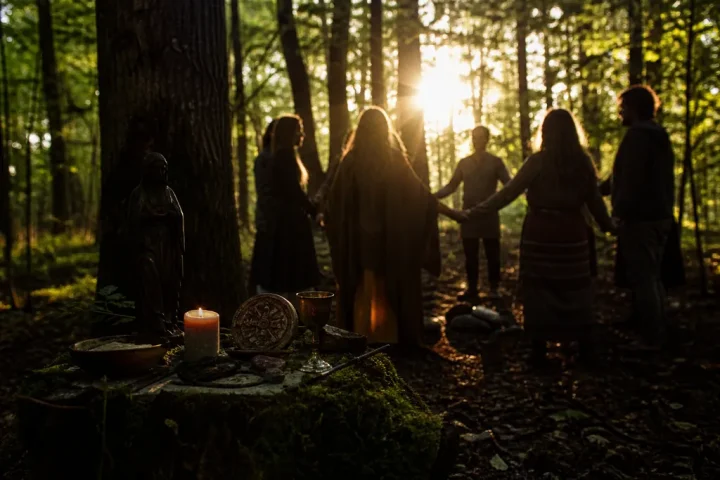
• Forests
• Crossroads
• Sickrooms
• Family homes
• Village rituals
• Magical circles
• Ancestral altars
It is not merely a Christian practice.
It is a human response to spiritual invasion.
And throughout history, people have responded to that invasion with prayer, command, smoke, sacred words, divine names, protective symbols, offerings, and ritual power.
A SERIOUS WARNING
Do not attempt dramatic exorcism work because you watched a film, read one ritual online, or feel angry at a presence.
Spiritual force without discipline can become chaos.
If you believe you are dealing with severe possession, self-harm, violence, medical symptoms, extreme psychological distress, or a person losing control of themselves, seek appropriate professional help immediately.
Spiritual support can exist alongside medical, psychological, or pastoral care, but it should never replace urgent real-world help.
Real protection work begins with stability.
Ground first.
Cleanse first.
Protect first.
Observe carefully.
Act with respect.
And never confuse panic with power.
————————————————–
Exorcism is the ancient art of removing what does not belong.
It is older than horror cinema, older than modern superstition, and older than many formal religions. It belongs to the long human history of recognising that the unseen world can sometimes press too closely against the living.
But true exorcism is not spectacle.
It is sacred boundary work.
It is spiritual authority in action.
It is the restoration of order, protection, and sovereignty.
The real question is not whether exorcism is frightening.
The real question is whether you understand what you are dealing with — and whether you know how to protect yourself before, during, and after spiritual contact.
LEARN THE ART OF PROTECTION BEFORE YOU NEED IT
If this article spoke to you, do not wait until fear takes over.
Protection is not something you learn in the middle of panic. It is something you build before the disturbance becomes stronger.
On Occult World, you can continue your study through the encyclopedia, the spiritual library, and members-only lessons on protection, banishing, cleansing, ritual safety, spirit contact, and sacred boundaries.
Begin with the foundations:
• Protection Techniques: Shielding, Banishing, and Energy Cleansing
• Spiritual Cleansing for the Home
• The Difference Between Spirits, Ghosts, Demons, and Attachments
• Signs of Spiritual Oppression
• Banishing Rituals for Beginners
The Occult World Mystery School is where deeper study begins.
WORK WITH ME FOR SPIRITUAL PROTECTION
If you feel spiritually exposed, watched, drained, disturbed, or affected by something you cannot easily explain, you do not have to face it alone.
I offer spiritual protection work for those who need serious, grounded support.
This is not theatrical fear-based work.
This is calm, focused, protective spiritual practice designed to help you regain clarity, strengthen your boundaries, and restore peace around yourself or your home.
Protection work may include:
• Energetic assessment
• Spiritual cleansing guidance
• Personalised protection recommendations
• Ritual support
• Candle work
• Prayer or affirmation work
• Home protection advice
• Boundary-setting against unwanted spiritual influence
• Guidance on what to do next
The goal is not to make you dependent.
The goal is to help you feel protected, stable, and spiritually sovereign again.
If you feel that something is pressing too close, if your home feels heavy, or if you keep experiencing patterns that feel spiritually intrusive, this work can help you create a stronger shield around your life.
Your energy is yours.
Your home is yours.
Your peace is yours.
Do not surrender it to fear.
Work with me for spiritual protection and begin restoring your sacred boundaries. Contact me !







Follow