
There are stories that refuse to die.
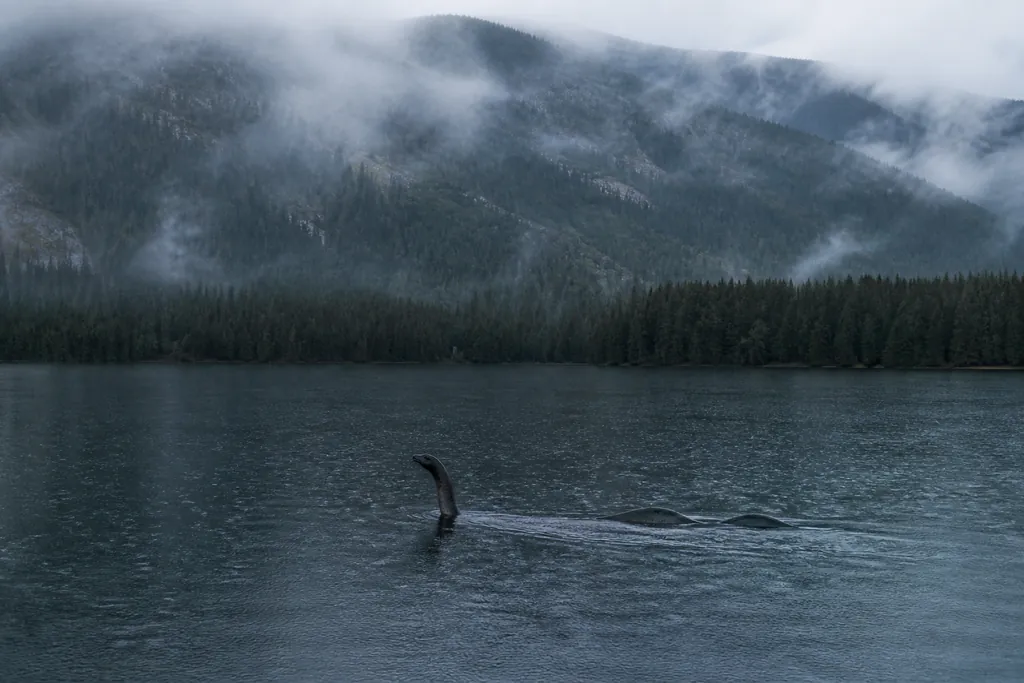
They rise from dark water, move beneath the surface of old lakes, and return generation after generation in the testimony of fishermen, travellers, children, priests, hunters, tourists, and local families. Sometimes they are described as serpents. Sometimes as long-necked animals. Sometimes as great black shapes, humps, wakes, shadows, or impossible movements in still water.
Lake monsters are among the oldest and most persistent figures in cryptozoology.
They occupy a strange place between folklore, eyewitness testimony, natural history, local identity, and human fear. Unlike dragons or purely mythical beasts, lake monsters are often reported in specific places, by specific witnesses, under specific conditions. They are not simply creatures of fairy tale. They are attached to geography.
A lake monster belongs to a body of water.
And that is why people keep returning.
What Is a Lake Monster?
In cryptozoology, a lake monster is usually described as an unknown or unverified creature said to inhabit a freshwater lake. These creatures are most often reported in deep, cold, ancient, or difficult-to-survey bodies of water.
Common descriptions include:
- A long neck rising from the water
- A serpentine or eel-like body
- One or more humps moving across the surface
- A dark mass creating an unnatural wake
- A large animal glimpsed briefly before diving
- A creature compared to a plesiosaur, giant eel, seal, sturgeon, or unknown aquatic animal
The term “monster” does not necessarily mean evil, demonic, or supernatural. In older usage, “monster” often meant something extraordinary, abnormal, frightening, or beyond ordinary classification. A lake monster is not always a beast of horror. Often, it is simply something seen before it is understood.
The Power of Dark Water
Lake monsters survive in human imagination because lakes are deceptive.
A lake appears calm from the shore, yet beneath the surface it may contain extreme depth, poor visibility, submerged trees, currents, caves, sudden temperature changes, and species rarely seen by casual observers. Water distorts size, distance, speed, and shape. A floating log can seem animate. A seal, otter, bird formation, wave pattern, or large fish can become something far stranger when seen at dusk, in fog, or from a moving boat.
But sceptical explanations do not fully erase the mystery.
What makes lake monster traditions important is not only the question of whether a creature exists. It is the persistence of the reports. The same shapes appear again and again across different regions: long bodies, raised humps, sudden dives, powerful wakes, and witnesses who insist they saw something that did not behave like ordinary wildlife.
This repetition is one reason lake monsters remain central to cryptozoology.
Loch Ness and the Birth of a Modern Legend
No lake monster is more famous than the Loch Ness Monster of Scotland.
The creature popularly known as Nessie became a global icon in the twentieth century, although strange accounts connected to Loch Ness are often traced much further back in local tradition. The modern legend intensified in the 1930s, when sightings, photographs, newspaper reports, and tourist interest transformed the creature into one of the most recognisable cryptids in the world.
Nessie is usually imagined as a long-necked aquatic creature, sometimes compared to a surviving prehistoric reptile. This comparison is controversial. Most scientists reject the idea that a breeding population of large prehistoric animals could remain hidden in Loch Ness. Yet the legend remains powerful because it combines several irresistible elements:
- A deep and atmospheric lake
- A remote Highland landscape
- Repeated witness testimony
- Ambiguous photographs and sonar claims
- A creature that seems ancient, elusive, and just beyond proof
Loch Ness became more than a location. It became a symbol of the hidden unknown.
Morag, Ogopogo, Champ, and the Wider Family of Lake Cryptids
Nessie is famous, but it is not alone.
Across the world, lakes have produced their own cryptid traditions. Scotland has Morag of Loch Morar, a lesser-known but serious figure in British cryptozoological lore. Canada has Ogopogo, associated with Okanagan Lake in British Columbia. North America has Champ, connected to Lake Champlain. Other regions have their own water beasts, serpent traditions, guardian creatures, and lake spirits.
These beings are not identical, but they often share certain traits:
- They are attached to a named lake.
- They are reported over long periods of time.
- They become part of local folklore and identity.
- They attract investigators, witnesses, sceptics, and tourists.
- They blur the line between animal, spirit, mistake, and myth.
In some cultures, the lake creature is not merely an unknown animal. It may be a guardian, warning force, ancestral being, water spirit, or omen. This is where cryptozoology meets mythology. The same sighting can be interpreted through many lenses: biological, folkloric, spiritual, psychological, or symbolic.
The Scientific Problem
Lake monsters present a difficult problem for science.
Large animals require food, breeding populations, biological remains, and ecological space. If a lake monster is a real flesh-and-blood animal, then there should eventually be stronger evidence: bones, carcasses, clear photographs, DNA traces, or repeated biological confirmation.
This is why mainstream science remains sceptical.
Cryptozoology, as a field, often relies heavily on eyewitness accounts, local reports, folklore, and incomplete evidence. Occult World’s Cryptozoology section notes that cryptozoology is concerned with animals that people think might exist, but which have not been completely proven, and that it also includes animals believed extinct but still occasionally reported. It also makes clear that cryptozoology is not recognised as a formal branch of zoology and is often criticised as pseudoscience because of its reliance on anecdotal material.
That scepticism matters.
A serious approach to lake monsters must not treat every sighting as proof. Misidentification, hoaxes, exaggeration, folklore, tourist mythology, optical illusions, and media sensationalism all play a role. Some lake monster reports may be ordinary animals seen under unusual conditions. Others may be stories shaped by local expectations.
But dismissal is not the same as understanding.
Why People Keep Looking
People do not chase lake monsters only because they expect to catch one.
They chase them because lake monsters represent a category of mystery that has not been fully domesticated. In a world of satellites, cameras, maps, databases, and constant surveillance, the idea that something large and unknown might still move beneath dark water is deeply compelling.
Lake monsters ask uncomfortable questions:
- How much of the natural world do we really know?
- How reliable is human perception?
- When does folklore preserve memory?
- Can myth grow around a real animal?
- Why do certain landscapes generate repeated stories?
- What do we do with testimony that is sincere but unproven?
This is the real value of lake monster traditions. They force us to examine the border between evidence and belief.
Lake Monsters as Folklore
Even if some lake monsters are never proven as biological animals, they remain culturally important.
A lake monster can protect a place from being forgotten. It gives a lake personality. It turns geography into story. It creates caution, reverence, fear, tourism, ritual memory, and local identity.
In older traditions, water was rarely seen as empty. Lakes, rivers, wells, and springs were often believed to contain spirits, guardians, dead souls, divine forces, or dangerous beings. The modern lake monster may be a cryptozoological figure, but it also carries echoes of ancient water belief.
Deep water has always been associated with the unknown.
The lake monster is what happens when that unknown takes shape.
Between Creature and Symbol
The enduring power of lake monsters lies in their ambiguity.
- They may be animals.
- They may be misidentified wildlife.
- They may be folklore attached to dangerous water.
- They may be hoaxes.
- They may be symbols of the ancient, hidden, and unresolved.
Or they may be several of these things at once.
A serious study of lake monsters does not need to choose between blind belief and total dismissal. It can examine the reports, question the evidence, respect the folklore, and acknowledge the psychological force of the unknown.
The lake monster survives because it is never fully seen.
A head rises.
A wake forms.
A witness turns.
The water closes.
And the chase begins again.
Explore More in the Occult World Cryptozoology Encyclopedia
If this article opened the door for you, continue into the Cryptozoology section of Occult World.
There you can explore hidden animals, legendary beasts, lake monsters, sea monsters, hominids, serpents, dragons, mysterious birds, out-of-place animals, and creatures that remain suspended between folklore and investigation.
Cryptozoology is not only about monsters.
It is about the human need to ask what may still be hiding beyond the edge of certainty.
Visit the Occult World Cryptozoology Encyclopedia:
https://occult-world.com/cryptozoology/
Continue Your Search into the Unknown
The world is not as fully mapped as we like to believe.
Some mysteries live in forests.
Some move through deserts.
Some are buried in old books.
And some wait beneath black water.
If you are drawn to hidden creatures, forbidden folklore, ancient monsters, and the strange border between myth and reality, continue your journey through Occult World.
Read deeper.
Follow the evidence.
Question the legends.
And never assume that the surface tells the whole story.
Explore more cryptids, lake monsters, sea beasts, and hidden creatures inside the Occult World Encyclopedia and keep returning as new entries, articles, and mysteries are added.





Follow