

Naberius
Naberius, also rendered as Naberus, Nebiros and sometimes identified with Cerberus, is a demon of the Solomonic tradition and one of the spirits listed among the 72 spirits of Solomon. He is usually described as a marquis of Hell who commands nineteen legions of demons and is counted in many grimoires as the twenty-fourth spirit. Naberius is a spirit of eloquence, cultivated skill and worldly polish, yet like so many infernal powers, he carries an ambiguity that makes his gifts dangerous as well as desirable. He is associated especially with rhetoric, the arts and sciences, and the restoration of lost honours and dignities, though some traditions also suggest that he may just as easily take such honours away.
The earliest well-known account of Naberius in printed demonology appears in Johann Weyer’s Pseudomonarchia Daemonum of 1583. There he is presented as a powerful and valiant marquis who reveals himself in avian form and speaks with a hoarse voice. Weyer wrote:
“Naberius [Naberus], alias Cerberus, is a valiant marquesse, shewing himselfe in the forme of a crowe, when he speaketh with a hoarse voice: he maketh a man amiable and cunning in all arts, and speciallie in rhetorike, he procureth the losse of prelacies and dignities: nineteene legions heare (and obeie) him.”
This passage is important because it preserves both his powers and one of the oldest surviving hints of his uncertain identity. Weyer explicitly links Naberius with Cerberus, the monstrous hound of Greek mythology, although whether this was based on an older occult tradition or on learned speculation remains unclear. From that point onward, Naberius became a spirit whose form and symbolism were never entirely settled.
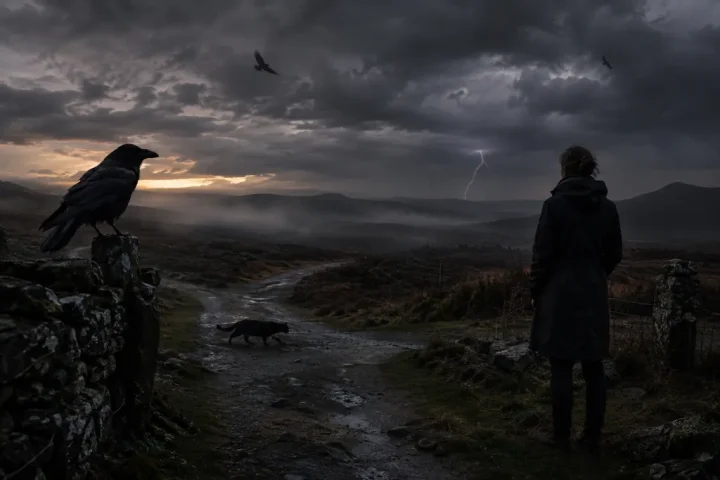
His appearance varies from source to source. In some descriptions he manifests as a crowing cock that flutters about the magic circle. In others he appears as a crow, a raven, a black crane, or even a three-headed dog, which naturally strengthens the proposed connection to Cerberus. These conflicting forms do not weaken his image so much as deepen it. Naberius is a spirit of liminality, voice and display, and it is fitting that he appears through creatures associated with ominous cries, black plumage and watchfulness, or else through the infernal image of the hound that guards the threshold of the underworld.
His voice is one of his most distinctive attributes. Nearly every account mentions that he speaks in a hoarse, harsh or raucous tone, a curious feature for a spirit so strongly connected with rhetoric and eloquence. The contradiction is part of his power. Naberius does not merely bestow graceful speech in the pleasant and superficial sense. He imparts the skill of persuasion, cultivated language, social polish and the intellectual arts by which one may influence others, recover standing and move effectively within society. He makes a person amiable, clever and accomplished, especially in verbal expression. In this sense, he is not simply a teacher of speaking well, but of speaking with effect.
Because of this, Naberius has long been associated with the arts and sciences in a broad sense, but above all with rhetoric. He teaches how to present oneself, how to argue, how to persuade, and how to acquire the style and refinement that open doors in the human world. Some traditions also credit him with teaching the art of gracious living, suggesting that his influence extends beyond speech into manners, poise and the subtle forms of social mastery. He is therefore a demon not only of knowledge, but of cultivated presence.
His other major power concerns lost dignities and honours. In many later descriptions, Naberius is said to restore lost offices, reputations or titles, making him attractive to those who have suffered disgrace, demotion or public humiliation. Yet Weyer gives the darker variation, stating that he procures the loss of prelacies and dignities. This tension is characteristic of grimoire spirits. The same power that can recover status may also strip it away. A spirit who rules the mechanics of esteem, rhetoric and worldly standing is never entirely safe, because he understands exactly how such things are won and lost.
Within the wider grimoire tradition, Naberius is therefore best understood as a demon of civilised power. He does not primarily tempt through brute force, lust or treasure, but through the more subtle realms of intellect, social advancement, honour and expression. He offers the ability to become admirable, persuasive and effective. Yet every such infernal gift carries its shadow. Eloquence can manipulate as easily as enlighten, amiability can conceal ambition, and restored honour may come at a hidden cost.
The uncertainty surrounding his name also contributes to his fascination. The identification with Cerberus has never been fully resolved, but it lingers because it feels symbolically appropriate. Whether Naberius truly derives from the infernal hound of classical myth or merely borrowed some of that imagery through Renaissance demonology, the association casts him as a guardian of thresholds, a being who stands between civility and savagery, elegance and menace, eloquence and the hoarse cry of something darker beneath it.
For the student of demonology, Naberius is a striking example of how a spirit may be both refined and ominous at once. He is a marquis of Hell who teaches polished speech, social grace and intellectual arts, yet he arrives in forms that belong to carrion birds, ominous fowl and underworld beasts. In him, infernal knowledge wears the mask of culture.
If Demonology, grimoires, Witchcraft, Black Magick and the hidden hierarchies of infernal power truly fascinate you, then stop skimming the surface and enter the Occult World Mystery School, where you can study the spirits, systems and forbidden traditions that shaped the occult world. Learn the names, powers and mysteries properly, instead of remaining one of the many who repeat them without ever understanding what they mean.
From “The Goetia: The Lesser Key of Solomon the King” (1904) Written by S.L. MacGregor Mathers
NABERIUS. – The Twenty-fourth Spirit is Naberius. He is a most valiant Marquis, and showeth in the form of a Black Crane, fluttering about the Circle, and when he speaketh it is with a hoarse voice. He maketh men cunning in all Arts and Sciences, but especially in the Art of Rhetoric.
He restoreth lost Dignities and Honours. He governeth 19 Legions of Spirits. His Seal is this, which is to be worn, etc.

From the “Pseudomonarchia Daemonum” ( 1583 ) Written by Johann Weyer (Johann Wier)
Naberius [Naberus], alias Cerberus, is a valiant marquesse, shewing himselfe in the forme of a crowe, when he speaketh with a hoarse voice: he maketh a man amiable and cunning in all arts, and speciallie in rhetorike, he procureth the losse of prelacies and dignities: nineteene legions hearehim.
Original Text : Naberus, alias Cerberus, Marchio est fortis, forma corvi se ostentans: Si quando loquitur, raucam edit vocem. Reddit and hominem amabilem and artium intelligentem, cum primis in Rhetoricis eximium. Prælaturarum and dignitatum jacturam parit. Novendecim legiones hunc audiunt.

From the “Dictionnaire Infernal” (edition of 1863 ) Written by Jacques Auguste Simon Collin de Plancy
Original Text :
Cerbère. Cerberus ou Naberus est chez nous un démon. Wierus le met au nombre des marquis de l’empire infernal. Il est fort et puissant ; il se montre, quand il n’a pas ses trois têtes de chien,sous la forme d’un corbeau; sa voix est rauque :
néanmoins, il donne l’éloquence et l’amabilité ; il enseigne les beaux-arts. Dix-neuf légions lui obéissent.
On voit que ce n’est plus là le Cerbère des anciens,ce redoutable chien, portier incorruptible des enfers, appelé aussi la bête aux cent têtes,
centiceps bellua, à cause de la multitude de serpents dont ses trois crinières étaient ornées. Hésiode lui donne cinquante têtes de chien ; maison s’accorde généralement à ne lui en reconnaître que trois. Ses dents étaient noires et tranchantes,et sa morsure causait une prompte mort.
On croit que la fable de Cerbère remonte aux Égyptiens, qui faisaient garder les tombeaux par des dogues. Mais c’est principalement ici du démon Cerberus qu’il a fallu nous occuper. En 1586,il fit alliance, avec une Picarde nommée Marie Martin.’







Follow