
Reading the Omens: When the World Becomes an Oracle
Long before human beings shuffled Tarot cards, cast Runes, swung a Pendulum or opened a book in search of an answer, they watched the world around them. A bird appearing at the wrong moment, an unexpected animal crossing the road, a sudden storm, a disturbing Dream, a stranger encountered on a journey or a flash of lightning across an otherwise clear sky could become something more than an ordinary event. It could become an Omen, a message hidden inside the fabric of the world.
This is one of the oldest ideas behind Divination: the future does not always announce itself through an organised oracle. Sometimes it leaks into the present through signs.
To those who believe in omens, the world is not silent. Nature, chance, dreams and strange coincidences may form a language whose symbols appear briefly and disappear again. The difficulty lies not in finding signs, because signs can potentially be found everywhere, but in deciding which events carry meaning and which are merely ordinary accidents.
That uncertainty is precisely what has made omen reading so compelling for thousands of years.
When Everything Could Become a Sign
An Omen is traditionally an occurrence interpreted as indicating something that has not yet happened. It may promise good fortune, warn of danger, announce death, suggest divine favour or reveal that a particular course of action should be abandoned. The omen itself is not necessarily positive or negative. Its meaning depends upon the cultural system through which it is interpreted and, sometimes, upon the circumstances surrounding its appearance. Occult World records traditions in which changes in the natural world, unusual animals, celestial phenomena, storms, apparitions, visions and dreams have all been treated as portents.
The deliberate interpretation of such signs belongs to the enormous territory of Augury, a form of Divination concerned with reading indications found in nature and the surrounding world. Ancient Roman augurs became famous for interpreting auspices connected with birds and other phenomena, and augury eventually became entwined with important questions of public religion and state. Yet the fundamental idea reaches far beyond Rome. Human beings in many cultures have watched animals, weather, stars, dreams and unexpected events in the belief that something unseen might be communicating through them.
The oracle, in other words, did not always live inside a temple.
Sometimes the oracle was the sky.
Birds Between Heaven and Earth
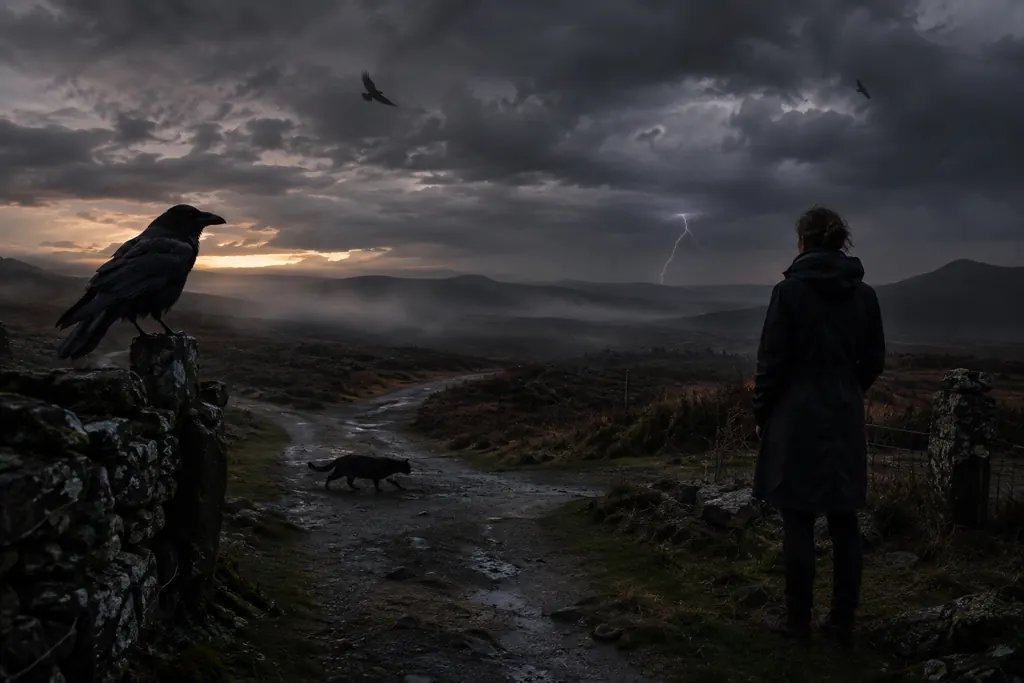
Birds have always seemed particularly suited to omen lore. They move through a realm inaccessible to ordinary human beings, appearing from nowhere, disappearing beyond the horizon and travelling between earth and sky. In many cultures their flight, cries, numbers, direction of movement and sudden appearance have been interpreted as signs.
This association lies behind some of the best known forms of Augury. A bird flying in an unexpected direction might once have influenced whether a journey began, whether a battle was undertaken or whether an important public act proceeded. The bird itself was not necessarily thought to cause the coming event. Instead, its behaviour could be understood as revealing a pattern already unfolding beyond ordinary perception.
The same principle survives in folklore long after formal divinatory systems disappear. An owl calling near a house, a raven repeatedly appearing around a person, birds striking windows, unusual migrations or a particular species appearing at a moment of crisis may all acquire ominous significance. Different cultures frequently interpret the same animal in completely different ways, reminding us that the language of omens has never been universal.
What terrifies one culture may bless another.
The Animal That Crosses Your Path
Not every omen comes from the sky. Some simply walk directly in front of you.
Apantomancy is divination based upon chance encounters, particularly unexpected meetings with animals, people or objects. The important element is not that the diviner deliberately produces the sign, but that something presents itself unexpectedly and is then interpreted. Occult World describes animal encounters involving cats, dogs, hares, bats and birds among the many examples historically associated with this kind of omen reading.
Closely related is Theriomancy, in which the behaviour or appearance of animals is treated as divinatory. Across different traditions, people have interpreted how animals cry, move, gather, disappear or behave unusually. Dogs howling, birds entering houses, unusual animal movements and other disruptions of normal behaviour have all accumulated layers of supernatural meaning.
This helps explain why an unexpected animal encounter can feel strangely powerful even to someone who does not consciously believe in divination. The human mind immediately notices the unusual. A fox standing motionless in the road at midnight feels different from seeing a fox in a field at dusk. A raven following the same path for several minutes seems more significant than one glimpsed among dozens of other birds. Context transforms the encounter, and once emotion enters the experience, coincidence begins to feel like communication.
When the Sky Speaks
Few things have inspired more awe than violent or unusual events in the heavens. Storms, eclipses, comets, meteors, strange clouds and lightning have repeatedly been interpreted as supernatural warnings because they appear above humanity, beyond control, arriving with overwhelming force.
Aeromancy is the broad practice of divining through atmospheric conditions and phenomena of the sky. Within it are specialised forms such as Nephomancy, the interpretation of clouds, and Ceraunoscopy, which concerns thunder and lightning. Ceraunomancy focuses specifically upon lightning, while Brontomancy interprets thunder. Cometomancy concerns comets, and Meteormancy interprets meteors and shooting stars. Occult World preserves these practices as separate branches of an ancient impulse to search the heavens for messages.
To ancient observers, these events could carry political, religious and personal significance. A blazing object suddenly appearing in the night sky could become a warning of war or the death of a ruler. Thunder might be interpreted as divine displeasure. Lightning could become the voice of a god. Clouds might reveal shapes that seemed too precise or too timely to dismiss.
Modern astronomy and meteorology explain the physical mechanisms behind these phenomena, but explanation has not entirely destroyed their psychological power. A violent thunderstorm erupting during a funeral, a meteor appearing while someone silently asks a question or sunlight suddenly breaking through clouds during an emotionally charged moment can still feel laden with significance.
Science may explain what happened.
It cannot determine what the event means to the person who witnessed it.
Dreams as Omens
Some omens do not enter through the eyes at all. They arrive while the conscious mind is asleep.
Dreams have been interpreted as warnings, prophecies and supernatural communications since antiquity. A dream occurring shortly before an important event may later be remembered as prophetic, particularly when its imagery appears to correspond with what follows. Dreams of death, water, animals, storms, strangers, journeys or ruined buildings have generated elaborate systems of interpretation across different cultures.
The boundary between Dream Divination, Prophecy and ordinary dreaming has never been easy to define. A vivid dream may feel fundamentally different from the scattered fragments of ordinary sleep, especially when it repeats or leaves the dreamer with an inexplicable certainty that something is about to happen.
Dream omens also reveal one of the central problems of divination. Interpretation often happens before the predicted event, but sometimes meaning becomes apparent only afterwards. A symbol that seemed incomprehensible at dawn may become disturbing when an unexpected event later gives it context.
Was the dream truly a warning, or did the mind retrospectively connect two unrelated experiences?
The omen remains suspended between those possibilities.
Apparitions and Omens of Death
Folklore becomes darkest when the omen takes human or supernatural form. Ghosts, Apparitions and certain supernatural beings have sometimes been regarded not merely as manifestations of the dead but as heralds of something still to come.
One of the most famous examples is the Banshee , whose lament in Irish tradition became associated with impending death. In such stories, the supernatural apparition does not necessarily cause the death. It announces it. This distinction is crucial to understanding traditional omen lore. The messenger is not always the executioner.
The same pattern appears in stories of spectral lights, phantom animals, mysterious knocks, death watches and strange figures seen shortly before a tragedy. Such traditions transform the terrifying idea of death into something even stranger: perhaps death casts a shadow before it arrives.
The Stranger Who Appears at Exactly the Right Moment
Animals and storms are not the only unexpected messengers. A human encounter can become an omen as well.
Xenomancy interprets encounters with strangers as signs. An unknown person appearing at a significant moment may be read according to their appearance, behaviour, direction of travel, words or objects carried. The concept belongs to a much older worldview in which chance meetings were not necessarily considered meaningless interruptions. A traveller asking for guidance might pay close attention to the first person encountered, wondering whether the meeting itself contained an answer.
This idea survives in subtler form today. Someone agonises over whether to leave a relationship, then overhears a stranger discussing divorce. A person wonders whether to accept a distant job and immediately meets somebody wearing a shirt bearing the name of that city. A book falls from a shelf and opens to a passage that appears to answer a private question.
At what point does coincidence become an oracle?
Meaningful Coincidence
The modern concept most frequently brought into discussions of omens is Synchronicity, associated particularly with Carl Gustav Jung. Jung used the idea of meaningful coincidence to describe events connected through significance rather than an obvious chain of physical cause and effect, and he explored the concept in relation to subjects including the I Ching, Astrology and psychical phenomena.
Synchronicity provides a modern language for an ancient experience: the disturbing sensation that an outer event has somehow mirrored an inner condition.
You think intensely about someone you have not seen for twenty years and receive a message from them that afternoon. You privately ask for a sign and encounter the same unusual symbol three times before sunset. You dream of an obscure place and unexpectedly see its name the following morning.
None of these events proves supernatural intervention. Yet their timing may make them feel impossible to dismiss.
The omen lives precisely in that uneasy territory between probability and meaning.
When Chance Is Deliberately Invited
There is an interesting boundary between spontaneous omens and organised divination. With an omen, the sign appears unexpectedly. In other practices, the diviner deliberately creates an opportunity for chance to speak.
In Bibliomancy, a book may be opened at random and a passage interpreted as an answer. In Cleromancy, objects such as stones, bones, beans or dice are cast and their resulting arrangement is read. Sortilege similarly uses lots or randomly selected objects to reveal information.
The logic is remarkably similar to omen reading. The practitioner creates a moment in which an unpredictable event can occur, then interprets the result as meaningful.
The difference is that the omen reader waits for the world to present the symbol, while the diviner deliberately opens a door through which the symbol may arrive.
The Danger of Seeing Omens Everywhere
There is a shadow side to omen reading. Once someone begins searching constantly for signs, almost anything can be made to fit a desired interpretation.
A black bird appears and becomes a warning. A white feather appears and becomes protection. The clock displays repeating numbers and becomes confirmation. Rain begins and becomes cleansing. Rain stops and becomes approval. Eventually the universe seems to agree with whatever the observer already wants to believe.
Traditional systems of Divination attempted, with varying degrees of success, to reduce this problem by establishing rules. Particular signs had particular meanings. Direction mattered. Timing mattered. Context mattered. The diviner was supposed to interpret rather than simply invent.
Even then, ambiguity remained.
Modern readers of omens may therefore find it useful to distinguish between an event that is merely convenient and one that is genuinely unusual. Repetition, improbability, emotional intensity and direct relevance to a question may make an occurrence more striking, but none of these provides objective proof that supernatural communication has taken place.
The mystery should not be destroyed by scepticism, but neither should every coincidence be forced into prophecy.
Learning to Read the World
The oldest diviners did not necessarily require elaborate instruments because their oracle surrounded them. They watched which bird appeared first in the morning. They listened to thunder. They studied clouds. They remembered dreams. They noticed animals behaving strangely. They paid attention to unexpected visitors, accidents, voices, unusual objects and disturbances in familiar patterns.
To practise this kind of observation today, the most important skill may be attention.
Instead of immediately assigning meaning, notice what happened. Record the date, place, circumstances and your thoughts at the moment. If the event seems connected to a question, write that question down before circumstances change. Over time, patterns may appear, or supposed patterns may disappear. Either result is more valuable than rewriting an omen after the future is already known.
This approach preserves the mystery without surrendering completely to imagination.
It also changes the experience of the world. The ordinary landscape becomes charged with possibility. The crow on the wall, the sudden wind, the unexpected stranger, the dream remembered at dawn and the lightning beyond the horizon become part of an ancient question humanity has never entirely abandoned.
What if the world is speaking?
When the World Becomes an Oracle
Perhaps the enduring power of omens comes from the possibility that reality contains more meaning than its visible surface suggests. Divination has always existed at the threshold between what can be known and what can only be interpreted. Cards can be shuffled, lots can be cast and stars can be calculated, but spontaneous omens are different because no ritual announces their arrival.
They interrupt ordinary life.
For one person, the raven is simply a raven. For another, appearing at a particular hour on a particular day after a particular question, it becomes something more. Neither interpretation can easily erase the other.
That is the unsettling beauty of the omen. It requires no temple, no deck, no crystal ball and no formal invocation. It needs only a world filled with patterns and a human being willing to wonder whether one of those patterns was meant to be noticed.
And sometimes the most disturbing oracle is the one you never asked to consult.
Go Beyond the Signs
Reading about omens will only take you to the threshold. If you are serious about Divination, Tarot, Runes, Magic, Witchcraft, spirits, ancient occult systems and the techniques once reserved for initiates, stop consuming fragments and start building real knowledge. Enter the Occult World Mystery School, choose your path and begin studying the systems behind the signs. There are thousands of spirits, gods, demons, magical traditions, grimoires and forgotten practices waiting beyond the surface, and if you keep standing outside merely reading about them, you will remain exactly where you are. Cross the threshold, do the work and claim the knowledge.











Follow