
El Cadejo
El Cadejo is one of the most recognisable supernatural creatures in Central American folklore. It is usually described as a spectral dog that appears at night, especially to travellers, drunkards, wanderers, or those walking alone on dark roads.
The legend is known in several countries, including Guatemala, El Salvador, Honduras, Nicaragua, and parts of southern Mexico. Although details vary from region to region, the core of the story remains the same: El Cadejo appears in two forms — one protective and one dangerous.
These two forms are commonly known as the White Cadejo and the Black Cadejo.
The Two Cadejos
The legend of El Cadejo is built around duality. The creature is not simply “good” or “evil.” Instead, it appears as a pair of opposing forces.
One Cadejo protects.
The other threatens.
One watches over the vulnerable.
The other tests, frightens, or punishes those who walk with harmful intentions.
This opposition gives the legend its symbolic power. El Cadejo is not merely a ghostly dog. It is a folkloric image of moral struggle, spiritual danger, and unseen protection.
The White Cadejo
The White Cadejo is usually described as a large, shaggy white dog with glowing eyes. Despite its strange and supernatural appearance, it is not considered dangerous. In many versions of the legend, the White Cadejo is a guardian.
It is said to appear to people travelling alone at night, especially those who are vulnerable, lost, frightened, or in danger. Rather than attacking, it follows quietly or walks nearby, guiding the traveller safely until they reach home.
In some traditions, the White Cadejo is interpreted almost like a guardian angel in animal form. It represents protection, mercy, and the hidden forces that watch over the innocent.
The traveller may not always understand what they have seen. They may feel fear at first, because the Cadejo is still a supernatural being. But once no harm comes to them — and once they arrive safely — the creature is understood as a protector rather than a threat.
The Black Cadejo
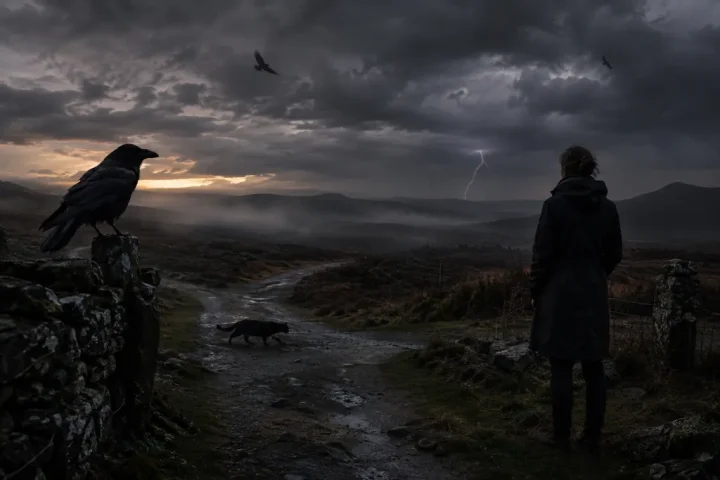
The Black Cadejo is the darker and more feared form of the legend. It is usually described as a large black dog with fiery or blood-red eyes. Some stories say it carries the smell of sulphur, connecting it with demonic or infernal imagery.
Unlike the White Cadejo, the Black Cadejo is dangerous. It is associated with fear, temptation, punishment, and misfortune. It may appear to those walking at night with bad intentions, those who are drunk, cruel, violent, or spiritually careless.
In some versions, the Black Cadejo attacks its victims directly. In others, it follows them silently, terrifies them, causes illness, or leads them into danger. Its presence is a warning that the person has strayed from the right path — physically, morally, or spiritually.
The Black Cadejo is sometimes linked with the Devil, cursed spirits, or demonic forces. However, in folkloric terms, it is also a symbol of consequence. It appears when a person moves too far into darkness without awareness, discipline, or respect.
Origins of the Legend
The legend of El Cadejo likely developed through a mixture of Indigenous Mesoamerican beliefs, Spanish colonial influence, Christian symbolism, and local oral tradition.
Before colonial Christianity reshaped many regional beliefs, animals were often seen as spiritual messengers, guardians, omens, or shape-shifting beings. Dogs in particular have long been associated with the boundary between the living and the dead, guidance through dangerous places, and protection during liminal moments.
After Spanish colonisation, older animal-spirit beliefs were often blended with Christian ideas of angels, devils, sin, punishment, and salvation. This may help explain why El Cadejo appears in two opposing forms: white and black, guardian and threat, protector and punisher.
The result is a legend that feels both ancient and moralistic. It carries traces of older spirit traditions while also reflecting later religious ideas about good, evil, temptation, and divine protection.
Symbolism of El Cadejo
El Cadejo is a powerful folkloric symbol because it works on several levels.
On the surface, it is a supernatural dog that appears at night.
On a deeper level, it represents the unseen forces that accompany human beings when they move through danger, fear, temptation, or moral uncertainty.
The White Cadejo symbolises protection, guidance, innocence, and spiritual guardianship.
The Black Cadejo symbolises danger, corruption, fear, punishment, and the consequences of harmful choices.
Together, the two Cadejos form a symbolic pair. They show that the road at night is never only physical. It is also spiritual. The person walking through darkness may be protected, tested, or confronted depending on their condition, intentions, and actions.
A Warning for Travellers
Many versions of the legend function as cautionary tales. People are warned not to wander alone at night, not to drink too heavily, not to behave recklessly, and not to walk through dangerous places with arrogance or bad intent.
In this sense, El Cadejo belongs to a wider family of folklore that teaches social and moral boundaries through fear. The story warns people that the night has its own laws. Roads, crossroads, forests, empty streets, and isolated paths are places where the ordinary world becomes unstable.
The Cadejo appears when a person crosses into that unstable space.
For the innocent, it may become a guardian.
For the foolish or malicious, it may become a predator.
Regional Variations
The legend changes depending on the country, village, and storyteller.
In some versions, the White Cadejo and Black Cadejo are brothers locked in eternal opposition. In others, they are separate spirits with no direct relationship. Some traditions describe the White Cadejo as constantly defending humans from the Black Cadejo, while other versions focus only on the terror of the black dog.
There are also variations in how the creature appears. Sometimes it is enormous. Sometimes it has goat-like features, blazing eyes, chains, or hooves. In some stories, it does not attack the body but instead damages the mind, leaving its victim traumatised, feverish, or spiritually weakened.
This flexibility is part of the legend’s power. El Cadejo is not fixed in one single form. It adapts to local fears, moral lessons, and spiritual beliefs.
El Cadejo in Modern Culture
El Cadejo remains an important figure in Central American and Mexican folklore. It continues to appear in stories, art, literature, film, music, and popular culture. Parents and grandparents still tell the story as a warning, especially to children and young people.
The legend survives because it speaks to something universal: the fear of walking alone in the dark, the sense of being followed, and the belief that unseen forces may be watching.
Even today, El Cadejo is more than a monster. It is a symbol of protection and danger, instinct and morality, darkness and guidance. It reminds us that folklore often preserves the deepest anxieties of a culture — but also its hopes.
Legacy
El Cadejo endures because it is both frightening and meaningful. It is not simply a ghost story about a black dog. It is a spiritual warning, a guardian myth, and a moral tale woven into the roads and nightscapes of Central America.
The White Cadejo offers the possibility that protection exists even in darkness.
The Black Cadejo warns that darkness also reveals what a person carries within.
Together, they form one of the most haunting and symbolic figures in Latin American folklore: a supernatural dog that follows the traveller, not only through the road, but through the hidden landscape of conscience, fear, and fate.
Continue Your Path with Occult World
If the legend of El Cadejo fascinates you, you are already stepping into one of the richest areas of occult and folkloric study: the world of spirits, omens, supernatural guardians, shadow beings, and old stories that still carry power.
Inside the Occult World Mystery School, you can explore deeper subjects such as folklore, spirit legends, demonology, witchcraft, protection magic, symbolic interpretation, divination, ritual practice, and the hidden meanings behind supernatural traditions from around the world.
The Occult World Mystery School is created for serious seekers who want more than shallow explanations. It is a place to study the old stories, understand their symbolism, and connect them with practical occult knowledge.
Join the Occult World Mystery School and continue your journey into the spirits, shadows, legends, and mysteries that still shape the magical imagination.







Follow