
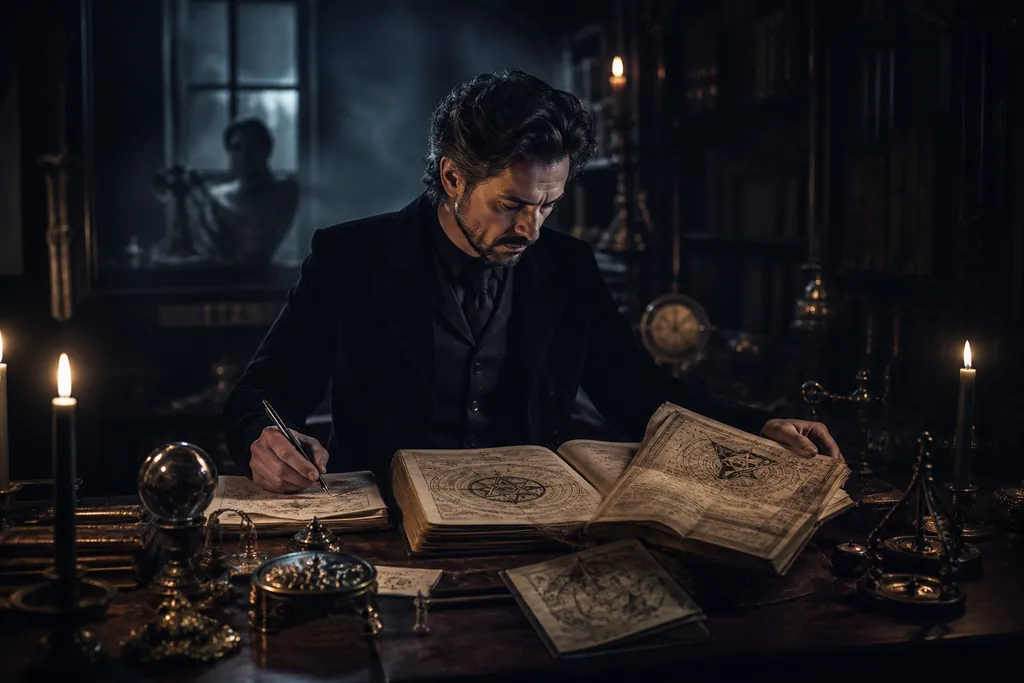
Demonology is one of the most misunderstood subjects in the entire occult field.
For many people, the word immediately suggests horror films, possession stories, satanic panic, forbidden rituals, or reckless attempts to “summon” something dangerous. In popular culture, demonology is often reduced to spectacle: dark rooms, Latin phrases, distorted faces, and the idea that anyone who studies demons must automatically worship them.
This is not accurate.
Demonology, in its serious sense, is the study of demons, spirits, spiritual hierarchies, cultural fears, religious symbolism, and the darker side of sacred imagination. It examines how human beings have understood hostile spirits, tempting forces, chthonic beings, fallen angels, trickster entities, underworld powers, and spiritual adversaries across history.
To study demonology is not the same as worshipping demons.
It is the difference between studying war and wanting violence.
It is the difference between studying poison and wishing to poison someone.
It is the difference between understanding fear and being ruled by it.
Demonology is not merely about “evil.” It is about how cultures name what threatens them, how religions define spiritual danger, and how occult practitioners learn to approach hidden forces with knowledge, discipline, and boundaries.
What Demonology Actually Means
The word demonology refers to the organised study of demons and related spirit beings. Historically, this study has appeared in many different contexts:
- Christian theology
- Jewish mysticism
- Islamic traditions concerning jinn and rebellious spirits
- Ancient Mesopotamian protective magic
- Greek and Roman ideas of daimones
- Medieval grimoires
- Renaissance magic
- Folklore and witchcraft traditions
- Modern occult practice
- Psychological and symbolic interpretations of shadow forces
This means demonology is not one single belief system. It is not limited to Christianity, and it is not automatically satanic.
In some traditions, demons are seen as fallen angels or servants of evil. In others, they are restless spirits, underworld beings, forces of chaos, disease-bringing entities, tricksters, guardians, tempters, or personifications of destructive impulses. In certain occult systems, demons are approached as intelligences connected to specific powers, symbols, names, seals, planetary forces, or psychological states.
A serious student of demonology must therefore ask careful questions:
What does this tradition mean by “demon”?
Is the being described as evil, dangerous, neutral, chaotic, or misunderstood?
Is the account theological, folkloric, magical, symbolic, or psychological?
What protections, warnings, or ethical boundaries are attached to the tradition?
How has fear shaped the way this being is described?
Without these questions, demonology becomes superstition. With them, it becomes a serious field of occult and cultural study.
Demonology Is Not the Same as Devil Worship
One of the biggest misconceptions is that anyone interested in demonology must be worshipping the Devil.
This is a modern simplification.
Devil worship implies devotion, religious allegiance, or reverence toward a figure understood as the Devil or Satan. Demonology, by contrast, is a field of study. It may involve research, comparison, ritual theory, historical analysis, symbolic interpretation, and in some traditions, practical spiritual work.
A person can study demonology without worshipping demons.
A historian can study medieval grimoires.
A theologian can study possession narratives.
A folklorist can study spirit beliefs.
An occult practitioner can study sigils, names, and hierarchies.
A psychologist can study demons as projections of fear, repression, trauma, or shadow material.
A writer can study demons as archetypal figures in myth and literature.
None of these require worship.
The problem begins when people confuse study with devotion, curiosity with allegiance, or symbolism with literal belief.
Serious demonology is not about blind obsession. It is about discernment.
Why Demons Appear in So Many Cultures
Nearly every culture has some concept of dangerous or disruptive spiritual forces.
They may not always be called demons, but the pattern is ancient. Human beings have long perceived certain experiences as invasions, temptations, curses, illnesses, nightmares, hauntings, or attacks from unseen powers.
Demons and demon-like beings often appear around:
Illness and plague
Sleep paralysis and nightmares
Madness, obsession, and compulsion
Sexual temptation or forbidden desire
Death and decay
Wilderness, deserts, crossroads, and abandoned places
Infant mortality and childbirth danger
War, famine, and social disorder
Spiritual impurity or broken taboos
Fear of the unknown
In this sense, demons are not just “monsters.” They are cultural containers for danger.
They give shape to the invisible.
They make fear describable.
They turn chaos into a name, a form, a story, and sometimes a ritual response.
This is one reason demonology remains so powerful. It does not only deal with spirits. It deals with the human need to understand what feels threatening, seductive, overwhelming, or beyond control.
Demons as Symbols of Fear
Not every demonological tradition must be read literally.
In many modern interpretations, demons can also be understood symbolically. They may represent forces within the human psyche: addiction, rage, envy, obsession, trauma, shame, uncontrolled desire, destructive patterns, or the parts of the self that have been rejected and pushed into shadow.
This does not mean demons are “only imagination.” It means that demonology works on more than one level.
A demon may be approached as:
A spiritual being
A mythological figure
A religious adversary
A force of temptation
A symbolic shadow
A cultural warning
A magical intelligence
A literary archetype
A psychological pattern
This layered approach is especially important for the general public. It allows demonology to be studied seriously without sensationalism.
A demon, in this sense, may be both an ancient spirit in a grimoire and a mirror held up to the human condition.
The question becomes not only “Is this real?” but also:
What does this figure reveal?
What fear does it carry?
What boundary does it test?
What power does it symbolise?
What part of the human experience does it expose?
Demonic Names, Sigils, and Symbols
One of the most recognisable aspects of demonology is the use of names and sigils.
In many magical traditions, names are not treated as casual labels. A name is understood as a key to identity, authority, and contact. To know the name of a spirit is to know something of its nature.
Sigils, seals, and symbols serve a similar purpose. They act as visual signatures, ritual focal points, or symbolic maps of a spirit’s presence and power.
This is why demonological texts often preserve long lists of names, ranks, offices, seals, and attributes. These are not decorative details. They form a symbolic system.
For example, grimoires may describe a demon by:
Name
Title or rank
Appearance
Powers or offices
Planetary or elemental associations
Seal or sigil
Method of approach
Warnings or restrictions
Ritual requirements
Protective measures
To the untrained eye, this may look like fantasy. To the serious student, it is a structured symbolic language.
Demonology is therefore not just about spirits. It is also about codes, correspondences, ritual grammar, and the disciplined use of symbol.
The Role of Fear in Demonology
Fear is central to demonology.
Not because the subject should be approached with panic, but because demons often represent the things people fear most: corruption, temptation, loss of control, spiritual danger, punishment, forbidden knowledge, madness, death, and the unknown.
A careless approach to demonology feeds fear.
A disciplined approach studies fear.
This distinction matters.
When demonology is sensationalised, it becomes entertainment. When it is studied seriously, it becomes a way of understanding the border between the sacred and the terrifying.
Fear can distort perception.
Fear can create obsession.
Fear can make people vulnerable to manipulation.
Fear can cause people to see every difficulty as an attack.
Fear can also warn us when we are entering territory that requires preparation.
A serious demonology student does not pretend fear is meaningless. They learn to read it carefully.
Is this fear instinctive caution?
Is it religious conditioning?
Is it psychological projection?
Is it a response to real energetic disturbance?
Is it caused by ignorance?
Is it a sign that stronger boundaries are needed?
In true occult study, fear is neither worshipped nor ignored. It is examined.
Why Discipline Matters
Demonology attracts curiosity, but curiosity alone is not enough.
This subject requires discipline because it deals with intense symbols, frightening narratives, spiritual danger, psychological projection, and traditions that often include strong warnings.
A serious approach requires:
Grounding
Research
Emotional stability
Respect for tradition
Clear boundaries
Protection practices
Ethical awareness
Discernment
Patience
Self-control
Without these, demonology can become unhealthy very quickly.
Some people become obsessed with signs. Others romanticise darkness. Some mistake every dream or coincidence for demonic contact. Others approach spirits with arrogance, treating ancient traditions like entertainment.
That is not demonology. That is recklessness.
The serious student understands that knowledge comes before practice, and protection comes before contact.
Demonology as a Study of Power
Demonology is also a study of power.
Not just supernatural power, but symbolic power.
Demons often appear at the edges of forbidden knowledge. They are connected with temptation, hidden wisdom, rebellion, desire, fear, authority, and taboo. They challenge the boundaries of religious and social order.
This is why they remain fascinating.
A demon is rarely just a frightening figure. It often stands at the place where power has been forbidden, demonised, suppressed, or misunderstood.
In some traditions, demons represent danger.
In others, they represent knowledge.
In others, they represent the untamed forces of nature.
In others, they represent the consequences of spiritual pride.
In others, they represent aspects of the self that must be confronted before transformation is possible.
This does not mean demons are safe.
It means they are meaningful.
Demonology asks us to look at the places where fear, power, morality, and hidden knowledge meet.
A Serious Approach for the Modern Student
Modern demonology should not be built on superstition, panic, or horror imagery.
A serious student should approach the subject through several lenses:
Historical: Where does this demon or tradition come from?
Religious: How was this being understood by believers?
Folkloric: What stories surrounded it?
Symbolic: What does it represent?
Psychological: What fear or shadow does it reveal?
Magical: How was it approached in ritual systems?
Ethical: What boundaries are necessary?
Practical: What protections are required before deeper study?
This layered method allows demonology to become a real discipline instead of a dark aesthetic.
It also protects the student from two common mistakes:
Mocking the subject as nonsense
Glorifying the subject as power without consequence
Neither approach is mature.
The serious path lies between scepticism and obsession. It studies carefully, questions constantly, and never confuses fascination with mastery.
Why Demonology Still Matters
Demonology still matters because human beings have not stopped experiencing fear, temptation, obsession, shadow, spiritual crisis, or the sense that unseen forces shape their lives.
The names may change.
The symbols may evolve.
The rituals may be reinterpreted.
The language may become psychological, spiritual, or literary.
But the pattern remains.
People still wrestle with inner demons.
People still fear hostile forces.
People still seek protection.
People still feel drawn to forbidden knowledge.
People still ask what lies beyond ordinary perception.
People still need language for darkness.
Demonology gives that darkness a structure.
At its best, it does not encourage fear. It teaches discernment. It does not promote worship. It encourages study. It does not glorify danger. It insists on discipline.
To study demonology seriously is to understand that darkness is not something to play with, but neither is it something to blindly fear.
It is something to examine with intelligence, caution, and respect.
Continue Your Study of Demonology
Demonology is not devil worship. It is not horror entertainment. It is not a game of reckless summoning.
It is the study of spirits, symbols, fear, power, protection, and the hidden structures that human beings have used for centuries to understand the darker side of the unseen world.
But this subject should never be approached carelessly.
If you feel drawn to demonology, do not begin with rituals. Begin with knowledge. Learn the history. Understand the symbols. Study the names, ranks, warnings, and traditions. Learn how protection works before you explore contact. Learn how to recognise the difference between curiosity, obsession, fear, and genuine spiritual discipline.
Enter the Demonology Course
If this subject calls to you, the next step is not random internet fragments or sensational videos.
The next step is structured study.
In the Occult World Demonology Course, you will learn demonology in a serious, grounded, and disciplined way — not as fantasy, not as fear-mongering, and not as reckless spiritual experimentation.
Inside the course, you will explore:
The history of demonology across cultures and traditions
The difference between demons, spirits, jinn, fallen angels, and shadow figures
Famous grimoires and their role in magical history
Demonic names, sigils, symbols, and classifications
Protection techniques, cleansing, and spiritual boundaries
The difference between invocation and evocation
How to approach demonology without fear, arrogance, or obsession
The symbolic and psychological meaning of demonic figures
Ethical considerations for advanced occult study
How to build discernment before attempting deeper practice
This course is for serious students of the occult who want more than superstition.
It is for those who want structure.
It is for those who want protection.
It is for those who want to understand the darker side of spiritual study without losing clarity, discipline, or control.
If demonology fascinates you, do not remain at the level of fear.
Study it properly.
Enter the Demonology Course and begin your path with knowledge, protection, and power.


Follow