
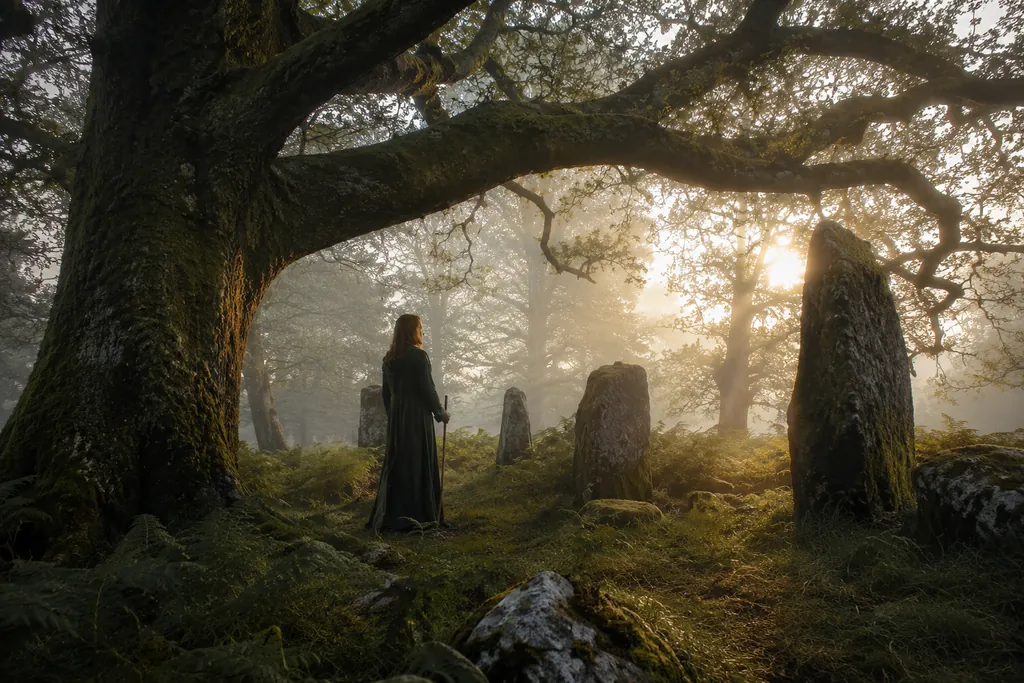
Druidry is one of the most evocative and misunderstood spiritual traditions associated with the ancient Celtic world. To many people, the word immediately calls up images of white-robed priests, sacred oak groves, mistletoe, stone circles and secret rites performed beneath the moon. These images are powerful, but they are also incomplete.
Historically, the Druids were not simply “nature priests” in the modern romantic sense. They belonged to the learned class of ancient Celtic society and were associated with religion, teaching, judgement, memory, ritual knowledge and sacred authority. Classical writers described them as priests, philosophers, advisers, teachers and legal authorities. Yet much of what we know about them comes from outsiders, especially Greek and Roman authors, because the Druids themselves left no written scriptures of their own. Britannica notes that the Druids maintained an oral tradition and that very little is known about them with certainty.
This makes Druidry a tradition surrounded by both history and mystery.
To understand Druidry properly, we must distinguish between ancient Druids and modern Druidry. Ancient Druids belonged to specific Celtic societies. Modern Druidry is a contemporary spiritual path inspired by Celtic tradition, nature reverence, seasonal ritual, poetry, wisdom, ancestry and the sacredness of the living world. It is not a perfect reconstruction of the ancient past. It is a living path shaped by fragments of history, folklore, revival movements, ecological spirituality and personal practice.
The Ancient Druids
The Druids were part of the religious and intellectual structure of Celtic cultures in ancient Europe. They were especially associated with Gaul, Britain and Ireland, although the exact role of Druids varied by region and time.
They were not merely ritual specialists. They were also guardians of knowledge.
Ancient sources present Druids as figures who could serve as:
- priests and ritual leaders
- teachers of sacred knowledge
- judges and legal authorities
- advisers to rulers
- philosophers
- poets and keepers of oral tradition
- interpreters of omens and signs
- mediators between the human world and the unseen world
Their authority came not from written scripture, but from memory, training and transmission. The Druidic world was oral. Knowledge was preserved through speech, repetition, poetry, teaching and initiation. This is one reason why the historical record is so difficult to reconstruct today.
The Druids appear to have been deeply concerned with the relationship between the human community, the gods, the ancestors, the land and the unseen forces of existence. Britannica describes the Druids as the early Celtic priesthood and notes their association with teachings about the transmigration of souls and the nature of the gods.
This suggests that Druidic thought was not simply practical magic or folk custom. It contained a philosophical and religious dimension: questions of death, rebirth, divine order, moral responsibility and the structure of reality.
The Sacredness of Nature
Druidry is inseparable from nature.
The oak tree, the grove, the spring, the mistletoe, the hill, the river, the stone and the changing sky all belong to the symbolic world of Druidry. In Celtic and Druidic imagination, nature is not dead matter. It is alive with presence.
The land is not merely scenery.
It is teacher, temple and witness.
In this worldview, the sacred is not locked away in a distant heaven. It is encountered through the living world: through trees, birds, storms, harvests, animals, stones, herbs, rivers and seasonal change.
This does not mean that ancient Druids worshipped “nature” in the vague modern sense. Rather, they lived in a religious universe in which landscape, deity, tribe, ancestry and ritual were deeply connected. Sacred places mattered. Boundaries mattered. Groves mattered. Certain trees, plants and natural signs held symbolic and ritual power.
Modern Druidry has inherited and reinterpreted this emphasis. For many contemporary Druids, nature is not simply a symbol of spirituality. Nature is the central spiritual reality. The divine may be understood as immanent within the natural world, expressed through the seasons, elements, ancestors, spirits of place or gods of the Celtic traditions.
Wisdom, Poetry and the Spoken Word
Druidry is also a path of language.
The ancient Celtic world placed immense value on poetry, memory and the spoken word. Words were not treated as empty decoration. They carried power, lineage, authority and enchantment.
In many modern Druid orders, this has developed into the threefold pattern of Bard, Ovate and Druid. Although this structure is modern in its present form, it reflects three important aspects of the Druidic imagination:
The Bard preserves inspiration, story, poetry, song and sacred memory.
The Ovate works with healing, divination, death, nature wisdom and hidden knowledge.
The Druid represents judgement, teaching, ritual leadership, spiritual philosophy and mature wisdom.
This does not mean that all modern Druids follow the same system. Druidry today is diverse. Some practise within formal orders. Some work alone. Some are reconstructionist. Some are animist. Some are polytheist. Some are more philosophical or ecological. Some combine Druidry with witchcraft, ceremonial magic, shamanic practice or Celtic devotional work.
But across these differences, one theme remains strong: Druidry honours wisdom that is lived, spoken, remembered and embodied.
It is not only a belief system.
It is a way of listening.
Druidry and the Otherworld
The Celtic imagination is rich with the idea of the Otherworld: a realm of spirits, ancestors, gods, faery beings, heroic dead and hidden wisdom. This Otherworld is not always separate from the human world. It may be close, layered, veiled or accessible at certain times and places.
Thresholds are important.
- Dawn and dusk.
- The edge of a forest.
- A spring emerging from the earth.
- A burial mound.
- A crossroads.
- A mist-covered hill.
- The turning points of the year.
Druidry pays attention to these thresholds because they represent moments when ordinary reality becomes more transparent. The visible world and invisible world touch.
In modern practice, this may appear through meditation, seasonal ritual, ancestor work, offerings to the land, divination, dreamwork, pilgrimage to sacred sites or quiet communion with nature.
The point is not escapism.
The point is relationship.
Druidry teaches that the human being is not isolated. We are part of a web of land, memory, spirit, ancestry, community and responsibility.
Seasonal Ritual and the Wheel of the Year
Modern Druidry often honours seasonal festivals, especially the solstices, equinoxes and the four great Celtic seasonal festivals: Samhain, Imbolc, Beltane and Lughnasadh. These festivals mark the turning of the year and the changing relationship between light, darkness, growth, harvest, death and renewal.
The Order of Bards, Ovates and Druids explains that the modern Druid movement developed out of earlier revival traditions and grew strongly in the twentieth century, particularly from the 1960s onward.
For modern Druids, seasonal practice is not merely decorative. It is a way of aligning human life with the rhythms of the earth.
- Samhain marks death, ancestors and the thinning of the veil.
- Winter Solstice marks darkness, stillness and the rebirth of light.
- Imbolc marks purification, inspiration and the first stirring of spring.
- Spring Equinox marks balance, renewal and emergence.
- Beltane marks fertility, fire, passion and life-force.
- Summer Solstice marks radiance, fullness and solar power.
- Lughnasadh marks harvest, skill, sacrifice and gratitude.
- Autumn Equinox marks balance, descent and preparation for the dark half of the year.
Through these observances, Druidry teaches that time is not only linear. It is cyclical. Life moves through birth, growth, fullness, decline, death and return.
This is one of Druidry’s deepest lessons: nothing in nature stands still, and wisdom comes from moving with the cycles rather than resisting them.
Druidry Is Not Fantasy
Because Druidry has been heavily romanticised, it is important to be clear about what it is not.
Druidry is not simply dressing in robes.
- It is not pretending to be an ancient priest from a lost civilisation.
- It is not fantasy role-play.
- It is not automatically the same as Wicca.
- It is not identical to Celtic reconstructionism.
- It is not a single dogmatic religion with one universal doctrine.
Druidry is better understood as a spiritual path of relationship: relationship with nature, ancestry, land, wisdom, inspiration, sacred time and the unseen dimensions of life.
It may be religious, magical, philosophical, ecological or devotional, depending on the practitioner. Some Druids honour Celtic gods. Some work with spirits of place. Some focus on environmental responsibility. Some approach Druidry as a poetic and contemplative path. Others practise it as a form of nature-based paganism.
What unites them is not one creed, but one orientation:
The world is alive.
Nature is sacred.
Wisdom must be embodied.
The human being has responsibilities to the land, the ancestors and the future.
The Modern Druid
In modern times, a Druid is usually someone who follows Druidry as a chosen spiritual path. The Order of Bards, Ovates and Druids describes a modern Druid as someone who follows Druidry spiritually or who has entered the Druid level of training within a Druid order.
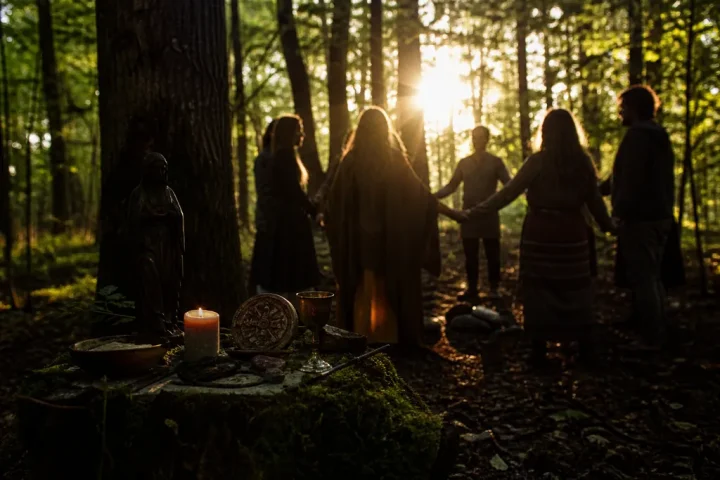
Modern Druids may practise alone or in groups called groves. Their practice may include:
- meditation in nature
- seasonal ceremonies
- poetry and creative work
- ancestor reverence
- tree and plant symbolism
- divination
- ritual at solstices and equinoxes
- offerings to spirits of place
- study of Celtic mythology
- environmental care
- personal spiritual discipline
This makes Druidry particularly relevant in the modern world. In an age of ecological crisis, spiritual disconnection and technological overstimulation, Druidry offers a return to rootedness.
It asks:
What does it mean to belong to the earth?
What does it mean to listen before acting?
What does it mean to live in rhythm with the seasons?
What does wisdom look like when it is not abstract, but grounded in land, body, memory and responsibility?
These are not nostalgic questions.
They are urgent ones.
Druidry as a Path of Power and Responsibility
Druidry is often described gently, with words such as peace, nature and harmony. These words are not wrong, but they can make the path sound softer than it is.
True Druidry is not passive.
To live in relationship with nature is to understand power. Nature creates, nourishes, destroys, renews and transforms. The forest is beautiful, but it is not sentimental. The sea is sacred, but it is not harmless. The storm is cleansing, but it is also dangerous.
Druidry teaches reverence, not domination.
The Druid does not seek power over nature, but power through alignment with nature. This is a very different thing.
In occult terms, Druidry may be understood as a path of sacred perception. It trains the practitioner to see signs, cycles, correspondences and thresholds. It teaches that wisdom does not only come from books. It may come from silence, weather, birdsong, grief, dreams, ancestral memory, ritual and the disciplined observation of the living world.
The Druidic path is therefore both mystical and practical.
It asks for devotion, but also discernment.
It honours inspiration, but also discipline.
It seeks beauty, but also truth.
It listens to the unseen, but remains rooted in the earth.
Why Druidry Still Matters
Druidry survives because it speaks to something ancient in the human spirit: the need to belong to a living cosmos.
Modern people are often spiritually homeless. They live surrounded by information, but starved of meaning. They know schedules, screens and systems, but not the language of seasons, trees, dreams, ancestors and sacred place.
Druidry offers a different kind of knowledge.
Not knowledge as possession.
Knowledge as relationship.
To ask “What is Druidry?” is therefore not only to ask about the past. It is to ask what kind of future we want to create. A future cut off from nature, memory and spirit? Or a future in which human beings remember that the world is alive, and that wisdom begins with reverence?
Druidry is not merely an ancient path.
It is a challenge.
To listen more deeply.
To live more consciously.
To honour the land beneath your feet.
To remember the dead.
To protect what is sacred.
To speak with care.
To recognise that power without wisdom is destruction.
And wisdom without action is only decoration.
Continue Your Path on Occult World
If Druidry calls to you, do not stop at the surface.
On Occult World, you can explore the deeper world of ancient spiritual traditions, nature-based magic, Celtic symbolism, sacred trees, seasonal rites, divination, witchcraft, mythology and the hidden structures of magical practice.
Druidry belongs to a wider world of esoteric knowledge — a world where symbols, spirits, ancestors, land and ritual all speak in their own language.
Explore more in the Occult World Encyclopedia, where ancient traditions and magical systems are studied with seriousness, depth and respect.
Go Deeper in the Occult World Community
If you want to move from reading into real practice, you can now continue your path inside the Occult World Mystery School.
This is where the courses, members-only teachings, study paths, and community discussions are being brought together in one structured space.
The Occult World Community is designed for those who want more than scattered information. It is for seekers who want structure, discipline, practice, and real spiritual development.
Inside the community, you can explore:
Witchcraft
Ritual practice
Protection and cleansing
Divination
Magical symbolism
Ancient grimoires
Spirit work
Seasonal magic
Nature-based spiritual practice
Demonology
Tarot
Hoodoo
Lenormand
Angelic work
Black Magick
Necromancy
Druidry begins with one simple but powerful recognition:
The world is alive.
The next step is learning how to listen — and learning alongside others who are walking the same hidden path.
Join the Occult World Mystery School and continue your studies beyond the article.


Follow