
Anemoscopy
Anemoscopy is a form of divination based upon the observation and interpretation of winds. The practitioner studies such characteristics as the wind’s direction, strength, sound and movement, together with visible effects produced by it, including the shapes of dust clouds, the movement of trees and leaves, and the behaviour of objects suspended in the air.
The underlying principle is that the wind can act as a carrier of signs. Because it is invisible and can be perceived only through its effects upon the surrounding world, it has long lent itself to symbolic and divinatory interpretation.
History
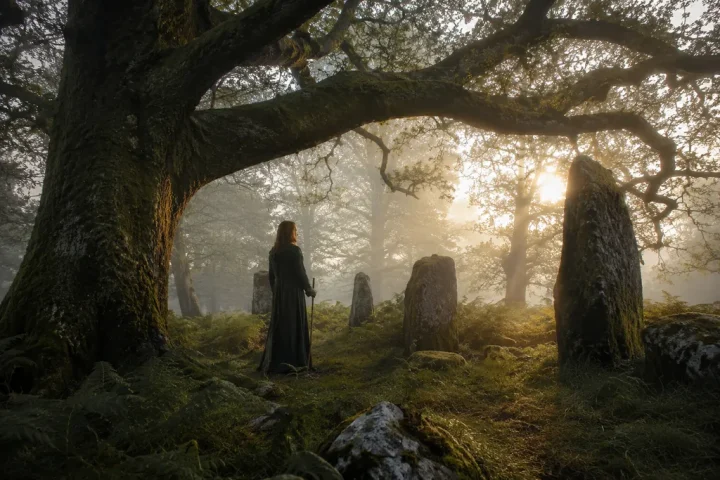
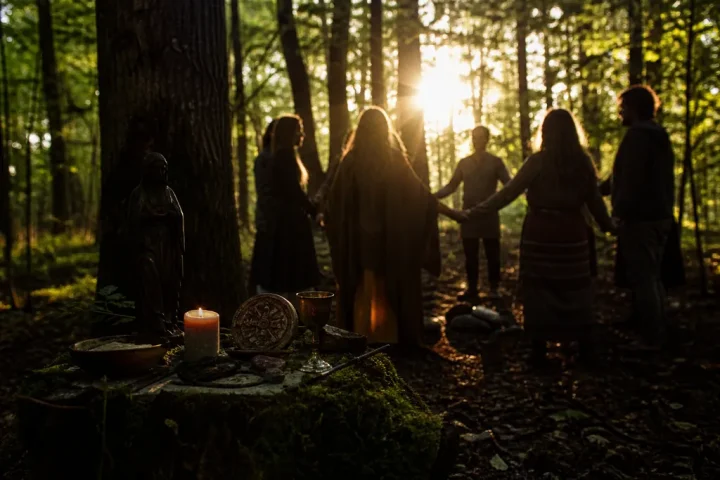
The ancient Greeks practised forms of wind divination at the sacred grove of Dodona, an important sanctuary dedicated to Zeus. The movement and sounds of the sacred trees were associated with the delivery of divine messages, making the wind that stirred their leaves an important part of the oracular environment.
Psellus referred to a related method when he wrote of “a mode of predicting by means of the air and the leaves of the trees”. According to the description, striking wands were suspended from the branches of sacred oak trees so that, when moved by the wind, they struck resonant brass basins.
The resulting sounds could then be interpreted as signs. In such a system, the wind itself remained unseen, yet its movement caused both the sacred trees and the suspended instruments to respond, transforming atmospheric motion into audible omens.
Methods
One method of anemoscopy involves observing the direction and force of the wind. A sudden change in direction, an unusually violent gust or an unexpected stillness may all be treated as significant, depending upon the system of interpretation employed by the diviner.
The wind may also reveal itself through dust. When strong air currents lift dust from the ground, the resulting clouds can form temporary shapes and patterns. These formations may be watched and interpreted in much the same way that other divinatory practices examine clouds, smoke or shifting natural forms.
Sound is another important element of anemoscopy. On a windy day, the practitioner may listen carefully to the changing tones created as air passes through trees, branches, buildings or other objects. The rustling of leaves, the whistling of stronger winds and the shifting noises produced by the landscape may be heard as possible responses or messages.
Within this interpretation, what might ordinarily be dismissed as random environmental sound becomes a form of natural oracle. The practitioner listens for unusual tones, repeated sounds or patterns that appear significant in relation to the question being asked.
Wind chimes may also be incorporated into the practice. Gentle winds set the chimes in motion, creating sounds whose timing, rhythm or sequence can be interpreted divinationally.
Pendulum Anemoscopy
A variation of anemoscopy combines wind divination with a suspended pendulum. The pendulum is held above a circle marked with runes, letters or other symbols and is allowed to respond to the movement of the surrounding air.
Rather than consciously swinging the pendulum, the practitioner watches as the wind moves it towards particular sections of the prepared circle. The symbols approached or indicated by the pendulum are then interpreted as the answer.
This form differs from ordinary pendulum divination because the wind, rather than the deliberate or unconscious movement of the operator, is treated as the force responsible for selecting the sign.
The Invisible Wind as an Oracle
Anemoscopy illustrates one of the most striking principles of natural divination: an invisible force may be interpreted through the physical changes it produces. The wind cannot itself be seen, yet leaves tremble, branches bend, dust rises and suspended objects begin to move when it passes.
For the diviner, these visible and audible effects provide the language through which the unseen wind may supposedly communicate. This makes anemoscopy closely related to aeromancy, the broader divination of atmospheric phenomena, while also overlapping with methods involving leaves, clouds and other natural signs.
Within the Occult World classification, anemoscopy belongs most naturally to Divination by Observation, because the practitioner deliberately observes the direction, force, sounds and visible effects of the wind and interprets them as signs. The pendulum variation introduces an element resembling sortilege, but observation of atmospheric movement remains the defining principle of the wider practice.
Learn to Hear What Moves Through the Air
Anemoscopy comes from a world in which the wind was never merely weather. It could move sacred trees, strike bronze vessels, lift dust into strange formations and carry sounds through a landscape that the diviner believed was alive with meaning.
If you want to understand these older systems instead of reducing divination to a handful of familiar modern tools, enter the Occult World Mystery School and study aeromancy, natural omens, spirits, ritual magic and the forgotten methods through which practitioners attempted to read the invisible forces surrounding them. There are thousands of spirits, gods, demons, magical systems, grimoires and forgotten traditions waiting beyond it. Stop hearing only noise in the wind and enter the Mystery School where the hidden traditions behind the signs are finally explored.
SEE ALSO:
- Aeromancy
- Divinations by Observation
- Divinations





Follow