
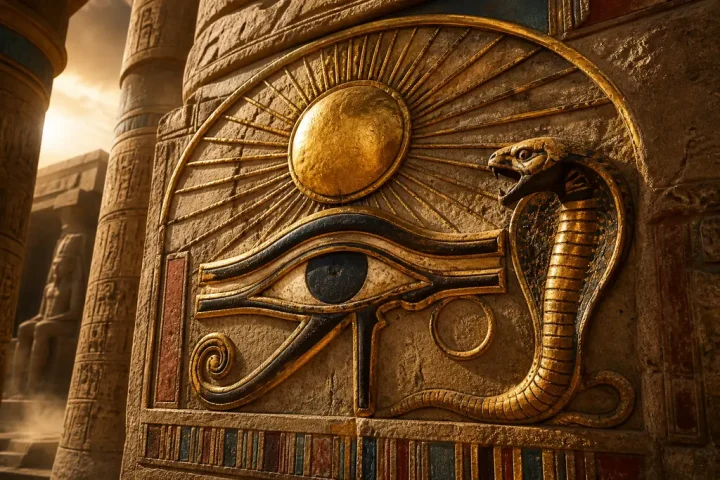
Behdety, also written Behedety or Horus Behdety, means “He of Behdet” and refers to a specific manifestation of Horus associated with Behdet, the ancient Egyptian name connected with Edfu in Upper Egypt. In Egyptian religious art, Behdety is most famously represented as the winged sun disk: a solar disk extended with great falcon wings, often accompanied by uraei, the sacred cobras of royal and divine protection.
This emblem became one of the most recognisable protective symbols of ancient Egypt. It appears above temple gateways, on lintels, in funerary contexts, and at the top of stelae, where it marks a space as divinely protected, ritually charged, and placed under the authority of the solar and royal gods.
Meaning and Identity
The name Behdety identifies the deity as “the one of Behdet.” Behdet was associated with Edfu, the major cult centre of Horus in Upper Egypt. The Greeks later called Edfu Apollinopolis Magna because they associated Horus of Edfu with Apollo, the Greek god of light, order, and solar brilliance.
Behdety is not a separate god in the same way as Osiris, Isis, or Anubis. Rather, he is a form or aspect of Horus: Horus as a solar, protective, sky-soaring power. The image unites two dominant forces in Egyptian symbolism:
The sun, representing divine radiance, kingship, cosmic order, life, and rebirth.
The falcon, representing height, vision, royal power, swiftness, and the sky.
Together, they form the winged sun disk: a symbol of heavenly authority descending into the human and ritual world.
The Winged Sun Disk
The winged sun disk is one of the most important religious emblems in Egyptian iconography. Its basic form consists of a central solar disk with wings spreading outward on both sides. In many examples, two uraei emerge from the disk, signifying protection, sovereignty, and the fiery power of divine defence.
The symbol was placed prominently over temple entrances and sacred thresholds. This was not merely decorative. In Egyptian religious thinking, images were not passive ornaments; they were active carriers of meaning and power. A symbol placed above a doorway guarded the passage beneath it. It marked the threshold as protected by divine force.
For this reason, Behdety often appears in architectural positions of great ritual importance. The winged disk looks down from above, as though the god himself were hovering over the sacred space. The wings suggest motion and watchfulness; the disk suggests solar permanence and divine illumination.
Behdety and Horus of Edfu
The great temple of Edfu, one of the best-preserved temples in Egypt, is central to the cult and mythology of Horus Behdety. At Edfu, Horus was worshipped as a powerful divine warrior, defender of kingship, and enemy of chaos.
In mythological texts associated with Edfu, Horus Behdety appears as a conquering solar force who fights the enemies of Ra. He rises into the sky in the form of the winged disk, seeing the enemies of the sun god from above and striking them down. This myth gives theological explanation to the symbol’s protective function: the winged disk is not only a sign of light, but a weapon against disorder.
The mythology reflects a central Egyptian religious idea: the world must be continually defended against chaos. The gods, the king, and ritual practice all participate in the maintenance of Ma’at — truth, balance, justice, and cosmic order. Behdety, as winged solar Horus, embodies this act of divine defence.
Royal and Protective Symbolism
Behdety was closely connected with kingship. Horus was already the divine model of the pharaoh, and the winged sun disk strengthened that association by linking royal authority with the sun’s universal power.
The emblem therefore expressed several layers of meaning at once:
Divine protection over the king
Solar authority and heavenly sanction
Victory over enemies and chaos
The union of sky, sun, and royal power
The guarding of sacred thresholds
Rebirth and renewal through solar force
In funerary art, the winged sun disk could also suggest protection of the deceased and passage into the afterlife. Placed at the top of stelae, it marked the scene below as under divine guardianship. The deceased, the offering formula, and the sacred names were all placed beneath the wings of solar protection.
Iconographic Features
The winged sun disk of Behdety may include several symbolic elements:
The solar disk
The central disk represents the sun, the visible manifestation of divine radiance. It is associated with life, renewal, kingship, and cosmic power.
The falcon wings
The wings link the disk to Horus, the falcon god. They suggest flight, surveillance, divine speed, and protection from above.
The uraei
The cobras often shown beside or emerging from the disk represent royal power and divine fire. The uraeus could destroy enemies and protect the sovereign.
The threshold placement
When placed above doors, gateways, and temple entrances, the winged disk becomes a guardian emblem. It watches over the passage between ordinary and sacred space.
Relationship with Ra and Other Solar Forms
Over time, Behdety became associated with wider solar theology. Horus of Edfu could be connected with Ra, Ra-Horakhty, and other solar manifestations. This blending was typical of Egyptian religion, where gods could merge, overlap, or appear as forms of one another without losing their individual identities.
The winged sun disk therefore belongs to a larger network of Egyptian solar symbolism. It is related to the daily journey of the sun, the triumph of light over darkness, and the king’s role as the earthly maintainer of divine order.
However, Behdety retains a distinct identity because of his specific connection with Horus, Behdet/Edfu, and the winged solar form.
Behdety in Temples and Funerary Art
The winged sun disk became widespread in Egyptian religious architecture. It can be found above entrances, along temple walls, on ceilings, and in reliefs connected with royal and divine scenes.
In funerary contexts, the symbol appears above stelae and offering scenes. Its presence indicates divine protection, but also cosmic legitimacy. The dead person is placed beneath a symbol of solar order, watched over by a divine power that belongs to the heavens.
This made Behdety especially suitable for liminal spaces — places of crossing. A temple gate, a tomb entrance, a funerary stele, and even the boundary between life and death are all thresholds. The winged disk guards such thresholds.
Misinterpretations and Modern Occult Use
In modern occultism, the winged sun disk is often treated as a general symbol of enlightenment, spiritual ascent, hidden knowledge, or solar initiation. While these interpretations can be meaningful in symbolic or esoteric practice, they should not erase the original Egyptian context.
Historically, Behdety was not simply an abstract symbol of “spiritual awakening.” He belonged to a specific religious world: the cult of Horus, the theology of kingship, the defence of Ma’at, and the sacred geography of Edfu.
Modern use of the winged sun disk should therefore be approached with respect. Its original meaning was not vague decoration, but divine guardianship, solar authority, and protection against chaos.
Behdety is the Horus of Behdet, most powerfully expressed through the winged sun disk. This image combines the sun’s radiance with the falcon’s height and vigilance, creating one of ancient Egypt’s most enduring protective symbols.
Placed above temples, funerary stelae, and sacred thresholds, Behdety represented divine watchfulness, royal legitimacy, and the triumph of cosmic order over chaos. He was Horus not merely as a falcon, but as a solar guardian: bright, elevated, and victorious.
In the winged disk, the ancient Egyptians expressed a profound religious idea: that light itself can guard, that the sky watches, and that sacred spaces must be protected by powers greater than the human world.
Continue Your Path into Egyptian Mythology
If Behdety interests you, continue exploring the sacred symbols, gods, and hidden religious language of ancient Egypt inside Occult World.
Read next on Occult World:
Horus – The Falcon God of Kingship and the Sky
Ra – The Solar Power Behind Creation and Divine Order
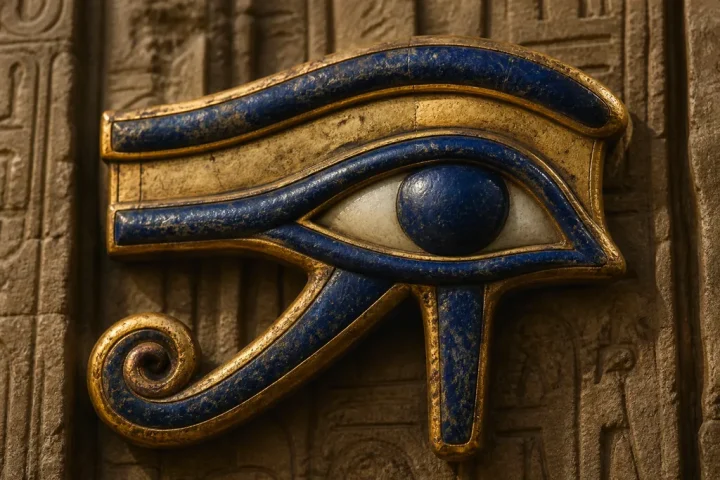
The Eye of Horus – Protection, Healing, and Royal Power
Egyptian Funerary Symbols — The Language of Death and Rebirth
The Winged Sun Disk — Solar Protection and Sacred Architecture
Go Deeper: Learn the Symbolic Language of the Ancient World
Ancient symbols were never random. They were keys to power, protection, initiation, kingship, death, rebirth, and divine contact.
Inside the Occult World library and courses, you can go deeper into:
- Egyptian gods and sacred symbolism
- Solar magic and divine kingship
- Temple imagery and hidden religious codes
- Protective symbols and their ritual meanings
- Ancient magical texts, grimoires, and spiritual systems
If you want to move beyond short encyclopedia entries and truly understand the spiritual architecture behind ancient symbols, join the Occult World Digital Coven and continue your study through structured lessons, private material, and deeper occult training.
The winged sun disk of Behdety was placed above sacred thresholds for a reason.
It marked the entrance into protected space.
Occult World is built for the same purpose: to guide serious students through the threshold between curiosity and real knowledge.
If you are drawn to ancient gods, sacred symbols, temple magic, Egyptian mythology, and the hidden language of power, do not remain at the surface.
Join the Digital Coven and begin walking the path with structure, depth, and protection.
Inside, you will find members-only teachings, occult study paths, symbolic interpretation, magical foundations, and guided lessons designed for those who want more than scattered information.
Enter the library. Study the symbols. Learn the language of the unseen.
Your next step begins inside Occult World.
SEE ALSO:
SOURCE:
Encyclopedia of World Mythology and Legend, Third Edition – Written by Anthony S. Mercatante & James R. Dow– Copyright © 2009 by Anthony S. Mercatante







Follow