
Flamborough
Flamborough, on the dramatic East Yorkshire coast, is a place of chalk cliffs, sea caves, old wells and deep hollows where local folklore once placed fairies, ghosts and other beings that were not entirely of the human world. Among its strangest traditions is the story of Jenny Gallows, a white-clad female spirit said to inhabit a circular hollow somewhere outside the village. Those reckless enough to circle her haunt repeatedly risked calling her from the ground, and according to one nineteenth-century account, a farmer who dared to test the legend discovered that Jenny was capable of doing considerably more than merely appearing.
The oldest known written version of the story was recorded by John Nicholson in 1890 in Folk Lore of East Yorkshire. Nicholson did not call the place a chalk pit or identify it precisely. He described it as a circular hole resembling a dry pond near Flamborough, where a local girl was said to have taken her own life. Her Christian name was given as Jenny, while the fuller name Jenny Gallows appears in a slightly later account. Whatever her original identity may have been, local belief transformed the dead girl into something far more dangerous than an ordinary ghost.
The Nine Circuits
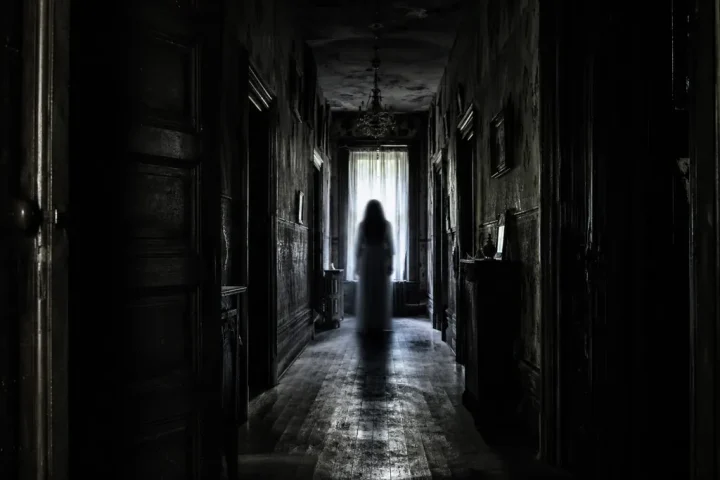
According to Nicholson, anyone bold enough to run nine times around the hollow would cause Jenny’s spirit to emerge. She appeared dressed in white, the traditional colour of countless English female apparitions, but the ritual was apparently easier to begin than to complete. By the eighth circuit, Jenny was said to make her presence known and threaten the person attempting to summon her.
Her warning survives in Nicholson’s East Yorkshire dialect:
Ah’ll tee [tie] on me bonnet
An’ put on me shoe,
An’ if thoo’s nut off
Ah’ll seean [soon] catch thoo.
The meaning is approximately, “I’ll tie on my bonnet and put on my shoe, and if you’re not gone, I’ll soon catch you.” Nicholson remarked that nobody had been courageous enough to complete the ninth circuit, because after the eighth Jenny’s warning was apparently sufficient to send even the boldest challenger running.
A closely related Flamborough tradition recorded a few years later adds another supernatural possibility. In material associated with Robert Fisher’s Flamborough: Village and Headland, published in 1894, A. H. Armytage recorded that running nine times around the hollow allowed a person to hear the fairies. This appears to have existed alongside the belief that the same ritual summoned Jenny.
The distinction is intriguing because it suggests that the hollow may have carried supernatural associations beyond the ghost of a dead girl. In older British folklore, ghosts and fairies do not always occupy completely separate worlds, and mysterious hollows, ancient mounds, wells and pits frequently attracted traditions involving both. Jenny may have been remembered as the spirit of a suicide, but the ritual surrounding her belongs to something older and stranger than a conventional haunted-place story.
The Farmer Who Challenged Jenny
Nicholson preserved one extraordinary account of a man who apparently decided to test the legend without relying upon his own feet. Some years before Nicholson recorded the story, a farmer was said to have galloped around the haunted hollow on horseback.
According to the tale, the ritual worked.
Jenny emerged from the hollow and pursued him.
The terrified farmer spurred his horse towards Flamborough while the white figure followed behind. The chase continued until he reached the edge of the village, where Jenny suddenly refused to go any farther. Her inability or unwillingness to cross this invisible boundary is never explained, but before abandoning the pursuit she supposedly managed to bite a piece from the horse’s flank.
The animal survived, yet the story claimed that the wound left behind a remarkable mark. For the remainder of the mare’s life, a white patch remained upon the place Jenny had bitten.
For nineteenth-century listeners, such a physical mark would have transformed a frightening story into apparent evidence. The apparition had not merely been seen by a terrified traveller in darkness. She had supposedly left something behind upon a living animal that neighbours could continue to see long after the encounter was over.
Whether such a horse ever existed cannot now be established, but the detail belonged to the story by 1890 and is therefore not a modern embellishment.
Ghost, Fairy or Something Older?
The later association between Jenny and the fairies makes the Flamborough tradition especially curious. If circling the same hollow nine times could either summon Jenny or allow someone to hear fairy voices, the location itself may once have been regarded as supernatural before the story of the dead girl became attached to it.
The number nine appears repeatedly in British and northern European folklore, particularly in rites involving sacred places, healing, divination and attempts to encounter supernatural beings. East Yorkshire possessed similar traditions in which a person had to circle a particular place nine times before something hidden would reveal itself.
Nicholson himself remarked upon the frequency with which pits and hollows in the East Riding were regarded as haunted. In a landscape filled with chalk depressions, wells, ancient earthworks and strange natural formations, such places easily became entrances into folklore’s invisible geography.
Jenny Gallows may therefore stand at the meeting point of several traditions. She is remembered as a dead woman, behaves like an aggressive ghost, inhabits a landscape associated with fairies and is summoned by a ritual more characteristic of old folk belief than of conventional ghost stories.
Where Was Jenny Gallows’ Hollow?
One of the most frustrating aspects of the legend is that the original location has been lost.
Nicholson says only that the circular hollow lay “near Flamborough”. Later versions variously place Jenny in a dry pond, chalk pit, well or other depression around the headland. None can be identified with certainty as the place Nicholson had in mind.
In the early twentieth century, the Reverend William Smith recorded a tradition involving a dry circular hollow near North Landing and connected Flamborough with fairy beliefs. This may have preserved a memory of the same supernatural site, although there is no way to prove that it was Nicholson’s haunted pond.
Local memory has also associated Jenny with a depression beside the road leading towards Flamborough Lighthouse. Again, the location fits the general geography of the old story, particularly because a horseman fleeing from the headland could conceivably have raced back towards the village along that route, but folklore has a habit of moving when the landscape changes and old landmarks disappear.
An even more tantalising possibility appears on nineteenth-century maps of the headland. The 1854 Ordnance Survey records a place called Gallows Hole on the cliffs between Selwick Bay and North Landing. The name naturally invites comparison with Jenny Gallows, but no documentary evidence has been discovered proving that the two are connected. It remains an evocative coincidence rather than an identification.
The uncertainty adds something important to the haunting. Somewhere around Flamborough there was once a hollow that local people recognised immediately when the story was told. They apparently knew where not to run nine times after dark. The story survived, but the landscape changed, memories fragmented and the precise place gradually vanished from collective knowledge.
Jenny Gallows and the Haunted Headland
Flamborough Head is a landscape capable of generating supernatural stories without assistance. Its enormous white cliffs rise above a violent sea, while caves penetrate the chalk and sudden fog can swallow paths, fields and coastline. Long before modern navigation made the coast safer, these waters were associated with shipwreck, drowning and disappearance. Inland, old wells, pits and hollows added another layer of mystery to a landscape already filled with dangerous boundaries.
Jenny Gallows belongs perfectly within this environment. Her story begins with a death in a hollow but refuses to remain a simple suicide legend. The dead girl becomes a white apparition capable of being deliberately summoned. Her haunt becomes associated with the voices of fairies, while the ritual necessary to reach her depends upon the ancient and magical number nine. When a farmer challenges the tradition, she does not merely appear but pursues him almost to the safety of the village, leaving a physical scar upon his horse before retreating.
Even the village itself seems to have represented a boundary she could not cross. Why Jenny supposedly stopped at Flamborough has never been explained. Perhaps the ghost belonged only to the land surrounding her hollow, or perhaps the village boundary possessed some forgotten protective significance within the older form of the tale.
Whatever the explanation, the most unsettling part of the legend may be that the challenge can no longer be repeated with certainty. The old instructions survive, but the location does not. Somewhere on or around the Flamborough headland may still lie the circular hollow where nineteenth-century villagers believed Jenny waited in white, listening as a reckless stranger began the first circuit around her grave.
Stop Reading the Legends and Enter the Hidden World
You can spend years collecting ghost stories, fairy legends and haunted places and still know almost nothing about the occult forces our ancestors believed were moving behind them. If you are satisfied with another entertaining story about a woman in white, close the page and remain a spectator. If you want to understand ghosts, spirits, fairies, necromancy, witchcraft, demonology, divination, grimoires and the old magical traditions that treated the unseen world as something dangerously real, then enter the Occult World Mystery School and stop feeding yourself scraps. Serious occult knowledge demands more than curiosity. Study the systems, learn the traditions and develop the understanding that separates someone who merely reads about mysteries from someone determined to penetrate them. The surface is crowded with people talking about the occult. The deeper world belongs to those prepared to do the work.
SEE ALSO:
SOURCE:
Haunted England : The Penguin Book of Ghosts – Written by Jennifer Westwood and Jacqueline Simpson –
Copyright © Jennifer Westwood and Jacqueline Simpson 2005, 2008



Follow