
Ma’at: Lady of Heaven, Queen of Earth, and Mistress of the Judgment Hall
Ma’at is one of the most profound and essential concepts in ancient Egyptian religion. She is a word, a cosmic principle, and a goddess. She is truth, justice, balance, harmony, right order, and the invisible law that keeps creation from collapsing into chaos.
To understand Ma’at is to understand the Egyptian vision of existence. The universe was not seen as random or meaningless. It was a sacred order, continually maintained through right action, ritual, speech, ethical conduct, and divine alignment. Ma’at was the living principle that held heaven, earth, the underworld, the gods, nature, kingship, society, and the human soul in balance.
She is known by many titles: Lady of Heaven, Queen of Earth, Mistress of the Underworld, Eye of Ra, Daughter of Ra, and Lady of the Judgment Hall. These titles reveal the vastness of her power. Ma’at is not confined to one realm. She belongs to the sky, the earth, the Duat, the divine court, and the human heart.
Ma’at as Word
The word Ma’at means “truth,” “genuine,” “authentic,” or “the real thing.” In ancient Egyptian language, something described as ma’at was not false, imitation, or corrupted. For example, khesbet ma’at meant “real lapis lazuli,” as opposed to blue paste or imitation stone.
This meaning is important. Ma’at is not merely truth in the sense of correct information. She is reality itself when it is aligned, pure, and genuine. She is the difference between what merely appears to be true and what is truly real.
In this sense, Ma’at cuts through illusion. She is the measure of authenticity. She asks whether a thing, a word, a person, a ruler, a ritual, or a soul is in harmony with what is real.
Ma’at as Sacred Order
As a concept, Ma’at is the sacred harmony that links the human world with the divine. It is the state of rightness that allows creation to continue. Ma’at includes truth, justice, balance, proportion, ethical behaviour, proper speech, ritual correctness, and respect for the divine structure of existence.
The opposite of Ma’at is chaos, disorder, falsehood, violence, greed, injustice, corruption, and spiritual imbalance. The Egyptians believed that Ma’at could be damaged by human actions, destructive emotions, selfishness, false speech, broken obligations, and immoral behaviour. When people acted against Ma’at, they did not merely commit private wrongdoing; they disturbed the sacred balance of the world.
This is why Egyptian temples, priesthoods, offerings, hymns, royal rituals, and daily acts of devotion were all understood as part of maintaining Ma’at. The temple was not only a place of worship. It was a cosmic engine, helping to preserve order against the forces of disorder.
To live in Ma’at was to live in alignment with truth. To violate Ma’at was to strengthen chaos.
Ma’at as Goddess
Ma’at is also the goddess who rules and embodies this state of sacred order. She is ancient, predynastic, and foundational to Egyptian spirituality. She is the goddess of truth, justice, balance, ethical law, divine order, and moral rightness.
She is not simply the spirit of legal law. Ma’at represents what is truly right, not merely what is permitted by authority. There is a difference between what is lawful and what is just, between what is technically allowed and what is spiritually correct. Ma’at stands for the deeper law beneath human systems.
This makes her an especially powerful goddess. She is not easily manipulated. She does not favour empty ritual without integrity. She does not bless falsehood hidden beneath respectable appearance. She is the divine standard before which every heart, king, priest, and ordinary person must eventually stand.
The Feather of Ma’at and the Judgment of the Dead
Ma’at is now most famous for her role in the ancient Egyptian afterlife judgment. After death, the soul entered the Hall of Judgment, where the heart of the deceased was weighed against the feather of Ma’at.
The heart was considered the seat of conscience, memory, character, and moral truth. It carried the record of the life that had been lived. On one side of the scales was the heart. On the other was Ma’at’s feather.
If the heart balanced with the feather, the soul was judged to be in harmony with Ma’at and could continue into blessed existence. If the heart was heavier than the feather, burdened by wrongdoing, falsehood, greed, violence, or spiritual corruption, the soul was denied eternal life. In many depictions, the devourer Ammit waits nearby, ready to consume the heart that fails the test.
This judgment is one of the most striking images in world spirituality. It teaches that the soul cannot escape truth. No title, wealth, status, cleverness, or outward appearance can outweigh the condition of the heart. At the final moment, the soul is measured against Ma’at.
The Negative Confession
In the Book of the Dead, the deceased makes a series of declarations often called the Negative Confession. These statements are not confessions of sin, but affirmations of innocence and alignment. The deceased declares that they have not stolen, lied, murdered, caused suffering, defiled sacred places, cheated, blasphemed, or acted unjustly.
These declarations reveal the ethical depth of Ma’at. Egyptian religion was not only about offerings to gods or magical formulas for the afterlife. It was also about how one lived. Speech, trade, family, ritual, sexuality, leadership, compassion, and social conduct all belonged to Ma’at.
The soul’s survival depended not only on belief, but on harmony with truth.
Ma’at and the Pharaoh
The pharaoh was expected to uphold Ma’at on earth. Kingship itself was justified by the ruler’s ability to preserve divine order. The pharaoh made offerings of Ma’at to the gods, symbolically returning truth and balance to the divine realm.
This offering was not merely ceremonial. It expressed the central duty of sacred kingship: to maintain justice, defeat chaos, protect the land, honour the gods, and ensure that Egypt remained aligned with cosmic order.
When a ruler failed Ma’at, the whole kingdom was believed to be endangered. Famine, invasion, social unrest, and spiritual disorder could all be interpreted as signs that Ma’at had been disturbed.
In this way, Ma’at was political as well as spiritual. She was the measure of legitimate power.
Ma’at and Thoth
Ma’at is closely associated with Lord Thoth, the ibis-headed god of wisdom, writing, sacred knowledge, measurement, magic, and divine recordkeeping. Thoth is the scribe of the gods, the keeper of cosmic law, and the recorder of the judgment of the dead.
Ma’at and Thoth stand together in the barque of Ra, assisting the sun god in his daily journey across the sky and nightly passage through the underworld. They represent order, wisdom, truth, calculation, and the correct functioning of the cosmos.
In some traditions, Ma’at and Thoth are envisioned as married or deeply paired. Their connection is natural: Ma’at is truth and order; Thoth records, measures, interprets, and preserves it. Together, they represent the sacred marriage of truth and wisdom.
Ma’at as the Eye of Ra
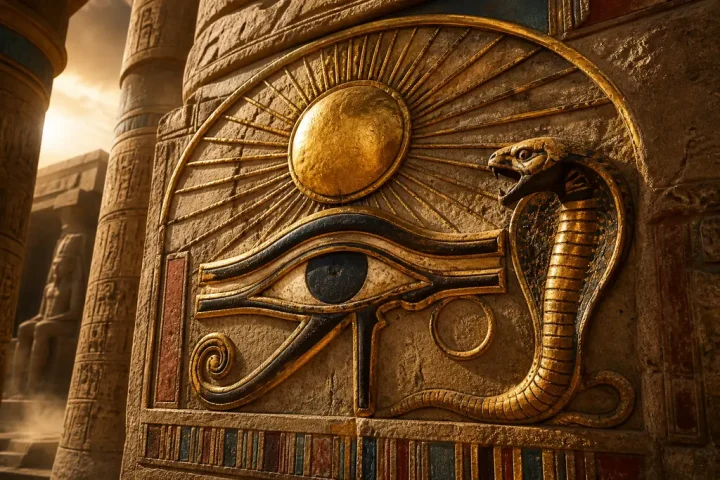
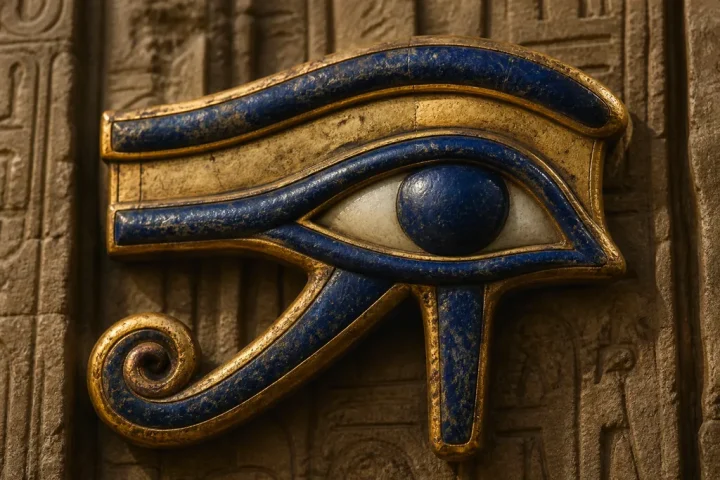
One of Ma’at’s titles is Eye of Ra. The Eye of Ra is a powerful and sometimes fierce divine force associated with protection, justice, punishment, solar power, and the defence of cosmic order. Many goddesses may bear this title, including Hathor, Sekhmet, Bastet, and Ma’at.
As Eye of Ra, Ma’at is not passive. She does not merely represent gentle harmony. She also defends order against chaos. She exposes falsehood, corrects imbalance, and stands as a divine force of judgment.
This aspect of Ma’at reminds us that truth is not always soft. Balance is not always comfortable. Justice may require confrontation. Ma’at restores the sacred order, even when that restoration is severe.
Ma’at as Personal Goddess
Although Ma’at is deeply cosmic, she was also venerated personally. She offered a model for right living, spiritual integrity, honesty, and moral balance. To honour Ma’at was to cultivate truth in speech, fairness in action, moderation in desire, and alignment between inner life and outward behaviour.
She was not only a goddess of kings, priests, and the dead. She was a guide for anyone seeking to live in harmony with divine law.
For modern seekers, Ma’at remains deeply relevant. She asks powerful questions: Is your heart light? Are your words true? Are your actions aligned with your values? Are you strengthening order or feeding chaos? Are you living from integrity, or merely from fear, appetite, or ambition?
Ma’at does not ask for perfection. She asks for truth.
The Occult Meaning of Ma’at
In occult terms, Ma’at represents spiritual alignment. She is the law of balance behind ritual, magic, divination, initiation, and the soul’s journey after death. Without Ma’at, power becomes corruption. Knowledge becomes arrogance. Magic becomes ego. Ritual becomes empty performance.
This is why Ma’at is essential for serious occult study. She reminds the practitioner that spiritual work must be rooted in balance, responsibility, truth, and inner order. To call upon spiritual forces without Ma’at is dangerous, because the magician who lacks balance becomes vulnerable to distortion.
In esoteric practice, Ma’at may be invoked for truth, justice, clarity, ethical guidance, protection against deception, spiritual cleansing, and the restoration of harmony. She is especially meaningful in work involving judgment, karmic balance, ancestral healing, truth-telling, and the weighing of difficult decisions.
She is the feather against which the soul measures itself.
Go Deeper into Ma’at, Egyptian Mysticism, and Occult Wisdom
Ma’at is more than an Egyptian goddess. She is a sacred key to understanding truth, justice, divine order, the afterlife, ritual ethics, spiritual balance, and the hidden law that connects the human soul with the cosmos. Her feather stands at the threshold between life and eternity, asking whether the heart has lived in harmony with truth.
Inside the Occult World Mystery School, you can explore Ma’at and the deeper mysteries of Egyptian spirituality, ancient deities, the afterlife, ritual symbolism, divine law, angelology, demonology, Kabbalah, ancient grimoires, and occult philosophy. You will also find fellow occultists and serious seekers who want to study these traditions with depth, structure, and meaning.
If Ma’at, Thoth, the Judgment Hall, the feather of truth, and the ancient Egyptian path of sacred balance speak to you, then do not remain at the surface. Step inside the Occult World Mystery School and continue your journey into the hidden wisdom of the gods, the soul, and the unseen world.
Ma’at and the Modern Soul
Ma’at remains powerful because she speaks to something timeless. Every person carries a heart. Every life leaves a weight. Every action either strengthens harmony or adds to disorder. In a world filled with confusion, manipulation, noise, and imbalance, Ma’at offers a severe but beautiful standard: live truthfully, act justly, restore balance, and keep the heart light.
She is Lady of Heaven because her law belongs to the divine realm.
She is Queen of Earth because her order must be lived here.
She is Mistress of the Underworld because every soul must eventually face her truth.
Ma’at is the real thing. The genuine thing. The sacred balance behind all things.
ORIGIN:
Egypt
MANIFESTATION:
Ma’at is a beautiful woman who may have wings. She may wear her signature feather on her head.
Iconography:
She is sometimes portrayed as a woman with an ostrich feather for a head.
ATTRIBUTE:
Ostrich feather, scales of justice
Consort:
Thoth
BIRDS:
Ostrich, vulture
Star:
Vega
SEE ALSO:
- Ra
- Eye of Ra
- Egyptian Afterlife
- Judgment Hall
- Ammit
- Book of the Dead
- Feather of Ma’at
- Egyptian Magic
- Divine Order
- Metis
- Michael
- Thoth
- Egyptian Mythology
SOURCE:
Encyclopedia of Spirits: The Ultimate Guide to the Magic of Fairies, Genies, Demons, Ghosts, Gods & Goddesses – Written by : Judika Illes Copyright © 2009 by Judika Illes.







Follow