

Magpie Mine: The Cursed Mine of the Peak District
Magpie Mine stands on the bleak limestone plateau above Sheldon, close to Ashford-in-the-Water in Derbyshire. Its ruined engine house rises from the surrounding fields like the shell of an abandoned fortress. The mine is now protected as a Scheduled Monument, yet its reputation reaches far beyond industrial archaeology. For almost two centuries, Magpie Mine has been associated with a deadly underground feud, a curse pronounced by grieving widows and the ghostly figure of an old miner who still appears to guard the drowned workings.
Lead was extracted from this landscape for hundreds of years. The workings that eventually became Magpie Mine developed from at least the seventeenth century, although the name Magpie appears in surviving production records during the eighteenth century. The mine grew into one of the most important lead-producing sites in the Peak District. Its prosperity did not bring peace.
The miners fought constantly against the water gathering beneath the hill. Pumps failed and shafts flooded. Expensive attempts to reach deeper deposits repeatedly ended in disappointment. The mine closed and reopened several times before final operations ceased during the twentieth century.
Local tradition does not explain these failures through geology or economics alone. According to the legend, Magpie Mine was cursed.
The Underground War
The origin of the curse is usually traced to a violent dispute that reached its fatal climax in 1833.
Lead miners worked veins of ore that continued beneath boundaries marked on the surface. This created bitter arguments between neighbouring mining companies. Each side believed it possessed the legal right to follow the vein underground, even when tunnels entered disputed territory.
The miners of Magpie became involved in a prolonged struggle with men working the nearby Great Red Soil and Maypit claims. Their confrontation was not confined to courtrooms. It continued within the darkness of the mine itself.
Men broke through into rival workings. Fires were deliberately lit underground so that smoke would force the opposing miners to retreat. Such tactics were extraordinarily dangerous in confined passages where ventilation was already poor.
In September 1833, smoke from fires associated with the Magpie workings entered the neighbouring mine. Three men were overcome by the fumes and suffocated underground.
The deaths caused outrage throughout the district. Twenty-four Magpie miners were eventually brought to trial. The prosecution could not prove which men had been directly responsible for lighting the fatal fires. It also struggled to demonstrate that the deaths had been deliberately intended. The accused miners were acquitted.
The widows of the dead men were left without justice.
According to the legend that later became attached to Magpie Mine, the widows gathered after the trial and cursed the mine. They condemned the enterprise to failure. No owner would ever enjoy lasting prosperity from the lead beneath the hill.
The mine closed not long afterwards.
The Widows’ Curse
It is impossible to determine exactly when the story of the curse first entered local folklore. The deaths of 1833 are historical, as are the underground fires and the subsequent trial. The image of the widows formally cursing Magpie Mine belongs to oral tradition.
Yet everything that followed seemed to strengthen the legend.
Later owners attempted to restore the workings, but the mine continued to consume money. Flooding returned whenever the pumps failed. Machinery broke down. Promising deposits proved difficult to reach. New investors arrived with confidence, only to abandon the enterprise when the expected riches failed to appear.
John Taylor, one of the most respected mining engineers of his age, took control of the mine during the nineteenth century. He improved the machinery and deepened the workings. His intervention brought another period of activity, but it did not permanently defeat the water beneath Magpie Mine.
During the 1870s, work began on the Magpie Sough. This long drainage tunnel was intended to carry water away from the mine towards the River Wye near Ashford-in-the-Water. It took approximately eight years to complete.
The sough was an impressive engineering achievement, but it did not deliver the lasting fortune its builders hoped to obtain. The mine again struggled financially. Further attempts to reopen it continued into the twentieth century, but Magpie never returned to its former importance.
To sceptics, the mine’s misfortunes reflect the ordinary dangers of lead mining. To believers, each failure represents another fulfilment of the widows’ curse.
The Ghost in the Tunnel
The most famous supernatural encounter at Magpie Mine took place shortly after the Second World War.
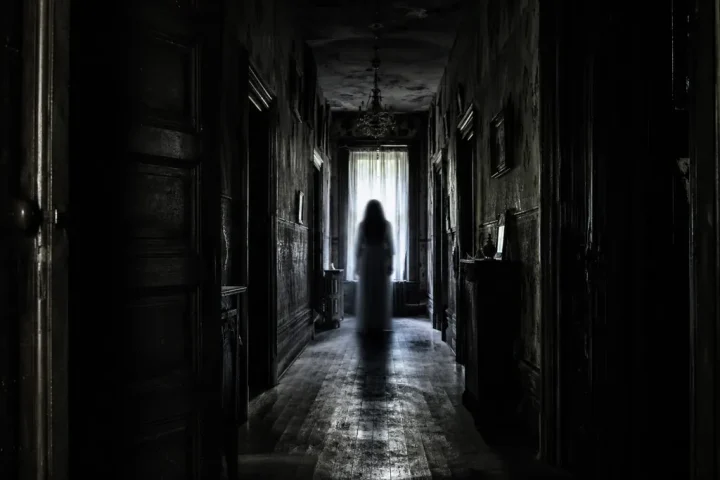
A group of speleologists entered the abandoned workings in 1946. During the exploration, one member of the party allegedly saw a man carrying a candle through one of the tunnels. The mysterious miner walked away from the explorers and then vanished without leaving any indication of where he had gone.
No open passage could be found through which he might have escaped.
The incident was later recorded by R. A. H. O’Neal in an article about Derbyshire lead mines. O’Neal connected the apparition with T’Owd Mon, the spectral guardian of local mining tradition.
He writes:
Just after the war a party of speleologists were exploring the mine when one of them reported that he had seen a man with a candle walking along a tunnel from which he disappeared without any trace. A photograph of another member of the party on a raft in a sough [short level for drainage] at the mine showed a second man standing, apparently, on nine feet of water. The Old Man was clearly either trying to protect his ancient rights or to help the twentieth century searchers find the ore, which is reported to be thick and pure in the main vein now 150 feet below the water level.
The disappearance of the candle-bearing figure was only the beginning of the story.
A photograph had reportedly been taken while another member of the group travelled through a flooded section of the mine on a raft. When the image was examined, a second man appeared to be standing nearby. He seemed to be upright upon water that was believed to be approximately nine feet deep.
The figure had not been noticed when the photograph was taken.
The original image has not become widely available for modern examination. The identities of the explorers are also rarely included in retellings of the event. The story therefore cannot be independently tested, but it remains one of the most striking accounts associated with any haunted mine in England.
The apparent figure did not resemble a monstrous underground creature. He appeared to be a miner. This detail connected the photograph with a much older belief found throughout the Derbyshire lead-mining region.
The apparition was identified as T’Owd Mon.
T’Owd Mon
T’Owd Mon means “the Old Man” in the local Derbyshire dialect. The expression could refer to the miners of former generations who had worked the veins long before the arrival of modern companies. In folklore, however, the Old Man became something more than a memory of the dead.
He was understood as a guardian presence within the mine.
T’Owd Mon knew the hidden passages beneath the earth. He remembered ancient boundaries that living owners might have forgotten. He could protect a mine from intruders, but he could also guide miners towards rich deposits of ore.
His appearance was not always considered an omen of death. Unlike the malicious spirits said to lure miners into dangerous workings, T’Owd Mon could be helpful. A glimpse of him might indicate that valuable ore remained nearby.
This possibility gives the Magpie Mine apparition an unusual ambiguity. The Old Man may have been protecting the mine from those who no longer possessed the right to enter it. He may instead have been attempting to guide the explorers towards the rich lead vein believed to lie beneath the flooded lower levels.
Stories of T’Owd Mon were not confined to Magpie Mine. A similar figure was said to haunt Hanging Flat Mine near Eyam. He wandered through the fluorspar workings with a spade over his shoulder while muttering quietly to himself.
The folklorist Sidney Oldall Addy recorded that Derbyshire miners once left part of a candle burning underground when they finished work on Christmas Eve. The flame was left for T’Owd Mon.
The gesture acknowledged that the miners were not alone beneath the earth. The mine belonged partly to those who had worked there before them. It also belonged to the unseen powers that governed the underground world.
A candle left in darkness was an act of respect. It could also be an offering intended to secure protection.
The candle carried by the apparition at Magpie Mine is therefore significant. It links the 1946 encounter with an older world of mining belief in which the dead continued to walk through the passages they had carved.
A Guardian or a Restless Ghost?
The identity of the spirit haunting Magpie Mine has never been established.
It may represent one of the generations of miners who spent their lives beneath the Derbyshire hills. It may be connected with the three men killed during the underground conflict of 1833. It may also be the guardian figure known collectively as T’Owd Mon.
The apparition could even belong to the mine itself.
Mines often develop a supernatural character within local tradition because they occupy a boundary between the human world and the unknown depths beneath it. The descent into a mine resembles an entry into the underworld. Sunlight disappears. Ordinary direction becomes uncertain. Every sound travels through the rock in ways that are difficult to interpret.
The miners who worked at Magpie lived constantly with the possibility that the earth might close around them. A sudden fall of stone could bury a man instantly. Water could rise through the workings and cut off the route to the surface. Smoke could move silently through a tunnel before anyone realised that escape had become impossible.
Under such conditions, belief in underground spirits was not merely superstition. It gave personality to dangers that could not always be seen.
T’Owd Mon embodied the memory of those who understood the mine better than any living visitor. He could appear as a warning. He could also become a guide.
The Haunted Ruins
Magpie Mine is now cared for by the Peak District Mines Historical Society. The surviving structures include the great engine house, the circular chimney and the steel headgear erected during the final phase of mining.
The surface remains quiet. Sheep graze around the ruins, while walkers cross the exposed plateau without seeing the drowned labyrinth beneath their feet.
The calm landscape conceals a history of conflict and death.
Far below the engine house, passages continue into darkness. Some are flooded beyond access. Others have collapsed. The main vein descends into levels that have remained beyond ordinary exploration for decades.
Those underground spaces form the true haunted heart of Magpie Mine.
The candle-bearing miner did not appear among the ruins in daylight. He was seen within the tunnels, moving through the world that had once belonged to him. The second figure appeared over deep water, where no living man could have stood.
Magpie Mine therefore remains one of the Peak District’s most compelling haunted locations. Its supernatural reputation does not depend upon a vague legend attached to a picturesque ruin. It grows from a documented tragedy that was followed by an acquittal, a curse and repeated failure.
The dead were never given justice.
The mine was never allowed lasting prosperity.
T’Owd Mon may still be guarding what remains below.
Enter the Darkness for Yourself
Reading about Magpie Mine from the safety of the surface will never teach you what lies beneath the legends. Ghosts, guardian spirits and cursed places belong to a hidden tradition that most people encounter only through distorted stories.
Stop standing outside the mystery. Enter the Occult World Mystery School and learn how haunted places, restless spirits and ancient supernatural traditions have shaped the occult imagination for centuries. There are thousands of spirits, gods, demons, magical systems, grimoires and forgotten traditions waiting beyond it. The door is already open. Cross the threshold now, or remain one of the frightened outsiders who will spend their entire lives pretending that the darkness contains nothing. Join the Occult World Mystery School today.
SEE ALSO:
SOURCE:
Haunted England : The Penguin Book of Ghosts – Written by Jennifer Westwood and Jacqueline Simpson –
Copyright © Jennifer Westwood and Jacqueline Simpson 2005, 2008



Follow