
Passenham: The Ghosts of the Mill, the Churchyard and Bobby Bannister
Passenham, a small Northamptonshire village beside the River Great Ouse, has long carried a reputation for being haunted. Its church, its old mill and the dark ground between them became the setting for stories of screaming women, phantom coaches, spectral huntsmen and a restless seventeenth century landowner whose name survived in local memory long after his death. The village may appear peaceful today, but its folklore belongs to a much darker landscape in which the dead were not always believed to remain quietly in their graves.
One of the oldest hauntings is attached to the mill. Local tradition tells of a woman named Nancy Webb, whose ghost became associated with the mill race and the water beneath the wheel. According to one version of the story, her husband died during the Crimean War and her newborn child died soon afterwards. Driven into despair, she eventually threw herself into the race and was caught by the mill wheel. Other tellings altered the details, but the central image remained the same: a woman dying violently in the water and leaving something of herself behind.
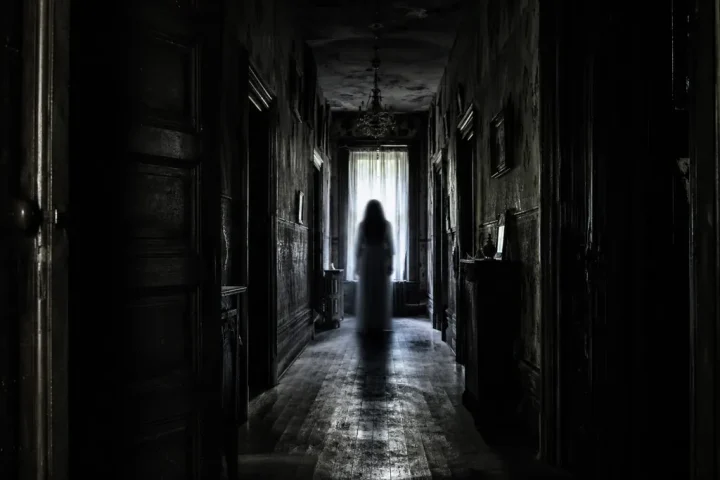
For years afterwards, terrible shrieks were said to come from the millpond. Some stories spoke of the apparition of a woman in white, sometimes carrying a child, moving towards the water before vanishing. Whether Nancy Webb was a historical person in precisely the form remembered by the legend is difficult to establish, but the story became part of the supernatural geography of Passenham. The millpond was no longer simply a place of water and machinery. It became a place where grief, death and memory had gathered.
The mill was also connected with another and far more elaborate haunting, that of the man remembered locally as Bobby Bannister.
Sir Robert Banastre
Bobby Bannister was not invented by storytellers. Behind the ghost stood a real man, Sir Robert Banastre, an important landowner and courtier of the early Stuart period. He held Passenham and other neighbouring estates and served within the royal household during the reigns of James I and Charles I.
His physical presence still survives inside St Guthlac’s Church at Passenham. In 1626 he rebuilt and richly decorated the chancel, creating an interior of carved woodwork, painted walls and a deep blue roof scattered with golden stars. His monument remains there, watching over the place where he was buried after his death in 1649.
Yet the reputation preserved by local folklore was considerably darker than the dignified image presented by his tomb.
Later tradition accused Banastre of being a harsh and self interested landowner. One nineteenth century manuscript claimed that he had deliberately reduced the villages on his estates in order to avoid the obligation of paying Poor Rates. The historical evidence does not securely prove this accusation, and the decline of the medieval settlement at Passenham appears to have begun before his lifetime, but the story became inseparable from his ghost.
In folklore, Banastre was transformed from wealthy landowner into guilty sinner.
A versified account of the legend claimed that he died while attempting to make a final confession, leaving his sins still upon him. Soon afterwards, rumours began spreading through the countryside that something connected with the dead man was walking after dark:
… rumours strange, about were noised,
Of howlings heard, a figure seen,
In armour clad, who walked the green
And verdant meadow late at night,
Causing the villagers much fright.
The dead Sir Robert had apparently returned to the land he had once controlled.
“Steady! Steady! I Am Not Ready!”
The strangest part of the legend concerns Banastre’s funeral.
As his coffin was carried towards St Guthlac’s Church, the men bearing it were said to have heard a familiar voice coming from inside. The words were unmistakable: “Steady! Steady! I am not ready!”
Terrified, the bearers opened the coffin. Sir Robert lay inside showing every sign of death. The coffin was closed again and the procession continued, but when they reached the church porch the voice supposedly came once more.
“Steady! Steady! I am not ready!”
The funeral service itself was said to have been plagued by strange disturbances and accidents, while above the confusion the same dreadful warning continued to be heard. The dead man, it seemed, had been buried before whatever awaited him beyond death was prepared to receive him.
The service was hurried to its conclusion and the coffin placed in the tomb. Yet burial brought no peace.
Soon the villagers began to fear the coming of darkness. Banastre’s ghost was said to travel through Passenham in a supernatural coach, racing through the night with terrifying speed. The old verse describes the apparition:
For scarce would even shadows fall,
And darkness close round the Churchyard wall
Than dashing along at a desperate pace,
(None e’er saw the driver’s face)
Was a coach and four with a headless team …
Oh! Who is it … utters that piercing scream
‘Steady, steady! I am not ready!’
The image is one of the most striking in Northamptonshire ghost lore. A headless team tears through the darkness beside the churchyard while an invisible or faceless driver controls the coach, and somewhere above the pounding hooves comes the desperate voice of a dead man protesting that he is still not ready.
Laying the Ghost
Eventually the haunting was said to have become intolerable. According to one version of the story, the local parson’s wife insisted that something had to be done, and church authorities were summoned to Passenham to conduct a ceremony intended to lay the spirit.
When Banastre appeared during the ritual, the ghost supposedly pleaded with them to stop. He promised that if he were allowed to continue working out his supernatural penance, he would cease troubling the villagers. The bishop therefore permitted the spirit to depart in peace, and in this version Bobby Bannister was never seen again.
Another nineteenth century account gives a far darker ending. It claimed that six men renowned for their piety were required to overpower and bind the ghost, after which Banastre’s spirit was laid permanently at the bottom of the mill dam.
The millpond therefore became associated with more than one restless dead person. Nancy Webb belonged to its waters, and according to some traditions Bobby Bannister was imprisoned beneath them.
This idea of laying a ghost beneath water, beneath a stone, inside a grave or at some remote boundary appears repeatedly in British folklore. The ghost was not necessarily destroyed. It was contained. The restless dead were treated almost like dangerous forces that could be restrained through ritual authority and spiritual discipline.
Bobby Bannister and the Wild Hunt
Yet not every version of the legend accepted that Banastre had been successfully laid.
The writer T. H. White preserved another and even more spectacular version of the haunting in which Bobby Bannister continues to ride through Passenham as a spectral huntsman. Here the dignified courtier buried beneath his monument becomes something closer to the ghostly riders of the Wild Hunt:
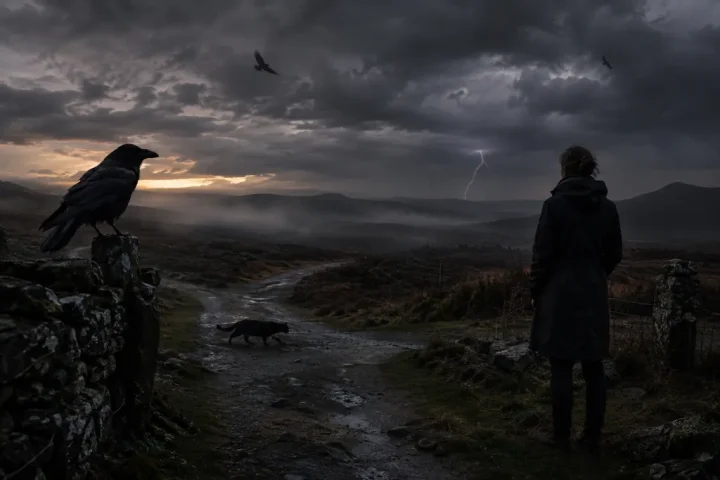
Then there was Robert Bannister, the huntsman … He rides with his whole pack of hounds in full cry … and marks to ground by his grave. He broke his neck out hunting, and was dragged home dead by a frightened horse with his foot in the stirrup. So now he rides like that, a rattling skeleton behind a fiery horse, and the neck is out of joint. It is a fine sight, with the pealing of the hounds and the jolting of the bones, on a roaring north-westerly night of windy December.
Historically, Banastre did not die in a hunting accident. His monument records that he died in 1649 at about eighty years of age. The broken neck, terrified horse and rattling skeleton belong entirely to the legend.
But folklore has never been constrained by monuments.
The historical Sir Robert Banastre lies beneath the church he helped beautify. Bobby Bannister rides somewhere else entirely.
In the imagination of Passenham, the dead courtier became a spectral huntsman racing through winter darkness with hounds in full cry, his ruined skeleton jolting behind a fiery horse. His grave became the point towards which the supernatural hunt returned, as if every wild journey through the night ended at the same place beneath the church.
The Haunted Landscape of Passenham
What makes Passenham particularly compelling is the way its ghosts seem to inhabit the landscape rather than a single building. The church, graveyard, manor land, mill race and surrounding fields all became connected through stories of restless death.
Nancy Webb belongs to the water. Bobby Bannister belongs to the churchyard, the road, the hunting field and, in some versions, the depths of the mill dam itself. Between them lies a landscape where tragedy and guilt have been transformed into supernatural memory.
The real Sir Robert still looks out from his monument in St Guthlac’s Church beneath the extraordinary painted ceiling he commissioned almost four centuries ago. Outside, the village is quiet.
Yet according to the old stories, quietness was never proof that Passenham was empty.
When winter darkness gathered around the churchyard wall and the wind came roaring across the fields, the villagers once listened for the sound of hooves, the cry of spectral hounds and the terrible voice of a man who had already been buried but who was still not ready for whatever waited beyond the grave.
Enter the Occult World Mystery School
Stories such as Bobby Bannister are not merely entertaining fragments of English folklore. Behind them lies an older supernatural world filled with ghost laying, exorcism, restless spirits, haunted boundaries, churchyard magic, ritual authority and the ancient belief that some of the dead could become dangerous if they were not properly contained.
If all you want is another ghost story, you can stop here. But if you want to understand why people once believed spirits could be bound beneath millponds, why certain places became supernatural thresholds, how the dead were summoned, restrained or exorcised, and how these traditions connect with ceremonial magic, necromancy, grimoires and spirit work, then you need to go deeper.
Join the Occult World Mystery School. There are thousands of spirits, gods, demons, magical systems, grimoires and forgotten traditions waiting beyond it. Stop wandering around the edges of the occult collecting stories without understanding the powers behind them. Enter the Mystery School, study the traditions properly, and discover what the old stories were really warning you about.
SEE ALSO:
SOURCE:
Haunted England : The Penguin Book of Ghosts – Written by Jennifer Westwood and Jacqueline Simpson –
Copyright © Jennifer Westwood and Jacqueline Simpson 2005, 2008







Follow