
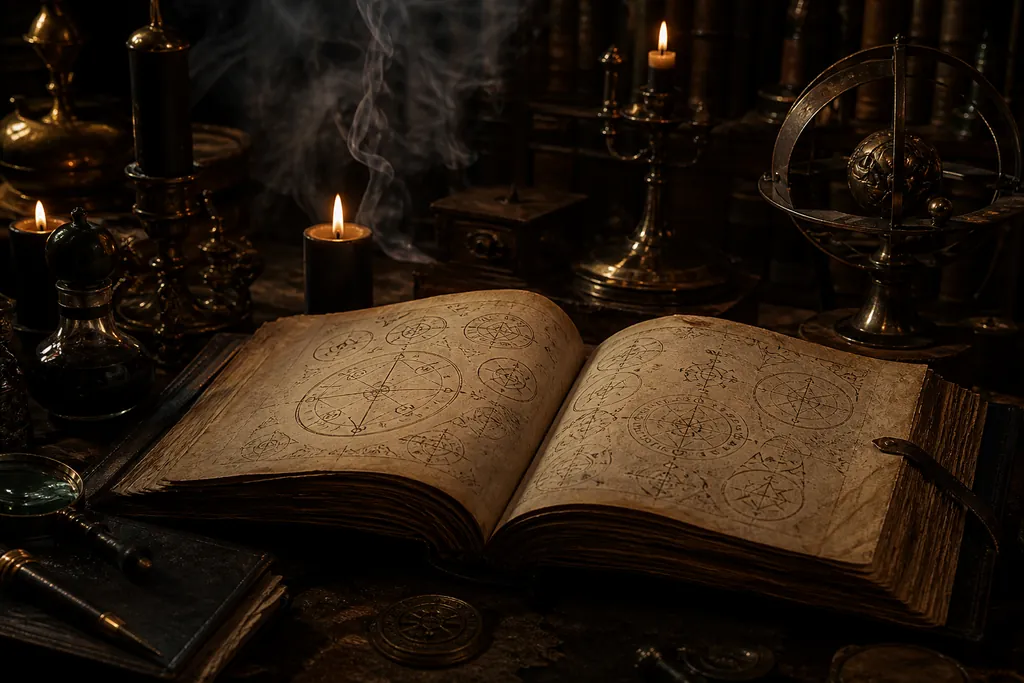
The seventy-two demons of the Goetia occupy one of the most recognisable places in Western demonology. Their names appear in occult books, grimoires, online encyclopaedias, magical orders, modern witchcraft circles, ceremonial magic, art, fiction, music, and popular culture. Even people with only a casual interest in the occult may have heard of figures such as Bael, Paimon, Asmodeus, Bune, Astaroth, or King Belial.
Yet the Goetic demons are often misunderstood.
To the general public, they are usually imagined as terrifying supernatural monsters or as figures belonging only to horror films and sensational stories about possession. In serious occult study, however, the Goetia is far more complex. It is not merely a list of “evil beings.” It is a structured magical catalogue of spirits, names, ranks, powers, symbols, and ritual relationships.
The fascination with the seventy-two demons does not come only from fear. It comes from the fact that they form a complete symbolic system: a hidden court of kings, dukes, princes, marquises, presidents, earls, and knights, each with a name, seal, appearance, function, and specialised field of influence.
This is what makes the Goetia so enduring. It gives form to the invisible. It organises the demonic world into a hierarchy. It turns spiritual danger into a system of study.
What Is the Goetia?
The word Goetia is most commonly associated with the first section of The Lesser Key of Solomon, also known as Lemegeton Clavicula Salomonis. This grimoire became one of the most influential magical texts in the Western occult tradition.
The first section, the Ars Goetia, presents a catalogue of seventy-two spirits or demons. Each spirit is described with a name, rank, appearance, powers, number of legions commanded, and a seal or sigil.
These spirits are traditionally said to have been bound by King Solomon, the legendary biblical king associated in later magical tradition with wisdom, command over spirits, and the construction of the Temple. According to the Solomonic legend, Solomon possessed divine authority that enabled him to constrain demons and compel them to reveal knowledge, perform tasks, or serve specific purposes.
Whether understood literally, mythologically, symbolically, or historically, this framework is central to the Goetia. The text does not present the demons as chaotic figures acting without order. Instead, it places them within a formal hierarchy governed by names, ranks, seals, and ritual commands.
This is one reason the Goetia remains so important in ceremonial magic. It does not merely describe spirits. It provides a system.
The Seventy-Two Spirits as a Hierarchy
The seventy-two demons are not presented as equal. They are organised according to ranks that resemble aristocratic or royal titles. Among them are kings, dukes, princes, marquises, presidents, earls, counts, and knights.
This hierarchy gives the Goetia its distinctive atmosphere. It is not a random collection of monsters. It is a demonic court.
Each spirit has a place, an office, and a sphere of action. Some are described as teaching sciences or liberal arts. Others reveal hidden things, reconcile enemies, grant favour, discover treasures, cause visions, answer questions, influence emotions, or provide knowledge of past and future events.
This structure reflects a deeper magical worldview: the invisible world is not shapeless. It can be mapped, named, classified, and approached through ritual discipline.
The hierarchy also reveals something important about the imagination of medieval and early modern magic. Spiritual power was often understood through the language of monarchy, command, service, and authority. Just as earthly kingdoms had rulers, officers, messengers, and servants, the invisible world was imagined as having ranks, offices, and chains of command.
In this sense, the Goetia is both a magical text and a symbolic map of power.
Names, Seals, and Identity
One of the most important features of the Goetia is its use of names and seals.
Each of the seventy-two spirits has a name and a sigil. The name identifies the spirit verbally. The seal identifies it visually. Together, they function as a kind of magical signature.
In the grimoire tradition, a name is not merely a label. Names are treated as keys to identity and authority. To know the name of a spirit is to know something essential about its nature. To possess the seal is to possess a symbol through which the spirit may be recognised and ritually addressed.
This is why Goetic seals remain so widely reproduced. They are mysterious, abstract, and visually compelling. They look like fragments of a hidden alphabet: loops, hooks, crosses, lines, curves, and symbolic marks that seem to belong to a language outside ordinary speech.
But these seals were not originally created as decorative occult designs. They were part of a ritual system. A seal was connected to a specific spirit, a specific name, and a specific operation.
To study the Goetia seriously means understanding that the seal cannot be separated from the tradition that produced it. A sigil without context is only an image. Within the Goetic system, it becomes a point of contact, recognition, and ritual focus.
Why the Goetia Is Not Simply “Devil Worship”
One of the most common misconceptions is that any study of the Goetia is automatically devil worship. This is not accurate.
The Goetia belongs to the tradition of ceremonial magic, not simple devotion. In its older framework, the magician does not worship the demons. The magician approaches them through divine authority, ritual preparation, protective structures, sacred names, and formal command.
This distinction matters.
Devil worship implies religious reverence or allegiance to the Devil. Goetic magic, in its classical ceremonial form, is structured around constraint, invocation of divine names, ritual protection, and the controlled engagement of spirits. The magician is not presented as surrendering to the demons, but as attempting to operate within a system of spiritual authority.
This does not mean Goetic work is safe or simple. It means the tradition is more complicated than the popular stereotype suggests.
The Goetia should not be reduced to horror imagery. It belongs to a larger history of Solomonic magic, grimoire traditions, angelic and demonic hierarchies, ritual language, sacred geometry, divine names, and protective magic.
A serious student studies the system before making assumptions about the practice.
The Powers of the Goetic Spirits
One reason the seventy-two demons continue to fascinate occult practitioners is that each spirit is associated with specific powers or offices.
Some are connected with knowledge.
Some with eloquence and persuasion.
Some with love, desire, and reconciliation.
Some with wealth, treasure, or material gain.
Some with visions, dreams, and divination.
Some with transformation, influence, or command.
Some with secrets, hidden things, and forgotten knowledge.
Some with war, conflict, or destruction.
This makes the Goetia feel like a complete occult map of human desire.
The spirits are not only frightening because they are demonic. They are fascinating because they are linked to things human beings have always wanted: knowledge, power, love, wealth, revenge, protection, influence, and access to the unseen.
In this sense, the Goetia functions almost like a mirror of human ambition. The spirits represent forces that are not merely external, but deeply psychological and symbolic. They reveal what people seek when they stand at the edge of forbidden knowledge.
This is why the Goetia is still studied. It speaks to the human longing to contact hidden powers and the equally human fear of what may answer.
The Role of Fear
Fear surrounds the Goetia for good reason. The text deals with demons, ritual contact, spiritual authority, and invisible powers. It belongs to a tradition that repeatedly emphasises protection, preparation, and control.
However, fear alone is not a sufficient way to understand the Goetia.
Fear can warn.
Fear can also distort.
Popular culture often presents the Goetic demons as uncontrollable forces that instantly destroy anyone who looks at their sigils or speaks their names. Serious occult study is more disciplined than this. It neither mocks the subject nor approaches it recklessly.
The Goetia requires discernment. A mature student must ask:
What is the historical context of the text?
What worldview produced this system?
What does each demon represent?
What role do names and seals play?
Why are protective structures so important?
What is the difference between study and practice?
What psychological forces are activated by this material?
What ethical boundaries are necessary?
The Goetia is powerful partly because it exists at the intersection of fear and fascination. It attracts those who want hidden knowledge, but it also warns them that hidden knowledge is never neutral.
The Goetia and the Psychology of Shadow
Modern occult practitioners often interpret the seventy-two demons not only as external spirits, but also as symbolic or psychological forces. This does not necessarily deny the spiritual interpretation. Rather, it adds another layer.
A Goetic demon may be studied as:
A spirit within a grimoire tradition
A symbolic force of desire, fear, or ambition
An archetype of the shadow
A representation of forbidden knowledge
A ritual intelligence
A cultural image of danger or power
A mirror of human impulses
This psychological reading helps explain why the Goetia remains relevant even to people who do not approach it as literal spirit work.
The demons often correspond to intense human themes: pride, lust, manipulation, courage, obsession, insight, charisma, destruction, wealth, knowledge, authority, and transformation. These are not abstract ideas. They are living forces in human experience.
To study Goetic demons as shadow figures is to ask: what part of the human psyche has been given this name? What desire, fear, wound, or power does this spirit represent? Why has this force been demonised? What happens when it is ignored, repressed, worshipped, or integrated?
This approach can make demonology intellectually and spiritually rich. But it must still be handled carefully. Shadow work without grounding can become obsession. Symbolism without discipline can become fantasy.
The Goetia demands seriousness in every interpretation.
The Danger of Superficial Goetic Practice
One of the major problems in modern occult culture is the casual use of Goetic material.
A person may find a sigil online, read a brief description of a demon, and attempt ritual contact without understanding the tradition, the warnings, the protective framework, or the psychological impact of such work. This is not serious demonology. It is spiritual impatience.
The Goetia was not designed as a casual beginner’s toy. Its spirits are embedded in a ritual structure involving preparation, authority, purification, timing, protective circles, sacred names, and precise ceremonial procedure.
Whether one interprets the system spiritually or psychologically, this structure matters. It creates boundaries. It slows the practitioner down. It forces seriousness.
A reckless approach can lead to fear, obsession, projection, fantasy, emotional instability, or unhealthy fixation. Even from a non-literal perspective, intense symbols can affect the mind. From a spiritual perspective, careless contact may open doors the practitioner is not prepared to close.
This is why proper study must come before practice.
The first step is not summoning.
The first step is understanding.
Why Occult Practitioners Still Study the Goetia
Despite the warnings, the Goetia continues to fascinate because it is one of the most complete and influential systems of demonological magic in the Western tradition.
Practitioners study it because it offers:
A structured hierarchy of spirits
A system of names and seals
A link to Solomonic magic
A catalogue of powers and offices
A ritual grammar for spirit contact
A symbolic map of desire and fear
A connection to grimoire history
A powerful framework for shadow work
A serious test of discipline and discernment
The Goetia also endures because it is beautiful in a dark and unsettling way. Its seals are visually striking. Its spirit descriptions are memorable. Its names carry atmosphere. Its structure feels ancient, forbidden, and formal.
It offers mystery, but not chaos.
It offers danger, but not without rules.
It offers power, but only through discipline.
That combination is exactly why it has survived.
The Goetia in Modern Culture
The seventy-two demons of the Goetia have moved far beyond the pages of grimoires. They now appear in novels, films, video games, music, visual art, tattoos, jewellery, online occult communities, and modern magical practice.
This widespread visibility has made Goetic demons more recognisable, but it has also diluted their meaning. A name such as Paimon or Asmodeus may be encountered first through entertainment rather than through demonological study. A sigil may be worn as an aesthetic symbol without any knowledge of its origin. A spirit’s name may become a brand, a fictional character, or a vague emblem of darkness.
This is not necessarily surprising. Occult symbols have always moved between religion, magic, art, and culture. But serious students must learn to separate source from adaptation.
The Goetia as a grimoire tradition is not the same as the Goetia in horror films.
A demon in ceremonial magic is not the same as a demon in popular fiction.
A sigil in a ritual manuscript is not the same as a design printed on clothing.
A name in demonology is not the same as a modern internet myth.
The serious student returns to the source, studies the context, and refuses to confuse aesthetic darkness with genuine occult knowledge.
The Academic Value of the Goetia
The Goetia is not only important to practising occultists. It is also valuable for the study of religion, folklore, literature, psychology, and cultural history.
It reveals how earlier societies imagined the invisible world. It shows how spiritual danger was organised into hierarchy and language. It demonstrates the interaction between Christian theology, Jewish and Solomonic legend, ritual magic, astrology, medieval cosmology, and the human desire to control unseen forces.
The Goetia also reveals the paradox of demonology: what is feared is also studied; what is condemned is also catalogued; what is forbidden is also named in detail.
This paradox is central to the history of occultism. The forbidden often becomes the most carefully preserved.
By studying the Goetia academically, one can better understand:
The development of Western ceremonial magic
The role of Solomon in magical legend
The structure of spirit hierarchies
The use of divine names and ritual authority
The symbolic language of sigils and seals
The relationship between fear and control
The cultural construction of demonic beings
The transformation of religious material into occult practice
This makes the Goetia an important text even for those who never intend to practise Goetic magic.
The Ethical Question
Any serious article on the Goetia must address ethics.
The traditional descriptions of Goetic spirits often include powers that touch on influence, desire, knowledge, wealth, conflict, secrecy, or control. These subjects raise ethical questions immediately.
Why does the practitioner seek contact?
Is the goal knowledge, transformation, power, revenge, obsession, or manipulation?
Does the work violate another person’s will?
Is the practitioner emotionally stable?
Are protection and grounding in place?
Is the practitioner prepared for consequences?
Does the practitioner understand the difference between spiritual authority and spiritual arrogance?
The Goetia is not merely a technical system. It tests character.
A person who approaches demonology only to gain power over others is already on unstable ground. A person who approaches it with fear but no discipline is equally unprepared. A person who approaches it with humility, study, patience, and clear boundaries is far more likely to understand the tradition properly.
Demonology is not about collecting dangerous names. It is about learning how to stand in the presence of difficult symbols without losing judgement.
Why the Seventy-Two Demons Still Matter
The seventy-two demons of the Goetia still matter because they continue to speak to the deepest themes of occult study: power, knowledge, fear, desire, control, protection, authority, shadow, and contact with the unseen.
They are not merely relics of an old magical book. They are part of a living symbolic system that continues to influence modern occultism.
Their fascination lies in their complexity.
They are feared, yet studied.
Condemned, yet preserved.
Dangerous, yet structured.
Symbolic, yet treated as real by many practitioners.
Ancient in atmosphere, yet modern in influence.
The Goetia endures because it does what powerful occult systems always do: it gives language to the hidden forces that human beings cannot stop trying to understand.
But it should never be approached carelessly.
The Goetia is not a game. It is not an aesthetic. It is not an invitation to reckless summoning. It is a demanding field of demonological study that requires history, context, protection, ethics, and discipline.
To study the seventy-two demons seriously is to enter one of the most powerful and controversial chambers of Western occult tradition.
Continue Your Study of Demonology
The seventy-two demons of the Goetia remain fascinating because they are more than names in a book. They are part of a complete demonological system involving hierarchy, symbols, seals, spiritual authority, ritual structure, and the study of hidden power.
But this subject should not be approached through fear, fantasy, or random internet fragments. It requires structure. It requires protection. It requires serious study.
Before attempting any deeper work with Goetic material, a student should understand the history of the grimoire tradition, the role of King Solomon in magical legend, the meaning of names and seals, the difference between invocation and evocation, and the protective measures that surround ceremonial demonology.
Knowledge must come before contact.
Protection must come before experimentation.
Discipline must come before power.
Enter the Occult World Demonology Course
If the seventy-two demons of the Goetia fascinate you, the next step is not reckless practice. The next step is structured learning.
The Occult World Demonology Course is designed for serious students who want to understand demonology with depth, clarity, and discipline. This course does not treat demons as horror entertainment, nor does it encourage careless spiritual experimentation. It offers a grounded path into the history, symbolism, classifications, grimoires, sigils, protection methods, and ethical questions surrounding demonological study.
Inside the course, you will explore:
The foundations of demonology and its place in occult history
The difference between demons, spirits, fallen angels, jinn, and shadow figures
Famous grimoires and their influence on Western magic
The seventy-two demons of the Goetia and their symbolic importance
Demonic names, ranks, seals, and hierarchies
Protection techniques, cleansing, grounding, and spiritual boundaries
The difference between invocation and evocation
How to approach demonology without fear, arrogance, or obsession
The psychological and symbolic meaning of demonic figures
Ethics, discernment, and preparation for advanced occult study
This course is for those who feel drawn to the darker side of occult knowledge but want to study it properly.
Not through panic.
Not through fantasy.
Not through reckless contact.
But through knowledge, protection, discipline, and respect.
If you are ready to go deeper, begin with proper study.
Enter the Occult World Demonology Course and learn the language of demons, spirits, sigils, grimoires, and hidden power with seriousness and protection.



Follow