
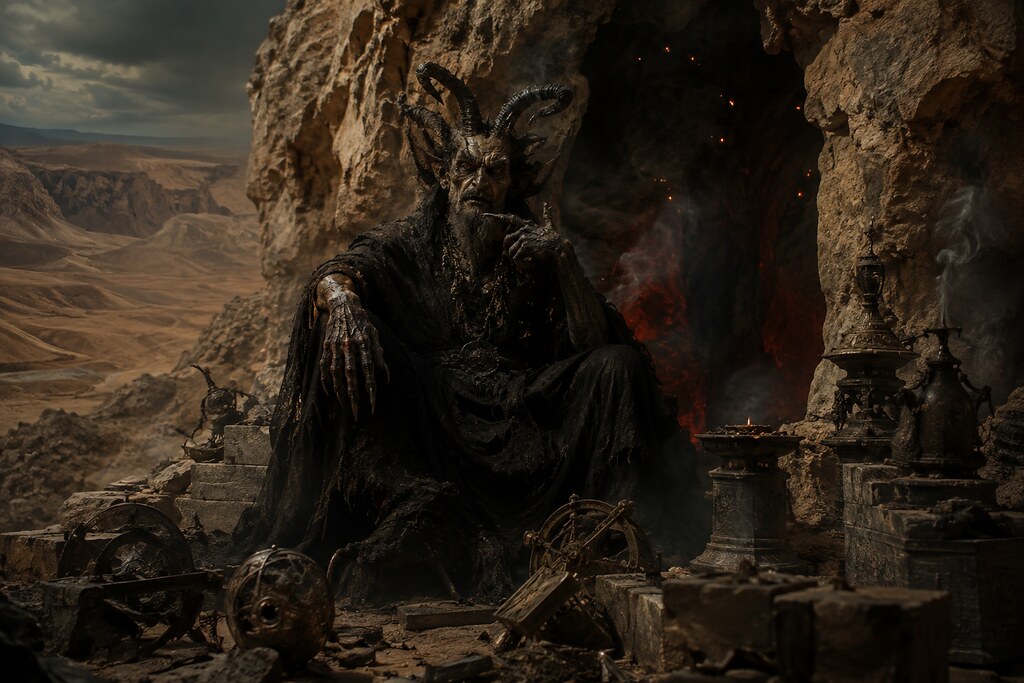
Belphegor : Master of the Opening
Belphegor is a demon whose origins lie in ancient Moabite religion, later absorbed into Hebrew lore and subsequently transformed within Christian demonology into a major infernal figure. His name is generally understood to mean “lord of opening” or “Lord Baal of Mount Phegor (Peor).” In his earliest form, he was worshipped as Baal-Peor, a Moabite deity associated with fertility, sexual power, and generative force, venerated on Mount Peor (Phegor), located east of the Dead Sea in what is now modern Jordan. His cult involved explicit sexual symbolism, and he was worshipped in the form of a phallus.
As religious paradigms shifted, Baal-Peor was demonised within Hebrew tradition and later Christianity, becoming Belphegor, a spirit associated with corruption, mockery, and moral inversion. Rabbinical sources describe obscene rites associated with his worship, including homage rendered upon a perforated chair and offerings consisting of human excrement. This imagery later influenced medieval demonological depictions of Belphegor seated on a toilet or pierced chair, a symbolic insult used by magicians to demonstrate domination rather than reverence.
Some scholars equated Belphegor with ancient fertility gods such as Pet (Crepilus) or Priapus, while others, including Selden (as cited by Banier), claimed that human sacrifices were once offered to him, and that his priests consumed the flesh of the victims. Wierus noted that Belphegor was described as having a perpetually open mouth, an observation possibly derived from the name Phegor, which, according to Leloyer, means a fissure or cleft. This interpretation aligns with his association with caves, crevices, openings, and subterranean worship, where offerings were cast through vents or apertures.
In Kabbalistic lore, Belphegor is said to have once been an angel of the order of Principalities before his fall. He is counted among the Togarini, meaning “the wranglers,” and is considered an arch-demon forming part of the infernal counterparts to the angels governing the ten sephirot of the Tree of Life. Belphegor is associated with the sixth sephirah, occupying a mirrored position within demonic cosmology.
In Christian demonology, Belphegor became identified with one of the Seven Deadly Sins, namely sloth, understood not merely as laziness but as negligence, apathy, procrastination, and moral indifference. According to St. Thomas Aquinas, sins arising from ignorance are rooted in sloth, reinforcing Belphegor’s role as a spirit who undermines effort, responsibility, and purposeful action.
Belphegor is also said to rule misogyny and licentious men. One legend claims that he emerged from Hell to investigate human marriage and sexuality. Disguised as a man, he lived among humans to experience sexual pleasures firsthand. Disgusted by what he observed, he fled back to Hell, relieved that such relations did not exist there.
Despite his association with sloth and ruin, Belphegor is paradoxically known as the demon of discoveries and ingenious inventions. He tempts humans by inspiring brilliant innovations, ambitious projects, and creative ideas—often those doomed to failure through overreach, greed, or lack of perseverance. In Hell, he rules over inventions and discoveries and is sometimes described as its infernal patron of failed genius.
Belphegor bestows wealth, riches, and inspiration, but he is considered difficult to conjure and highly unreliable. If he takes a liking to a person, he may grant great treasures, financial success, and inventive brilliance; however, legends warn that such gifts often lead to downfall. He delights in sowing discord, encouraging greed, and luring individuals to ruin through their own ambitions.
He is also said to serve as infernal ambassador and guardian of France, particularly Paris, where he allegedly resides. He is believed to preserve and protect the erotic and risqué elements of French culture, including cabarets and so-called French postcards.
Belphegor is a shape-shifter who delights in unexpected manifestations. He may appear as a beautiful young woman or naked maiden to tempt men, or as a horned, monstrous spirit with jagged claws. Misinterpretations of his name led to descriptions of him with an eternally open mouth, though this more accurately refers to his dominion over symbolic openings such as caves, wombs, and sexual organs. In ancient times, Baal-Peor presided over ecstatic and erotic rites on Mount Peor, condemned by Hebrew prophets as abominations.
In modern culture, Belphegor has occasionally appeared in art and literature. In 1955, Australian artist Rosaleen Norton was charged with obscenity following an exhibition that included a painting titled Belphegor.
Manifestations:
Belphegor is a shape-shifter. He may appear as a beautiful young woman, a naked maiden, or a fierce horned spirit. He is sometimes depicted seated on a pierced chair or toilet, a symbol derived from both ancient rites and medieval magical mockery.
Iconography:
Originally venerated as a phallus in his Baal-Peor form. Medieval demonology depicts him seated on a toilet or pierced chair, reflecting ritual insult rather than devotion.
Offerings:
Absinthe; erotically shaped pastries; historically obscene offerings are referenced in ancient sources.
See Also:
- Baal
- Baal Peor
- List of Demons
FURTHER READING:
- Hyatt, Victoria, and Joseph W. Charles. The Book of Demons. New York: Simon & Schuster, 1974.
- Mack, Carol K., and Dinah Mack. A Field Guide to Demons: Fairies, Fallen Angels, and Other Subversive Spirits. New York: Owl Books/Henry Holt, 1998.
SOURCES:
- Encyclopedia of Spirits: The Ultimate Guide to the Magic of Fairies, Genies, Demons, Ghosts, Gods & Goddesses – Written by : Judika Illes Copyright © 2009 by Judika Illes.
- The Encyclopedia of Demons and Demonology – Written by Rosemary Ellen Guiley – Copyright © 2009 by Visionary Living, Inc.
From the “Dictionnaire Infernal” (edition of 1863 ) Written by Jacques Auguste Simon Collin de Plancy
Original Text : Belphégor, démon des découvertes et des inventions ingénieuses. Il prend souvent un corps de jeune femme. Il donne des richesses. Les Moabites, qui l’appelaient Baalphégor, l’adoraient sur le mont Phégor. Des rabbins disent qu’on lui rendait hommage sur la chaise percée, et qu’on lui offrait l’ignoble résidu de la digestion. C’était digne de lui.
C’est pour cela que certains doctes ne voient dans Belphégor que le dieu Pet ou Crepilus ; d’autres savants soutiennent que c’est Priape. — Selden, cité par Banier, prétend qu’on lui offrait des victimes humaines, dont ses prêtres mangeaient la chair. Wiérus remarque que c’est un démon qui a toujours la bouche ouverte ; observation qu’il doit sans doute au nom de Phégor, lequel signifie, selon Leloyer, crevasse ou fendasse, parce qu’on l’adorait quelquefois dans des cavernes, et qu’on lui jetait des offrandes par un soupirail.
English Translation : Belphegor, a demon of discoveries and ingenious inventions. He often takes the body of a young woman. He bestows riches. The Moabites, who called him Baal-phegor, worshipped him on Mount Peor. Rabbis say that homage was rendered to him upon a perforated chair, and that he was offered the ignoble residue of digestion. This was fitting for him.
For this reason, certain scholars see in Belphegor nothing more than the god Pet or Crepilus; other learned men maintain that he is Priapus. Selden, cited by Banier, claims that human victims were offered to him, and that his priests ate their flesh. Wierus remarks that he is a demon who always has his mouth open—an observation he doubtless derives from the name Phegor, which, according to Leloyer, signifies a fissure or cleft, because he was sometimes worshipped in caverns, and offerings were thrown to him through an air-hole.

Continue Your Study of Belphegor Inside the Occult World Mystery School
Belphegor is not only a demon of temptation, invention, wealth, and dangerous illusion. He is also a powerful reminder that demonology is never just about names and legends. It is about understanding symbols, spirits, desire, power, corruption, ambition, and the hidden forces that move behind human choices.
Inside the Occult World Mystery School, you can go deeper.
In the Demonology Course, you will study demons like Belphegor within their historical, symbolic, spiritual, and occult context. You will learn how demons are understood across traditions, how their myths developed, what their names and symbols reveal, and why figures such as Belphegor still fascinate magicians, occultists, and seekers today.
And if you are drawn to the darker, more practical side of occult power, the Black Magick Course takes you further into intention, ritual structure, shadow work, influence, protection, ethics, and the responsible study of forbidden magical currents.
Do not only read about Belphegor as a legend.
Study what he represents.
Enter the Occult World Mystery School and begin your deeper path into demonology, black magick, and the hidden architecture of power.



Follow