
Bradwell and the Lumb Boggart
In the Derbyshire village of Bradwell, deep in the Hope Valley of the Peak District, an old ghost story once attached itself so firmly to the surrounding landscape that generations of local people were said to fear particular pools and waterways after dark. Known as the story of the Lumb Boggart, the tradition concerns the supposed murder of a young girl, a violently haunted house at Hill Head, and an extraordinary ceremony in which a local practitioner attempted to bind the dead girl’s spirit through a mixture of prayer, magical authority and ritual command.
The story is best known from Seth Evans’s Bradwell: Ancient and Modern, published in 1912, although Evans was not its earliest recorder. A substantially similar version had already appeared in William Wood’s Tales and Traditions of the High Peak in 1862, showing that the legend was circulating in the district at least half a century before Evans committed his account to print. Neither writer was particularly sympathetic towards popular superstition, yet both preserved a tradition that appears to have been deeply embedded in local memory.
The Murder at Hill Head
According to the legend, the haunting began at a house at Hill Head in Bradwell after the body of a young girl was discovered buried beneath the staircase. She was believed to have been murdered, although no securely identified historical record has yet been found that proves such a killing actually occurred. The murder should therefore be understood as part of the traditional narrative rather than as an established criminal case. What mattered within the folklore of Bradwell was the belief that the girl’s death had been violent and improper, creating the conditions in which her spirit could not rest.
The ghost supposedly began appearing night after night, terrifying not merely the inhabitants of the house but people throughout the surrounding neighbourhood. In the imagination of traditional communities, a spirit produced by murder presented a particularly serious problem because it represented a death that had broken the expected order between the living and the dead. Such ghosts were not necessarily thought capable of disappearing simply because prayers had been spoken or the corpse had been buried. In some British traditions, the dead had to be confronted, commanded and ritually confined before peace could be restored.
It was precisely such a solution that the inhabitants of Bradwell were said to have sought.
Seth Evans and the Lumb Boggart
In Bradwell: Ancient and Modern (1912), Seth Evans tells the story of the ‘Lumb Boggart’ (‘Lumb’ coming from the Old English word for a pool). He writes:
It used to be said that about a century and a half ago the body of a young girl who was supposed to have been murdered was found buried under the staircase of a house at Hill Head. The ghost of the girl appeared every night until everybody in the neighbourhood were terrified and thrown into a cold sweat. Unable to bear it any longer the people got a well known individual who belonged to the Baptists … to undertake the task of ‘laying’ the ghost. As this individual professed to be able to rule the planets, of course no one doubted his power of getting rid of the ghost.
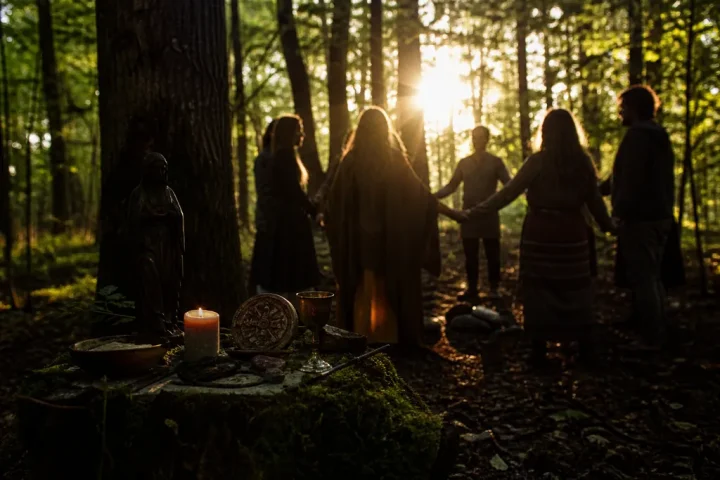
The time came, and the haunted house was filled with affrighted spectators when the exorcist appeared among them with his paraphernalia, and when he prayed until streams of sweat poured from his face as he knelt within a ring he had chalked on the chamber floor, the lookers-on kneeling around, and later afterwards declared that they ‘felt the floor move for yards up and down in quick succession.’ Then the magician arose and exclaimed, ‘Arise! arise! I charge and command thee,’ when the spirit appeared, and the man ordered it to depart and assume the body of a fish, and to locate itself in the Lumb Mouth. He also ordered that every Christmas eve the ghost should assume the form of a white ousel, and fly to Lumbly Pool.
Evans dismissed the tradition as an absurd tale, yet the details he preserved make the account unusually important within English ghost lore. The man summoned to confront the apparition was not presented merely as a conventional clergyman. Although Evans associated him with the Baptists, he was also believed to possess authority over the planets, suggesting a reputation grounded in astrology or popular magic as well as religion. William Wood’s earlier version makes this aspect clearer, portraying the mysterious practitioner as someone credited with herbal knowledge, necromantic abilities and command over occult forces.
The distinction matters because the ritual described at Bradwell was not simply a Christian exorcism. The practitioner drew a circle upon the floor, placed himself inside it and performed his operation from within its protection. The magical circle has long been one of the fundamental defensive structures of ceremonial magic, particularly in rites involving the conjuration of spirits. The magician does not ordinarily stand inside such a circle merely as decoration; the boundary establishes his ritual authority while protecting him from the entity being summoned or commanded.
The Bradwell account therefore belongs as much to the history of English folk magic and necromancy as it does to conventional ghost folklore.
The Ghost-Laying Ceremony
The ritual apparently attracted numerous spectators, transforming the haunted room into something resembling a public supernatural confrontation. As the practitioner prayed inside the chalked circle, his exertion became so intense that sweat reportedly streamed from his face. Those kneeling around him later claimed that the floor itself began moving repeatedly beneath them, creating the sensation that the chamber was being physically shaken by the forces invoked during the ceremony.
The magician eventually rose and commanded the spirit to appear. The words attributed to him are particularly revealing because William Wood’s earlier account preserves a magical formula connected with the rite: “Berald, Beroald, Balbin, gab bagor agaba.” Immediately afterwards came the command remembered by Evans: “Arise! arise! I charge and command thee.”
These strange words are not merely meaningless inventions added to make a village legend sound mysterious. A remarkably similar formula appears in the seventeenth-century magical material printed in Reginald Scot‘s The Discoverie of Witchcraft. In the 1665 edition, a ritual dealing with the raising and interrogation of the dead includes the words “Berald, Beroald, Balbin gab gabor agaba”, followed by a command for the spirit to arise.
The correspondence is extraordinary. It suggests that the Bradwell story preserves, whether through actual magical practice, oral transmission or later incorporation into the legend, a genuine formula associated with early modern necromancy. It is impossible now to determine whether the mysterious ghost-layer owned or had encountered magical literature containing the conjuration, whether the formula circulated independently among local cunning people, or whether Wood’s account was shaped by literary knowledge. Nevertheless, the relationship between the Bradwell formula and the older magical tradition is too close to ignore.
This transforms the Lumb Boggart from an entertaining village haunting into something much more significant: a story in which the practices of ceremonial conjuration appear within nineteenth-century local folklore.
Binding the Spirit to the Water
The magician did not command the girl’s spirit simply to vanish. Instead, he imposed upon it an entirely new form of existence. According to the story, the ghost was ordered to assume the body of a fish and take up residence at the Lumb Mouth, associated with the emergence of an underground watercourse at Bradwell.
This form of punishment or containment reflects a wider tradition of ghost laying, in which troublesome spirits were believed to be capable of being bound to particular objects, locations or natural features. A ghost might be confined to a river, a pool, a tree, a rock or some remote place where its power over the living could be controlled. Such spirits were not necessarily destroyed or sent permanently into another world. Instead, their freedom was restricted through the authority of the person who had successfully mastered them.
The Bradwell ghost was therefore transformed from the restless spirit of a murdered girl into a supernatural being attached to the landscape itself. Her haunting was transferred away from the house and into the waters surrounding the village.
The spell contained one remarkable exception. Once each year the spirit was permitted to leave its watery prison, abandon the shape of the fish and assume the form of a white ousel, flying from the Lumb Mouth towards Lumbly Pool. Evans places this annual transformation on Christmas Eve, while Wood’s earlier account gives Christmas Day, illustrating how details shifted as the story continued to circulate through successive generations.
The precise bird intended by the word ousel is uncertain. The term has historically been applied to different birds, including blackbirds and ring ouzels, and it would therefore be misleading to identify the creature too confidently with any particular species. Within the supernatural logic of the story, the important feature was surely its unnatural whiteness and the idea that, for a brief period each winter, the murdered girl’s imprisoned spirit regained movement through the landscape.
The result is one of the most unusual transformations found in English ghost folklore. The girl exists successively as a human being, a restless apparition, a fish dwelling within subterranean waters and finally a mysterious white bird travelling through the darkness of Christmas Eve.
The Lumb Boggart
Over time the apparition became remembered as the Lumb Boggart. The word boggart belongs particularly to the folklore of northern England and the Midlands and can describe several kinds of troublesome supernatural beings, ranging from domestic spirits to frightening entities attached to particular stretches of countryside. In many stories the boundaries between a boggart, a ghost and another type of supernatural presence remain deliberately uncertain.
The Bradwell spirit illustrates this ambiguity perfectly. Its story begins as an identifiable human ghost whose supposed murder explains the haunting, yet the ritual changes its character. Once bound to the water and transformed into animal shapes, the spirit becomes something closer to a landscape entity whose presence belongs to the pools, streams and hidden waterways around Bradwell.
Such geographical attachment was essential to the survival of supernatural traditions. The places associated with the legend were not remote imaginary kingdoms but features encountered by villagers during ordinary journeys. Hill Head was part of Bradwell itself, while Lumbly Pool and the surrounding waterways belonged to the physical environment through which local people travelled. Every journey past such a location could therefore renew the memory of the story.
Evans recalled that people had once hurried past the Lumb after dark and that the reputation of Lumbly Pool was powerful enough to frighten generations of villagers. He claimed that belief in the tale had survived until approximately half a century before he was writing, which would place living belief in the Lumb Boggart well into the nineteenth century.
Religion, Magic and the Restless Dead
One of the most fascinating aspects of the Bradwell tradition is the ease with which seemingly incompatible systems coexist within it. A man associated with the Baptists enters a magical circle. Prayer is combined with planetary knowledge. The ghost of a murdered girl is summoned through words connected with necromantic literature. Instead of being sent towards a conventional Christian afterlife, the spirit is magically transformed and bound to the natural landscape.
Modern attempts to separate religion, magic, superstition and folklore into clearly defined categories can obscure the way supernatural belief actually functioned within earlier communities. A person could attend a chapel and nevertheless believe that certain individuals possessed unusual powers. Biblical prayer could exist alongside astrology, charms and traditional methods of dealing with troublesome spirits. A practitioner might regard his abilities as ultimately deriving from divine authority while employing techniques that later observers would recognise immediately as magical.
The mysterious Bradwell ghost-layer therefore belongs to the long history of British cunning folk, wise men, charmers and ritual specialists who existed on the boundary between accepted religion and forbidden magic. Such individuals might be consulted when ordinary religious remedies appeared insufficient, particularly when illness, witchcraft, curses or troublesome spirits were suspected.
Whether the dramatic ceremony at Hill Head ever occurred exactly as described can no longer be established. William Wood was writing decades after the supposed events, and Evans was recording the story still later. Folklore inevitably changes through repetition, while dramatic details become amplified and explanations are reshaped by later generations. Yet the ritual elements embedded within the legend suggest that the people who transmitted the story possessed knowledge of a magical worldview that was far richer than simple belief in ghosts.
A Ghost Bound to the Peak District
The Lumb Boggart survives because it joins supernatural belief to a real landscape. The supposed murdered girl cannot be securely identified, and the precise haunted house remains uncertain, yet Bradwell, Hill Head and the waters associated with the legend are not imaginary places. They belong to the geography of Derbyshire, where underground streams, limestone caverns, pools and steep valleys have always provided fertile ground for stories about hidden and supernatural forces.
The tale also preserves something more elusive: the memory of a period when the haunting of a house could become a communal crisis and when people might genuinely seek someone believed capable of commanding the dead. The magician within his chalk circle was not attempting merely to reassure frightened villagers. According to the logic of the tradition, he confronted the spirit directly, compelled it to manifest and then dictated the conditions under which it would continue to exist.
That is what makes the Lumb Boggart so much more than another picturesque English ghost story. Beneath the account lies an older conception of magic in which the dead could be summoned, questioned, commanded and bound. The ghost did not disappear because people stopped believing in it; according to the legend, it disappeared because someone possessed enough occult authority to force it into obedience.
The murdered girl of Hill Head may never be identified, and no evidence presently allows us to prove that her body was ever discovered beneath a staircase. Yet the tradition surrounding her has survived for more than a century in print and probably considerably longer in oral memory. Through Wood and Evans, Bradwell preserves the image of a frightened community gathered inside a haunted house while a sweating magician kneels within his circle and orders a dead girl to arise.
Then the spirit is driven underground, into the water, where the Lumb Boggart waits.
Go Beyond the Ghost Story
Most people will read the story of the Lumb Boggart, enjoy its strangeness and move on. That is precisely where superficial occult curiosity ends. The real questions begin when you ask what magical circle the practitioner believed would protect him, why spirits were thought capable of being bound to particular locations, how necromantic conjurations travelled through magical literature, and why the same formulas can surface centuries later inside apparently simple village folklore.
Those questions lead directly into the grimoires, spirit traditions, ceremonial magic, necromancy, witchcraft and forgotten magical systems that lie beneath stories such as Bradwell’s haunting. If you are serious about the occult, stop consuming fragments and start studying the traditions that created them. Join the Occult World Mystery School and go beyond the legends into the actual systems of magic, spirits and esoteric practice. There are thousands of spirits, gods, demons, magical systems, grimoires and forgotten traditions waiting beyond it. Do not remain outside reading scraps of occult history while other people learn what lies behind them. Enter the Occult World Mystery School, claim your place, and start studying the hidden world properly.
SEE ALSO:
SOURCE:
Haunted England : The Penguin Book of Ghosts – Written by Jennifer Westwood and Jacqueline Simpson – Copyright © Jennifer Westwood and Jacqueline Simpson 2005, 2008






Follow