
Mortehoe, an ancient village overlooking the North Devon coast near Woolacombe, has long been associated with one of England’s most remarkable legends of supernatural punishment. At the centre of the tradition stands William de Tracy, one of the four knights responsible for the murder of Archbishop Thomas Becket in Canterbury Cathedral in 1170. Although the surviving medieval evidence points towards Tracy spending his final years abroad, Devon folklore insisted that he returned to the West Country, hid along the coast, lived in disgrace near Mortehoe and remained spiritually bound to the landscape after death.
The historical William de Tracy was a real man, and his role in Becket’s murder is beyond doubt. On 29 December 1170, Tracy entered Canterbury Cathedral with Reginald FitzUrse, Hugh de Morville and Richard le Breton after the four knights had interpreted King Henry II’s furious remarks about Becket as a signal to act against the archbishop. The confrontation ended with Becket being struck down inside the cathedral, an act that horrified medieval Europe and rapidly transformed the dead archbishop into a martyr and saint.
The fate of the four killers became surrounded by stories almost immediately. Medieval accounts placed them under severe penance, while William de Tracy appears in documentary evidence in southern Italy only a few years after the murder. A surviving charter places him at Cosenza in the 1170s, and later traditions claimed that he died abroad, perhaps before completing a penitential journey towards the Holy Land. Devon, however, developed a very different memory of him, one in which the murderer came home.
The Fugitive in Crookhorn Cave
According to local tradition, Tracy initially concealed himself in Crookhorn, or Crewkhorne, Cave, west of Ilfracombe. The cavern was said to be accessible only under particular tidal conditions, with the sea filling much of it at high water. Nineteenth-century Ilfracombe boatmen reportedly maintained that Tracy hid there for a fortnight while his daughter secretly brought him food.
There is no contemporary medieval evidence that Tracy ever sought refuge in the cave, yet the story is important because it shows how thoroughly the landscape of North Devon had absorbed his memory. A historical murderer who may have died hundreds of miles away was transformed into a fugitive sheltering beneath the cliffs, hidden from the world but never free from the consequences of his crime.
From the cave, local tradition carried Tracy towards Mortehoe and Woolacombe, where the Tracy family genuinely possessed lands. The existence of a medieval manor known as Woolacombe Tracey gave the story a firm geographical anchor, and generations of local people came to believe that the murderer had lived there in retirement or banishment.
Penance in Devon
The Devon tradition did not portray Tracy simply as a man hiding from justice. He was said to have spent his remaining years attempting to atone for the killing of Becket. Several churches and religious foundations became associated with his supposed penitence, including places bearing the Tracy name, although the extent of his personal involvement in these foundations cannot be demonstrated historically.
This association between murder and church-building reflects a powerful medieval idea: extraordinary sin required extraordinary acts of penance. To later generations, the possibility that one of Becket’s killers might have returned to Devon, founded churches and sought spiritual forgiveness seemed entirely plausible, particularly when local place-names and family estates appeared to support the story.
The most persuasive physical evidence seemed to stand inside the parish church of St Mary Magdalene at Mortehoe.
The Tomb of William de Tracey
In the south transept of Mortehoe church stands a medieval altar tomb bearing the name William de Tracey. For generations, villagers believed that the monument contained the body of Becket’s murderer, and the damaged inscription on the tomb appeared to reinforce the identification. It was reconstructed as declaring that Sir William de Tracey lay there and asking God to have mercy upon his soul.
The difficulty was that the effigy carved upon the tomb was unmistakably clerical. The dead man was shown in priestly vestments, holding a chalice, which did not fit the biography of the twelfth-century knight. Local tradition resolved the problem by claiming that Tracy had entered the priesthood as part of his repentance after returning to Devon.
Historical investigation later offered a simpler explanation. The tomb belongs to another William de Tracey, a cleric associated with Mortehoe who died in the early fourteenth century, roughly a century and a half after Becket’s murder. The priestly clothing therefore reflects the actual identity of the man commemorated there, not the supposed conversion of the assassin.
The mistaken identification is nevertheless crucial to the legend. Once generations of villagers believed that one of the most notorious murderers in medieval England was buried inside their church, every unusual feature of the monument could be interpreted through that story. The tomb became proof of the legend because people expected it to be proof.
The Curse of the Tomb
By the early seventeenth century, stories had already gathered around the grave. Tristram Risdon recorded a tradition that people who removed lead connected with de Tracy’s burial never prospered afterwards. Whether the original warning referred to the fourteenth-century cleric or had already become associated with Becket’s murderer is impossible to determine, but once the two men were confused, the legend of a cursed tomb became inevitable.
The idea fits a familiar pattern in British supernatural folklore. The remains of a powerful or dangerous dead person are not passive objects but spiritually charged presences, and disturbing them can bring consequences upon the living. In Mortehoe, the supposedly sacred remains of a murderer under divine punishment offered an ideal foundation for such beliefs.
Yet the most vivid traditions concerning Tracy do not keep him safely inside a tomb.
The Eternal Penance on Woolacombe Sands
According to local folklore, William de Tracy remained restless after death. His punishment continued on Woolacombe Sands, the long beach stretching beneath Mortehoe, where his spirit was condemned to perform an impossible task over and over again.
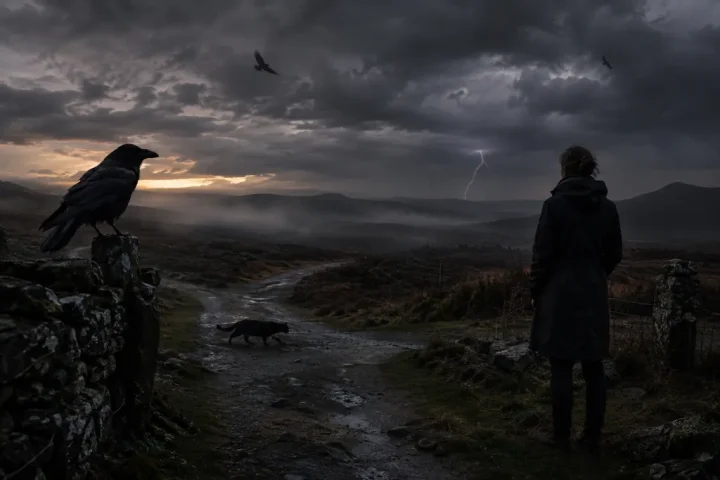
He was said to wander the shore attempting to gather sand into bundles or weave it into a rope. The labour was futile from the beginning, but the legend ensured that even supernatural perseverance could never free him. Whenever the work neared completion, a Black Dog appeared carrying a ball of fire in its mouth and destroyed the rope, forcing Tracy to begin again.
The image is one of the most powerful in English ghost tradition. Tracy’s crime cannot be undone, so neither can his punishment be completed. The sand will never hold, the rope will never survive, and the Black Dog will always return at the moment when release seems closest.
The tradition resembles the impossible punishments found in ancient mythology, where condemned figures repeat useless tasks throughout eternity. In Mortehoe, however, the setting is not the classical underworld but the exposed North Devon coast, where wind, darkness, fog and the roar of the sea transform an ordinary beach into a place suited to supernatural penance.
People living near the shore were said to hear Tracy’s cries and lamentations at night, while later sceptical observers suggested that some of these sounds might have been produced by foghorns or the coastal weather. Whatever their physical origin, such noises became part of the legend because the landscape already possessed a ghost who had reason to scream.
Morte Point and the Coast of Death
The geography surrounding Mortehoe strengthened the tradition considerably. Nearby Morte Point has a long and genuine history of shipwrecks, drownings and maritime disaster. Its jagged slate formations, submerged rocks and dangerous currents made the headland notorious among sailors, and numerous vessels were lost along this stretch of coast during the nineteenth century.
The association between Mortehoe and death therefore did not depend upon folklore alone. Real bodies were brought ashore, real ships broke apart on the rocks, and generations of families lived with the possibility that someone might be lost to the sea. Such landscapes repeatedly become fertile ground for ghost stories because the boundary between the living and the dead is constantly renewed by actual tragedy.
Within that setting, Tracy’s endless wandering became entirely believable to those who already accepted that violent or sinful death could prevent the spirit from finding rest.
The Black Dog of the Ferry
The Black Dog connected with Tracy’s punishment eventually entered another local tradition associated with the ferry route between Braunton Burrows and Appledore. Here the supernatural animal was no longer simply the creature that destroyed Tracy’s rope of sand but an ominous presence capable of appearing to the living.
According to a tradition recorded in 1919, a long-drawn cry of ‘Boat ahoy!’ would at times come ringing out of the dark across the waters:
No one answers that call now after dusk, for once, many years ago, the ferryman, who is well remembered among the Appledore people, went over, and no man was there, but a black dog jumped into the boat. The ferryman, not much liking this, put back again as fast as he could, but when Appledore was nearly reached the dog swamped the boat, made his way to shore, and was lost in the shadows of Northam Burrows.
The story gives the Black Dog a life independent of Tracy while preserving its role as a creature of danger and supernatural disruption. The ferryman expects a human passenger but receives something entirely different, an apparition that crosses the boundary between land and water and almost destroys him before disappearing into the darkness.
Black Dogs appear throughout British folklore as death omens, guardians, spectral predators and supernatural beings attached to roads, churchyards, bridges and coastlines. Some are protective, others terrifying, while many resist simple classification. In the Mortehoe tradition, the Black Dog is particularly sinister because it appears to function as both punisher and enforcer, ensuring that Tracy’s sentence continues while remaining dangerous to anyone who encounters it.
The Restless Dead of Mortehoe
The legend of William de Tracy at Mortehoe is ultimately less about the historical details of his life than about the transformation of guilt into supernatural geography. A real medieval murderer became attached to a real Devon family, a real manor, a real church and a real medieval tomb. Once those connections took hold, folklore expanded them into a complete afterlife of punishment.
The historical Tracy may never have returned to Mortehoe at all. The man buried inside the church was almost certainly another William de Tracey, and there is no reliable evidence that Becket’s killer spent his final years on Woolacombe Sands. Yet the absence of historical proof did little to weaken the tradition, because the legend answered a deeper moral need.
The murder of Thomas Becket was one of the great sacrileges of medieval England. To local storytellers, it was not enough for one of the killers simply to disappear into the uncertainty of the historical record. Such a crime demanded consequences, and the Mortehoe tradition supplied them. Tracy returned to Devon, sought forgiveness, failed to escape his guilt and remained bound to an eternal punishment that could never be completed.
The Black Dog ensured that mercy would always remain just beyond his reach.
History, Folklore and Supernatural Punishment
Mortehoe is a particularly rich haunted place because history and legend cannot be separated cleanly from the physical landscape. William de Tracy existed, the murder of Becket happened, the Tracy family possessed Devon estates, Woolacombe Tracey was real, and the medieval tomb inside Mortehoe church genuinely bears the name of another William de Tracey. Every element of the legend therefore begins with something tangible.
The supernatural story emerges from the way those facts were joined together. A shared name became mistaken identity, family estates became proof of exile, a coastal cave became a fugitive’s refuge, an ordinary medieval tomb became the grave of an assassin, and the dangerous sands beneath Mortehoe became the stage for eternal punishment.
This is how powerful hauntings often develop. History supplies fragments, folklore joins them together, and the landscape preserves the finished story long after its original contradictions have been forgotten.
The mortal William de Tracy may have died far from Devon, but the William de Tracy of Mortehoe never left at all. In local tradition he remains somewhere beyond the village, condemned to gather the sands beneath the cliffs while a fiery Black Dog waits for the moment when his impossible work is almost complete.
Enter the Occult World Mystery School
Mortehoe is not merely a picturesque ghost story about an unfortunate medieval knight. Beneath the legend lies an older system of belief in which guilt survives death, violent acts bind spirits to the landscape, spectral animals enforce supernatural law and the dead can be condemned to repeat impossible tasks beyond the grave. These ideas connect directly with revenant traditions, Black Dog folklore, cursed burials, restless spirits, death omens and the wider occult understanding of places where human tragedy becomes spiritually embedded.
If you are satisfied with haunted-place stories stripped of their deeper meaning, stop here. If you want to understand why traditions like Mortehoe emerged, what Black Dogs represent, how the restless dead were understood and why certain landscapes became spiritually dangerous, then join the Occult World Mystery School and start studying the occult at the level it deserves. There are thousands of spirits, gods, demons, magical systems, grimoires and forgotten traditions waiting beyond it. Stop standing outside the mystery. Enter the Occult World Mystery School, go beyond the folklore, and learn the hidden systems that generations of people feared, practised and passed down in secret.
SEE ALSO:
SOURCE:
Haunted England : The Penguin Book of Ghosts – Written by Jennifer Westwood and Jacqueline Simpson – Copyright © Jennifer Westwood and Jacqueline Simpson 2005, 2008



Follow