
Hadleigh Castle, standing above the Thames estuary in Essex, has long possessed the kind of landscape that naturally attracts supernatural tradition. Its broken towers, unstable ground and ruined walls overlook marshland and distant water, and by the nineteenth century the castle had acquired a reputation for strange stories involving ghosts, smugglers and unexplained encounters. Among these traditions, the most intriguing concerns a mysterious Woman in White who supposedly appeared among the ruins at dawn and attempted to lure a young milkmaid into returning alone at midnight.
Unlike many White Lady legends, the apparition at Hadleigh is not simply a sorrowful figure seen wandering aimlessly through an old building. She speaks, issues instructions, promises hidden knowledge and becomes violently angry when disobeyed. Her behaviour places the story within a much older European pattern in which supernatural women haunt ruined castles and guard mysteries, secrets or treasure that can be revealed only to those willing to accept a dangerous invitation.
The Castle above the Thames
Hadleigh Castle was established during the first half of the thirteenth century, when the manor belonged to Hubert de Burgh, one of the most powerful men at the court of Henry III. Construction began during the 1220s and continued into the 1230s, creating a fortified residence on high ground overlooking the Thames approaches. After de Burgh fell from royal favour, the castle returned to the Crown and later gained renewed strategic importance under Edward III during the Hundred Years’ War.
Edward III substantially strengthened the site during the fourteenth century, transforming Hadleigh into an important royal stronghold from which the lower Thames could be watched and defended. Yet the castle had been built on unstable clay, and movement of the underlying ground gradually damaged the structure. By the sixteenth century it had declined considerably, while stone and other materials were removed after the property passed into private ownership. By around 1600, Hadleigh was already becoming the ruin familiar to later generations.
The decay of the castle helped create the atmosphere in which supernatural stories flourished. Broken walls, abandoned chambers and isolated stretches of the former precinct offered an ideal setting for ghost lore, while the surrounding marshes and estuary could become particularly eerie in poor weather or darkness.
The Woman in White
One of the most important nineteenth-century sources for Hadleigh’s supernatural reputation is Philip Benton’s History of Rochford Hundred, published in 1867. Benton collected local memories and traditions concerning the district, including stories that more sceptical observers dismissed as superstition.
Among them was a tale told to him by an elderly woman about a Woman in White who supposedly haunted the castle ruins.
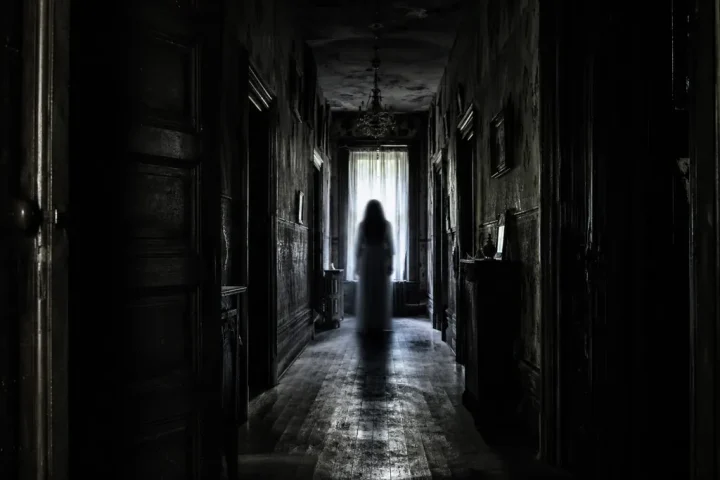
According to the tradition, a young milkmaid from Castle Farm encountered the apparition early one morning while passing through the castle precincts. The spectral woman did not merely appear before her and vanish. Instead, she addressed the girl directly and instructed her to return to the ruins at midnight, when she promised to reveal certain “mysteries” connected with the place.
The invitation immediately transformed the encounter into something more ominous than an ordinary sighting. The apparition expected obedience, and whatever knowledge she possessed could apparently be revealed only under particular conditions. The milkmaid would have to return alone, in darkness, to the same ruined castle where she had encountered the supernatural figure at dawn.
The girl could not bring herself to do it.
Wry-neck Sal
When midnight arrived, the milkmaid remained away from the ruins, unwilling to discover what the Woman in White intended to reveal. The following morning, however, she encountered the apparition again.
This time the White Lady was furious.
According to the legend, she bitterly reproached the girl for failing to obey her instructions and then struck her violently on the side of the head. The blow was said to have been so powerful that it almost dislocated the girl’s neck, leaving her permanently injured.
From that time onwards she supposedly became known locally as “Wry-neck Sal” or “Wry-neck Sall”, a nickname that preserved the memory of the supernatural encounter long after the event itself had passed into folklore.
The physical aggression of the apparition makes the Hadleigh story unusually disturbing. Many English White Ladies are melancholy or passive spirits associated with death, betrayal or lost love, but the Hadleigh ghost behaves like an entity whose authority has been challenged. She does not simply disappear when the milkmaid refuses her invitation; she returns, confronts her and imposes punishment.
What Did the White Lady Want to Reveal?
Benton’s account leaves the promised “mysteries” deliberately unexplained. The apparition may have intended to disclose something about her own identity, the history of the castle or an event that had supposedly taken place within the ruins. Later versions of the story occasionally suggest that she knew the location of hidden treasure, although that detail should be treated as a later interpretation rather than as something securely established in the earliest surviving version.
The possibility of concealed treasure is nevertheless entirely consistent with a much wider body of European folklore. Ruined castles frequently become associated with hidden wealth, lost chambers and supernatural guardians, while female spirits are sometimes said to possess knowledge that can only be revealed when a living person fulfils a specific condition.
The fact that the meeting had to take place at midnight is also significant. Midnight has long functioned in European supernatural belief as a liminal hour when ordinary boundaries weaken and encounters with spirits become more likely. By ordering the milkmaid to return at that precise time, the Woman in White effectively required her to cross from an ordinary daylight encounter into a deliberate supernatural appointment.
The failure to appear meant that the mystery remained unresolved.
White Ladies and Castle Spirits
The Hadleigh apparition belongs broadly to the European tradition of the White Lady, a supernatural female figure frequently associated with castles, noble families and old estates. Such spirits appear throughout Britain and continental Europe, although their behaviour varies considerably. Some are interpreted as ancestral ghosts, others as women who died violently or tragically, while certain examples act almost as guardians of particular buildings or territories.
The Hadleigh tradition is especially interesting because the White Lady resembles the supernatural key maidens found in German and Central European folklore. These beings often haunt ruined castles and appear to selected individuals while guarding secrets, enchanted treasure or some knowledge connected with the site.
In many such stories, the person encountering the maiden must fulfil a condition before the secret can be revealed. Courage, silence, persistence or obedience may be required, and failure usually means that the supernatural opportunity disappears, sometimes forever.
Hadleigh follows the same basic pattern. The milkmaid is selected, instructed to return and offered access to knowledge unavailable to ordinary people. Her fear prevents her from completing the encounter, and the mystery survives precisely because the supernatural test was never fulfilled.
There is, however, a harsher quality to the Hadleigh legend. The White Lady does not merely express disappointment when the girl fails. She retaliates physically, suggesting that the midnight appointment was perceived less as an invitation than as a command.
Smugglers among the Ruins
Hadleigh Castle developed other mysterious associations during the eighteenth and nineteenth centuries, particularly with smuggling. The Thames estuary and Essex coast offered opportunities for contraband to be moved inland, and local tradition maintains that smugglers sometimes used the abandoned castle as a hiding place.
Stories even developed that smugglers deliberately encouraged belief in ghosts by producing strange lights and noises around the ruins. Creating a supernatural reputation would have served a practical purpose, because people frightened of encountering spirits after dark were considerably less likely to investigate suspicious activity.
Such explanations have often been applied retrospectively to haunted places, but they do not necessarily account for the White Lady tradition. Benton’s story contains a developed narrative involving repeated appearances, a specific command, an unresolved secret and a lasting injury to a local woman. Even if smugglers sometimes exploited the castle’s reputation, the Woman in White had become an independent figure within local folklore.
The relationship between smuggling and supernatural legend may instead have reinforced both traditions. Strange lights seen among the ruins could be interpreted as evidence for ghosts, while existing belief in ghosts offered convenient cover for human activity.
A Ghost without a Name
Unlike many castle apparitions, Hadleigh’s Woman in White was never securely identified with a particular historical woman. Later storytellers did not successfully transform her into a murdered noblewoman, abandoned bride or betrayed lover whose biography could explain every element of the haunting.
In some ways, this absence makes the story more compelling.
The apparition is defined not by who she was but by what she knew. She appears to possess information connected with the castle and seeks a living person willing to receive it. Her significance therefore lies in the mystery itself rather than in an invented tragedy attached to her identity.
Had the milkmaid returned at midnight, perhaps the White Lady would have disclosed the reason for her haunting. She might have revealed concealed treasure, exposed some forgotten event or demanded that the girl perform an action capable of releasing her from the ruins.
Nothing in the surviving tradition allows us to know.
The milkmaid’s fear ensured that Hadleigh Castle kept its secret.
Hadleigh as a Haunted Landscape
Hadleigh is a powerful example of the way ruins become supernatural landscapes. The castle ceased functioning as a fortress centuries ago, yet its abandonment created new meanings. Once walls collapse and rooms disappear, imagination begins filling the empty spaces.
Local people remember stories about what happened there, while unfamiliar sounds become attached to earlier traditions. Historical ruins accumulate ghosts because they stand visibly between past and present, preserving enough of the old world to suggest that something may still remain within them.
The White Lady belongs perfectly to that environment. She emerges at dawn, one of the most liminal moments of the day, and instructs the living to return at midnight, another boundary between ordinary time and supernatural possibility. Her movements take place among ruined fortifications whose original purpose had already been forgotten by most people who encountered them.
The milkmaid was offered entry into that hidden layer of the landscape but refused to cross the threshold.
Her punishment ensured that others remembered the warning.
The Mystery That Was Never Revealed
The Hadleigh tradition survives because it ends without resolution. There is no final explanation for the Woman in White, no treasure uncovered beneath the ruins and no revelation concerning the mysteries she promised to disclose.
Instead, the unanswered question remains at the centre of the story.
What would have happened if the milkmaid had returned at midnight?
The possibility allows the legend to remain permanently unfinished. Every later reader or listener is placed in the position of the frightened girl and invited to imagine whether they would have acted differently.
That uncertainty is precisely what gives the Hadleigh White Lady her enduring power. She is not simply a ghost from the past but a supernatural figure offering forbidden knowledge under conditions that demand courage.
The ruins still stand above the Thames, while the secret she supposedly guarded remains unrevealed.
Enter the Occult World Mystery School
The Woman in White of Hadleigh Castle belongs to a much deeper tradition than ordinary ghost stories suggest. Across centuries of European folklore, spirits appear at ruins, guard concealed knowledge, test the courage of the living and offer access to mysteries that ordinary people are too frightened to pursue. Behind those traditions lie older ideas about liminal places, supernatural guardians, hidden treasure, spirit communication and the dangerous exchange of knowledge between the living and the dead.
If you are content to read ghost stories and then walk away from the mystery, remain where Wry-neck Sal remained. If you want to understand what lies behind these traditions, join the Occult World Mystery School and begin studying the occult properly. There are thousands of spirits, gods, demons, magical systems, grimoires and forgotten traditions waiting beyond it, and the surface-level paranormal world will never teach you what they mean. Stop turning away from the doorway. Enter the Occult World Mystery School, cross the threshold, and start learning the hidden traditions that generations before you were too frightened to approach.
SEE ALSO:
SOURCE:
Haunted England: The Penguin Book of Ghosts – Written by Jennifer Westwood and Jacqueline Simpson – Copyright © Jennifer Westwood and Jacqueline Simpson 2005, 2008







Follow