

The Crescent Hotel: Cancer, Death and the Ghosts of the Ozarks
The Crescent Hotel in Eureka Springs, Arkansas, has become one of the most famous haunted hotels in the United States, yet its reputation rests upon far more than ghost stories. The building has passed through several radically different lives, beginning as an elegant nineteenth-century spa resort, becoming a women’s college, then being transformed into a fraudulent cancer hospital before eventually returning to hotel use. Each period left its own imprint, and the supernatural traditions now associated with the Crescent seem to draw upon all of them. Some of the stories are supported by strong historical evidence, while others belong to the shifting world of paranormal testimony and local folklore, but together they have created one of the most enduring haunted locations in the Ozark Mountains.
The hotel was built between 1884 and 1886 during the rapid development of Eureka Springs as a fashionable health destination. Wealthy visitors travelled to the area because the local mineral springs were widely promoted as possessing curative properties, and the Crescent was intended to offer those visitors the luxury expected of a prestigious resort. Former Arkansas governor Powell Clayton was closely involved with the Eureka Improvement Company behind the project, while St Louis architect Isaac S. Taylor designed the massive building. Irish stonemasons participated in the construction, working with locally quarried limestone to create walls of extraordinary thickness and a structure whose imposing appearance still dominates the wooded ridge above the town.
When the Crescent opened in 1886, it represented the confidence of an era in which health, tourism and spectacle often overlapped. Guests could stay in elegant surroundings while taking advantage of the springs below, and features such as electricity and elevators reinforced the impression that the hotel belonged to the most modern and sophisticated level of American resort culture. The attraction of the springs, however, gradually weakened as the medical reputation of such waters declined and public enthusiasm shifted. The Crescent survived, but the world that had created it was changing.
From Health Resort to Women’s College
In 1908 the building acquired a very different identity when it became the Crescent College and Conservatory for Young Women. The school operated during the academic year, while the property could still return to hotel use during summer periods. This arrangement allowed the owners to keep the enormous building productive even though the old spa culture had lost much of its former economic strength.
The college itself went through several phases and eventually suffered from financial instability. The first institution closed in the 1920s, and a later junior-college incarnation continued into the early 1930s before the educational period finally ended. By the middle of that decade, the Crescent once again stood at a crossroads, and the man who would transform it next brought with him a history far darker than anything associated with the original spa or the college.
Norman Baker and the Business of False Hope
Norman Glenwood Baker was not a physician, although later stories about the Crescent often surround him with the sinister aura of one. He possessed no medical degree and no legitimate training that qualified him to cure cancer, but he did possess an extraordinary gift for publicity. Baker had already moved through several careers before entering the world of fraudulent medicine, working as a machinist, entertainer, entrepreneur, radio broadcaster and political agitator. His radio station KTNT, whose call letters were interpreted as “Know the Naked Truth”, became one of the principal tools through which he promoted himself as an outsider willing to expose the supposed corruption of established institutions.
By the late 1920s Baker had turned his attention towards cancer treatment, presenting himself as someone who possessed knowledge that conventional doctors either lacked or deliberately suppressed. He attacked surgery, radium and other accepted treatments while promoting his own methods as effective alternatives, even though there was no credible medical evidence that his preparations cured malignant disease. His skill lay not in medicine but in persuasion, particularly in understanding what frightened patients and their families most desperately wanted to hear.
When Baker purchased the Crescent Hotel in 1937 and converted it into the Baker Hospital and Health Resort, he transformed the building into the centre of his medical enterprise. The former hotel was redecorated in strong colours that reflected his flamboyant personality, while his own appearance became part of the performance. Baker often wore white suits with lavender details and protected his office behind bulletproof glass, maintaining an image that was equal parts businessman, prophet and self-appointed medical reformer.
The hospital’s advertisements promised patients relief from cancer without the treatments they feared, and people travelled to Eureka Springs believing that they had found an answer denied to them elsewhere. That promise was the foundation of the fraud. Federal court records later revealed that patients were given preparations with no demonstrated ability to cure cancer and that medical procedures within Baker’s system could be astonishingly crude. Staff testimony described numbered injections whose contents were not always understood even by those administering them, while some diagnostic practices lacked the equipment and scientific rigour expected of serious cancer treatment.
The cruelty of Baker’s operation did not require secret murder chambers or grotesque experiments in order to be horrifying. He built a business upon the desperation of seriously ill people and encouraged them to believe that recovery was possible through methods that had no proven curative value. Older accounts of the Crescent sometimes claimed that no patients died during Baker’s years, but that assertion cannot be sustained. He was treating people with advanced illnesses, and the wider documentary record of his medical career shows that patients he had presented publicly as successes later died of cancer.
Death Inside the Hospital
The Crescent’s later ghost stories often treat death during the Baker period as though it occurred in mysterious circumstances, yet the more important historical reality is simpler and more disturbing. Terminally ill people entered the building because they believed they were receiving effective treatment, and some died there after placing their trust in a system that could not deliver what it promised.
No reliable surviving record establishes an exact number of deaths within the Crescent during Baker’s ownership, so claims of enormous hidden casualty figures should be treated with caution. The absence of an exact number does not diminish the seriousness of the operation. Baker’s wrongdoing lay in fraudulent treatment, false advertising and the exploitation of vulnerable patients rather than in any documented programme of deliberate killing.
The presence of a morgue within the building has contributed greatly to the Crescent’s macabre reputation. The hotel still preserves Baker-era spaces associated with the handling and examination of bodies, including facilities identified as a cadaver cooler and autopsy area. Such rooms were not inherently sinister within a hospital receiving seriously ill patients, but their survival gives the building a physical connection with death that later paranormal traditions have naturally embraced.
The Buried Medical Bottles
One of the most remarkable discoveries connected with the Crescent occurred in 2019, when work on the hotel grounds unexpectedly uncovered old medical bottles and jars. The discovery led to a formal archaeological investigation involving the Arkansas Archeological Survey, and hundreds of containers were eventually recovered from the site. Some held liquids or powders, while others contained suspected biological material associated with the period of Baker’s hospital.
The find was important because stories about preserved specimens had circulated around the hotel for decades, often dismissed as part of the exaggerated mythology surrounding Norman Baker. Archaeology showed that at least part of that tradition had a genuine historical foundation. Medical bottles and preserved material had indeed been buried on the property, providing a rare case in which the physical evidence beneath a haunted location unexpectedly intersected with its folklore.
At the same time, the discovery did not prove the most extreme legends. It offered no confirmation that Baker secretly murdered patients, concealed skeletons in the walls or routinely burned human bodies in the middle of the night. The evidence established the existence of medical specimens and hospital material, but the stories built around those objects grew much larger than what the archaeology itself could demonstrate.
The Legends of the Incinerator and Hidden Skeletons
Among the darker traditions surrounding the Crescent is the claim that Baker concealed bodies and jars of human tissue until they could be destroyed in an incinerator at night. The story fits easily within the atmosphere created by a fraudulent cancer hospital, a morgue and buried medical specimens, but strong historical evidence supporting the full claim has not been found.
The same caution applies to stories that renovation workers later discovered human skeletons hidden inside the walls. Such accounts have been repeated widely in haunted-location literature, yet no clear archaeological, police or historical record has emerged that confirms them. Considering the attention generated by the verified discovery of the bottle cache in 2019, the authenticated discovery of concealed human skeletons would almost certainly have created a substantial documentary trail.
These stories are still worth preserving because folklore is part of the Crescent’s history, but they should remain identified as legends rather than presented as established fact. The building’s real past is dark enough that exaggeration only weakens it.
Baker’s Conviction and the Return of the Hotel
Federal authorities eventually brought Baker’s medical enterprise to an end through charges of mail fraud connected with the promotion of his cancer treatment. In 1940 he was convicted after prosecutors demonstrated that his claims concerning successful cures were false and that the treatments offered through his institutions lacked legitimate medical foundation.
Baker entered the federal penitentiary at Leavenworth in 1941 and remained incarcerated until 1944. After the closure of the hospital, the Crescent stood unused for several years before new owners purchased and renovated it. The building reopened as a hotel in 1946, beginning another long period of reconstruction and changing ownership.
A serious fire in 1967 damaged part of the upper structure, but the Crescent survived and was gradually restored. By the late twentieth century, preservation and tourism had once again transformed the property, although this time its appeal depended not only upon Victorian architecture and Ozark scenery but also upon the supernatural reputation that had developed around it.
Michael and Room 218
The oldest and most famous ghost associated with the Crescent is known as Michael, an Irish stonemason who is said to have died during construction after falling from the building in the 1880s. Hotel tradition places the accident near the location that later became Room 218, which has consequently acquired a reputation as the most actively haunted room in the property.
The presence of Irish workers during construction is historically well documented, but the specific identity of Michael and the exact circumstances of his death are much harder to verify independently. No strong contemporary record has yet surfaced that conclusively confirms the story as it is now told.
Despite that uncertainty, Room 218 has accumulated decades of paranormal testimony. Guests have described unexplained movement around the bed, strange noises, sudden sensations of being touched and the feeling that another presence occupies the room. Some visitors report being awakened unexpectedly, while others describe pressure on the mattress or movement they cannot immediately explain.
Whether these experiences originate in paranormal activity, the psychology of expectation or the ordinary sounds of an old building remains unresolved, but Michael has become so firmly embedded in the Crescent’s identity that Room 218 is now inseparable from his story.
Theodora of Room 419
Another important figure within Crescent folklore is Theodora, an apparition associated with Room 419. She is generally described as a woman from the Baker hospital period who identifies herself as a former cancer patient, and stories surrounding her include appearances within the room and unusual disturbances involving personal possessions.
Guests and hotel staff have reported objects being moved or luggage appearing to have been rearranged, while some accounts describe a female presence searching for something she has lost. The hotel now openly identifies the room with her haunting.
Unlike Baker, Theodora cannot presently be tied securely to a known historical patient. Her biography appears to have developed through paranormal reports rather than archival documentation, so it is more accurate to describe her as a spirit believed to represent a former patient than as a historically confirmed woman whose identity has been recovered.
Her importance lies less in proving who she was than in the role she plays within the hotel’s larger supernatural narrative. Theodora has become the personal face of the many anonymous patients who entered Baker’s institution believing they might leave cured.
The Nurse with the Gurney
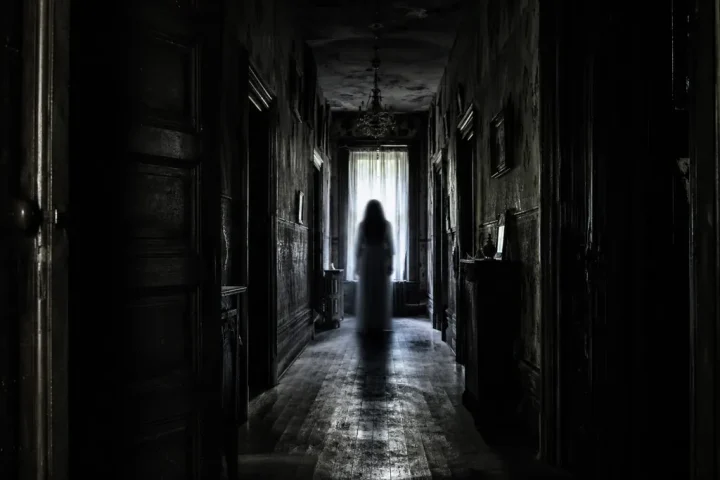
The hospital period has also produced repeated reports of a nurse pushing a gurney through the corridors. Witnesses describe a figure dressed in clothing associated with medical staff of an earlier era, sometimes appearing only briefly before vanishing from view.
No verified historical identity has been attached to the apparition, but the image fits naturally within the building’s past. During the Baker years, nurses and attendants really did move seriously ill patients through these corridors, and the architecture that modern hotel guests now experience as atmospheric once belonged to a working hospital.
The story of the spectral nurse therefore requires very little invented backstory. She functions as an echo of the institution itself, whether understood as a genuine apparition, a residual haunting or a symbolic projection generated by the knowledge of what once occurred there.
Norman Baker’s Apparition
Norman Baker has inevitably become part of the supernatural folklore surrounding the Crescent as well. Reports occasionally describe a male figure wearing clothing reminiscent of Baker’s distinctive white suits, sometimes appearing in former hospital areas or moving through spaces associated with his activities.
Witnesses have interpreted the figure as Baker because his personality dominates the history of the property so completely. A man who carefully manufactured his public image during life has, in a sense, continued to shape the way visitors interpret the building decades after his death.
There is no objective evidence proving that Baker’s spirit remains within the Crescent, but his transformation into a ghost is almost inevitable from a folkloric perspective. Haunted places frequently assign unexplained apparitions to the most notorious personalities associated with them, and few people have left a stronger psychological imprint on a building than Baker left on the Crescent.
The Victorian Gentleman
Not every apparition within the Crescent has been given a definite identity. Visitors have reported seeing a well-dressed Victorian gentleman near the lobby and bar, sometimes describing a bearded man whose clothing appears unmistakably out of place among modern guests.
The absence of a fixed biography makes this apparition particularly interesting. Haunted-location folklore often becomes less convincing when every unexplained figure is immediately given a name and elaborate personal history. An anonymous apparition preserves the ambiguity of the original experience and allows the possibility that, if something unusual was genuinely seen, its identity may simply be unknowable.
The gentleman is usually associated with the hotel’s early resort years rather than the Baker hospital period, reinforcing the idea that the Crescent’s hauntings belong to several different layers of its history.
Room 202 and Photographic Anomalies
Room 202 has also developed a reputation for unusual activity, including reports of mist-like figures and unexplained forms appearing in photographs. Such evidence must be approached carefully because photographic anomalies can result from reflections, moisture, movement, dust and the behaviour of cameras in low-light conditions.
No single image connected with Room 202 has been independently established as proof of a paranormal apparition, but the reports remain part of the wider folklore associated with the hotel. They also demonstrate how contemporary ghost belief has absorbed modern technology, with cameras now performing much the same role that séances and spirit photography once occupied in earlier periods.
Footsteps, Touches and Unexplained Sounds
Many of the Crescent’s most persistent haunting reports involve phenomena that are far less dramatic than complete apparitions. Guests and employees have described phantom footsteps, unexplained knocking, movement in empty corridors and the sensation of being touched when no visible person is nearby.
Experiences of this kind are difficult to evaluate because old buildings naturally produce sounds that can be hard to identify, particularly at night. Sleeping guests may also experience phenomena such as sleep paralysis, sudden waking and heightened sensitivity to unfamiliar surroundings.
The existence of ordinary explanations does not resolve every individual report, but it shows why hauntings often grow through repeated ambiguous experiences rather than one universally accepted supernatural event. At the Crescent, generations of such testimony have accumulated into a larger narrative in which unexplained sounds are rarely interpreted in isolation from the building’s reputation.
The Telephone Calls from the Basement
One of the more memorable Crescent stories concerns the old hotel switchboard, which was said to receive telephone calls originating from basement extensions even when the lower areas were locked and apparently empty.
No surviving switchboard log has been produced that would allow these incidents to be verified independently, but the story has become firmly established within the hotel’s paranormal tradition.
Its power comes from the implication of intention. A creaking floorboard may be explained as a physical response within an old building, but a telephone call suggests that someone or something is attempting communication. For that reason, stories involving phones, bells and other deliberate signals often become among the most unsettling forms of haunting folklore.
The Basement and the Memory of Death
The basement remains the psychological centre of the Crescent’s supernatural reputation because it combines documented history with the strongest expectations of paranormal activity. The morgue belonged to a real hospital, the building housed seriously ill patients and material connected with Baker’s medical operation was eventually recovered from the grounds.
Visitors enter this part of the hotel knowing that death was not merely an abstract possibility there. Bodies were handled within the institution, patients died and the building’s medical history involved people who had arrived hoping desperately to survive.
That knowledge changes how a place is experienced. Every sound carries more weight, every shadow seems more significant and every unexplained sensation can acquire a connection with the dead.
Paranormal investigators have reported voices, apparitions and temperature changes in the basement, while the hotel’s ghost tours have made the area one of its principal attractions. The commercialisation of the space does not prove or disprove the experiences reported there, but it does influence how visitors approach them.
Limestone and the Stone Tape Theory
The Crescent’s massive limestone construction has encouraged another paranormal interpretation based upon the so-called Stone Tape theory. According to this idea, certain materials may somehow absorb emotional or traumatic impressions and later replay them as apparitions, sounds or repeated actions.
No accepted scientific evidence demonstrates that limestone can record consciousness or psychic energy in this way, but the theory remains influential within paranormal culture because it offers an explanation for so-called residual hauntings. In such cases, an apparition does not appear to interact intelligently with witnesses but instead repeats the same movement or behaviour as though a moment from the past were being replayed.
The Crescent’s exceptionally thick limestone walls make the idea particularly attractive because the building appears physically capable of preserving the past. Whether stone can preserve human memory is another matter, but the symbolism fits the hotel remarkably well.
A Haunted Building with Several Histories
The Crescent Hotel is most interesting when its hauntings are understood as belonging to different periods rather than being forced into one explanation. Michael belongs to the dangerous labour of construction, while the Victorian gentleman appears connected with the elegant resort years. Theodora and the nurse belong to the hospital period, while Norman Baker represents the darker legacy of medical fraud and exploitation.
This layering creates the impression of a building haunted not by one tragedy but by its entire history. Different generations used the same rooms for radically different purposes, and later folklore transformed those layers into a collection of supernatural personalities.
The Crescent therefore functions almost like an archive in which architecture, history and paranormal belief have become impossible to separate completely.
When History Becomes Haunting
One reason the Crescent’s ghost stories remain so effective is that the building does not need invented horror to create atmosphere. Terminally ill people really travelled there because they believed they might be cured. Norman Baker really operated a fraudulent medical enterprise inside the building, and federal records document the lack of legitimate medical foundation behind his claims. The hospital really contained spaces associated with the dead, and archaeological investigation really uncovered buried medical material decades later.
Those facts provide a fertile environment for supernatural interpretation because the emotional history of the place is already intense. Once visitors learn what happened inside the building, unexplained sounds and fleeting impressions acquire meanings they would not necessarily possess elsewhere.
This does not mean that every apparition can be dismissed as imagination, nor does it establish that spirits inhabit the property. It means that history shapes paranormal experience.
The Crescent demonstrates how easily memory, architecture and supernatural belief can become intertwined until nobody can say precisely where one ends and another begins.
The Crescent Hotel Today
Today the Crescent functions once again as a hotel, but its haunted reputation has become central to its identity. Ghost tours lead visitors through areas associated with the Baker hospital, while guests deliberately book rooms connected with particular spirits in the hope of experiencing something unusual.
The commercial element inevitably affects the folklore because visitors often know the stories before they arrive. Someone entering Room 218 already expects Michael, while someone sleeping in Room 419 knows that Theodora is supposed to be nearby. This creates an environment in which ambiguous experiences are immediately interpreted according to established narratives.
That process does not necessarily invalidate every report. Folklore has always shaped how people interpret supernatural encounters, and a commercial ghost tour merely accelerates a process that has existed for centuries.
The Crescent therefore remains both a historic hotel and a living haunted tradition, continually producing new stories that are added to the ones already surrounding it.
The Hotel Above Eureka Springs
The power of the Crescent Hotel lies in the uneasy relationship between what can be proven and what remains unexplained. Norman Baker’s fraudulent cancer hospital is documented, the morgue belongs to the building’s genuine history and the buried medical bottles discovered in 2019 provide physical evidence that parts of the darker tradition surrounding the property were based upon real material.
Around those facts grew stories of hidden bodies, skeletons in walls, spectral nurses, phantom patients and spirits moving through the halls. Some of those stories may eventually prove to have ordinary origins, while others may never be resolved at all.
The Crescent does not require every legend to be true in order to remain unsettling. Its architecture contains more than a century of human expectation, suffering, ambition and disappointment, and every generation has added another layer of meaning to the building.
Visitors may decide that the footsteps heard after midnight belong to the natural movement of an old limestone hotel, or they may wonder whether someone who once walked the same corridor never completely left it. The evidence cannot settle that question, but the history ensures that the question will continue to be asked.
Stop Chasing Ghosts and Start Understanding Them
Haunted locations have become entertainment for people who want a quick thrill, a photograph in a dark corridor or a story to tell when they return home, but serious occult study demands far more than that. A haunting exists within a larger tradition involving death, memory, spirit belief, mediumship, necromancy, psychic perception and the ways human beings have tried to understand the possibility that consciousness might remain attached to a place after the body is gone.
The Occult World Mystery School is for people who want to move beyond ghost-tour folklore and begin studying the supernatural with discipline. If you are genuinely interested in haunted places, spirit communication, mediumship, necromancy and psychic phenomena, then learn the historical traditions behind them, understand the difference between testimony and evidence, study methods of protection and spirit contact, and develop enough knowledge to recognise when folklore, expectation and occult experience begin to overlap. There are thousands of spirits, gods, demons, magical systems, grimoires and forgotten traditions waiting beyond the threshold, and none of them will reveal much to someone satisfied with wandering through another haunted hotel carrying a camera. Enter the Occult World Mystery School and start treating the unseen as something worthy of serious study.
FURTHER READING:
- Taylor, Troy. The Haunting of America. New York: Barnes & Noble, 2001.
SOURCE:
The Encyclopedia of Ghosts and Spirits– Written by Rosemary Ellen Guiley – September 1, 2007


Follow