

Auðhumla: The Primeval Cow at the Birth of the Norse Cosmos
Auðhumla, also written Auðhumbla, Auðumla or Audhumla, is the mysterious primeval cow who appears at the beginning of creation in Norse mythology. Although her appearance in the surviving sources is surprisingly brief, her role is fundamental. Before Odin rules Asgard, before Midgard has been fashioned and before the familiar gods and giants begin their long conflict, Auðhumla already exists within the primordial emptiness of Ginnungagap. She nourishes the first great being, Ymir, while simultaneously uncovering Búri, the ancestor from whom Odin and the Æsir will eventually descend.
Her name is usually interpreted as meaning something close to “rich hornless cow”. The first element is related to Old Norse auðr, a word associated with wealth, prosperity or riches, while the second part has traditionally been understood as referring to a hornless cow. The precise etymology is not entirely certain, but the interpretation fits her mythic role. Auðhumla is abundance appearing before there is even a world capable of producing abundance.
She does not graze in a meadow because no meadow yet exists. She drinks from no ordinary stream because the rivers of the created world have not yet been formed. Instead, she appears within an impossible environment of ice, heat, mist and melting rime, where the first forms of life emerge from the meeting of elemental extremes.
The Birth of Auðhumla
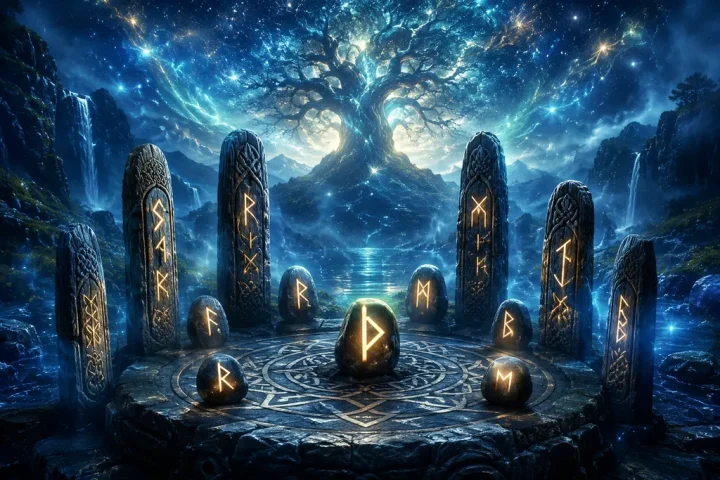
Snorri Sturluson describes the beginning of the cosmos in the Gylfaginning, the first major section of the Prose Edda. At one extreme lies Niflheim, the freezing realm associated with cold, darkness and primordial waters. At the other lies Muspelheim, the region of consuming heat and fire. Between them stretches Ginnungagap, the enormous yawning emptiness that exists before the ordered universe.
When the warmth from Muspelheim reaches the frozen rime flowing from Niflheim, melting begins. Drops form and life emerges from the interaction between heat and cold. From this moisture comes Ymir, the primordial being from whom the race of jötnar, or giants, will descend.
Auðhumla appears within the same process. Snorri writes that when the rime dripped, a cow emerged, and from her udders flowed four rivers of milk. Ymir drinks from these streams and survives because of them.
The image is extraordinary when considered carefully. Milk exists before pasture, vegetation and ordinary animal life. Nourishment appears before the structures that would normally make nourishment possible. Auðhumla is therefore not merely a gigantic cow wandering through a mythical landscape. She is the principle of sustenance appearing at the beginning of existence itself.
The newborn cosmos cannot continue without her.
The Nourisher of Ymir
Ymir possesses tremendous generative power and becomes the ancestor of the giants, yet his survival initially depends entirely upon Auðhumla. The four rivers of milk flowing from her sustain him during the earliest phase of creation.
This places the primeval cow in a curious position within Norse cosmology. She nourishes the being whose descendants will eventually become the enemies, lovers, spouses and relatives of the gods. The antagonism between Æsir and jötnar has not yet begun because neither side exists in its later form.
At creation, there is nourishment before there is conflict.
Auðhumla herself must also feed, but the primordial world offers no grass. She instead licks salty blocks of rime and ice. Her tongue gradually wears away the frozen surface, and this apparently simple act reveals that something has been concealed within it.
Her feeding becomes an act of creation.
Búri Beneath the Ice
On the first day that Auðhumla licks the salty rime-stones, hair appears from the frozen mass. On the second day, the head of a man emerges. By the third day, the entire being has been revealed.
His name is Búri.
The distinction between Búri and Borr is important because the names are sometimes confused in modern retellings. Búri is the primordial ancestor released by Auðhumla. He later becomes the father of Borr, who in turn fathers Odin, Vili and Vé.
Snorri describes Búri as beautiful, large and powerful. Nothing in the surviving myth explains why he was hidden within the ice or how he came to exist there before Auðhumla uncovered him. This silence gives the episode much of its occult power. The cow does not appear to manufacture Búri from nothing. She strips away the frozen substance that conceals something already present.
Creation therefore occurs through revelation.
What appears lifeless contains hidden form, and repeated contact with Auðhumla gradually exposes it.
From Búri to Odin
Búri fathers Borr, who marries Bestla, daughter of the giant Bölþorn. Their union produces three sons: Odin, Vili and Vé.
The genealogy immediately demonstrates that the divisions within Norse mythology are more complicated than a simple conflict between unrelated races of gods and giants. Bestla belongs to the jötunn lineage, meaning that Odin and his brothers possess giant ancestry through their mother even though they become the principal architects of the divine order.
Auðhumla stands just before this mingling of lineages. She does not give birth to Búri in the conventional sense, yet her actions make his emergence possible. Without her, the ancestral chain leading to Odin cannot begin as Snorri tells it.
The mythology then turns upon itself. Odin, Vili and Vé eventually kill Ymir, the same primordial being who survived because Auðhumla fed him. They use his enormous corpse to create the organised cosmos. His flesh becomes the earth, his blood becomes seas and waters, while other parts of his body are transformed into the structures of the world.
Auðhumla has therefore sustained both sides of creation. Her milk preserves Ymir, whose body becomes cosmic matter, while her tongue reveals Búri, whose descendants become the beings who shape that matter into an ordered world.
Creation Without Violence
Much of Norse cosmogony depends upon conflict. Ymir must die before his body can become the world, while later myths repeatedly describe the unstable relationship between gods and giants.
Auðhumla represents a different form of creative power. She neither kills nor conquers. She nourishes and reveals.
Her milk allows life to continue, while her patient licking removes what prevents another form of life from appearing. Nothing in her surviving story suggests domination or destruction.
This makes Auðhumla unusual among primordial beings. Her power is enormous, but it is expressed through sustenance rather than violence. She brings about consequences that will eventually reshape the universe without behaving like a ruler or warrior.
She creates the conditions from which power can emerge.
There is no reliable evidence that Auðhumla possessed an organised cult in pre-Christian Scandinavia, and no surviving ritual dedicated specifically to her is known. Modern practitioners may interpret or honour her spiritually, but such practices should be understood as modern constructions rather than the revival of a fully documented historical cult.
The Four Rivers of Milk
The four streams flowing from Auðhumla have inevitably attracted symbolic interpretation. Modern occultists may be tempted to identify them with the four directions, elements or other systems based upon the number four, but Snorri provides no such explanation.
The safest interpretation begins with what the myth actually emphasises: abundance. Auðhumla produces enough nourishment to sustain primordial life before the ordinary world exists.
Cattle represented enormous material value within ancient northern European societies because they provided food, hides, labour and visible wealth. The probable connection between Auðhumla’s name and prosperity therefore gives her cosmic role a familiar earthly foundation.
The myth magnifies the importance of cattle until one cow becomes a source of nourishment at the creation of existence itself.
The wealth represented by Auðhumla is not accumulated treasure. It is life-sustaining abundance that continually flows outward.
The Hidden Divine Form
The strangest element of Auðhumla’s myth remains Búri’s appearance from the ice. The episode suggests a form of creation different from birth, crafting or violent dismemberment.
Búri appears to have been present before he became visible.
Auðhumla’s tongue does not impose a form upon shapeless matter. It removes what hides the form.
From an occult perspective, this can be read as an image of latent potential. Something may appear frozen, lifeless or completely without possibility while still containing a structure that has not yet emerged. Transformation then consists not of creating an entirely new reality but of removing the layers that prevent an existing potential from becoming visible.
The process takes three days. Each day reveals more than the one before, suggesting gradual manifestation rather than instantaneous creation.
The first sign is almost insignificant. A few hairs appear from the ice. Only continued action reveals that those hairs belong to something vast.
This makes Auðhumla an unexpectedly powerful symbol of persistence. What is hidden may not reveal itself after one attempt, and the first evidence of transformation may be so small that its final form cannot yet be imagined.
Auðhumla and Primordial Cattle
Cosmic cattle appear in several ancient religious traditions, which has encouraged comparisons between Auðhumla and other primordial bovine beings. One particularly interesting parallel exists in Zoroastrian cosmology, where the primordial Bovine, known in Middle Persian tradition as Gāw ī Ēwdād, belongs among the first creations of Ohrmazd.
The Iranian myth differs significantly from the Norse story. The primordial Bovine does not uncover an ancestor by licking ice, nor does Auðhumla share the exact cosmological function assigned to the Iranian being. The comparison is therefore useful only when handled cautiously.
Both traditions nevertheless demonstrate how cattle could be elevated from ordinary livestock into symbols of cosmic life. In societies where cattle represented survival and prosperity, the idea that bovine life belonged near the beginning of creation would have carried enormous symbolic weight.
Whether these similarities preserve an extremely ancient Indo-European inheritance or developed independently cannot be demonstrated from the surviving evidence. The comparison remains intriguing precisely because the parallels exist alongside substantial differences.
Auðhumla and Tacitus
Another comparison has been made with a genealogical tradition recorded by the Roman historian Tacitus in Germania, written around 98 CE. Tacitus states that Germanic peoples celebrated an earth-born god named Tuisto and his son Mannus. Mannus then produced three sons from whom major Germanic tribal groupings were believed to descend.
The structural resemblance to Búri, Borr and the three sons Odin, Vili and Vé is tempting. Both traditions contain an early ancestral being, a second generation and then three important descendants.
The similarity does not prove that the myths are identical. Tacitus records no primordial cow and says nothing about salty rime, Ginnungagap or a divine ancestor emerging from ice. His three sons of Mannus are ancestral figures connected with peoples, while Odin, Vili and Vé become divine creators.
What the comparison does demonstrate is that genealogical explanations of cosmic and human origins existed deeply within the Germanic mythic world. Descent from primordial ancestors offered a way of organising both identity and the structure of existence.
Auðhumla belongs to one surviving version of that mysterious beginning.
The Cow Who Disappears
One of the most intriguing aspects of Auðhumla is how completely she vanishes from the surviving mythology after performing her essential role.
Snorri provides no story of her death and no explanation of where she goes. She does not reappear among the gods, giants or creatures involved in the later events of Norse mythology.
Her purpose seems to belong exclusively to creation.
Once Ymir has been nourished and Búri has been revealed, the cosmic conditions she was needed to establish have been fulfilled. The mythology moves forward while Auðhumla recedes into the primordial past.
This disappearance contributes to her mystery. Some mythological beings dominate enormous cycles of stories, but Auðhumla requires only a few paragraphs to change the future of the entire cosmos.
Her importance is not measured by the amount of narrative devoted to her.
Without her, the story cannot proceed.
Auðhumla as an Occult Symbol
Within an occult interpretation, Auðhumla can represent the power hidden beneath apparent inactivity. Ice looks dead, yet something living waits inside it. Repetition looks insignificant, yet persistent action eventually reveals an ancestor of gods.
Her milk and her tongue express two complementary magical principles. One sustains what has already emerged, while the other uncovers what has not yet become visible.
Creation requires both.
A possibility that emerges but receives no nourishment may die before it develops. A potential that remains buried can never become active, no matter how powerful it might eventually be.
Auðhumla embodies the force that feeds one process while exposing another.
Her position between Ymir and Búri also places her beyond the later opposition between giant and god. She belongs to an older stage of existence, before the cosmic conflict has hardened into opposing sides.
She nourishes without judging the future role of what she nourishes.
In that sense, Auðhumla belongs less to order than to possibility.
Before Odin, There Was Auðhumla
Modern Norse mythology is dominated by Odin, Thor, Loki and the dramatic events leading towards Ragnarök, but the deeper cosmology begins before any of them exists. The gods themselves are descendants of a chain of beings whose first revealed ancestor emerges because a primordial cow licks salt from frozen stones.
That image should destroy any simplistic idea that Norse creation begins with warrior gods imposing order through strength alone. Before the weapon comes nourishment, and before conquest comes revelation.
Auðhumla never wields Mjölnir or carries Gungnir. She establishes no kingdom and demands no throne. Yet her actions make the later divine world possible.
The richest power in the beginning of the Norse cosmos is therefore not the power to destroy.
It is the power to sustain what is becoming and uncover what has always been hidden.
Stop Skimming the Surface of the Gods
Most people stop at Odin and Thor because popular mythology has trained them to recognise characters instead of understanding the forces beneath them. They memorise names, watch stories and call that knowledge while remaining completely ignorant of the primordial powers that existed before the gods inherited the cosmos.
That is not occult study. Enter the Occult World Mystery School and go beneath the surface. Study mythology, Demonology, Black Magick, spirits, ancient cosmologies and the hidden systems through which serious occultists develop knowledge, discipline and personal power. Stop allowing shallow information and inherited beliefs to define the limits of your world. There are thousands of spirits, gods, demons, grimoires, magical systems and forgotten traditions waiting beyond the threshold. If you want real occult knowledge, stop standing outside admiring the door. Enter the Mystery School, seize the knowledge and start mastering your own path now.
SOURCE:
Encyclopedia of World Mythology and Legend, Third Edition – Written by Anthony S. Mercatante & James R. Dow
Copyright © 2009 by Anthony S. Mercatante

Follow