
The Haunted Secrets of Amsterdam’s Spooksteeg
In the heart of Amsterdam, among canals, cobblestones, leaning houses, and narrow streets heavy with history, there is a small alley whose name alone suggests unease: Spooksteeg, or Ghost Alley.
Hidden in one of the oldest parts of the city, Spooksteeg has become part of Amsterdam’s haunted folklore. It is a place where the ordinary world seems to thin, where shadows gather too closely, and where old stories of jealousy, death, plague, guilt, and restless spirits still cling to the stones.
Ghost Alley
Spooksteeg is not grand or dramatic. Its power lies in its narrowness, its age, and its atmosphere. Like many old Amsterdam alleys, it feels compressed by history. The buildings rise close around it, the light can feel dim even during the day, and at night the passage seems to belong more to memory than to the living city.
Its name means Ghost Alley, and over time it has attracted stories of apparitions, strange sounds, cold sensations, and figures glimpsed at the edge of vision.
Whether one approaches these tales as folklore, psychic residue, or urban legend, Spooksteeg remains one of Amsterdam’s most atmospheric haunted locations.
A Dark and Troubled Past
Amsterdam’s old centre has witnessed centuries of trade, poverty, disease, violence, passion, and death. During the plague years, the city’s cramped houses and narrow streets created ideal conditions for sickness to spread. It is easy to understand why later generations imagined certain alleys as places where suffering lingered.
Spooksteeg is sometimes associated in ghostly retellings with plague victims, death, and bodies awaiting burial. Whether taken as literal history or as the kind of dark memory that attaches itself to old places, the association deepens the alley’s reputation as a threshold between the living and the dead.
In folklore, places of repeated sorrow often become spiritually charged. The past does not entirely vanish; it settles into walls, stones, and shadows.
The Legend of Helena
The most famous legend of Spooksteeg concerns a young woman named Helena.
According to local ghost lore, Helena lived near the alley with her family. Her sister Dina was gentle and loved by a handsome sailor. Helena, consumed by jealousy, could not bear to see her sister chosen. In some versions of the story, she murdered Dina and concealed the crime, allowing others to believe the death was an accident.
Helena later married the sailor, but guilt followed her. On her deathbed, she finally confessed what she had done. After her death, her spirit was said to haunt the alley, unable to escape the consequences of envy, betrayal, and murder.
In this legend, Spooksteeg is not merely haunted by death. It is haunted by guilt.
The Wailing Spirits
Visitors and storytellers have long associated Spooksteeg with faint cries, whispers, and mournful sounds heard after dark.
Some say these are the voices of plague victims. Others believe they belong to Helena, Dina, or unnamed souls trapped by grief and violence. The sound is described as distant yet close, as though it rises from the stones themselves.
Such stories give Spooksteeg its emotional force. The haunting is not only visual. It is heard, felt, and sensed.
Shadowy Figures
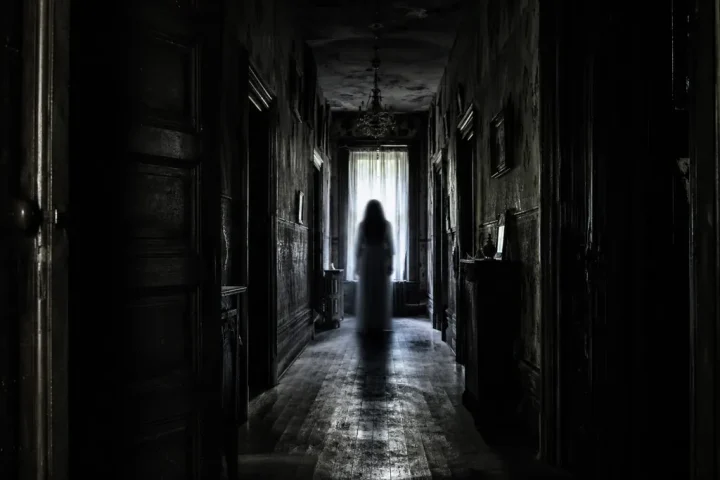
Another common element in the folklore of Spooksteeg is the appearance of shadowy figures moving through the alley.
Witnesses describe shapes slipping quickly across the passage, only to vanish before they can be clearly seen. Some appear hunched, thin, or distorted. Others seem like ordinary people until they disappear into darkness where no doorway stands.
These apparitions may be interpreted as ghosts, psychic impressions, or the imagination responding to an intensely atmospheric place. Yet in haunted folklore, that distinction is rarely simple. Sometimes the mind perceives what the rational world refuses to name.
The Cold Touch
One of the more unsettling legends of Spooksteeg involves the sensation of being touched by something unseen.
Those who enter the alley at night sometimes report an icy brush against the skin, a sudden chill at the back of the neck, or the feeling of someone standing too close when no one is there.
In ghost lore, cold spots are often associated with spirit activity. At Spooksteeg, the cold touch is said to be a warning: do not linger too long, and do not mock the dead.
The Phantom Light
Another tale speaks of a mysterious light appearing in the alley, flickering like a lantern carried by an invisible hand.
Some say it is the light of a ghost searching for a lost loved one. Others believe it is connected to the sailor in the Helena legend, still moving through the alley in search of truth, love, or forgiveness.
The phantom light belongs to the classic language of ghost stories. It suggests a soul that has not completed its journey, a presence still moving through the world of the living.
A Place of Folklore and Fear
Spooksteeg is powerful because it gathers several kinds of haunting into one small place. There is the historical fear of plague. There is the emotional horror of jealousy and murder. There is the spiritual weight of guilt. There is the possibility that the dead may not rest easily when violence, betrayal, or sorrow remains unresolved.
This is what makes the alley so memorable. It is not only a haunted location; it is a container for Amsterdam’s darker imagination.
In Spooksteeg, the city’s elegant beauty meets its shadow.
Visiting Spooksteeg
Those who seek out Spooksteeg should approach it as both a physical place and a piece of living folklore.
During the day, it may seem like a narrow Amsterdam alley with a strange name and an old reputation. At night, however, the atmosphere changes. The shadows lengthen, the modern city feels further away, and the stories become easier to believe.
Visit respectfully. Do not treat haunted places as entertainment alone. Whether the spirits are real, symbolic, or born from centuries of storytelling, places like Spooksteeg deserve a certain reverence.
Respecting the Dead
In occult tradition, locations associated with death, grief, or tragedy should never be approached carelessly. Even if one does not believe in ghosts, respect is essential.
Do not provoke. Do not mock. Do not attempt spirit contact without preparation, protection, and clear intention.
The dead, whether literal spirits or ancestral memories, are not props for amusement. They are part of the hidden history of a place.
The Occult Meaning of Spooksteeg
Spooksteeg may be understood as a liminal place: a narrow threshold between past and present, guilt and confession, memory and haunting.
Its legends remind us that cities are not only built from stone, wood, and water. They are also built from stories. Every street carries emotional residue. Every alley has witnessed lives now forgotten. Some places seem to hold their secrets more tightly than others.
Spooksteeg is one of those places.
It is Amsterdam’s Ghost Alley, a small passage into the darker side of the city’s soul.
Join the Occult World Mystery School
If you are fascinated by haunted places, ghost stories, spirit communication, psychic impressions, urban legends, occult history, and the hidden energies of old locations, join us inside the Occult World Mystery School.
Inside the community, we explore ghosts, hauntings, demonology, angels, grimoires, witchcraft, protection magic, Vodou, Hoodoo, mythology, folklore, and the unseen forces that shape the world around us.
Join the Occult World Mystery School and continue your journey into the haunted, hidden, and mysterious side of reality.



Follow