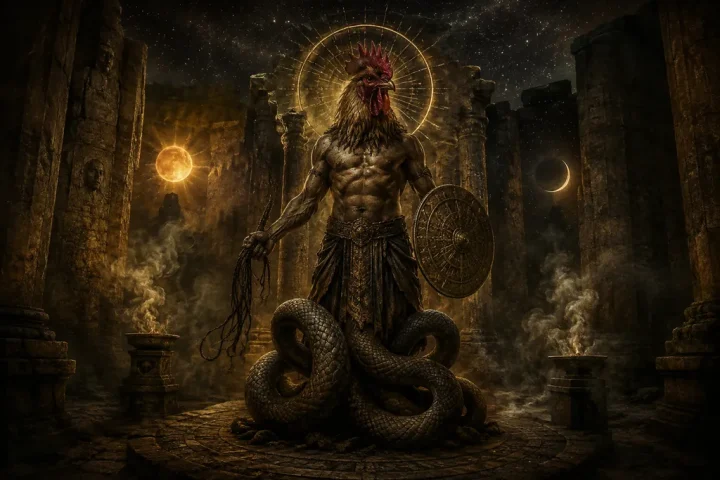
Abraxas: The Gnostic Power Beyond Good and Evil Abraxas, also written as Abrasax, Abraxis, or Abracax, is one of the most mysterious and paradoxical figures in Gnostic, magical, and demonological tradition. He
Lilith : Screech Owl; Beautiful Maiden; Dark Maid; Flame of the Revolving Sword; Maid of Desolation; Night Demon; Hand of Inanna; The Night Witch; The Howler Lilith: First Woman, Night Demon and Queen of the Wilderness Few supernatural beings possess
Aditi (free, unbounded?) In Hindu mythology, a goddess, the “mother of the world,” who, according to some Hindu texts, is the mother of both Indra and Vishnu. Aditi’s descendants, the Adityas, are
Adi-Buddha (first enlightened one) In Mahayana Buddhism, the primordial Buddha who “was before all,” infinite, omniscient, selfexisting, without beginning and without end. He is not, however, a creator god, nor equivalent to
Adi In Hindu mythology, a son of Adharma. He tried to avenge his father’s death at the hands of Shiva by transforming himself into a snake and entering Shiva’s abode. He then
Adharma (unrighteousness) In Hindu mythology, a son of the god Brahma. He personified unrighteousness or vice, being called “the destroyer of all things.” SOURCE: Encyclopedia of World Mythology and Legend, Third Edition
Adaro In Melanesian mythology, sun spirits who move about in waterspouts, cross from place to place using rainbows as bridges, or come to earth during sun showers. They are part fish, part
Adapa (man) In Near Eastern mythology, Babylonian hero who lost the gift of immortality for humankind through a trick of the gods. The myth of Adapa is found in various texts, all
Adamanthaea In Greek mythology, a Cretan nurse of Zeus who suspended his cradle from a tree so that he was neither on earth nor heaven nor the sea. She had drums and
Adachigahara is in Japanese folklore, a cannibalistic woman spirit, portrayed with a kitchen knife, sometimes preparing to kill a child. According to one legend, she was a woman of high rank attached
Actis (beam of light) In Greek mythology, son of Helios and Rhode; brother of Candalus, Cercaphus, Macar, Ochimus, Tenages, and Triopas. Actis and his brothers were the first to sacrifice to Athena.
Actaeus (of the coast) In Greek mythology, first king of Attica and father of Agraulos. Agraulos married Cecrops, whom the Athenians called their first king, though Actaeus ruled before him. SOURCE: Encyclopedia
We're excited to share THIS LIST of spellcraft and witchcraft guides. Whether you're just starting out or deepening your practice, these books cover everything from wicca to hoodoo to demonology.CLICK HERE




Follow