
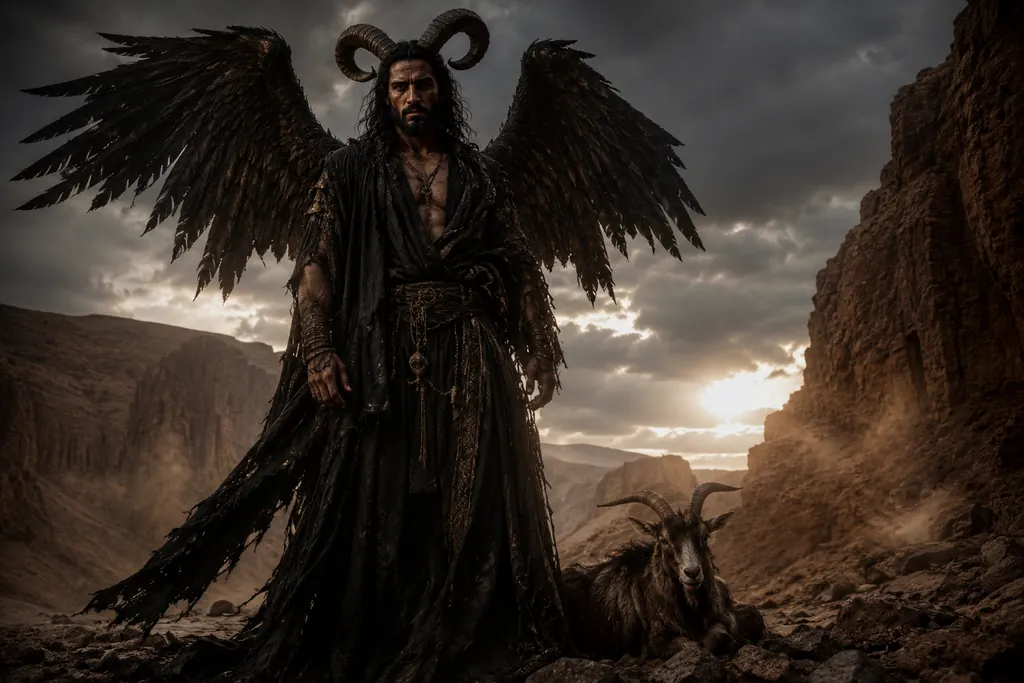
Azazel: Desert Spirit, Fallen Watcher and Teacher of Forbidden Knowledge
Azazel, also known as Azael or Azazeel, is one of the most mysterious and contradictory figures in demonology, Jewish lore, apocalyptic literature and occult tradition. Depending on the source, he appears as a desert spirit, a fallen angel, a Watcher, an archdemon, a scapegoat power, a teacher of forbidden arts and the ruler of the goatlike spirits known as the Se’irim.
His identity has never remained fixed. In some traditions, Azazel belongs to the wilderness and receives the sins cast out from the sacred community. In others, he is an angel who descended from heaven, revealed forbidden knowledge to humanity and was condemned for violating the boundaries between the celestial and earthly realms. Later demonology transformed him into a prince of Hell, a keeper of occult secrets and a powerful symbol of rebellion, exile and dangerous illumination.
Azazel stands at the place where sacred order gives way to the desert. He receives what society rejects, teaches what heaven forbids and embodies the consequences of crossing boundaries that were never meant to be crossed.
Azazel and the Scapegoat Ritual
One of the oldest and most important references to Azazel appears in the Jewish Day of Atonement ritual described in Leviticus 16.
During the ceremony, two goats were selected. One was sacrificed to Yahweh, while the other remained alive. The sins and impurities of the people were symbolically transferred onto this second animal, which was then driven into the wilderness “for Azazel”.
This goat became the origin of the word scapegoat: a living being made to carry the guilt, disorder and rejected burdens of an entire community.
The ritual placed Azazel in direct opposition to the sacred space of the temple. One goat belonged to Yahweh and was offered within the religious order, while the other was sent beyond the boundaries of civilisation into the desert. Azazel therefore became associated with exile, impurity, sin-removal and the chaotic world existing outside the protection of divine law.
The ritual did not necessarily mean that Azazel was worshipped. Rather, the goat and everything placed upon it were removed from the sacred community and sent into the place with which Azazel was associated. The desert received what could not remain within the purified social and religious order.
The origins of this practice may extend into older Semitic traditions. Azazel may once have been connected with a forgotten class of desert powers, goatlike spirits or wilderness beings whose presence was believed to inhabit barren and desolate places.
King of the Se’irim
Azazel is frequently described as the ruler or king of the Se’irim, goatlike spirits associated with deserts, ruins and wild landscapes.
To the people of the ancient Near East, the wilderness was not empty. It was believed to be inhabited by demons, spirits, exiles and supernatural beings that existed beyond the protection of cities, temples and cultivated land.
The Se’irim belonged to this world. They represented the dangerous and untamed powers of the desert, appearing as goat-shaped or goatlike beings that haunted isolated places.
As their king, Azazel is more than a simple demon of evil. He is a sovereign of the outside world, ruling over the spiritual territory beyond ordinary law. He belongs to the place where impurity is sent, where civilisation loses its authority and where forbidden forces continue to exist beyond the borders of sacred order.
The goat symbolism surrounding Azazel may also have contributed to later portrayals of demons with horns, hooves and animalistic features. Yet in the earliest traditions, the goat is not merely a symbol of wickedness. It represents wilderness, instinct, fertility, aggression and the untamed power that remains outside human control.
Azazel Among the Watchers
In the apocalyptic traditions surrounding the Watchers, Azazel is one of the angels who descended from heaven and entered into forbidden relationships with mortal women.
These angels violated the boundary separating the divine realm from humanity. Their descent disrupted the order of creation because they revealed heavenly secrets that were never intended to be shared openly with mortals.
Azazel became one of the most important teachers among them. He is particularly associated with metalworking, weapons, jewellery, cosmetics, adornment, witchcraft and other hidden arts.
He taught men how to manufacture swords, knives, shields and armour, thereby introducing new forms of violence and warfare. He also taught women the use of ornaments, jewellery, pigments and beautification.
These teachings were not necessarily evil in themselves. Metalworking could produce tools as easily as weapons, and adornment could represent art, beauty and self-expression. The danger existed in the premature revelation of knowledge and in humanity’s use of it.
Azazel is therefore a culture-bringer, but a destructive and transgressive one. He offers knowledge that transforms civilisation, yet the transformation produces vanity, violence, seduction and bloodshed.
His gift is illumination, but it is an illumination taken from heaven without permission.
Teacher of Witchcraft and Hidden Arts
Azazel’s reputation as a teacher expanded beyond metalworking and adornment. In magical lore, he became a master of witchcraft, herbal knowledge, spirit work and occult power.
He is sometimes credited with teaching arts that enabled human beings to manipulate natural and celestial forces. Some traditions claim that he revealed powers through which the Sun, Moon and stars could be drawn down from the heavens.
This strange image places Azazel within the world of cosmic magic. His secrets do not concern only simple charms or household spells. They involve the structure of the heavens, the movement of celestial powers and the knowledge reserved for angels and divine beings.
Azazel is also said to guard hidden treasures and to reward those who approach him with knowledge and information. He becomes an initiatory figure who offers access to mysteries unavailable through conventional religious authority.
Yet his knowledge is never harmless. It carries the danger of separation, punishment and spiritual exile because it originates in the violation of divine boundaries.
Those who seek Azazel are not merely seeking information. They are entering the territory between revelation and rebellion, where knowledge brings power but also responsibility and consequence.
Azazel’s Punishment in the Desert
For revealing heavenly secrets and corrupting humanity, Azazel is condemned to a severe punishment.
In one tradition, angels bind him hand and foot and cast him into a desert place called Dudael. There he is imprisoned beneath jagged and broken stones until the final Day of Judgement.
Another account describes him hanging upside down in a deep canyon beyond the Mountains of Darkness, suspended in a barren place until the Apocalypse.
The punishment mirrors his nature. Azazel, lord of the wilderness, is imprisoned within the wilderness. The teacher of forbidden knowledge is silenced in the land of exile. The angel who crossed the boundary between heaven and earth is fixed within a place that belongs fully to neither.
His imprisonment also reflects the scapegoat ritual. Just as the goat carrying the sins of the people was driven into the desert, Azazel himself became the one upon whom the corruption of humanity was placed.
Some texts declare that all the sins of the earth should be attributed to him. In this sense, Azazel becomes not only the teacher who introduced forbidden arts, but the supernatural scapegoat held responsible for the consequences of human violence and desire.
Later lore added further physical humiliation to his punishment, claiming that his nose was pierced after his fall. This image reinforced his transformation from an exalted angel into a bound and disgraced rebel.
Azael and Naamah
Under the name Azael, Azazel appears as one of the principal angels who descended to cohabit with mortal women. The name Azael has been interpreted as meaning “whom God strengthens” or “God strengthens”.
According to one tradition, Azael slept with Naamah, a mysterious female figure associated with beauty, sexuality, music and demonic power.
Their union produced spirits known as the Sedim. These beings were sometimes connected with Assyrian guardian spirits and were invoked in rites intended to expel or control evil entities.
This tradition gives Azael the role of a supernatural progenitor. His union with Naamah creates beings that exist between the demonic and protective worlds.
The story also continues the central theme of forbidden mixture. An angel joins with a female being connected with seduction and occult power, producing spirit children whose nature cannot be described as entirely good or evil.
Azazel’s mythology repeatedly breaks down clear divisions. Heaven and earth mix, angels become demons, dangerous spirits become guardians and forbidden knowledge becomes the foundation of civilisation.
Azazel, Azza and Uzza
In 3 Enoch, Azazel or Azael is associated with Azza and Uzza, two other powerful angels connected with the revelation of heavenly secrets.
Some accounts describe the three as exalted ministering angels who once inhabited the seventh and highest heaven. From this elevated position, they witnessed divine mysteries and possessed knowledge unavailable to humanity.
Their later fall makes Azazel’s story even more dramatic. He does not begin as a minor demon or wilderness creature. He descends from the heights of heaven into punishment, exile and demonic association.
This movement from angelic glory to desert imprisonment is fundamental to his myth. Azazel is a being of descent. He moves from divine proximity into separation, from sacred knowledge into forbidden teaching and from heavenly authority into chains.
His story suggests that the greatest fall belongs not to the powerless, but to those who once stood closest to the divine.
Azazel in Jewish Tradition
Within Jewish tradition, Azazel is connected with sin, judgement, impurity and the wilderness. He may be interpreted as a demon, a location, a spiritual force or a symbolic representation of complete removal.
Some Jewish texts place him among the avenging angels. In this role, he is not simply a rebel against divine order but an agent connected with punishment and judgement.
The ambiguity of the phrase “for Azazel” in Leviticus has led to centuries of debate. Some interpreters understand Azazel as the name of a supernatural being, while others consider it a reference to a rugged place, cliff or remote region into which the goat was sent.
Later folklore increasingly personified him. The wilderness power became a fallen angel, demon and ruler of spirits.
The modern Hebrew expression Lech le-Azazel, meaning “Go to Azazel”, functions much like “Go to Hell”. This survival in ordinary language shows how strongly his name became associated with banishment, punishment and the place beyond acceptable society.
Azazel in Christian Demonology
Christian demonology usually presents Azazel as one of the fallen angels in Satan’s host.
His role as a teacher of weapons, cosmetics and forbidden knowledge made him a natural figure within Christian explanations of how sin and corruption entered human civilisation.
Some later demonological systems elevated him to the rank of archdemon or prince of Hell. His name was occasionally used almost as a synonym for Satan, although the two figures do not share the same origins.
Early apocalyptic writings refer to sinners being thrown into the fire of Azazel. The phrase suggests that he became associated not only with the desert but with an infernal realm of punishment.
Within these traditions, Azazel represents the corruption caused by knowledge detached from divine obedience. He teaches humanity how to transform the world, but the transformation leads to violence, vanity and spiritual decline.
The tragedy of Azazel is not that he lacks wisdom. It is that his wisdom is separated from sacred permission and restraint.
Azazel in Akkadian and Near Eastern Lore
Some occult sources connect Azazel with Akkadian traditions and classify him among the Maskim, destructive spirits or princes of the underworld.
The Maskim were feared powers associated with illness, misfortune, attack and unseen danger. They were not always described in the same way, but they belonged to the wider Near Eastern landscape of hostile or unpredictable spirits.
This association places Azazel within an ancient world in which desert demons, storm spirits, underworld powers and fallen beings often overlap.
The boundaries between angel, demon, wilderness spirit and infernal prince developed differently across cultures. Azazel absorbed elements from several of these categories, becoming a figure whose identity reflects centuries of religious exchange and reinterpretation.
Azazel in Islamic Lore
In some Islamic and later popular traditions, Azazel or Azazeel is identified as the name of Iblis before his fall.
According to this account, Azazeel was once an exalted and devoted being. He worshipped God and rose through the ranks of the spiritual world, but his pride was revealed when God commanded the heavenly beings to bow before Adam.
Azazeel refused.
He believed his own fiery nature made him superior to the human being created from clay. Because of this refusal, he was cast down and became Iblis, the adversarial figure who tempts humanity away from divine obedience.
The identification of Azazeel with Iblis is not accepted uniformly across all Islamic teachings, but it became influential in folklore, mystical writing and later occult traditions.
This version emphasises one of the most important themes associated with Azazel: refusal to submit.
As with Lilith, this refusal has sometimes been romanticised as an expression of independence. Yet traditional accounts present it as a catastrophic act of pride that separates the rebel permanently from divine grace.
Azazel’s defiance is therefore both powerful and tragic. He refuses obedience, but the price is exile from the divine presence.
The Symbolism of Azazel
Azazel represents the wilderness beyond the temple, the force that receives what sacred society cannot contain and the figure burdened with the sins of others.
He is the goat driven away from the community, carrying its guilt into a land from which it may never return.
He is also the Watcher who descends from heaven and reveals knowledge that transforms humanity. His teachings produce beauty, craft, warfare and magic, but they also bring corruption and destruction.
Azazel embodies the dangerous threshold between civilisation and wilderness, obedience and rebellion, divine secrecy and forbidden revelation.
He cannot be reduced to a flat image of evil. His role is more unsettling because he occupies the place where categories collapse.
He is punished, yet his knowledge remains powerful. He is blamed for human sin, yet humanity chooses how to use what it learns. He is cast into the wilderness, but the sacred community depends upon that same wilderness to receive what it rejects.
Azazel is the outsider created by the need to preserve order.
He carries the shadow of civilisation so that civilisation can continue to imagine itself as pure.
Azazel in Modern Occult Practice
Modern occultists often approach Azazel as a spirit of initiation, shadow work, forbidden knowledge, rebellion and magical transformation.
He may be invoked as a severe teacher who confronts the practitioner with fear, ambition, pride and the desire for power. Rather than offering comfort, Azazel is believed to lead the seeker into the symbolic wilderness, where familiar certainties disappear.
Some practitioners associate him with self-mastery, occult discipline, metalworking, protection, spirit communication and the transformation of destructive impulses into focused power.
Others approach him as an initiator connected with exile and independence. He may represent the courage required to stand outside inherited systems of belief, but he also embodies the danger of mistaking defiance for wisdom.
Azazel should not be romanticised as a harmless spirit of liberation. His mythology is filled with punishment, corruption, transgression and consequence.
He teaches, but his teachings belong to the wilderness. He reveals, but revelation may destroy innocence. He offers power, but power forces the seeker to confront responsibility.
To study Azazel is to study the cost of knowledge.
Enter the Forbidden Mysteries Inside the Occult World Mystery School
Azazel’s story reaches far beyond the familiar image of a fallen angel. His mythology connects the ancient scapegoat ritual with desert spirits, the Watchers, forbidden magic, celestial rebellion, demonic hierarchy and the hidden consequences of spiritual knowledge.
An article can introduce these traditions, but true occult study begins when the seeker moves beyond isolated legends and examines the texts, symbols and magical systems from which they emerged.
Inside the Occult World Mystery School, you can continue your exploration of Azazel and the darker traditions surrounding the fallen angels, demons, Watchers and spirits of forbidden knowledge.
Study demonology, ancient grimoires, black magick, angels, witchcraft, Luciferian currents, necromancy, Hoodoo, Vodou, Kabbalah, mythology, Tarot, Lenormand and many other paths through structured courses and the expanding Occult World Library.
This is a community for serious seekers, occult students, witches, magical practitioners and those who feel drawn towards the mysteries that exist beyond the boundaries of conventional belief.
Ask questions, share your experiences and connect with others who understand that the occult is not merely entertainment. It is a living field of study that demands curiosity, discernment, discipline and respect.
Azazel remains bound in the wilderness of myth, but the knowledge associated with him continues to call to those who seek what has been hidden.
Join the Occult World Mystery School and go deeper into Azazel, the Watchers, fallen angels, demonology and the forbidden traditions of the occult. Step beyond the surface, enter the mysteries and continue your path towards Making the Invisible Visible.
Manifestations:
He is a shape-shifter and may appear in any form, including a winged angel. In The Apocalypse of Abra ham, an apocalyptic text, Azazel appears as a twelve-winged dragon with human hands and feet.
Realm:
Azazel, Chief of the Se’irim, lives in the Negev and Sinai deserts. The Jordan River valley, once wilderness, was a favoured haunt. Azazel the Rebel Angel was banished to the desert of Dudael past the Mountains of Darkness, home of Demons and “fiery serpents.” Despite being chained, Azazel remains so powerful that many spirits placed themselves under his command. (He is the spiritual equivalent of an imprisoned mafia don or mob boss still calling the shots from behind bars.)
Opponent:
Should you find yourself in trouble with Azazel or afraid of him, the archangel Raphael is his traditional opponent and may be invoked for protection.
Offering:
Frankincense
In Mikhail Bulgakov’s novel, The Master and Margarita, Azazelo, as he’s called, raises havoc in Communist Moscow.
Continue Your Study of Azazel in the Occult World Mystery School
If Azazel fascinates you, do not stop with a short article.
Inside the Occult World Mystery School, you can go deeper into demonology, fallen angels, the Watchers, black magick, spirit work, ancient grimoires, occult symbolism and the hidden traditions surrounding beings like Azazel.
You can also find and study The Book of Azazel inside the community, together with other occult books, course material and deeper resources from the Occult World Library.
This is where serious seekers, occultists, demonology students, witches, Luciferians, Left Hand Path practitioners and magical students can meet, ask questions, follow structured courses and explore the darker and more powerful currents of the occult path.
Azazel is not a figure for shallow curiosity.
He belongs to the wilderness, the forbidden gate, the hidden teaching and the fire of transformation.
Join the Occult World Mystery School and continue your study of Azazel, the Watchers, demonology, black magick, grimoires, forbidden knowledge and the deeper mysteries of the unseen world.

SEE ALSO:
- Demon
- Mahalat
- Peacock Angel
- Prometheus
- Raphael
- Se’irim
- Shedim
SOURCE:
Encyclopedia of Spirits: The Ultimate Guide to the Magic of Fairies, Genies, Demons, Ghosts, Gods & Goddesses – Written by : Judika Illes Copyright © 2009 by Judika Illes.



Follow