

Badessy
Spirit of the Winds and the Open Sky
Badessy is an obscure lwa associated with the winds and the celestial realm in Haitian Vodou. Unlike prominent spirits such as Danbala, Ogou, Ezili or Baron Samedi, very little detailed information about Badessy survives in widely available sources. Most references preserve little more than the spirit’s name and elemental domain.
The name is sometimes written Bedessy, while descriptions vary between identifying the lwa with the winds and assigning the spirit to the sky more generally. It is possible that Badessy represents a regional manifestation, an alternative spelling of another spirit’s name or a figure whose traditions were never extensively recorded outside particular Vodou communities. (Wikipedia)
A Spirit of Moving Air
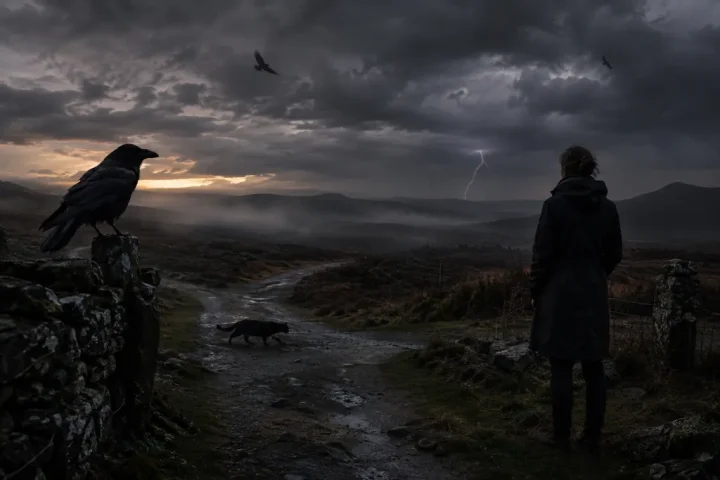
As a lwa of the winds, Badessy may be understood through the invisible but unmistakable force of moving air. Wind cannot be held or seen directly, yet its presence is revealed through everything it touches. Trees bend, clouds travel, waters rise and voices are carried across great distances.
This makes the wind an appropriate symbol of spiritual movement. Like a lwa entering a ceremony, it may arrive suddenly, alter the atmosphere and make an unseen presence impossible to ignore.
Badessy’s influence may be imagined within the soft breeze that brings relief from oppressive heat, but also within the violent gusts that announce an approaching storm. Wind is neither permanently gentle nor permanently destructive. Its nature depends upon its intensity, direction and the conditions through which it moves.
Badessy and the Sky
Some references associate Badessy with the sky rather than specifically with the wind. These two domains need not contradict one another. The wind moves through the heavens, drives clouds across the horizon and carries the changing weather over the earth.
The sky is also a realm of distance, height and mystery. It appears open and limitless, yet human beings can never grasp it. A spirit connected with the sky therefore belongs to a domain that surrounds the world while remaining beyond ordinary reach.
Badessy may consequently represent not only wind itself, but the vast and shifting atmosphere through which unseen forces travel.
Badessy, Bade and Sogbo
Badessy should be distinguished carefully from Bade, another Haitian lwa associated with the wind. Bade is more clearly documented as the inseparable companion of Sogbo, the lwa of thunder and lightning. When wind and lightning act together, they express the gathering force of a storm. (bpb-us-e2.wpmucdn.com)
Because Badessy and Bade have similar names and overlapping associations, they may occasionally have been confused in modern reference works. They may represent separate spirits, regional names, related manifestations or variant spellings transmitted through different sources.
Without stronger historical or liturgical documentation, it would be misleading to state with certainty that Badessy and Bade are identical. The safest approach is to preserve Badessy as an obscure wind or sky lwa while acknowledging the possible connection.
The Meaning of Lwa
Badessy is described as a lwa, traditionally also written loa.
A lwa is not simply a “deified spirit of the dead”. Haitian Vodou distinguishes between the lwa and ordinary ancestral spirits, although both may remain involved in the lives of the living. The lwa are powerful spiritual beings who serve beneath Bondye, the transcendent creator, and interact with devotees through ceremony, prayer, offerings, dreams and spirit possession. (Wikipedia)
Each lwa possesses an individual character, history and manner of approaching humanity. Some govern recognisable natural forces, while others are connected with healing, warfare, agriculture, love, death, water or social relationships.
Badessy belongs to the less documented regions of this immense spiritual world.
Wind as Messenger
Across many religious traditions, wind is associated with messages, breath and invisible spiritual activity.
A sudden change in the air may be interpreted as an announcement that something is approaching. Wind carries words, music, scents and signs from one place to another. It connects distant regions without becoming fixed in any of them.
Seen through this symbolism, Badessy may represent communication that arrives indirectly. The spirit’s presence would not necessarily be expressed through a visible form. It might instead be experienced as movement, pressure, sound or a sudden alteration in the surrounding atmosphere.
This interpretation is symbolic rather than a documented ritual teaching specifically attributed to Badessy. Because the surviving information is so limited, modern elaborations should not be presented as established Vodou tradition.
Freedom and Unpredictability
The wind follows no human road. It crosses borders, enters through open windows and moves wherever conditions allow.
Badessy may therefore evoke freedom, transition and the breaking of stagnation. A wind spirit naturally suggests movement after stillness and the arrival of change after a period in which nothing appears to progress.
Yet wind also warns against attempting to control every force. It may assist a journey or overturn it. It may cleanse the air or carry destruction. Its power cannot be reduced to a single moral quality.
Like many spirits of nature, Badessy should not be understood as entirely benevolent or malevolent. The wind gives life, but it can also expose human vulnerability.
An Elusive Lwa
The scarcity of information surrounding Badessy is itself significant.
Haitian Vodou is an initiatory and community-based religious tradition. Not every lwa is described fully in books, and knowledge may belong to particular families, temples or regions. Details concerning songs, rhythms, ritual service and relationships between spirits are not always available to outsiders.
Western reference works frequently compress complicated spiritual beings into a single sentence. Such summaries may preserve a name while losing the living traditions that once surrounded it.
Badessy therefore remains mysterious: a name carried on the wind, pointing towards a body of knowledge that has either remained private, changed over time or been imperfectly recorded.
Explore the Lwa and the Mysteries of Haitian Vodou
Badessy is only one of the many spirits whose names survive at the edges of written Vodou tradition. Behind every brief reference lies a far greater world of sacred songs, spirit families, ritual service, possession, healing and relationships between humanity and the unseen.
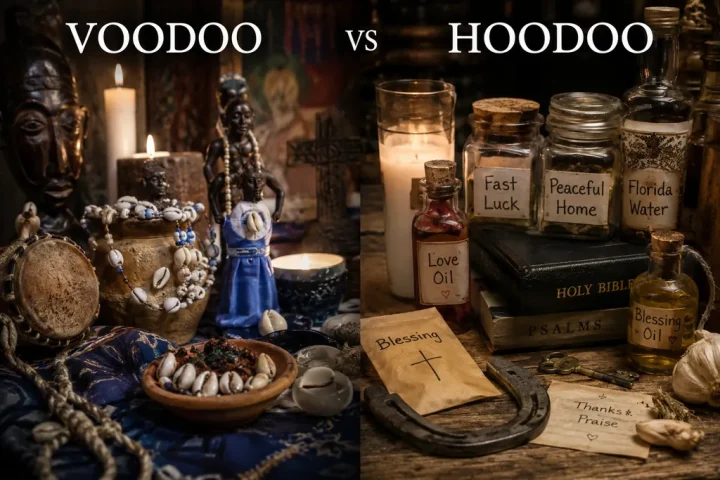
Inside the Occult World Mystery School, you can explore Haitian Vodou, the lwa, African and Caribbean spiritual traditions, Hoodoo, spirit work, divination, necromancy, witchcraft and practical occult knowledge in far greater depth.
The Classroom gives you access to structured courses, while the expanding Library contains rare books, historical texts and valuable material for deeper study. You can also ask questions, discuss difficult subjects and receive personal guidance within a community created for serious seekers of hidden knowledge.
Do not allow the mysteries to remain nothing more than names carried upon the wind.
Join the Occult World Mystery School today and begin discovering the spirits, traditions and sacred knowledge concealed beyond the surface of the occult world.
SOURCE:
Encyclopedia of World Mythology and Legend, Third Edition – Written by Anthony S. Mercatante & James R. Dow– Copyright © 2009 by Anthony S. Mercatante






Follow