

Balam
Also known as: Balan
Balam is the fifty-first spirit named in the Ars Goetia, the first book of the Lesser Key of Solomon, where he is described as a great and terrible king commanding forty legions of demons. Later demonological traditions also identify him as one of the Fallen Angels and claim that before his fall he belonged to the angelic order of the Dominions, one of the celestial hierarchies traditionally associated with authority and governance.
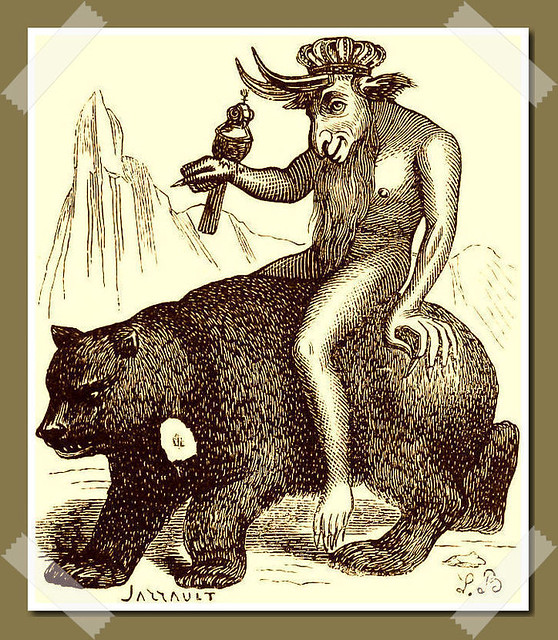
His appearance is among the most striking of the seventy-two spirits attributed to Solomon. Balam is described as having three heads, those of a bull, a man and a ram, while his body terminates in the tail of a serpent and his eyes blaze like flames. He rides upon an angry bear and carries a goshawk upon his fist, giving him the appearance of an infernal king who combines animal strength, predatory vision and supernatural intelligence. Some depictions show him naked, which makes the combination of human and animal characteristics even more unsettling.
Despite his terrifying form, Balam is not primarily described as a spirit of destruction. His principal powers concern knowledge, perception and concealment, and when properly compelled within the framework of Solomonic magic he is said to provide truthful answers concerning events of the past, present and future.
Balam as a Great King
The title of King places Balam among the higher-ranking spirits of the Goetic hierarchy. His command over forty legions indicates considerable authority and suggests that he was understood as far more than an isolated supernatural being.
The hierarchy preserved in the Ars Goetia reflects a wider medieval and Renaissance tendency to imagine the infernal world as an organised kingdom. Demons were assigned titles such as kings, dukes, princes, marquises, presidents and earls, creating a supernatural political system that mirrored earthly courts and military structures.
Balam’s royal position therefore carries both magical and symbolic importance. He possesses his own office, authority and recognised powers, while the spirits beneath him form part of the greater infernal order imagined by the grimoire tradition.
Knowledge of Past, Present and Future
Balam’s best-known ability is his power to reveal hidden knowledge concerning time. He is said to answer questions about what has already happened, what is taking place in the present and what may occur in the future.
Within the worldview of ceremonial magic, this made him particularly valuable because knowledge itself was considered a form of power. Understanding past events could expose concealed motives or forgotten actions, while insight into present circumstances might reveal things occurring beyond the magician’s immediate perception. Knowledge of the future entered the still more dangerous territory of prophecy and divination.
The tradition that Balam gives truthful answers is noteworthy because grimoires frequently warn that spirits may deceive or manipulate the person who approaches them. Balam’s reputation instead presents him as a frightening but potentially reliable source of hidden information when constrained according to the ritual authority prescribed by the Solomonic tradition.
The Power of Invisibility
Balam is also credited with the ability to make people invisible.
Medieval and Renaissance magical texts contain numerous references to invisibility, although the meaning of the term is not always straightforward. Some readers have understood it literally as the supernatural ability to vanish from physical sight, while later occult interpretations sometimes treat invisibility more broadly as the ability to remain unnoticed, escape attention or move without attracting observation.
Whatever interpretation is preferred, the power fits Balam’s wider association with perception. The same spirit who is believed capable of revealing what is hidden can supposedly manipulate what other people are able to perceive.
This combination gives Balam a particularly interesting position within demonology because his powers revolve around the boundary between the visible and invisible worlds.
Balam and the Gift of Wit
Another traditional ability attributed to Balam is the power to grant wit.
In the older language of the grimoires, wit should not be understood simply as humour. It refers more broadly to intelligence, cleverness, mental agility and the ability to understand situations quickly.
This attribute fits naturally with Balam’s other powers. A spirit who reveals hidden knowledge would also be associated with the intelligence required to interpret that knowledge, while the ability to remain unnoticed would benefit from quick judgement and strategic thinking.
Balam therefore represents a dangerous form of insight in which perception, concealment and intelligence are closely connected.
The Three Heads of Balam
Balam’s three heads have inspired considerable symbolic interpretation.
The bull has long represented physical strength, fertility, authority and force, while the ram is frequently associated with aggression, determination and leadership. Between these animal heads appears the human face, suggesting consciousness and intelligence existing alongside raw instinct.
The serpent tail introduces another ancient symbol that has repeatedly been connected with hidden wisdom, transformation, danger and the mysteries of forbidden knowledge.
The goshawk carried on Balam’s fist contributes a further dimension. Birds of prey possess extraordinary eyesight and observe the landscape from a perspective unavailable to creatures confined to the ground, making the goshawk an appropriate companion for a spirit whose principal powers concern seeing what others cannot.
His bear also carries considerable symbolic weight. The animal is associated with physical strength, ferocity and territorial power, yet Balam does not struggle against it. He rides it, suggesting command over the violent force the animal represents.
Taken together, the imagery surrounding Balam creates the impression of a ruler whose intelligence exists in complete partnership with dangerous instinct.
Balam and the Fallen Angels
Later demonological traditions describe Balam as a former member of the angelic order of the Dominions.
Within Christian angelology, the Dominions occupy a relatively exalted position in the celestial hierarchy and are associated with divine authority, regulation and the governance of lower angelic orders.
The idea that Balam once belonged to such an order adds another layer to his infernal kingship. His authority in Hell becomes an inversion of the celestial authority he was once believed to possess.
This theme appears frequently within demonology, where powerful demons are portrayed not as primitive monsters but as fallen beings whose former angelic dignity has been corrupted rather than completely erased.
Balam’s intelligence, command over legions and royal title consequently become easier to understand within that theological framework.
Balam in the Solomonic Tradition
Balam belongs to the wider magical world surrounding King Solomon, who was credited in medieval and early modern occult literature with possessing extraordinary authority over spirits.
The Solomonic tradition describes the magician as compelling supernatural beings through divine names, seals, prayers and carefully constructed rituals. The power does not supposedly come from the magician alone but from invoking a higher divine authority capable of constraining the spirit.
Within that system, demons were given individual seals and clearly described offices so that the practitioner could identify the precise spirit associated with a desired form of knowledge or influence.
Balam’s position as the fifty-first spirit therefore places him within a carefully ordered magical cosmology rather than presenting him as an isolated monster.
Understanding that system is essential because the Ars Goetia is not simply a collection of bizarre demonic descriptions. It belongs to a much larger tradition involving ceremonial magic, sacred names, spirit hierarchies and the belief that invisible forces could be organised and approached through ritual knowledge.
Beyond the Image of the Three-Headed Demon
Balam is easy to remember because of his dramatic appearance, but concentrating only on the bull, ram, serpent and bear misses what makes him genuinely interesting within demonology.
His description opens directly into the history of Fallen Angels, Solomonic magic, infernal kingship, divination, invisibility, spirit command and the complicated medieval attempt to classify the supernatural world.
This is why demonology becomes far more rewarding when it is studied as a tradition rather than treated as a collection of frightening names.
The seventy-two spirits of the Ars Goetia are part of a system that developed through manuscripts, religious ideas, magical experimentation and centuries of reinterpretation. Understanding Balam properly therefore means understanding the occult world that produced him.
Go Far Beyond the Ars Goetia
If Balam fascinates you, then reading that he commands forty legions and can reveal the future should be the beginning of your study rather than the end of it.
The Occult World Mystery School was created for people who want to understand demonology beyond simplified online descriptions and recycled lists of spirits.
Inside the Demonology course, you can go much deeper into the history of demons, Fallen Angels, infernal hierarchies, Solomonic magic, grimoires, spirit classification and the occult traditions that preserved these beings for centuries. Instead of encountering a demon as an isolated name, you begin to understand the theological, magical and historical framework that gave that name meaning.
There are thousands of spirits, gods, demons, magical systems, grimoires and forgotten traditions waiting beyond it, and every one of them becomes more fascinating once you understand the world from which it emerged.
Balam is only one figure among the seventy-two spirits attributed to Solomon, while the Ars Goetia itself represents only one branch of a vast demonological tradition extending across ancient religion, medieval theology, Renaissance magic and later ceremonial occultism.
If you are genuinely serious about demonology, there comes a point when collecting demon names is no longer enough. You need to understand the grimoires that preserved them, the hierarchies that organised them and the magical systems that attempted to explain their powers.
Join the Occult World Mystery School and enter the Demonology course. Go beyond the names and begin studying the infernal tradition in depth.
From “The Goetia: The Lesser Key of Solomon the King” (1904) Written by S.L. MacGregor Mathers
BALAM. -The Fifty-first Spirit is Balam or Balaam. He is a Terrible, Great, and Powerful King. He appeareth with three Heads: the first is like that of a Bull;the second is like that of a Man; the third is like that of a Ram. He hath the Tail of a Serpent, and Flaming Eyes. He rideth upon a furious Bear, and carrieth a Boshawk upon his Fist. He speaketh with a hoarse Voice, giving True Answers of Things Past, Present, and to Come. He maketh men to go Invisible, and also to be Witty.
He governeth 40 Legions of Spirits. His Seal is this, etc.

From the “Pseudomonarchia Daemonum” ( 1583 ) Written by Johann Weyer (Johann Wier)
Balam is a great and a terrible king, he commeth foorth with three heads, the first of a bull, the second of a man, the third of a ram, he hath a serpents taile, and flaming eies, riding upon a furious [very powerful] beare, and carrieng a hawke on his fist, he speaketh with a hoarse voice, answering perfectlie of things present, past, and to come, hee maketh a man invisible and wise, hee governeth fourtie legions, and was of the order of dominations.
Original Text:
Balam Rex magnus and terribilis: prodit tribus capitibus, primo tauri, altero hominis, tertio arietis: cauda adhæc serpentina, oculis flammeis, equitans in urso fortissimo, and accipitrem in manu portans. Raucam edit vocem: perfectè respondet de præteritis, præsentibus and futuris: reddit hominem and invisibilem and prudentem. Quadraginta legionibus præsidet, and fuit ex ordine dominationum.

From the “Dictionnaire Infernal” (edition of 1863 ) Written by Jacques Auguste Simon Collin de Plancy
Balan, who commands 40 legions, is presented with a serpent’s tail, eyes that shoot fire, and three heads: a bull, a man, and a ram. He is usually shown carrying a sparrowhawk on his wrist and riding nude and horned upon a bear. His voice is hoarse and harsh. Balan can tell of past/present/future events, teaches cunning, finesse, and the easy way to see without being seen. He was once in the heavenly order.
Original Text :
Balan, roi grand et terrible dans les enfers.
Il a quelquefois trois tôles : celle d’un taureau, celle d’un homme, celle d’un bélier. Joignez à cela une queue de serpent et des yeux qui jettent de la flamme. Mais plus ordinairement il se montre à cheval, nu et cornu, sur un ours, et porte un épervier au poing. Sa voix est rauque et violente. Il répond sur le passé, le présent et l’avenir. — Ce démon, qui était autrefois del’ordre des dominations, et qui commande aujourd’hui quarante légions infernales, enseigne les ruses, la finesse et le moyen commode devoir sans être vu.




Follow