
Barguest : Black Dog of northern England.
Etymology:
Possibly from the German Bargeist (“spirit of the [funeral] bier”), the German Berggeist (“hill ghost”), the German Bärgeist (“bear ghost” or “bar [gate] ghost”), or the Old English burh gast (“town ghost”); alternatively, a derivative of the English boggart, a supernatural being. Another possibility is a derivative of “barrow ghost.”
Variant names:
Bargest, Barghaist, Barghest,Barn-ghaist.
Physical description:
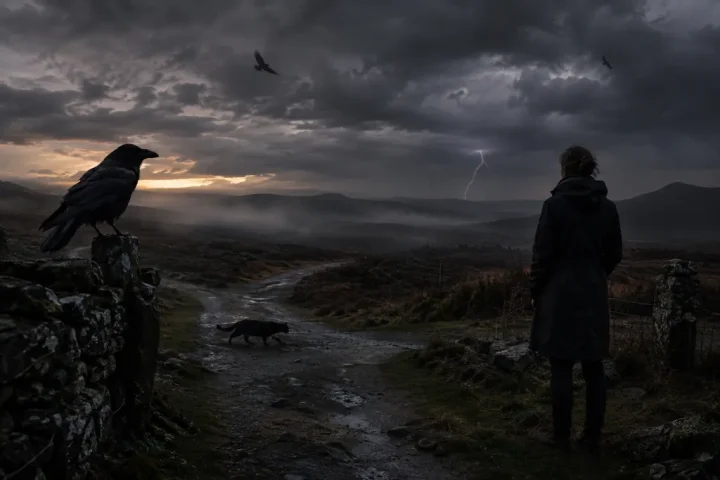
Black dog as large as a calf. Woolly. Large, luminous eyes. Big fangs.
Behaviour:
Howls and shrieks. Accompanied by the sound of chains. Can change its shape. Said to appear at the deaths of notable people. Domestic dogs will follow it, howling and baying.
Habitat:
Dark lanes, churchyards.
Distribution:
Yorkshire and Lancashire, England.
Sources:
- William Hone, The Every-Day Book and Table Book (London: T. Tegg, 1841), vol. 3, p. 655;
- William Henderson, Notes on the Folk-Lore of the Northern Counties of England and the Borders (London: Folk-Lore Society, 1879), pp. 274–275;
- John Harland and T. T. Wilkinson, Lancashire Folk-Lore (Manchester, England: John Heywood, 1882);
- Jessica Lofthouse, North Country Folklore (London: Robert Hale, 1976).
SEE ALSO:
SOURCE:
Mysterious Creatures – A Guide to Cryptozoology written by George M. Eberhart – Copyright © 2002 by George M. Eberhart






Follow