
Cahal Pech: The Haunted Maya Ruins of Belize
Cahal Pech is one of Belize’s most atmospheric Maya sites. Resting on a hill above San Ignacio in the Cayo District, it is not only valued for its archaeology, age and architecture, but also for the strange feeling many visitors describe when walking through its ancient courtyards. Some say the ruins feel unusually still. Others describe the sense of being watched, as though the old stone walls still remember the people who once lived, ruled, worshipped and died there.
Unlike more dramatic ghost stories filled with apparitions, screams or violent legends, the haunted reputation of Cahal Pech is quieter and more psychological. It is a place of pressure, silence, shadow and presence. Its haunting is not always described as a visible ghost, but as an atmosphere — a feeling that the ancient inhabitants have not entirely left.
What Is Cahal Pech?
Cahal Pech is an ancient Maya site located near the modern town of San Ignacio in western Belize. Its name is usually translated as “Place of Ticks,” a modern name connected to the area’s later use as pastureland. The original ancient name of the site has been lost, which already gives Cahal Pech a mysterious quality. We know the stones, the courtyards and the ceremonial spaces, but not the name by which its own people called it.
The site is one of the oldest known Maya settlements in the region, with evidence of occupation reaching back to around 1200–1000 B.C. Over time, Cahal Pech developed into an important centre in the Belize River Valley. It contained temples, palaces, ballcourts, courtyards, residential structures and ceremonial spaces. The site was not simply a village or a ruin in the modern sense. It was once a living world of politics, ritual, family life, hierarchy, trade and sacred power.
Cahal Pech is especially known for its compact and intimate layout. Unlike vast ceremonial cities where visitors may feel overwhelmed by scale, Cahal Pech draws people inward. Its maze-like rooms, narrow passages, shadowed corners and enclosed courtyards create the impression of entering a private world. This is one of the reasons the site feels so haunted to many people. It does not feel abandoned in the ordinary sense. It feels as though one has stepped into a place where something is still present.
The Haunted Reputation of Cahal Pech
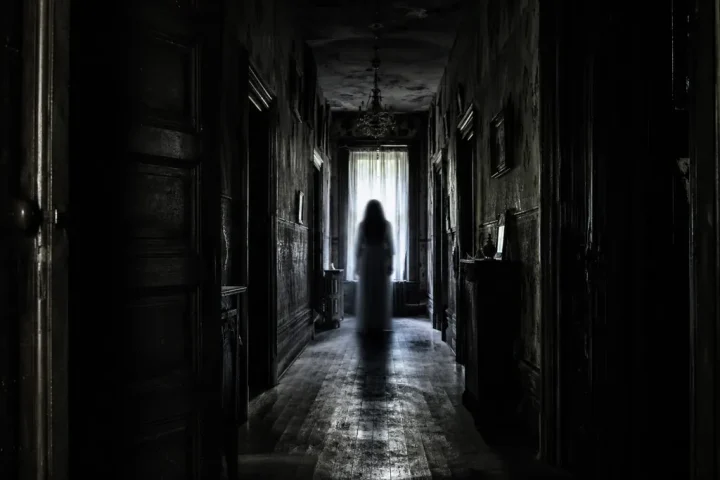
The haunted reputation of Cahal Pech centres mainly on the sensation of being watched. Visitors have reported unease in certain areas of the ruins, especially in the quieter courtyards and near enclosed chambers. Some describe the atmosphere as heavy. Others feel as though unseen eyes are observing them from doorways, staircases or the edges of the jungle.
This type of haunting is subtle but powerful. There may be no famous “white lady” or single ghostly figure attached to Cahal Pech, but the site carries the deeper, older feeling of ancestral presence. The spirits believed to linger there are often imagined as the ancient inhabitants themselves — nobles, priests, servants, warriors, families and ritual specialists whose lives were bound to the stones.
Many haunted places are remembered because something terrible happened there. Cahal Pech is different. Its eerie reputation comes from age, sacredness and silence. It is haunted not only by death, but by memory. When visitors walk through the ruins, they are moving through the remains of a world that lasted for centuries and then disappeared. That disappearance creates a spiritual tension. The people are gone, but their architecture remains. Their voices are gone, but their spaces still shape the body of anyone who enters them.
Why Cahal Pech Feels So Eerie
Cahal Pech has a different atmosphere from many open archaeological sites. Its layout is enclosed and intimate. The courtyards can feel like rooms without roofs. The corridors and chambers invite the imagination to fill the empty spaces with movement. A visitor may turn a corner and feel, for a brief moment, that someone has just moved out of sight.
The jungle also plays a role in the haunted feeling. Trees surround the ruins. Shadows shift over the stone. Birds, insects and rustling leaves create sudden sounds that seem to come from nowhere. The boundary between architecture and wilderness is thin. Roots press near ancient walls. Light falls unevenly across staircases and entrances. One moment the site feels peaceful; the next, it feels watchful.
This is the perfect environment for ghost lore. Human beings are highly sensitive to enclosed spaces, silence and peripheral movement. In a place like Cahal Pech, the mind naturally becomes alert. Yet for those with an occult or spiritual sensitivity, that alertness can feel like more than imagination. The site seems to hold a charge — not necessarily malevolent, but undeniably powerful.
Ancient Maya Presence and the Spirits of the Dead
To understand the haunted reputation of Cahal Pech, one must consider the ancient Maya relationship with the dead. The Maya world was not divided in the same modern way between the living and the dead, the material and the spiritual. Ancestors mattered. Lineage mattered. Sacred space mattered. The dead could remain spiritually significant, especially when connected to ruling families, ritual authority and place.
Cahal Pech was associated with elite residence and ceremonial life. This means it was not merely a practical settlement, but a place where power was performed and maintained. Courtyards, temples and restricted spaces would have shaped how people moved, gathered, witnessed rituals and experienced hierarchy. In such a setting, the presence of ancestors would not have been abstract. It would have been woven into the social and spiritual identity of the site.
For this reason, the idea that Cahal Pech is haunted by ancient inhabitants feels symbolically appropriate. Whether one interprets the haunting literally or psychologically, the ruins do seem to hold ancestral weight. They are the remains of a world where the dead were not simply forgotten. They were part of continuity, memory and sacred authority.
The Feeling of Being Watched
The most persistent element in Cahal Pech’s haunted reputation is the feeling of being watched. This sensation is often reported at ancient sites, especially those with narrow entrances, elevated platforms and enclosed courtyards. At Cahal Pech, the architecture itself seems to create this effect.
Standing in one of the courtyards, a visitor may notice how many doorways, platforms and edges surround them. The body instinctively understands that these were once places from which people observed, gathered and moved. Even when empty, the structures retain that function. The architecture remembers watching.
This is where archaeology and haunting meet. A palace, temple or ceremonial courtyard was designed to direct attention. People would have looked down from platforms. Rituals would have been witnessed. Authority would have been displayed. Today, the people are gone, but the design remains. The result is a strange reversal: the visitor comes to look at the ruins, but the ruins seem to look back.
A Haunting Without a Single Ghost
Some haunted places are dominated by one famous apparition. Cahal Pech is more diffuse. Its ghost story is not centred on one named spirit, but on the collective presence of the ancient dead. This makes it feel older and more mysterious.
The spirits of Cahal Pech, if one believes they remain, are not easily reduced to a simple legend. They belong to a civilisation whose full inner world cannot be completely recovered. Their names, languages, rituals and personal histories are only partly known through archaeology. This absence creates space for the uncanny. The unknown becomes a doorway.
The lack of a single ghost also makes Cahal Pech more believable to many visitors. The atmosphere does not depend on theatrical horror. It depends on the quiet awareness that thousands of human lives unfolded here. Children may have played in these spaces. Rulers may have planned alliances. Priests may have performed rituals. Families may have mourned their dead. The stones are silent, but they are not empty.
Cahal Pech in Paranormal Imagination
Cahal Pech has also entered modern paranormal imagination through ghost-hunting interest and local storytelling. Ancient ruins often attract this kind of attention because they combine death, ritual, mystery and dramatic atmosphere. For occultists and paranormal researchers, Cahal Pech offers the perfect setting: an ancient ceremonial landscape, a vanished elite residence, jungle silence and a strong emotional response from visitors.
However, it is important to approach such places with respect. Cahal Pech is not a fantasy setting created for ghost tourism. It is a real archaeological site connected to the history and heritage of the Maya people. Any discussion of its haunted reputation should honour that reality. The spirits spoken of in relation to Cahal Pech are not entertainment props. They represent ancestral memory, cultural depth and the sacred relationship between land and people.
This respectful approach makes the haunting more meaningful. Instead of asking only, “Are there ghosts here?” we can ask deeper questions. What does it mean for a place to remember? Can architecture hold emotional and spiritual residue? Do sacred sites continue to affect human consciousness long after their original purpose has faded? Cahal Pech invites these questions.
The Occult Meaning of Ruins
From an occult perspective, ruins are powerful because they exist between worlds. They are neither fully alive nor fully dead. They are fragments of a past civilisation still standing in the present. This makes them liminal spaces — thresholds between time periods, between the visible and invisible, between memory and mystery.
Cahal Pech has this liminal quality strongly. It sits above the modern town, yet belongs to a much older reality. Visitors can arrive from contemporary Belize, climb into the ruins, and suddenly feel transported into another layer of existence. The transition is not only historical. It can feel spiritual.
Ruins also remind us that human power is temporary. Cahal Pech was once a place of authority, ritual and elite life. Today, its rulers are gone. Its original name is gone. Its ceremonies have ceased. Yet the site remains, and in that remaining there is power. Haunted places often teach the same lesson: nothing truly disappears without leaving an imprint.
Is Cahal Pech Truly Haunted?
Whether Cahal Pech is truly haunted depends on how one defines haunting. If a haunting must involve a visible apparition, documented voices or objects moving by themselves, then the evidence remains uncertain. But if a haunting can also mean the lingering presence of memory, emotion, ancestral power and sacred atmosphere, then Cahal Pech is undeniably haunting.
Many visitors do not need proof to feel that something is unusual there. The body responds before the mind explains. A sudden chill, a sense of pressure, the feeling of being watched, the instinct to lower one’s voice — these experiences are part of the haunted reputation of the site.
Sceptics may explain these sensations through architecture, shadow, jungle sounds and expectation. Spiritual visitors may interpret them as contact with the ancient dead. Both views can exist side by side. Cahal Pech does not force a single answer. It invites experience.
Visiting Cahal Pech with Respect
Anyone visiting Cahal Pech should remember that this is a protected archaeological site, not merely a haunted attraction. The stones, chambers and artefacts belong to Belize’s cultural heritage. Visitors should stay on permitted paths, avoid climbing where prohibited, never remove stones or objects, and never leave offerings unless this is explicitly allowed by site authorities.
For those who are spiritually sensitive, a respectful inner attitude is also important. Before entering, take a moment to acknowledge the land and the people who once lived there. Do not provoke, command or challenge any presence you may feel. Ancient sites should be approached with humility. If you feel watched, simply observe the feeling. If you feel uneasy, step back, breathe and leave the space respectfully.
The best occult practice at a place like Cahal Pech is not domination, but listening.
Why Cahal Pech Still Captures the Imagination
Cahal Pech captures the imagination because it feels intimate, ancient and alive with absence. It is not the largest Maya ruin in Belize, but it may be one of the most atmospheric. Its enclosed rooms, courtyards, stairways and jungle surroundings create a sense of entering a hidden memory palace.
The haunted reputation of Cahal Pech is therefore not just about ghosts. It is about the relationship between place and presence. It is about how the past presses against the present. It is about how sacred architecture can continue to affect the human spirit long after its builders are gone.
For some, Cahal Pech is an archaeological treasure. For others, it is a haunted ruin. For occultists, it can be both: a site where history, spirit, ancestry and mystery meet beneath the Belizean sky.
Explore Haunted Places, Ancient Mysteries and Occult Knowledge with Occult World
If the haunted reputation of Cahal Pech fascinates you, do not stop at the surface of the story. The world is filled with ancient ruins, sacred landscapes, ghost lore, spirit traditions and forgotten mysteries waiting to be explored with depth, respect and occult insight.
Inside the Occult World Mystery School, you can go deeper into the hidden side of history and spirituality. Join fellow occultists, witches, seekers and magical practitioners who are exploring haunted places, ancient grimoires, demonology, witchcraft, spirit work, divination, Voodoo, Hoodoo, Kabbalah, angels, necromancy, secret societies and much more.
Occult World is not just a place to read about mysteries. It is a community where you can study, ask questions, share experiences and grow your occult knowledge with others who take the unseen world seriously.
If Cahal Pech calls to your imagination, let it be the beginning of a deeper journey.
Join the Occult World Mystery School today and step beyond ordinary history into the living world of magic, spirits and ancient mystery.


Follow