

Faust: The Magician Who Bargained with Hell
Few names in the history of Western occultism possess the dark resonance of Faust. His legend stands at the meeting point of demonology, ceremonial magic, forbidden knowledge and the ancient fear that the human hunger for power can carry the magician beyond a boundary from which there is no easy return. Faust is remembered as the learned man who summoned an infernal spirit, entered into a blood pact and received twenty-four years of supernatural service in exchange for his body and soul. During those years the world appeared to open before him. Spirits obeyed, impossible journeys became possible, the dead could be made to appear and questions about Heaven, Hell and the hidden structure of creation could be placed directly before a demon. Yet every act of power took place beneath the shadow of a contract whose final clause could not be forgotten.
The legend did not arise entirely from literary invention. Behind Doctor Faustus stands a shadowy historical magician who appears to have lived in the German lands from approximately 1480 until 1540 or 1541. Sources disagree about his precise name and origins, calling him Georg Faust, Johann Faust or Johann Georg Faust, and much of what later generations believed about him is impossible to separate from rumour. What survives from his own period suggests a wandering astrologer, diviner and magician who deliberately cultivated an extraordinary reputation. Some contemporaries considered him learned, while others regarded him as a fraudulent necromancer and dangerous braggart. The hostility directed towards him is significant because Faust lived during an age in which theology, astrology, alchemy, magic and demonology could exist disturbingly close to one another. A man claiming unusual knowledge might be treated as a philosopher by one observer and as a servant of the Devil by another.
Even Faust’s death became part of the darkness surrounding his name. Later reports claimed that he died violently at an inn and that his body had been found mutilated, allowing rumours to develop that the Devil had finally taken him. It is possible that the historical Faust died in an accident involving alchemical experiments, although the evidence is uncertain. What matters for the development of the legend is that an ambiguous death became perfect material for demonological imagination. The controversial magician disappeared from history, but the story that Hell had collected him continued to grow.
The Devil’s Pact Before Faust
The idea of signing an agreement with the Devil was already centuries old when Faust became famous. Medieval Christianity preserved numerous legends concerning individuals who surrendered themselves to infernal powers in return for worldly advantage, wealth, love or influence. One of the most important was the story of Theophilus of Adana, a cleric who supposedly entered into a written agreement with the Devil after losing his position. The Theophilus legend ultimately ends with repentance and salvation through the intervention of the Virgin Mary, demonstrating that even a demonic contract did not necessarily place a sinner beyond divine mercy.
Faust inherited this older tradition but transformed it into something much more intellectually dangerous. He did not merely seek money, advancement or physical pleasure. His deepest desire was forbidden knowledge. He wanted to understand things unavailable to ordinary scholarship and to penetrate mysteries that theologians and philosophers could only discuss from a distance. He wanted spirits to answer questions about creation, Hell, the fall of Lucifer and the invisible structures behind the visible universe. In this sense, Faust became the ideal occult figure for the Renaissance, an age fascinated by the possibility that ancient knowledge, magical philosophy and direct contact with spiritual intelligences might reveal powers inaccessible to conventional learning.
The Faustbuch of 1587
The most important early version of the legend appeared in 1587 when Johann Spies published the anonymous Historia von D. Johann Fausten at Frankfurt. Usually called the Faustbuch, the work gathered stories surrounding the magician and transformed them into a coherent tale of ambition, conjuration, infernal deception and damnation. An English version appeared only a few years later, helping spread the legend beyond the German-speaking world and eventually providing important material for Christopher Marlowe’s Doctor Faustus.
The Faustbuch presents Faust as a man of exceptional intelligence who receives an education in theology but becomes dissatisfied with the limits of conventional knowledge. Books cannot answer everything he wants to know, and theology places boundaries around mysteries he wants to penetrate directly. Rather than accepting those boundaries, Faust begins turning towards magic. His intellectual ambition gradually becomes inseparable from pride because knowledge is no longer something he wishes merely to possess. He wants knowledge that grants authority.
This transition is crucial to the occult meaning of the legend. Faust does not enter demonology because he lacks intelligence. He enters it because intelligence has convinced him that ordinary limits should no longer apply to him. The danger begins when learning becomes entitlement and when curiosity develops into the conviction that every hidden door should be opened simply because the magician has found the key.
The Conjuration at the Crossroads
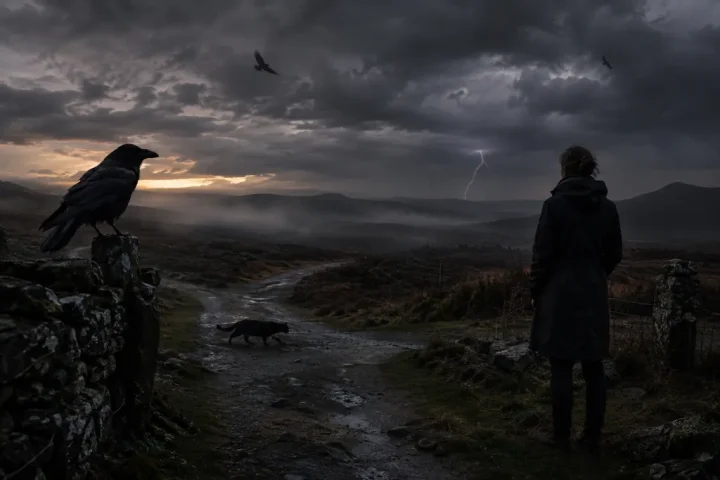
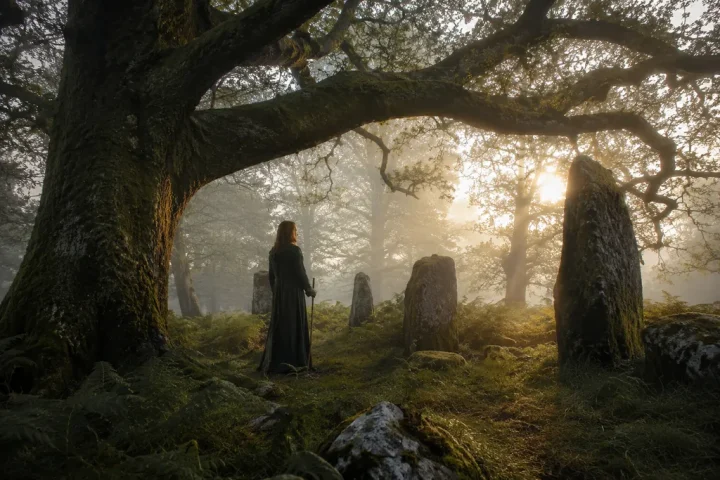
One of the most atmospheric passages of the early legend concerns Faust’s first deliberate encounter with infernal power. He travels into a wooded place associated with a crossroads and prepares a magical circle before performing his conjuration. Crossroads already possessed a long history of magical and supernatural associations, existing symbolically between directions and territories and frequently becoming places where ordinary boundaries were thought to weaken. Faust deliberately chooses such a threshold and attempts to command whatever answers.
The response unfolds through a sequence of terrifying manifestations. A strange supernatural form appears resembling a griffin or dragon, followed by fiery lights and other alarming phenomena. A burning human shape manifests, and eventually the entity assumes the much more ordinary appearance of a grey friar. The progression is suggestive because something that first reveals itself through monstrosity, flame and supernatural disturbance finally clothes itself in the form of religion. The terrifying becomes familiar, and the unfamiliar face of the infernal world becomes easier for Faust to approach.
Faust orders the spirit to come to his house, and the entity obeys. At first this obedience appears to confirm the magician’s superiority. He has performed the conjuration successfully, survived the manifestations and commanded a spirit to appear elsewhere. Yet the relationship is already more ambiguous than Faust understands. The spirit obeys because negotiations have only begun, and what looks like submission may simply be the first stage of a deeper entanglement.
Mephostophiles and the Blood Pact
The spirit eventually identifies itself as Mephostophiles, the early form of the name later immortalised as Mephistopheles. In the Faustbuch, Mephostophiles is not simply identical with Satan himself but belongs to an infernal hierarchy and serves greater powers. Faust demands that the demon obey him, answer his questions and provide whatever he desires, while Mephostophiles requires a price that no amount of earthly wealth can satisfy.
The agreement grants Faust twenty-four years of demonic service. During that period the spirit must provide knowledge, supernatural assistance and physical pleasures. When the agreed period expires, Faust will belong to the infernal powers. The contract is not merely spoken. It must be written and sealed in Faust’s own blood, turning the pact into both legal document and magical act.
One of the most chilling details in the tradition occurs when Faust attempts to draw the blood required for the agreement. The words O homo, fuge, meaning “O man, flee”, are said to appear as a warning. The moment is important because it removes any comforting suggestion that Faust is merely an innocent victim deceived without warning. He recognises danger, understands that he is crossing a boundary and nevertheless continues because the promise of knowledge and power outweighs his fear of what the agreement may ultimately cost.
The protective circle that once surrounded him during the conjuration cannot save him from a choice made deliberately. The magical circle protects the operator from an external force, but it offers no defence against ambition already operating within the magician himself.
Twenty-Four Years with a Demon
Once the contract is sealed, Mephostophiles becomes Faust’s supernatural companion and servant. The demon frequently appears in the form of a friar and provides the magician with luxurious food, wine, women and other pleasures, but Faust’s curiosity remains as important as his sensual appetites. He questions Mephostophiles relentlessly about the origins of the universe, the nature of Heaven and Hell, the fall of Lucifer and the organisation of the infernal world.
These conversations give the legend a distinctly demonological character because Faust effectively possesses a private instructor drawn from the very realm theologians describe only through scripture and speculation. Yet this access creates a problem that the magician never satisfactorily resolves. A demon may possess knowledge unavailable to ordinary people, but the magician cannot assume that the demon is truthful merely because it answers. The infernal teacher controls the information and therefore has the power to shape the pupil’s understanding of reality.
This problem appears repeatedly in magical and demonological literature. Conjuring a spirit is one thing, but establishing whether that spirit speaks truthfully is another. An intelligence capable of appearing in different forms, manipulating perception and understanding the magician’s desires may be far more dangerous when it appears cooperative than when it openly threatens him. Mephostophiles does not need to terrify Faust constantly because the magician’s own appetite keeps the relationship alive.
Faust’s Journey into Hell
After years of demonic service, verbal explanations are no longer sufficient for Faust. He wants to see Hell directly. According to the early legend, he asks for Belial but encounters Beelzebub instead, and preparations are made for a supernatural journey into the infernal regions. A strange chair made of bone appears, and Faust is carried away into a realm filled with hideous sights, violent heat, sulphurous fumes, terrifying sounds and the suffering of the damned.
What makes this episode especially interesting from an occult perspective is the uncertainty that follows it. Faust cannot determine whether he physically travelled into Hell, experienced a genuine spiritual journey or was subjected to a demonic illusion designed to overwhelm his senses. The early narrative itself allows this ambiguity to remain.
The problem is central to visionary magic. If a spirit transports the magician into another realm, creates visions or manipulates perception, the practitioner must somehow distinguish between revelation and deception. Faust possesses no reliable method of doing so because the same entity providing access to the experience is also capable of altering it. The magician believes he has gained extraordinary knowledge, but the demon retains control over what he sees and how he interprets it.
Forbidden Journeys and Magical Displays
As the twenty-four years continue, Faust becomes increasingly involved in supernatural travel, magical entertainment and displays of power before important people. He visits Rome, where the story depicts him mocking the Pope and stealing from the papal table, and later travels to Constantinople and appears before princes and emperors. Emperor Charles V becomes one of the rulers before whom Faust demonstrates his abilities, and the magician gains fame through manifestations that seem to collapse the boundary between illusion, necromancy and spirit conjuration.
These adventures are deliberately seductive. Faust appears to have obtained everything the pact promised. He moves through the world beyond normal restrictions, encounters powerful people and produces phenomena that astonish those around him. Yet the temporary nature of every triumph gives the episodes their darker meaning. The twenty-four years continue to pass regardless of how successful the magician becomes, and nothing Faust summons can stop time.
His supernatural power therefore contains a concealed weakness from the beginning. He can manipulate appearances, command spirits and travel beyond normal human limitations, but he cannot change the one condition upon which all of those abilities depend. Every successful operation consumes part of the period for which his power was purchased.
Helen of Troy
Among the most famous manifestations in the Faust tradition is the appearance of Helen of Troy, the legendary beauty whose memory was already inseparable from the destruction of an ancient civilisation. Faust initially summons Helen before a group of students, creating the impossible spectacle of a woman from classical antiquity apparently standing once more among the living.
Later the magician becomes fascinated by her himself and commands that Helen return. The early tradition eventually depicts her as Faust’s companion, and she is said to become pregnant and bear a son named Justus Faustus. The child is associated with unusual knowledge and supernatural characteristics, reinforcing the suspicion that neither mother nor son belongs fully to the ordinary human world.
The episode is deeply characteristic of Faust because even death and historical distance become boundaries he refuses to respect. It is not enough for him to study Helen as legend or history. He wants the ancient dead to become physically present and available to his desire. The magician who once demanded knowledge of invisible worlds eventually attempts to possess something that belongs to another age and another realm.
When Faust dies, Helen and the child disappear. Their vanishing suggests that the entire relationship was dependent upon the infernal agreement and that the world created around Faust by demonic power can survive only as long as the pact remains in force.
The Old Man and the Possibility of Repentance
One of the most important episodes in the Faustbuch occurs when a devout old man urges Faust to abandon his demonic allegiance and return to Christianity. This moment complicates the popular assumption that the blood pact automatically makes salvation impossible. The old man insists that divine mercy remains available, implying that the infernal contract possesses no absolute power over a person who genuinely repents.
Mephostophiles responds by increasing Faust’s fear and despair. The magician becomes convinced that he has passed beyond forgiveness, and rather than breaking with the demonic world he renews his commitment and signs another agreement in blood. His damnation therefore develops as much through despair as through magical practice.
This is one of the most subtle aspects of the legend. The demon’s greatest power may not lie in granting forbidden pleasures or producing supernatural phenomena but in controlling Faust’s understanding of his own condition. Once the magician believes that repentance has become impossible, he stops attempting it. Mephostophiles does not merely hold a contract over Faust; he teaches Faust to believe that the contract is stronger than mercy.
Within Christian demonology, such despair is itself an infernal victory. A person convinced that redemption is impossible becomes far easier to control than one who still believes another path remains open.
The Final Year
As the twenty-fourth year approaches its end, Faust’s earlier arrogance begins to collapse. Knowledge, supernatural travel, sensual pleasure and the obedience of spirits no longer appear as impressive as they once did because the magician understands that none of them can postpone the appointed hour. The man who once sought access to mysteries beyond ordinary human comprehension becomes increasingly consumed by fear of the single mystery he cannot escape.
Faust arranges his affairs and gathers students and companions around him for a final evening. He warns them against following his example and acknowledges that his pursuit of forbidden knowledge has brought him to the edge of destruction. The contrast with the confident magician who originally commanded Mephostophiles could hardly be greater. Power has not freed him from fear. It has merely given him twenty-four years in which to postpone confronting it.
During the final night, Faust withdraws to a room while his companions remain nearby. A violent supernatural disturbance develops after midnight. The house shakes, terrifying sounds fill the darkness and Faust is heard crying out, but those outside the room are too frightened to enter.
When morning arrives, the room presents a horrifying scene. Blood is said to cover the interior, while fragments of Faust’s body have been hurled against the walls. His mutilated remains are eventually discovered outside, while Helen and Justus have vanished completely. The legend leaves no uncertainty about the interpretation. The term of the agreement has expired, and the powers Faust once believed he could command have come to collect what was promised to them.
Christopher Marlowe and Doctor Faustus
The Faust story crossed quickly into England and became the foundation for Christopher Marlowe’s The Tragical History of Doctor Faustus. Written or first performed around the end of the sixteenth century and first printed in 1604, Marlowe’s play transformed the German legend into one of the greatest dramatic treatments of magical ambition.
Marlowe deepened Faust’s intellectual dissatisfaction. His Faustus has studied philosophy, medicine, law and theology but finds each discipline insufficient. He does not turn to magic because he lacks education; he turns to it because education has convinced him that there must be something beyond ordinary intellectual achievement. Necromancy appears to promise direct power over the forces hidden behind nature.
The tragedy becomes increasingly bitter because Faustus dreams of enormous magical authority but frequently wastes the supernatural powers available to him on spectacle, tricks and courtly entertainment. A man who imagined controlling the elements and reshaping kingdoms finds himself performing increasingly trivial wonders. His failure therefore concerns more than damnation. He obtains power but never develops the wisdom necessary to use it meaningfully.
Marlowe’s Faustus reveals one of the enduring occult themes hidden within the legend: power itself does not transform the character of the person who receives it. If ambition, insecurity or vanity already dominate the magician, greater power may simply give those weaknesses a larger field in which to operate.
Goethe’s Faust
More than two centuries later, Johann Wolfgang von Goethe transformed the legend once again. Goethe began working with Faust material during the early 1770s and continued returning to it throughout much of his life. Faust, Part One appeared in 1808, while Part Two was completed near the end of Goethe’s life and published posthumously in 1832.
Goethe’s version retains Mephistopheles, magic, witchcraft, necromantic imagery and the dangerous hunger for knowledge, but it changes the structure of the agreement fundamentally. Instead of receiving exactly twenty-four years before his soul becomes forfeit, Goethe’s Faust enters into a wager. Mephistopheles may serve him and expose him to everything the world can provide, but if Faust ever reaches a moment of such complete satisfaction that he wishes it to remain forever, the Devil may claim him.
The significance of this change is enormous. Goethe turns Faust’s danger away from a simple countdown and towards a philosophical problem. Faust’s protection lies in continual striving, while his damnation would come through the moment when desire finally stops and he becomes entirely satisfied with what he has achieved.
The Prologue in Heaven
Goethe frames the drama through the famous Prologue in Heaven, strongly influenced by the biblical Book of Job. Mephistopheles appears before the Lord and speaks cynically about humanity, after which Faust becomes the subject of a cosmic wager. The Devil is permitted to tempt him, confident that human weakness will eventually bring Faust under infernal control.
This reverses the structure of the earlier legend in an unsettling way. The Faustbuch begins with the magician deliberately calling the infernal world into his own life. Goethe places Faust within a much larger spiritual drama in which Mephistopheles is already discussing him before the magician fully understands what is happening.
Mephistopheles consequently becomes something more complicated than the obedient spirit of an occult contract. He remains cynical, destructive and dangerous, but his actions take place within a cosmic order larger than his own intentions. Even the Devil’s negation may unknowingly contribute to a process he does not ultimately control.
Gretchen, Witchcraft and Walpurgis Night
In Faust, Part One, Faust’s renewed vitality and desire lead directly into the tragedy of Gretchen, or Margarete. Through Mephistopheles and magical intervention, Faust becomes capable of pursuing the young woman, but their relationship unleashes a sequence of seduction, death, guilt and imprisonment.
Goethe surrounds the tragedy with powerful occult imagery. A witch participates in restoring Faust’s youth, while Walpurgis Night carries him into one of the most famous magical gatherings in European literature, where witches, spirits and supernatural beings move through a visionary world associated with the Brocken.
Gretchen ultimately refuses to escape from prison through the means Faust and Mephistopheles offer. She turns instead towards divine judgement. Mephistopheles declares that she is condemned, but a heavenly voice announces that she is saved.
The moment marks a crucial departure from the older Faust tradition because infernal judgement is shown to be incomplete. Mephistopheles may believe that he understands the fate of a human soul, but another authority exists beyond him.
The Devil Loses Faust
Faust, Part Two expands the story into an immense symbolic universe involving emperors, classical mythology, magical creation, spirits and the reappearance of Helen of Troy. Goethe’s Faust continues striving and experimenting until his death, at which point Mephistopheles finally expects to obtain the prize for which he has waited.
The infernal forces gather around Faust’s body, but angels intervene and carry away his immortal essence. Goethe therefore reverses the brutal conclusion of the Faustbuch. The earlier Doctor Faustus ends dismembered after the demonic powers enforce their claim, whereas Goethe’s Faust escapes infernal possession through a mysterious combination of ceaseless striving and divine grace.
Gretchen appears among the redeemed and participates in drawing Faust upwards, while the conclusion invokes the mysterious Eternal Feminine as a force leading humanity towards transcendence. Mephistopheles has understood the wording of his wager, but he has failed to understand the total spiritual reality in which that wager operates.
The demon who believed himself to be the master of the bargain discovers that his knowledge is also limited.
Faust and the Occult Hunger for Power
Faust remains essential to Demonology because his legend explores a fear hidden inside the very structure of ceremonial magic. Grimoires describe circles, seals, divine names, conjurations and hierarchies through which spirits are supposedly constrained. The magician stands within a protected space and addresses entities believed to possess knowledge and abilities beyond ordinary human limits. The ritual implies authority.
Faust represents the nightmare concealed within that promise of control. A spirit may obey because obedience itself advances the spirit’s purpose. A magician may believe that successful manifestations prove mastery when those manifestations are actually reinforcing dependence. The spirit may answer questions truthfully enough to gain credibility while shaping the magician’s desires in ways that gradually make the relationship impossible to abandon.
The deepest danger is therefore not necessarily a demon breaking through the magical circle. It is the possibility that the magician leaves the circle convinced that he has won.
Faust’s story repeatedly returns to the difference between external power and internal mastery. He gains access to spirits, pleasures, travel, knowledge and magical spectacle, yet he remains vulnerable to pride, fear and despair. He can compel Mephostophiles to perform wonders but cannot command his own appetite for more. His greatest weakness is not lack of magical ability. It is lack of mastery over the person using it.
The Faustian Shadow
The word Faustian survives because the pattern described by the legend extends far beyond literal demonology. It refers to any bargain in which knowledge, influence, power or achievement is obtained by surrendering something whose true value becomes apparent only after the exchange has been made.
For the occult reader, however, the original image remains far more disturbing than the metaphor. Faust enters a magical space because he believes hidden knowledge can elevate him beyond ordinary humanity. A spirit answers because he has successfully opened a door. The pact appears to give him extraordinary freedom, yet the very power he receives binds him increasingly to the source from which it came.
This is why the legend has survived for centuries. It speaks directly to the secret desire that has accompanied magic in almost every age: the conviction that reality contains hidden forces and that the person who learns their names, symbols and methods may acquire extraordinary influence over the world.
Faust discovers that influence without self-mastery is not liberation. The magician who cannot govern his own ambition eventually becomes governed by whatever promises to satisfy it.
Enter the Occult World Mystery School
If Demonology fascinates you, then memorising another catalogue of demon names is not enough. If Black Magick attracts you, then repeating rituals copied from random pages without understanding their history, structure or symbolism is not enough. Occult power has always been associated with knowledge, discipline, concentration, will, self-command and the ability to understand the system in which a ritual operates. Without those things, the practitioner is not controlling the operation. The operation is controlling the practitioner.
The Occult World Mystery School is built for people who want to move beyond passive fascination and begin understanding the machinery beneath the occult. Go deep into Demonology, Black Magick, ceremonial magic, Necromancy, ancient grimoires, Hoodoo, Vodou, spirits, divination and the hidden systems through which generations of occultists attempted to understand and influence their world. Learn why names of power matter, why ritual circles were constructed, why grimoires place spirits within hierarchies, why magical protection was considered essential and why serious traditions always demanded something far greater than curiosity from the person performing the work.
Power does not begin with commanding a demon or memorising a spell. It begins with refusing to live unconsciously. It begins with understanding your own mind, recognising what governs your choices, directing your attention deliberately and refusing to surrender your life to fear, distraction, habit or the expectations of other people. The powerful occultist does not merely dream about changing reality. The powerful occultist studies the forces that shape reality and then develops the discipline required to act within them intelligently.
That is what separates the serious practitioner from the endless crowd consuming occult entertainment while remaining completely powerless in their own lives. Join the Occult World Mystery School and stop being a spectator. Study Demonology until the hierarchies make sense. Study Black Magick until you understand the relationship between desire, will and consequence. Study the grimoires until the circles, seals, names and ritual structures stop looking like mysterious decoration and begin revealing the systems behind them.
Faust reached for power before he had mastered the one force closest to him: himself. Do not repeat his mistake. Enter the Occult World Mystery School and take control of your occult education, your discipline and the direction of your own world. There are thousands of spirits, gods, demons, magical systems, grimoires and forgotten traditions waiting beyond the threshold, but they reveal nothing to the person who is satisfied with fragments. If you want the surface, stay outside. If you want knowledge, power and genuine command over the direction of your own life, enter the Mystery School and go deeper.
FURTHER READING:
- Goethe, Johann Wolfgang von. The Autobiography of Johann Wolfgang von Goethe. Vols. 1 & 2. Chicago: University of Chicago Press, 1976.
- Goethe, Johann Wolfgang von. Faust. Edited by Cyrus Hamlin, translated by Walter Arendt. New York: Norton, 1976.
- Gray, Ronald D. Goethe the Alchemist: A Study of Alchemical Symbolism in Goethe’s Literary and Scientific Works. Mansfield Centre, Conn.: Martino, 2002.
- “Historia and Tale of Doctor Johannes Faustus.” Available online. URL: https://lettersfromthedustbowl.com/Fbk1. html. Downloaded March 7, 2008.
- Lukacs, Georg. Goethe and His Age. New York: Grosset & Dunlap, 1969.
SOURCE:
The Encyclopedia of Demons and Demonology – Written by Rosemary Ellen Guiley – Copyright © 2009 by Visionary Living, Inc.





Follow