
Abraxas: The Gnostic Power Beyond Good and Evil
Abraxas, also written as Abrasax, Abraxis, or Abracax, is one of the most mysterious and paradoxical figures in Gnostic, magical, and demonological tradition. He has been called a god, a demon, a supreme cosmic ruler, a magical name, and a symbol of the hidden force that stands beyond ordinary ideas of good and evil.
In some traditions, Abraxas is a divine power. In others, he is placed among demons. To the Gnostics, he represented a vast cosmic intelligence connected with the structure of the universe itself. To Christian demonologists, he became a dangerous and heretical being, associated with forbidden knowledge, magical rites, and spiritual rebellion.
This is what makes Abraxas so fascinating. He does not belong neatly to heaven or hell. He stands at the threshold between light and darkness, spirit and matter, creation and destruction. He is not merely a figure of evil, nor simply a being of light. Abraxas represents the terrifying unity of both.
Abraxas in Gnostic Tradition
In Gnostic belief, Abraxas was associated with the highest and final aeon, or spiritual sphere, ascending towards the unknowable God. He was believed to rule over the 365th aeon, a number that connects him directly with the solar year, cosmic time, and the hidden order of existence.
The number 365 is central to the mystery of Abraxas. In Greek numerology, the letters of his name were believed to add up to 365. This number was interpreted as the full cycle of the year, the totality of divine emanations, and the complete structure of heavenly powers.
For this reason, Abraxas was not seen as a minor spirit. He was a cosmic figure of immense significance. His name represented the full circle of time, the powers of the heavens, and the hidden forces that move through creation.
The Basilidian Gnostics and the 365 Powers
The Basilidian Gnostics, a sect active in the second century CE, regarded Abraxas as a supreme divine power. Some accounts describe him as the highest god of their system, while others place him as the ruler of 365 heavens or aeons.
These 365 powers were sometimes understood as gods, virtues, emanations, or cosmic forces, each corresponding to a day of the year. In this system, Abraxas was not simply one being among many. He was the ruler of the complete spiritual order.
Some traditions claimed that the Basilidians believed Jesus Christ was not a physical being, but a phantom or spiritual emissary sent into the world by this higher power. Whether taken literally or symbolically, this shows how radically different Gnostic theology could be from orthodox Christianity.
To the Gnostics, salvation was not achieved merely through obedience, but through gnosis: direct spiritual knowledge. Abraxas became part of this hidden language of knowledge, power, and cosmic ascent.
Abraxas and Demonology
Christian demonologists later placed Abraxas among the ranks of demons. This was partly because Gnostic teachings were regarded as heretical, and partly because Abraxas stood outside the approved Christian hierarchy of angels and saints.
What Gnostics saw as a supreme spiritual intelligence, demonologists interpreted as a deceptive or infernal power. In this way, Abraxas moved from the world of Gnostic theology into the darker catalogues of demonology.
This shift is important. Abraxas was not originally a simple demon in the modern sense. His demonisation reflects the way Christian authorities often reclassified rival gods, spirits, and magical powers as demonic. A being once associated with cosmic wisdom, solar power, and divine mystery became, in later occult literature, a spirit of danger, heresy, and forbidden knowledge.
Abraxas therefore belongs to a special category of occult beings: those who are too complex to be understood through one religious system alone.
Abraxas and the Solar Mysteries
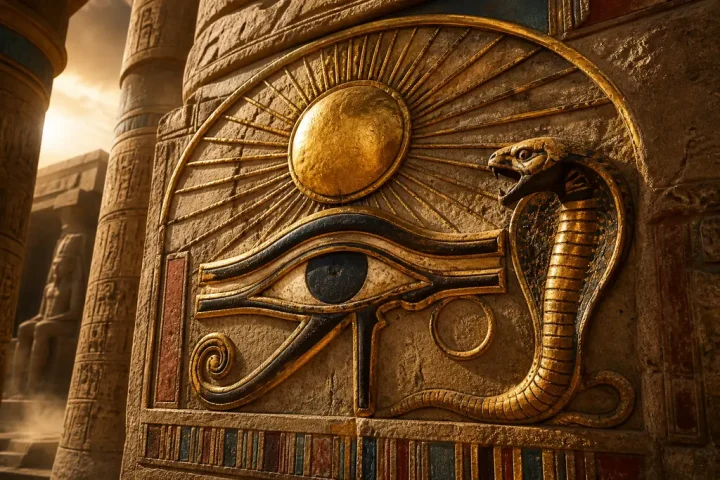
Abraxas is strongly connected with solar symbolism. Some traditions associate him with the Sun, the yearly cycle, and the powers that govern the movement of time. His link with the number 365 reinforces this solar identity.
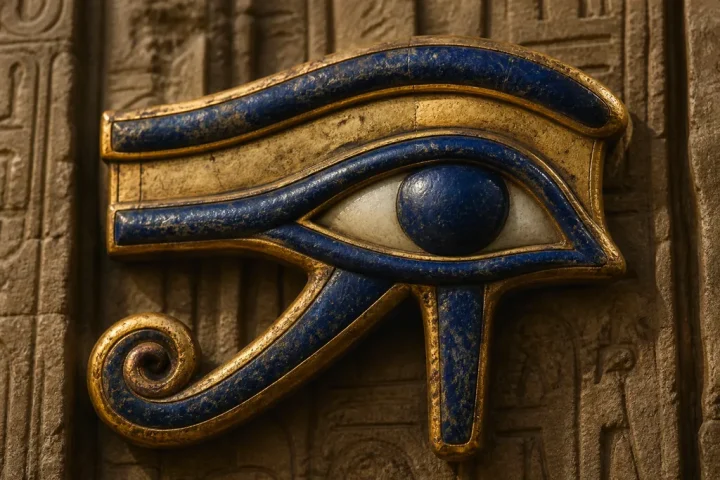
He has also been associated with Egyptian and mystery traditions, especially through symbolism connected with Isis and the ouroboros. The ouroboros, the serpent biting its own tail, represents eternity, return, self-generation, and the endless cycle of life and death.
Through this imagery, Abraxas becomes more than a deity or demon. He becomes a symbol of cosmic circulation: the power that moves through the year, the heavens, the body, and the soul.
Some writers have also connected Abraxas with Mithraic mystery religion, another ancient system rich in astrology, numerology, solar worship, and cosmic symbolism. Like Gnosticism, Mithraism used layered spiritual imagery to describe the soul’s ascent through hidden levels of reality.
The Appearance of Abraxas
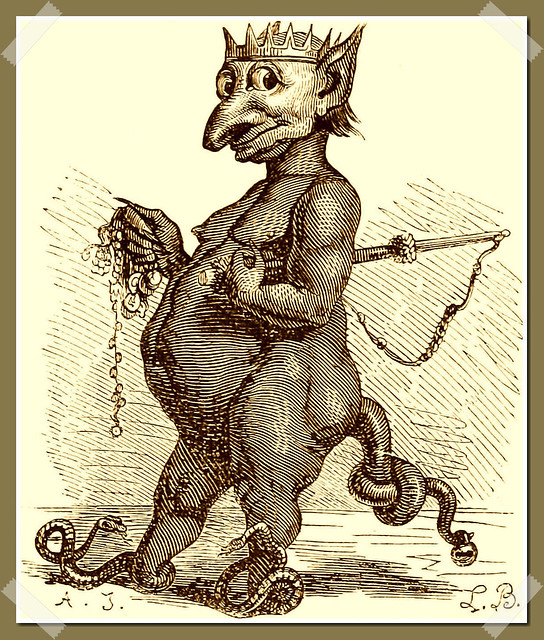
Abraxas appears most famously on Gnostic gems and magical amulets. These talismans often show him with a human body, the head of a rooster or cock, and serpent-like legs. In some descriptions, he has the head of a lion or king, while his legs may end in serpents or scorpions.
He is usually shown holding a whip, club, or flail in one hand and a round or oval shield in the other. The shield is sometimes inscribed with the name IAO, a sacred name connected with divine power and reminiscent of the Hebrew name of God.
Some images show Abraxas mounted on a chariot drawn by four white horses, with the Sun and Moon above him. This image presents him as a cosmic ruler moving through the heavens, commanding the powers of light, darkness, time, and celestial motion.
His appearance is strange, hybrid, and deliberately symbolic. Abraxas does not look like an ordinary god, angel, or demon. His body is a magical diagram.
The Symbolism of Abraxas
Every part of Abraxas carries meaning.
The rooster head represents wakefulness, vigilance, and the solar force that announces the dawn. It is the cry that breaks the silence of night and calls consciousness back into the world.
The human torso represents logos, reason, speech, and articulated thought. It shows that Abraxas is not merely animal instinct or chaotic force, but intelligence embodied.
The serpent legs represent prudence, earthly wisdom, hidden knowledge, and movement through the lower worlds. The serpent is both dangerous and sacred, connected with healing, temptation, rebirth, and magical power.
The shield symbolises wisdom and spiritual defence. It protects the divine warrior from illusion, ignorance, and hostile forces.
The whip, flail, or club represents command, motion, discipline, and the relentless driving force of life. It is the power that moves creation forward.
The four horses symbolise cosmic movement and the circulation of solar energy through the universe. They may also be read as powers of the four directions, four elements, or four subtle ethers.
Together, these symbols show Abraxas as a being of totality. He is not one thing. He is a union of many forces: solar, earthly, intellectual, animal, magical, and divine.
Abraxas and Abracadabra
Some scholars have suggested that the magical word “abracadabra” may be derived from Abraxas or connected with the same stream of magical language. Whether this connection is certain or not, both words belong to the world of sacred names, protective formulas, and ritual speech.
In magical traditions, names are not just labels. A name can be a key, a command, a vibration, a seal, or a container of power. The name Abraxas was used in various magical rites and engraved on amulets because it was believed to hold force in itself.
This makes Abraxas not only a figure to be depicted, but a word to be spoken, written, worn, and invoked.
Abraxas in Later Occult and Literary Tradition
Abraxas continued to fascinate occultists, writers, psychologists, and students of hidden religion long after the ancient Gnostic sects disappeared.
He appears in The Book of the Angel Raziel, a mystical work associated with angelic wisdom and magical knowledge. His presence there shows how fluid the boundaries between angelology, demonology, magic, and Gnosticism can be.
In Hermann Hesse’s novel Demian, published in 1917, Abraxas becomes a symbol of the realm beyond good and evil. He represents a reality that contains both the divine and the demonic, both the beautiful and the terrifying. This literary use reflects the deeper occult meaning of Abraxas as a force that cannot be reduced to moral simplicity.
Carl Jung and the Terrible Power of Abraxas
Carl G. Jung gave Abraxas a powerful psychological meaning. He called Abraxas the “truly terrible one” because Abraxas generates truth and falsehood, good and evil, light and darkness with the same word and in the same deed.
For Jung, Abraxas represented the terrifying wholeness of the psyche. Human beings often want to identify only with light, goodness, purity, and spiritual elevation. But the unconscious also contains shadow, desire, fear, rage, instinct, and contradiction.
Abraxas symbolises the uncomfortable truth that spiritual growth does not come from pretending darkness does not exist. It comes from confronting the whole self.
In Jungian terms, Abraxas is not simply a demon to be rejected. He is a symbol of psychic integration. He teaches that wisdom begins when a person stops fleeing from contradiction and begins to understand the hidden unity beneath it.
Abraxas as a Power Beyond Good and Evil
The true mystery of Abraxas is that he cannot be safely contained inside one moral category. He is not simply benevolent. He is not simply malevolent. He is creative and destructive, luminous and frightening, divine and demonic.
This is why he became so important to Gnosticism, demonology, magic, and psychology. Abraxas represents the forces that polite religion often tries to separate: light and shadow, spirit and flesh, heaven and earth, wisdom and danger.
To study Abraxas is to enter a more complex occult worldview. It is to understand that not every powerful being can be understood through fear, and not every dark figure is merely evil. Some beings represent thresholds. Some represent forbidden knowledge. Some represent the parts of existence that cannot be simplified.
Abraxas is one of those beings.
He is the solar demon, the Gnostic god, the magical name, the serpent-legged ruler, the rooster-headed herald of awakening, and the terrible power that stands behind opposites.
Continue Your Study Inside the Occult World Skool Community
Abraxas is not a simple demon, and he is not a simple god. He belongs to the deeper current of demonology, Gnosticism, magical symbolism, shadow work, and forbidden spiritual knowledge.
Inside the Occult World Skool Community, you can go far beyond short encyclopedia entries and begin studying these subjects in a structured way.
In the Demonology Course, you will explore demons, spirits, infernal hierarchies, historical demonologists, grimoires, sigils, offerings, protection, and the deeper meaning behind beings that have been feared, worshipped, misunderstood, and demonised throughout history.
In the Black Magick Course, you will enter the darker side of occult practice: power, protection, shadow, will, ritual structure, magical authority, and the disciplined use of intention. This is not Hollywood darkness. This is serious occult education for those who want to understand how power works.
If Abraxas fascinates you, do not stop at curiosity.
Enter the Occult World Skool Community and study the forces behind the names.
Learn demonology.
Study black magick.
Understand the symbols.
And begin walking the path with knowledge instead of fear.
FURTHER READING:
- Hoeller, Stephan A. The Gnostic Jung and the Seven Sermons to the Dead. Wheaton, Ill.: Quest Books, 1982.
- Hyatt, Victoria, and Joseph W. Charles. The Book of Demons. New York: Simon & Schuster, 1974.
- The Old Testament Pseudepigrapha. Vols. 1 & 2. Edited by James H. Charlesworth. 1983. Reprint, New York: Doubleday, 1985.
SOURCE:
The Encyclopedia of Demons and Demonology – Written by Rosemary Ellen Guiley – Copyright © 2009 by Visionary Living, Inc.



Follow