
Dendromancy
Dendromancy is a form of divination involving the leaves, branches and other parts of trees and plants, especially oak and mistletoe. The practice may include observing the condition of plant material, interpreting unusual formations, or burning sacred branches and reading the smoke that results.
The name is derived from the Ancient Greek dendron, meaning “tree”.
History
Mistletoe occupies an important place in European folklore and was traditionally associated with life, fertility, protection and sexuality. It was believed to offer protection against poison and was also regarded as an aphrodisiac. During the Middle Ages, branches of mistletoe were hung from ceilings to ward off evil spirits, while in parts of Europe they were placed above the doors of houses and stables to prevent witches from entering. Oak mistletoe was also believed to possess the power to extinguish fire.
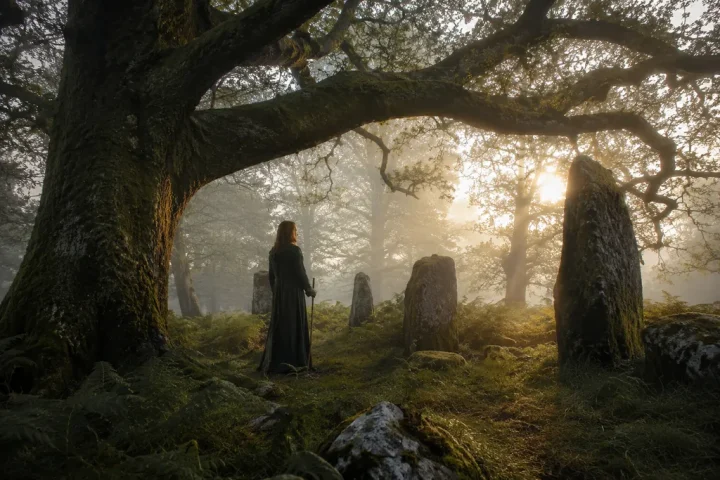
The mistletoe growing upon sacred oaks was especially revered among ancient peoples of Gaul, Germany and Britain. According to traditional accounts, white-robed Druid priests cut mistletoe from the oak on the sixth night of the Moon using a golden sickle. Two white bulls were then sacrificed, accompanied by prayers that those who received the mistletoe would prosper.
In later symbolic interpretations, the ritual cutting of mistletoe from the oak came to represent the emasculation or overthrow of an ageing king by his successor, transforming the harvesting of the plant into a symbol of succession, death and renewal.
Methods of Dendromancy
One simple method of dendromancy involved burning oak and mistletoe and observing the patterns formed by the rising smoke. The shapes, direction and behaviour of the smoke were then interpreted as omens.
Other forms of dendromancy relied upon directly examining parts of oak and mistletoe for unusual signs. Leaves, branches, growths and other natural formations could become objects of divination if they appeared in a manner considered significant.
A particularly curious example appears in sixteenth-century folklore concerning the oak apple, a gall or swelling that develops on an oak as a result of the activity of a gallfly. According to this tradition, an oak apple could be opened and its contents examined for omens concerning the future.
If a worm was discovered inside, it was interpreted as indicating a life marked by poverty and strife. If the worm was seen to move rapidly or “run about”, it was believed to presage plague. The discovery of a spider was regarded as an omen of pestilence and scarcity in the corn crop, while the appearance of a fly was interpreted as a sign of war during the following year.
These examples show how dendromancy could combine plant lore, omen-reading and symbolic interpretation. The tree itself became a divinatory medium, with natural growths, insects, smoke and plant material all capable of being read as signs.
Within the Occult World classification, dendromancy belongs most naturally to Divination by Observation, because the practitioner interprets visible signs appearing in trees, leaves, branches, galls or smoke. Some individual practices may overlap with augury, especially when a naturally occurring sign is treated as an omen, but the broader method is fundamentally observational.
Enter the Living World of Occult Divination
Dendromancy reveals how deeply divination was once rooted in the natural world. A branch, a gall, a curl of smoke or an insect hidden within an oak could become a message when viewed through the symbolic logic of traditional occult practice.
If you want to understand these systems beyond a handful of definitions, enter the Occult World Mystery School and study the deeper structures behind divination, sacred plants, spirits, omens, ritual magic and forgotten traditions. There are thousands of spirits, gods, demons, magical systems, grimoires and forgotten traditions waiting beyond it. Stop looking at the surface of occult knowledge and start learning how the hidden world was read through nature itself.





Follow