

Harlequin: The Goblin of the Wild Hunt
In European folklore, Harlequin is far more than the colourful clown later seen in theatre. Behind the mask and costume lies an older, darker figure: a goblin-like spirit, a night wanderer, and in some traditions, a name connected with Satan, the Devil, and the restless dead.
The origin of the name Harlequin is uncertain, and it appears in many spellings across European folklore, including Erlequin, Herlekin, Hierlekin, Hellequin, Hennekin and Hellekin. These variations show how widespread and changeable the figure became, moving between demon, goblin, ghostly leader, trickster and theatrical clown.
In some traditions, Herlaken was used as a name for the Devil and also connected with the will-o’-the-wisp, the mysterious wandering light believed to lure travellers into danger. In French folklore, Harlican could refer to both imps and troublesome children, suggesting a mischievous, unruly and disruptive spirit.
The Hennekin were sometimes associated with incubi, and were said to dance at crossroads during the night. Crossroads have long been seen as liminal places: thresholds between worlds, meeting points for spirits, witches, demons and the dead. In this sense, Harlequin belongs to the strange world between the human and the supernatural, where boundaries become thin and dangerous.
Another related tradition speaks of the Herlethingi, troops of night wanderers made up of the dead. In England, such ghostly bands were described in the 11th and 12th centuries, sometimes appearing as processions of dead aristocrats. Although they were most often connected with the night, some accounts claimed they could appear even at noontime, making them even more unsettling.
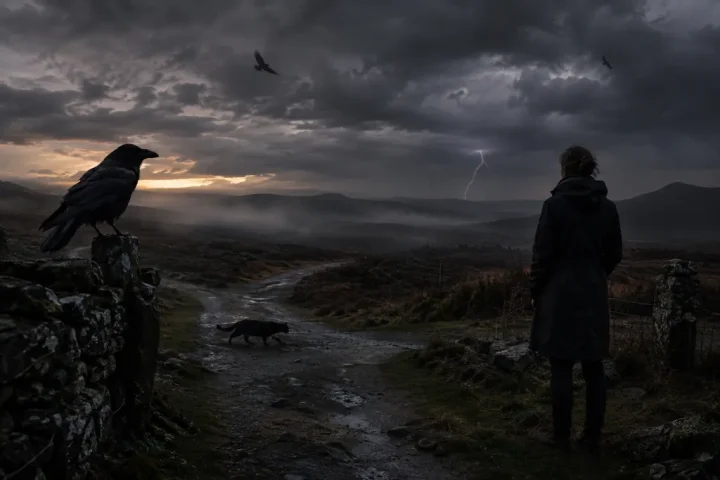
Harlequin, or Helequin, is also linked to the Wild Hunt, where he appears as the leader of a spectral pack of ghosts and demons riding through the air on stormy nights. The Wild Hunt was feared across Europe as an omen of death, disaster, war or spiritual disturbance. To see it was to glimpse the restless dead in motion, carried by wind, storm and infernal force.
Over time, this dark folkloric figure transformed into the familiar Harlequin of the Italian commedia dell’arte, popular from the 16th to the 18th centuries. There, he became a comic servant, trickster and clown, dressed in a patterned costume and known for agility, wit and mischief. Yet even in this theatrical form, echoes of the older Harlequin remain: the mask, the trickery, the liminal identity and the shadow of something not entirely human.
Harlequin is therefore a fascinating example of how folklore changes shape. A demon of the night becomes a goblin, a leader of ghosts becomes a trickster, and a terrifying figure of the Wild Hunt becomes a clown on the stage. But beneath the laughter, the older spirit still lingers.
Enter the Hidden Theatre of the Occult
Harlequin teaches us that folklore is never simple. Behind the mask of the clown may stand the goblin, the demon, the Devil, the restless dead and the wild rider of stormy nights.
Inside the Occult World Mystery School, we explore figures like Harlequin in their deeper context: folklore, demonology, witchcraft, spirits, grimoires, black magick, haunted traditions and the strange beings that move between myth and fear.
This is not just a place to read about the occult. It is a living community where you can meet fellow occultists, share your fascination with the hidden world, ask questions, study darker traditions and walk the path of forbidden knowledge with others who understand the call of the unseen.
Join the Occult World Mystery School and step beyond the mask. Discover the demons, spirits, ghosts and magical traditions that still haunt the edges of European folklore.
FURTHER READING:
- Remy, Nicholas. Demonolatry. Secaucus, N.J.: University Books, 1974.
SOURCE:
The Encyclopedia of Demons and Demonology – Written by Rosemary Ellen Guiley – Copyright © 2009 by Visionary Living, Inc.

Follow