

Leshii: The Forest Lord
The Leshii, more commonly rendered in English as Leshy, is one of the most important supernatural inhabitants of Russian and East Slavic forest folklore. His name derives from the Russian les, meaning forest, and traditional names for him include the Forest Master, Forest Grandfather, Forest King and Forest Dweller. He is not simply an animal or monster that happens to live among the trees. In the old belief system he is the supernatural master of the forest itself, controlling its animals, guarding its resources and determining how safely human beings may enter his territory.
The singular form is normally Leshy, while Russian folklore can speak of multiple forest spirits, each associated with its own woodland territory. Large forests might be imagined as divided between several such beings, and some traditions developed elaborate hierarchies in which lesser forest spirits answered to a more powerful Forest King. In Russian incantations this ruler could be called Musail-les, while traditions from parts of the Russian North also knew a great forest sovereign under titles such as Chestnoi lesa, the Honourable or Venerable Forest. Musail should therefore not be treated as the universally accepted king of every Leshii in Slavic mythology, but he is a genuine figure in regional Russian tradition.
Master of the Forest
The Leshii’s primary function is expressed in his many titles: he is the owner and guardian of the woodland. Forest animals, birds, game, berries, mushrooms and other resources fall beneath his authority. To hunters, herders and villagers who depended upon the forest for survival, this made the Leshii a power who could not safely be ignored. Success in hunting or the safe return of livestock might depend upon his favour, while disrespectful behaviour could attract his hostility.
The older folklore does not present him as simply good or evil. He can protect the forest from excessive exploitation and may reward people who observe the proper customs, yet he can also be cruel, unpredictable and dangerous. People entering the forest were expected to recognise that they were entering someone else’s domain. Shouting, whistling, unnecessary destruction and disrespect towards the resources of the woodland could provoke its supernatural master.
The original tradition that the Leshii “weep when trees are cut down” needs qualification. Russian sources certainly describe the Leshii as capable of human-like crying as well as laughing, whistling and shouting, and his role as guardian of the forest makes hostility towards destructive behaviour entirely consistent with the folklore. I have not, however, found a strong early source supporting the more precise statement that the sound of his weeping was specifically believed to accompany the cutting down of trees. That detail is better omitted or described as a later interpretation.
The Shapeshifter
There is no single appearance of the Leshii.
He may appear as an old man, a peasant, a relative, a familiar traveller or an impossibly large human figure. He can also take animal forms, including those of a bear, wolf, hare, bird, dog or goat, and some accounts give him characteristics combining human and animal anatomy. Other stories make him almost indistinguishable from the vegetation itself, appearing as a tree, bush or stump.
One of his strangest abilities is his changing size. Deep inside the forest he may grow as high as the tallest trees, while outside his proper territory he can shrink until he is no taller than the grass. Traditional descriptions sometimes give him unusual bodily signs by which the observant traveller might recognise that the apparent man before him is not human. His clothing may be fastened incorrectly, his shoes placed on the wrong feet, his hair combed in the wrong direction, or some aspect of his body may appear reversed or incomplete. Certain traditions say he lacks eyebrows, eyelashes or a shadow.
This sense of reversal is important. The Leshii belongs to a world adjacent to the human one but governed by different rules. Consequently, one of the traditional methods for escaping his influence after becoming lost was to reverse one’s own clothing, putting garments on inside out or exchanging shoes from one foot to the other. By deliberately entering the Leshii’s reversed order, the lost traveller might break his enchantment and recover the path home.
The Voice in the Trees
The Leshii is particularly associated with sound. He laughs loudly, whistles, claps his hands, calls through the trees and imitates the voices of animals. Forest echo itself was sometimes identified as the response or voice of the Leshii.
More dangerously, he could imitate the voice of someone familiar.
A traveller might hear a relative, friend or companion calling from somewhere deeper among the trees. Someone searching for a missing cow might hear the animal lowing ahead. The sound would continue just far enough away to encourage pursuit, leading the victim farther from the road and deeper into the forest. Some tales describe the Leshii appearing in the physical form of a familiar person and offering to guide a mushroom picker or traveller towards exactly what they were seeking, only to abandon them in a swamp, ravine or impenetrable thicket.
This is one of the most consistent elements of the tradition. To be “led by the Leshii” became an explanation for the terrifying experience of becoming lost in familiar woodland and finding that paths which should lead home somehow return to the same place.
Bears, Wolves and the Herds of the Forest
All wild animals may fall under the Leshii’s protection, but bears and wolves occupy a particularly important place in the folklore. The bear is repeatedly described as one of his favourite animals and even as his companion or servant. Wolves also belong closely to his realm, and some traditions imagine the Leshii himself appearing as a white wolf leading the pack.
The original article compares the Leshii with the Roman Faunus as a mediator between wolves and domestic herds. The comparison is interesting from the perspective of comparative mythology, but it should not be presented as part of native Russian belief. What is firmly attested is that herders entered ritual agreements with the Leshii for the protection of cattle grazing near or within forests. In these traditions the Leshii could prevent wolves from attacking a herd, return missing animals or provide supernatural assistance to the shepherd.
Such agreements demonstrate that villagers did not necessarily regard him as a straightforward devil. He could be negotiated with because he possessed authority over territory and animals in much the same way that a human landowner possessed authority over his estate.
The Leshii Who Gambled Away His Animals
One of the most remarkable traditions in the original entry is genuinely supported by nineteenth-century folklore.
Leshii were believed to gamble with one another, particularly at cards, using the animals of their forests as stakes. When one forest spirit lost, he was obliged to drive the animals he had wagered into the territory of the winner. Unexplained mass movements of squirrels, hares and other animals could therefore be interpreted as the payment of a supernatural gambling debt.
A famous nineteenth-century example concerns large migrations of squirrels. In 1843, when unusually large numbers of squirrels appeared in parts of Russia, peasants explained that a Leshii in Vyatka had lost his squirrels to another forest spirit in Vologda and was driving the animals towards their new supernatural owner. Later ethnographic material records similar explanations for the movement of hares, mice and other forest creatures.
The story captures the peculiar character of the Leshii perfectly. The animals are not simply creatures living inside his forest. They are his possessions, his herd and, apparently, something he can recklessly gamble away.
The Leshii and Human Intruders
Hunters, woodcutters, mushroom gatherers, berry pickers and herders all entered territory regarded as belonging to the Forest Master. Consequently, they appear frequently in stories concerning his tricks and punishments.
The surviving folklore strongly supports the idea that the Leshii hides possessions, confuses travellers, terrifies hunters, disrupts human activity and punishes people who behave improperly inside the forest. Specific later claims that he routinely hides woodcutters’ axes or deliberately causes logging accidents are harder to trace to strong early sources, so those details should be treated cautiously. The older and better documented pattern is broader: the Forest Master resents violations of his domain and can make tools or belongings disappear, interfere with work and place offenders in dangerous situations.
The safest relationship with him was therefore one of respect rather than confrontation.
The Kidnapper
Far darker traditions accuse the Leshii of carrying human beings away.
Children were especially vulnerable. Slavic changeling beliefs included the Leshii among the supernatural beings capable of taking an infant and leaving another creature in its place. In Russian stories, children cursed by angry parents were believed to be particularly susceptible. A careless expression such as consigning a child “to the Leshii” could be interpreted literally by the supernatural world.
Women could also disappear into his forest.
Some were said to become his wives. Others were taken because the Leshii required human assistance. One widespread Russian tale describes a village midwife being carried into the forest to attend the birth of a child belonging to the Leshii or his wife. Another tells of a woman taken away to nurse or care for one of his children, only to return after what seems an impossible passage of time.
The claim in the original article that he particularly prefers unmarried women or women trapped in unhappy relationships is more difficult to establish as a broad folkloric rule. Russian accounts certainly contain women who voluntarily or involuntarily enter relationships with forest spirits, but the more securely attested motif is simply that young women, especially those who became lost, were cursed or attracted the Leshii’s attention, could be taken as supernatural wives.
Eating the Food of the Forest World
Stories about those carried away by the Leshii contain an important taboo that appears throughout supernatural folklore: do not eat the food of the other world.
Russian sources preserve accounts in which captives can return only if they have refused the Leshii’s food. One older encyclopaedic account specifically states that prayers might recover kidnapped girls only if they had never tasted the food offered by the forest spirits.
Other stories complicate the rule. People sometimes eat in the Leshii’s domain and still return, but food or gifts carried back into the human world reveal their true nature. Bread becomes moss, leaves or manure, a drinking vessel becomes a pine cone, and apparently valuable gifts become pieces of ordinary forest matter.
Here the forest world resembles the otherworlds found throughout European folklore. What appears substantial within supernatural territory cannot always retain its form once carried across the boundary into ordinary human reality.
Those Who Return
The fate of people who return after spending time with the Leshii is among the darkest parts of the tradition.
Some are described as wild, withdrawn or unable to reintegrate into village life. Children may forget ordinary human speech or refuse clothing. Adults may behave strangely, lose the ability to communicate normally or appear mentally altered after their experience.
Yet there is another tradition in which the returned person brings something back.
Some stories say the Leshii teaches abducted people secret knowledge, transforming them into healers, sorcerers or people capable of communicating with spirits. This does not justify describing every returned captive as a “shaman”, which imposes a broader comparative label upon Russian folk material. It does, however, support the original article’s idea that contact with the Leshii could leave a person possessing unusual magical knowledge.
The pattern is significant. The person who enters the Leshii’s world may return damaged, transformed or gifted, but rarely returns unchanged.
Agreements with the Forest Master
The Leshii could also establish relationships with humans voluntarily, particularly hunters and shepherds whose livelihood depended upon entering his domain. Ethnographic traditions record agreements in which the spirit protected livestock, assisted hunters or instructed herders in supernatural methods of controlling their animals.
These agreements were viewed uneasily within Christian culture. In one Olonets tradition the Leshii takes a shepherd boy’s cross and belt, later returning them but instructing him not to wear the cross. Such material reflects the opposition between the Christian markers of the human community and the supernatural world of the forest.
The original statement that anyone befriending the Leshii had to swear never again to wear a cross or receive Communion appears in later occult summaries, but I have found much firmer ethnographic support for the removal or rejection of the cross than for a universal prohibition against taking Communion. The final article should therefore preserve the cross motif while treating the Communion detail as a regional or later claim rather than a defining rule.
Similarly, the claim that making the Leshii laugh guarantees safety appears mainly in later compilations. Laughter is unquestionably one of his characteristic sounds, but the stronger traditional methods of escaping his influence include prayer, making the sign of the cross, reversing clothing and shoes, ritual offerings and, paradoxically, sometimes even obscene language intended to break the supernatural condition.
Leshii and the Dead
The Leshii also touches the uncertain border between nature spirit and spirit of the dead.
It would be too strong to say that he universally “presides over a realm of death”. The folklore is more complicated. Some Russian traditions hold that people who die unnatural or socially improper deaths can become Leshii, while other accounts describe suicides, cursed people and other restless dead as living beneath his authority or serving within his forest household.
The wider connection between forests and improper burial is historically real. Suicides were often denied burial in consecrated cemetery ground and could be buried in forests, fields, crossroads or other marginal places. Ethnographic records from areas of Russia describe both suicides and unbaptised children being buried outside normal cemeteries, including in woodland.
Unbaptised children occupied an especially dangerous position within Slavic folk demonology. Their souls could be imagined as wandering spirits, appearing in forests, fields and other liminal places. This does not mean that all such souls belonged directly to the Leshii, but it helps explain why the forest could become associated with people who had died outside the accepted religious order.
The claim that ancient Pagan Slavs generally buried their dead in sacred groves is also too broad to retain without qualification. Sacred groves unquestionably existed in Slavic religious culture, and trees and woodland played important roles in burial symbolism, but Slavic funerary practices varied enormously by period and region. The later placement of suicides and unbaptised children outside consecrated cemeteries provides a much more secure historical basis for discussing the forest as a place associated with the excluded or unsettled dead.
The Forest That Watches
The Leshii emerges from the verified folklore as something more complicated than either a woodland demon or a kindly guardian of nature. He represents the forest understood as an independent domain with its own master, animals, laws and boundaries. Human beings may enter that domain, hunt within it, graze animals there and gather its resources, but they do not truly own it.
That distinction explains both sides of his character. The respectful hunter may receive assistance, while the careless traveller is led into a swamp. A shepherd may negotiate protection for his herd, while a cursed child disappears among the trees. The forest may provide food, medicine and shelter, yet the same forest may swallow a person so completely that when they return they have forgotten how to live among human beings.
Perhaps the most unsettling aspect of the Leshii is that he does not behave according to human morality. He guards what belongs to him. He may help, punish, deceive, abduct, bargain or simply amuse himself with those who cross his path. To the villagers who preserved these stories, entering the forest therefore meant crossing an invisible border between the ordered world of the village and another territory where the rules belonged to someone else.
If a familiar voice called your name from somewhere deeper among the trees, the safest response was not always to answer.
If the Leshii interests you because you understand that the forest in old Slavic belief was never merely scenery, then do not stop with simplified mythology pages and modern fantasy monsters. Enter the Occult World Mystery School and go deeper into the spirits, gods, folk magic, demonology and forbidden traditions that once made every forest, river and crossroads part of a living supernatural world. The old traditions become far more dangerous and far more fascinating when you stop looking at them from the safety of the path.
ORIGIN:
Russia
FAVOURED PEOPLE:
The Leshii insists on allegiance to Paganism. Unlike other spirits who may don the masks of saints in order to accommodate devotees, the Leshii brooks no compromise. Allegedly, hunters seeking his protection and gifts must remove their crosses, swear allegiance to the Leshii and no longer swallow the host but bring it to the Leshii as proof it wasn’t consumed.
MANIFESTATION:
Allegedly, the Leshii casts no shadow and leaves no footprints. He commonly manifests in various forms:
• The Leshii manifests as a man. The clue to his true identity is that something is wrong with his appearance for instance, his clothes are on backwards or his shoes are on the wrong feet.
• Sometimes he appears as a man whose size dizzyingly shifts from tiny to large.
• He manifests with goat’s horns and hooves, sometimes with black fur and wings.
• Other frequent manifestations include pigs, rabbits, ravens, roosters, wolves, burning fir trees and mushrooms, especially Amanita muscaria
However, the Leshii is a master shape-shifter who can assume the guise of specific people. This is one way he lures people into the forest: You think you’re following someone you know who eventually disappears; morphs into another form or is revealed as really the Leshii.
ATTRIBUTE:
Club
Mount:
Leshii ride storm winds.
Plant/fungus:
Amanita muscaria (fly agaric; toadstool)
ANIMALS:
All of them, but each Leshii is allegedly accompanied by a huge white wolf.
ALTAR:
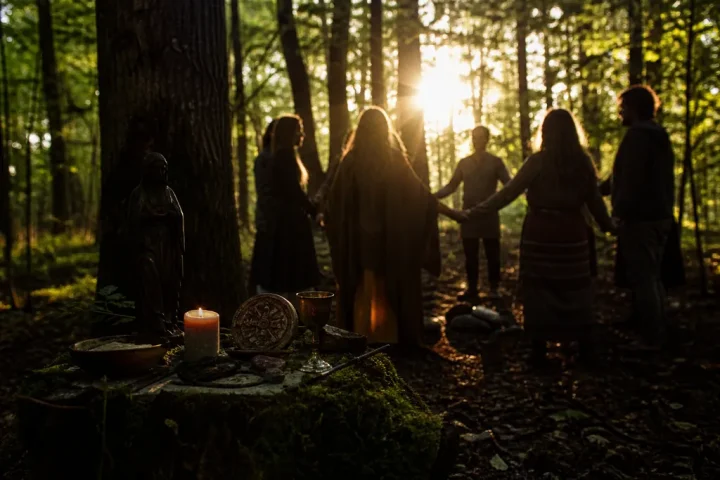
Tree stumps and fallen logs serve as altars; leave offerings there or wrap food in a clean cloth, tie it up with a red ribbon and leave at a forest crossroads.
OFFERINGS:
He likes simple, traditional Russian food offerings like blinis or kasha plus salted bread; cookies; candy; hard-boiled eggs with shells dyed red (onion peel in the boiling water may turn the trick as will other natural dyes). He is propitiated with really good jokes. (He decides if they’re good.) The Leshii is a passionate card player and gambler. In Northern Siberia, hunters allegedly earned the Leshii’s alliance with gifts of playing cards with the suit of clubs removed.
SEE ALSO:
SOURCE:
Encyclopedia of Spirits: The Ultimate Guide to the Magic of Fairies, Genies, Demons, Ghosts, Gods & Goddesses– Written by Judika Illes Copyright © 2009 by Judika Illes.




Follow