
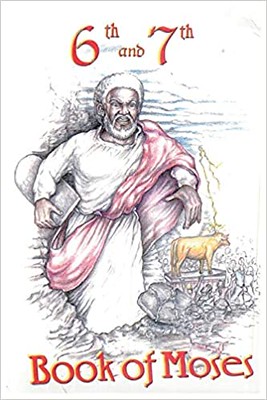
The Sixth and Seventh Books of Moses is one of the most famous magical texts associated with folk magic, conjuration, talismans, seals, and the Powwowing tradition of German settlers in America. It is sometimes called the “Mystery of All Mysteries” and has long been regarded as both powerful and dangerous.
Although the title suggests a biblical origin, the text does not belong to the recognised books of the Old Testament. Instead, it is a later magical grimoire built around biblical authority, sacred names, Kabbalistic ideas, charms, seals, and ritual formulas.
Origins and Publication
The Sixth and Seventh Books of Moses was published in 1849 in Stuttgart, Germany. It is usually credited to Johann Scheibel, who lived from 1736 to 1809. Because the book appeared after his death, it is often described as having been published posthumously.
According to legend, however, the book is far older. Lore claims that the text was dictated by God to Moses on Mount Sinai but omitted from the Old Testament because of its enormous magical power.
The legendary chain of transmission says that the book was passed from Moses to Aaron, Caleb, Joshua, David, and finally to King Solomon, who was himself traditionally regarded as one of the greatest masters of magical knowledge.
This origin story places the text within the wider world of Solomonic magic, biblical magic, and sacred-name traditions.
Contents of the Book
The Sixth and Seventh Books of Moses contains spells, conjurations, charms, seals, talismans, sacred names, magical diagrams, and formulas for a wide range of purposes.
It is said to contain more than 125 seals, talismans, and Hexenfoos, used for summoning spirits and performing magical operations.
The magical purposes associated with the book include:
- Luck
- Wealth
- Healing
- Protection
- Necromancy
- Curses
- Spirit summoning
- Magical defence
- Practical folk magic
- Sacred-name magic
The text is based largely on Talmudic and practical Kabbalistic magic. It also includes the secret magic of the Psalms, sacred names of power, and ritual formulas intended to command spiritual forces.
The Book and Powwowing
The Sixth and Seventh Books of Moses became especially popular among German-speaking settlers in America, particularly within the Powwowing tradition.
Powwowing, also known as Braucherei, is a form of Pennsylvania German folk magic that blends Christian prayer, healing charms, protective formulas, biblical passages, and practical magical remedies.
German-language editions of the Sixth and Seventh Books of Moses were brought to America by immigrants. English translations appeared by the early nineteenth century, making the text more accessible to a wider audience.
Powwowers often used it alongside John George Hohman’s The Long Lost Friend, another important magical and healing text in Pennsylvania German folk practice.
Magic, Danger, and Folk Belief
Like many famous grimoires and “black books,” the Sixth and Seventh Books of Moses gained a reputation for being powerful but dangerous.
Folk tales warn that such books can bring trouble if they fall into the wrong hands or are misused. The book is often portrayed as something that gives power, but also tests the moral and spiritual strength of the owner.
This is a common theme in European magical folklore: the magical book is not only a tool. It is almost alive with power. It may attract spirits, alter the atmosphere of a home, resist destruction, or bring danger to anyone who handles it carelessly.
The Tailor’s Wife and the Magical Book
One German folk tale tells of an old master tailor in Trent whose wife inherited a strange book from her mother. The book was believed to be the Sixth and Seventh Books of Moses.
Whenever the wife read from the book, deer, wolves, hares, and other animals came to her. They lay at her feet and played with her children. When she closed the book, the animals vanished.
The tailor was disturbed by this and decided that he did not want the book in his house. One day, while his wife was reading it, he grabbed the book and threw it into the stove.
To his astonishment, the fire went out, and the book remained unharmed.
The tailor asked for advice, and elders told him that the book could only be destroyed if it was thrown into the stove by a boy born on a Sunday during the sermon. The tailor followed this instruction. When the boy threw the book into the stove, it was immediately consumed by the fire.
This tale reflects a common Christian interpretation of magical-book folklore. The occult book resists ordinary destruction, but it can be overcome by purity, Sunday birth, church time, and Christian sacred power.
The Book Locked in Wittenberg
Another German folk tale claims that no more magic or witchcraft exists because the Sixth and Seventh Books of Moses is safely locked away in Wittenberg, Germany.
This legend presents the book as a source of magical power so great that its removal from the world ends witchcraft itself. It also connects the book to Wittenberg, a city strongly associated with religion, learning, Protestant history, and German magical legend.
Biblical Authority and Magical Power
The power of the Sixth and Seventh Books of Moses comes largely from its claimed connection to biblical figures.
Moses was already associated with miracles, divine law, plagues, signs, and wonders. Solomon was associated with spirit command, wisdom, seals, and magical authority. By linking the text to both Moses and Solomon, the book places itself within a powerful biblical-magical lineage.
This is why the book has remained so influential. It speaks to a world in which prayer, magic, scripture, seals, and spirit command are not separate categories, but part of one sacred technology of power.
Legacy
The Sixth and Seventh Books of Moses remains one of the most important magical texts in the history of folk magic and grimoire traditions. Its influence can be found in Powwowing, Christian folk magic, hoodoo, conjure, ceremonial magic, and modern occultism.
It is not simply a book of spells. It is a symbol of forbidden knowledge, sacred power, hidden biblical magic, and the dangerous attraction of the magical book itself.
For some, it is a grimoire of protection, healing, and divine names.
For others, it is a dangerous black book.
For folklorists, it is a window into the way ordinary people used biblical authority to understand and practise magic.
Whether approached as folklore, magical history, or practical grimoire tradition, the Sixth and Seventh Books of Moses remains one of the most enduring and mysterious texts in Western occult literature.
Continue Your Path with Occult World
The Sixth and Seventh Books of Moses belongs to the powerful world of grimoires, seals, spirit conjuration, folk magic, protection, curses, sacred names, and hidden biblical magic.
Inside the Occult World Mystery School, you can explore these traditions in greater depth, including ancient grimoires, witchcraft, black magick, protection work, demonology, spirit communication, ritual practice, Tarot, Lenormand, and the hidden history of magical books.
This community is created for serious seekers who want more than surface-level spirituality. It is a place to study occult texts, symbols, spirits, rituals, and magical traditions with structure and depth.
Join the Occult World Mystery School and continue your journey into grimoires, witchcraft, black magick, protection, spirit work, and the deeper mysteries of Occult World.
FURTHER READING:
- Heindel, Ned D. Hexenkopf: History, Healing & Hexerei. Easton, Pa.: Williams Township Historical Society, 2005.
See Also
- Book of Shadows
- Grimoires
- Powwowing
- The Long Lost Friend
- Kabbalah
- Solomonic Magic
- King Solomon
- Moses
- Talismans
- Seals
- Charms
- Necromancy
- Protection Magic
- Curses
- Folk Magic
SOURCES:
- The Encyclopedia of Witches, Witchcraft and Wicca – written by Rosemary Ellen Guiley – Copyright © 1989, 1999, 2008 by Visionary Living, Inc.
- The Encyclopedia of Magic and Alchemy Written by Rosemary Ellen Guiley Copyright © 2006 by Visionary Living, Inc.




Follow