
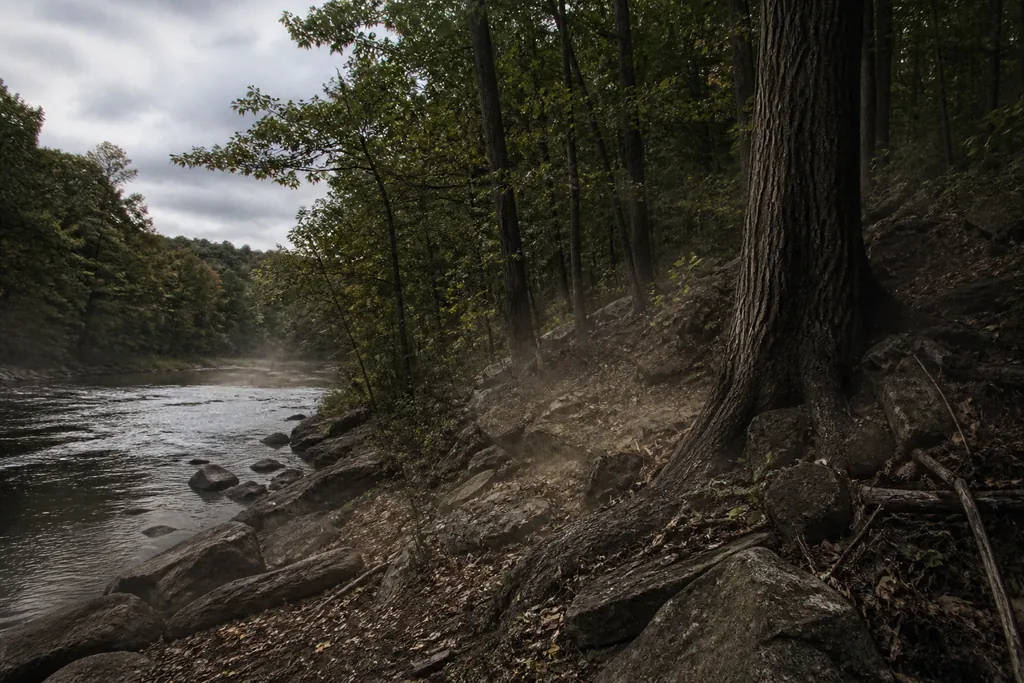
The Moodus noises are underground rumbling sounds and tremors that have been reported for centuries near the Moodus River in Connecticut. The phenomenon is especially associated with the Moodus section of East Haddam, a region long known for strange subterranean sounds, small earthquakes, and unexplained vibrations.
The name itself preserves the mystery. The area was known to Native Americans as Matchitmoodus or Machimoodus, commonly translated as “Place of Bad Noises” or “Place of Noises.” The Indigenous people who lived in the region associated the rumblings with powerful and troubling spiritual forces. In later retellings, the sounds were connected with evil gods or restless supernatural beings beneath the earth.
When Puritan settlers arrived in the region during the 1670s, they also heard the noises. Their interpretation, however, came through a Christian worldview. To them, the sounds were not the voices of Native spirits or gods, but possible evidence of the Devil’s presence beneath the land. In this way, the Moodus noises became part of both Native American sacred geography and early colonial demonological folklore.
Description of the Phenomenon
The sounds have been described in many ways:
a deep underground rumbling
a sudden boom like cannon fire
a heavy rolling sound beneath the ground
a clap of thunder without a storm
a vibration that seems to rise from the earth itself
Unlike ordinary earthquakes, the Moodus noises were often heard more strongly than they were felt. This made them especially disturbing. People could hear the earth groan, crack, boom, or roll beneath them, even when little visible damage occurred.
The sounds were most often associated with the area around the Moodus River, the Salmon River, Cave Hill, Mount Tom, and what is now Machimoodus State Park.
Native and Colonial Interpretations
For the Native peoples of the area, the noises were not merely geological events. They were meaningful signs. The land itself seemed alive, inhabited by invisible powers that could express anger, warning, or sacred force through sound.
The Puritans interpreted the same phenomenon differently. To them, strange noises beneath the earth suggested demonic activity, divine judgement, or the Devil’s disturbance of the natural world. In a religious culture deeply concerned with sin, witchcraft, punishment, and unseen spiritual warfare, the Moodus noises easily became part of a supernatural landscape.
The same sound, therefore, produced two very different explanations:
For Native inhabitants, the rumblings were connected to local spiritual powers.
For Puritan settlers, they were associated with the Devil.
For later scientists, they became a geological puzzle.
The Legend of Dr. Steel
One of the most curious stories connected with the Moodus noises concerns Dr. Steel, sometimes spelled Dr. Steele, an alchemist said to have been sent to Connecticut by King George III of England in the 1760s.
According to legend, the noises had become so alarming that the king wanted their cause investigated. Dr. Steel supposedly claimed that the source of the disturbance was a giant pearl, carbuncle, fossil, or magical stone blocking the mouth of a subterranean cave near the river. He was said to have attempted to remove it in order to quiet the earth.
Whether Dr. Steel was a real figure, whether he actually came to Moodus, or whether he removed anything from the ground remains uncertain. The story belongs more to folklore than documented history. Yet it is significant because it shows how the Moodus noises were understood before modern seismology. They were not treated simply as earthquakes. They were imagined as the result of hidden caverns, blocked passages, magical minerals, subterranean fires, or occult forces.
Some versions of the story say that after Dr. Steel’s intervention, the noises became quieter and less frequent. Whether this was coincidence, exaggeration, or folklore cannot be proven.
The Earthquakes of 1816 and 1817
Although the noises reportedly became subdued for a time, they did not disappear. In 1816 and 1817, the tremors intensified into larger earthquakes. These events renewed public interest and concern.
Scientists of the period attempted to explain the phenomenon through the knowledge available to them. Some suggested that the noises were caused by underground gases. Others proposed chemical explosions beneath the earth. These explanations reflected early attempts to move away from purely supernatural interpretations and toward natural causes.
Yet the mystery remained. The sounds were too persistent, too localised, and too strange to be easily dismissed.
Modern Scientific Explanation
By the twentieth century, scholars increasingly concluded that the Moodus noises were caused by seismic activity. In 1981, scientists identified the phenomenon as the result of microearthquakes — very small earthquakes occurring beneath the region.
Modern research supports the idea that the noises are produced by small, shallow seismic movements in unusually strong and brittle rock. Because the quakes occur close to the surface, and because the local geology can amplify sound, even minor underground movements may produce loud booms or rumbling noises. A later report noted that studies in the area detected hundreds of microearthquakes over a three-month period, helping explain why the sounds could be frequent even when the tremors were very small. (fosa-ct.org)
The area remains seismically notable for Connecticut. Connecticut is not usually thought of as earthquake country, but the Moodus region has a long history of small seismic events linked to underground faults in the central part of the state. (connecticuthistory.org)
The Moodus Noises Today
Today, the Moodus noises are generally understood as a natural geological phenomenon rather than the work of evil gods, demons, the Devil, underground explosions, or magical stones. However, the mystery has not completely vanished.
The explanation may be scientific, but the atmosphere of the place remains powerful. The name Machimoodus still preserves the ancient memory of a landscape that seemed to speak from below. Visitors to the area, especially around Machimoodus State Park, Cave Hill, and Mount Tom, are still drawn to the legend of the rumbling earth.
The phenomenon also continues to attract attention because small earthquakes still occur in the region. In March 2026, two minor earthquakes were recorded in the Moodus section of East Haddam, measuring magnitude 2.1 and 1.9. No damage was reported, but the events renewed interest in the old “Moodus noises” tradition. (CT Insider)
Recent reporting also notes that scientists are still studying why Moodus experiences more frequent small earthquakes than many surrounding areas. The general cause is understood as shallow seismic activity, but the exact reason for the region’s unusual concentration of tremors remains a subject of continued research. (CT Insider)
Folkloric Significance
The Moodus noises are important because they sit at the crossroads of folklore, religion, science, and place-memory.
They are not merely “strange sounds.” They are a record of how different cultures explain the unknown:
Indigenous people interpreted them through sacred geography and spiritual power.
Puritans interpreted them through the Devil and divine judgement.
Alchemists and early investigators imagined hidden stones, caverns, gases, or underground reactions.
Modern scientists explain them through microearthquakes and local geology.
This layered history makes the Moodus noises one of New England’s most fascinating examples of a natural phenomenon becoming part of supernatural tradition.
Legacy
The Moodus noises remain one of Connecticut’s oldest and most enduring mysteries. Science has provided a strong explanation, but folklore has preserved the emotional force of the phenomenon: the fear of hearing the earth speak beneath one’s feet.
Even today, the story has not lost its power. The noises remind us that before instruments, sensors, and seismic maps, people listened to the land and interpreted its sounds through the spiritual language they knew.
In Moodus, the ground did not simply shake.
It spoke.
SEE ALSO:
SOURCE:
The Greenhaven Encyclopedia of Paranormal Phenomena – written by Patricia D. Netzley © 2006 Gale, a part of Cengage Learning







Follow