
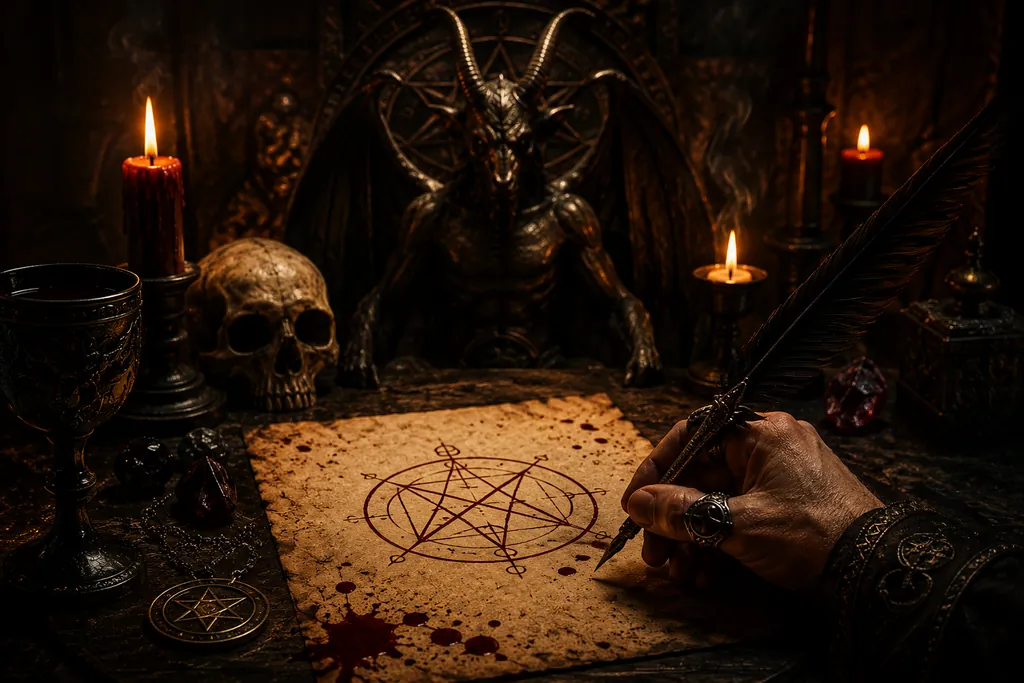
Pact: Agreements with Demons, Spirits, and the Devil in Magic, Witchcraft, and Grimoires
A pact is a binding agreement with a spirit, demon, or the Devil for services beyond the ordinary powers of nature. In folklore, such agreements are often made for treasure, love, power, youth, knowledge, worldly success, or magical ability. In return, the person making the pact is usually said to offer obedience, service, blood, sacrifice, or, in the most dramatic legends, the soul itself.
Pacts appear in many forms: legendary, theological, witchcraft-related, ceremonial, grimoire-based, Satanic, and Vodoun. Some are described as informal temptations. Others are formal written agreements. In grimoires, pacts may be used as part of ritual magic to compel or secure the services of a spirit. In witchcraft trials, however, the alleged Devil’s pact became one of the most dangerous accusations in European history.
The idea of the pact sits at the crossroads of demonology, magic, Christian theology, folklore, fear, power, and the human desire to gain what ordinary life does not easily provide.
Biblical and Theological Roots of the Devil’s Pact
The idea of a covenant with dark powers was often read into biblical passages by later Christian theologians and demonologists. In the book of Isaiah, the prophet says:
“For you have said: We have entered into a league with death; we have made a covenant with hell”
Matthew 4 also became important to later discussions of the Devil’s pact. In the temptation of Jesus in the wilderness, the Devil offers worldly glory and power in exchange for worship:
“Again, the devil took him to a very high mountain, and showed him all the kingdoms of the world and the glory of them; and he said to him, ‘All these I will give you, if you will fall down and worship me’ ”
Jesus refuses, and the Devil leaves him. Later Christian demonologists saw in this episode the essential structure of the Devil’s pact: worldly reward offered in exchange for spiritual surrender.
Early theologians gave weight to the idea that magic, sorcery, or even divination involved some kind of demonic agreement. Origen condemned divination, while St. Augustine strengthened the association between magical practice and demonic contracts in De Doctrina Christiana.
By the 13th century, St. Thomas Aquinas stated in Sententiae:
“Magicians perform miracles through personal contracts made with Demons.”
This theological idea would later become central to witchcraft persecutions, demonological theory, and the grimoires of ceremonial magic.
Legendary Pacts with the Devil
Informal pacts with demons or the Devil appear throughout legend and folklore. These stories usually involve a vulnerable person seduced by the promise of power, treasure, love, revenge, knowledge, or pleasure. The Devil or a demon offers assistance, but always at a price.
One of the earliest Christian pact stories appears in the writings of St. Jerome in the fifth century. The story concerns St. Basil. A man who wants to seduce a young woman seeks help from a magician. In payment, he agrees to renounce Christ in writing. The magician sends the renunciation to the Devil, and the man calls upon the powers of darkness. He is brought before Lucifer and undergoes a parody of baptism, reaffirming his rejection of Christ. Lucifer requires a written pact. The man signs it, and the girl falls in love with him. Eventually, St. Basil discovers the pact, helps the man repent, and saves the girl from damnation.
Another early pact legend concerns Theophilus, treasurer of the church of Adana, who was said to have sold his soul to the Devil around 538 in order to become a bishop. This story circulated widely throughout Europe and became one of the foundations of the later Faust legend. It also helped strengthen devotion to the Virgin Mary, who often appears in such stories as the merciful figure who saves the sinner and retrieves the pact from the Devil.
In the legend of Faust, a scholar and alchemist sells his soul to Mephistopheles in exchange for youth, knowledge, pleasure, and worldly experience. A female version of the Faust legend appears in the story of Mary of Nemmegen. These tales were moral warnings. The victim might receive supernatural favours for a time, but the ending was usually dreadful unless divine mercy intervened.
According to Jacques Collin de Plancy:
“The angel of darkness is not hard to deal with, provided of course that he receives the soul as a pledge.”
Pacts in Ceremonial Magic
In ceremonial magic, a pact is not always presented as a moral tale of temptation. Grimoires describe formal agreements made between a magician and a spirit in order to obtain specific services or favours.
There are two main types of pact.
A unilateral pact is one in which a demon agrees to serve without condition.
A bilateral pact is one in which the demon agrees to conditional service, often with severe penalties if the magician fails to keep the terms.
Grimoires warn that some spirits bind easily, while others are dangerous, deceptive, obstinate, or not to be trusted.
The Key of Solomon mentions “penal bonds” and “pacts” mainly in connection with magic for love and favours, but gives little detail. It states that pentacles, magical inscriptions of words and symbols, are sufficient to protect the magician from demons. The Grimorium Verum says comparatively little about pacts and protection, while the Lemegeton does not focus on pacts as armour for the magician’s soul.
The Grand Grimoire, however, places heavy emphasis on pacts. This famous book of black magic states that if the magician cannot master a kabbalistic circle and a blasting rod, then a pact becomes necessary. The blasting rod is described as a wand feared by every demon. Even with these tools, the grimoire suggests that a pact may still be advisable.
According to the Grand Grimoire, a pact cannot be made directly with the highest demons named in the text: Lucifer, Beelzebub, and Astaroth. Instead, the magician must make the pact with one of their lieutenants. The most important of these is Lucifuge Rofocale, described as the prime minister of Lucifer.
The Grand Grimoire and Lucifuge Rofocale
The Grand Grimoire presents Lucifuge Rofocale as reluctant, obstinate, and difficult to command. He must be forced to appear through the use of ritual threats, the blasting rod, and words of power.
In one version, the demon demands that the magician:
“give thyself over to me in fifty years, to do with thy body and soul as I please.”
After bargaining and threats, Lucifuge Rofocale agrees to appear and provide services under specific conditions. The grimoire gives the following pact text:
I also approve thy Book, and I give thee my true signature on parchment, which thou shalt affix at its end, to make use of at thy need. Further, I place myself at thy disposition, to appear before thee at thy call when, being purified, and holding the dreadful Blasting Rod, thou shalt open the Book, having described the Kabbalistic circle Ps s s s and pronounced the word Rocofale. I promise thee to have friendly commerce with those who are fortified by the possession of the said Book, where my true signature stands, provided that they invoke me according to rule, on the first occasion that they require me. I also engage to deliver thee the treasure which thou seekest, on condition that thou keepest the secret for ever inviolable, art charitable to the poor, and dost give me a gold or silver coin on the first day of every month. If thou failest, thou art mine everlastingly. LUCIFUGE ROFOCALE
IMPRIMATUR
The “Book” mentioned here refers to the spurious Fourth Book attributed to Henry Cornelius Agrippa.
The Grand Grimoire gives a ritualised dialogue between the magician and Lucifuge Rofocale. The spirit first appears and says:
Lo! I am here! What dost thou seek of me? Why dost thou disturb my repose? Answer me. LUCIFUGE ROFOCALE
The magician replies:
It is my wish to make a pact with thee, so as to obtain wealth at thy hands immediately, failing which I will torment thee by the potent words of the Clavicle.
The spirit responds:
I cannot comply with thy request except thou dost give thyself over to me in twenty years, to do with thy body and soul as I please. LUCIFUGE ROFOCALE
The magician’s written pact is then described in the grimoire as follows:
I promise the grand Lucifige to reward him in twenty years’ time for all the treasures he may give me. In witness thereof I have signed myself N.N.
The spirit refuses:
I cannot grant thy request. LUCIFUGE ROFOCALE
After further conjuration, the spirit is said to reappear and declare:
Why dost thou torment me further? Leave me to rest, and I will confer upon thee the nearest treasure, on condition that thou dost set apart for me one coin on the first Monday of each month, and dos not call me oftener than once a week, to wit, between ten at night and two in the morning. Take up thy pact; I have signed it. Fail in thy promise, and thou shalt be mine at the end of twenty years. LUCIFUGE ROFOCALE
King James VI of Scotland, in Daemonologie, agreed that the need for a pact indicated weakness on the part of the magician. If the magician truly had power, he would not need to bargain with demons.
Historical Pact Formulae in Grimoires
Some grimoires describe formulae for conjuring the Devil or a demon into a pact. These should be understood as historical material from demonological and magical literature, not as practical advice.
One formula calls for a pact to be written on virgin parchment and signed in the magician’s blood. The pact reads:
“I promise GREAT Demon to repay him in seven years for all he shall give me. In witness thereof, I sign my name.”
The pact is then held while the following incantation is recited:
Lucifer, Emperor, Master of All Rebellious Spirits, I beseech thee to be favourable to me in calling upon thy GREAT MINISTER which I make, desiring to make a pact with him.
Beelzebub, Prince, I pray thee also, to protect me in my undertaking.
Astaroth, Count, be propitious to me and cause that this night the GREAT Demon appear to me in human form and without any evil smell, and that he grant me, by means of the pact which I shall deliver to him, all the treasures of which I have need.
GREAT Demon, I beseech thee, leave thy dwelling, in whatever part of the world you may be, to come speak with me; if not, I shall thereto compel thee by the power of the mighty words of the Great Key of Solomon, whereof he made use to force the rebellious spirits to accept his pact. Appear then instantly or I shall continually torment thee with the mighty words of the Key: AGLON, TETRAGRAMMATON, VAYCHEON, STIMULAMATHON, EROHARES, RETRASAMMATHON, CLYORAN, ICION, ESITION, EXISTIEN, ERYONA, ONERA, ERASYN, MOYN, MEFFIAS, SOTER, EMMANUEL, SABAOTH, ADONAI. I call you. AMEN.
Such passages show how grimoires combined Christian divine names, threats, Solomonic authority, and demonic hierarchy into one ritual framework.
Pacts in Witchcraft and the Inquisition
During the Inquisition and the witch trials, the Devil’s pact became a deadly accusation. European witch hunters believed that witches entered into pacts with the Devil or one of his subordinate demons. Unlike the ceremonial magician, who supposedly sought treasure, knowledge, or favours, the witch was accused of making a pact in order to gain power to harm others.
The pact could be oral or written. It was often said to be written on virgin parchment and signed in blood. It might be made privately, when the Devil approached the candidate in the form of a black-clad man or animal, or publicly during a sabbat.
In witchcraft theory, the pact required the accused to renounce Christianity, trample the cross, deny baptism, refuse the Eucharist, attend sabbats, and serve the Devil. The Malleus Maleficarum made the Devil’s pact central to its theory of witchcraft.
The first appearance of a Devil’s pact in witchcraft trials occurred in Toulouse, France, in 1335. The accused woman, Catherine Delort, claimed that a shepherd with whom she had a tryst forced her into a pact. Her deposition, quoted by Julio Caro Baroja in The World of Witches, states:
This loathsome ceremony took place at midnight at the edge of a wood at a place where two roads meet. She let some blood from her left arm and allowed it to flow on to a fire made of human bones which had been stolen from the parish cemetery. She pronounced certain strange words which she no longer remembers and the Devil Berit appeared to her in the form of a violet flame. Since then she has made certain harmful concoctions and potions which cause men and beasts to die. After that, Delort said, she attended obscene sabbats every Friday night.
Demonologists distinguished between explicit and implicit pacts. An explicit pact was a solemn vow of fidelity and homage made to a visible form of the Devil, often before witnesses. An implicit pact involved a written petition offered to the Devil either directly or through a proxy.
Sometimes, witchcraft trial records describe pacts as spontaneous. Nicholas Remy, a French demonologist, wrote of a 1587 case in which a woman said that her mother and she made a pact with a mysterious shoemaker whose belt was stained with pitch. He made them swear allegiance, marked them on the brow, had sex with them, danced with them, gave them money, and vanished into the air. The money then crumbled into dust.
Guazzo’s Eleven Characteristics of the Devil’s Pact
Francesco-Maria Guazzo, a leading Italian demonologist of the 17th century, said that those who entered into explicit or implicit pacts shared eleven characteristics:
- They deny the Christian faith, withdraw allegiance from God, repudiate the protection of the Blessed Virgin Mary, and deny their Baptism. The Devil places a claw on their brow to rub off the Holy Chrism and destroy the mark of their baptism.
- They undergo a mock baptism administered by the Devil.
- They forswear their old name and are given a new name.
- The Devil forces them to deny their godfathers and godmothers, both of baptism and of confirmation, and assigns them new ones.
- They give the Devil a piece of their clothing as a symbol of the acquired goods that now belong to him.
- They swear allegiance to the Devil within a circle traced upon the ground. The circle is a symbol of divinity, and the earth is “God’s footstool.” This demonstrates that the Devil is their God of heaven and Earth.
- They pray to the Devil to strike them out of the book of life and write their names in the book of death.
- They vow to sacrifice to him on a regular basis, such as offering up children they murder.
- They make annual gifts to their Demons in order to avoid being beaten by them. The gifts must be black.
- The Devil brands them with his mark on some part of their body, especially those he suspects will lose their faith in him.
- After being marked, they make many vows. In return, the Devil promises to stand by them, fulfill all their prayers in this world, and award them happiness after death. The vows are:
• never to adore the Eucharist
• to insult and revile in both word and deed the Blessed Virgin Mary and the saints continually
• to abstain from making the sign of the cross and from using anything consecrated by the church, including holy water and blessed salt and bread
• never to make confessions again to a priest
• to maintain silence concerning their pact with the Devil
• to participate in sabbats when they can
• to recruit others into the service of the Devil
Guazzo, like other demonologists, held that these elaborate promises were ultimately empty because the Devil never keeps his word.
Forced Confessions and Witch Trial Evidence
Inquisitors tortured accused witches in order to force confessions of Devil’s pacts. Producing an actual written pact was not necessary. An oral confession alone could be enough to secure a death sentence.
Two of the most famous French possession cases involved alleged pacts: the Aix-en-Provence Possessions and the Loudun Possessions.
In 1611, Father Louis Gaufridi was tried in the Aix-en-Provence Possessions, which involved bewitched nuns. Under torture, he recited his alleged pact:
I, Louis Gaufridi, renounce all good, both spiritual as well as temporal, which may be bestowed upon me by God, the Blessed Virgin Mary, all the Saints of Heaven, particularly my Patron St. John-Baptist, as also S. Peter, S. Paul, and S. Francis, and I give myself body and soul to Lucifer, before whom I stand, together with every good that I may ever possess (save always the benefits of the sacraments touching those who receive them). And according to the tenor of these terms have I signed and sealed.
One of Gaufridi’s alleged victims, Madeleine de la Palud, also confessed orally to making a pact:
With all my heart and most unfeignedly and with all my will most deliberately do I wholly renounce God, Father, Son and Holy Ghost; the most Holy Mother of God; all the Angels and especially my Guardian Angel, the Passion of Our Lord Jesus Christ, His Precious Blood and the merits thereof, my lot in Paradise, also the good inspirations which God may give me in the future, all the prayers which are made or may be made for me.
Gaufridi was convicted and burned alive. Madeleine was convicted and banished from the parish.
In 1633, Father Urbain Grandier, parish priest of Saint-Pierre-du-Marche in Loudun, France, was tried during the Loudun Possessions. A written pact was introduced as evidence. One version reads:
We, the all-powerful Lucifer, seconded by Stana, Beelzebub, Leviathan, Elimi, Astaroth, and others, have today accepted the pact of alliance with Urbain Grandier, who is on our side. And we promise him the love of women, the flower of virgins, the chastity of nuns, worldly honours, pleasures, and riches. He will fornicate every three days; intoxication will be dear to him. He will offer to us once a year a tribute marked with his blood; he will trample under foot the sacraments of the church, and he will say his prayers to us. By virtue of this pact, he will live happily for twenty years on earth among men, and finally will come among us to curse God. Done in hell, in the council of the devils.
(Signed by) Satan, Beelzebub, Lucifer, Elimi, Leviathan, Astaroth.
“Notarized the signature and mark of the chief devil, and my lords the princes of hell.
(Countersigned by) Baalberith, recorder.
Another version of the same pact gives the opening name as Satan rather than Stana:
We, the all-powerful Lucifer, seconded by Satan, Beelzebub, Leviathan, Elimi, Astaroth, and others, have today accepted the pact of alliance with Urbain Grandier, who is on our side. And we promise him the love of women, the flower of virgins, the chastity of nuns, worldly honours, pleasures, and riches. He will fornicate every three days; intoxication will be dear to him. He will offer to us once a year a tribute marked with his blood; he will trample under foot the sacraments of the church, and he will say his prayers to us. By virtue of this pact, he will live happily for twenty years on earth among men, and finally will come among us to curse God. Done in hell, in the council of the devils. (Signed by) “Satan, Beelzebub, Lucifer, Elimi, Leviathan, Astaroth.
“Notarized the signature and mark of the chief devil, and my lords the princes of hell. (Countersigned by) “Baalberith, recorder.
Grandier was convicted and burned alive at the stake.
In England, the witch-finder Matthew Hopkins tortured many accused witches into confessing Devil’s pacts during the mid-17th century.
Johann Weyer and the Critique of Devil’s Pacts
Johann Weyer, the 16th-century physician and writer on demons and witchcraft, was one of the earliest authoritative voices to oppose the witch hysteria. In De praestigiis daemonum, or On the Illusions of Demons, he acknowledged that some people might believe they had made pacts with Satan, but argued that the harm attributed to witches was often misunderstood.
Weyer maintained that if a supposed witch killed cattle, she did so by poison rather than supernatural power. He distinguished between sorcerers who entered demonic pacts for personal gain and the vulnerable people persecuted by the church. He argued that accused witches should be forgiven if they renounced Satan and repented.
As for the pacts themselves, Weyer considered them illusory and without legal weight. He wrote:
“The deception occurs when an apparition of Satan’s choice is cunningly imposed upon the optic or visual nerves by the disturbing of the appropriate humors and spirits, or when whistling, or whispering, or murmuring, corresponding in form to the corrupt image, is aroused in the organs of hearing by the evil spirit’s art. . . . Satan needs the help of no second creature in displaying his power and declaring his actions, he who is constrained by the will or command of none but God and God’s good ministers.”
For Weyer, there could be no true legal contract between a human being and a demon.
Pacts in Satanism
In some forms of modern Satanism, followers may pledge themselves to Satan in a symbolic or ritualised form of pact. However, the Church of Satan does not require a formal pact in order for someone to become a Satanist.
Anton Szandor LaVey, founder of the Church of Satan, wrote in The Satanic Bible that the Devil’s pact was a threat:
“devised by Christianity to terrorize people so they would not stray from the fold.”
In this modern Satanic interpretation, the pact is often understood less as a literal contract with a supernatural Devil and more as a symbol of rebellion against Christian fear, guilt, and spiritual control.
Pacts in Vodoun
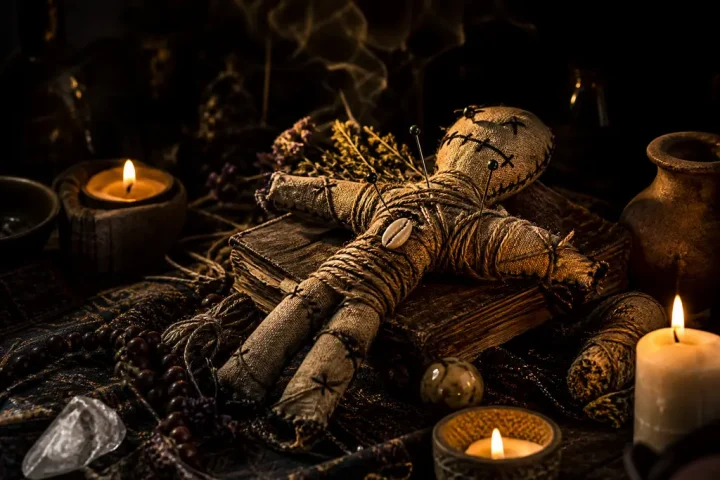
In Vodoun, a pact with a loa, or god, is known as an engagement. Such pacts are usually said to involve evil loas and may be compared to demonic pacts in Western terminology.
This does not mean that Vodoun itself should be reduced to demonology. Vodoun is a complex religious and magical tradition with its own theology, spirits, ethics, rituals, and ancestral practices. The comparison applies specifically to certain harmful or dangerous forms of spiritual agreement described in occult reference works.
Breaking a Pact
In Christian moral tales, pacts with the Devil are not always irrevocable. Redemption may still be possible through repentance, confession, appeal to Jesus or the Virgin Mary, or the destruction of the pact itself. In some versions of the Faust legend, however, salvation is not granted once the pact has been made.
St. Alphonso Maria de Liguori, founder of the Redemptorist order in the 18th century, gave advice for breaking demonic pacts. He taught that the person must renounce and abjure the pact, burn it if it exists in writing, declare it rejected, destroy charms, talismans, and writings connected with black magic, and make restitution where possible.
Modern demonologists often argue that human free will remains intact and that a diabolical pact can be revoked. Repentance, in this view, renders the pact useless.
The Meaning of the Pact in Occult History
The pact is one of the most powerful and disturbing ideas in the history of demonology and magic. It reflects the fear that forbidden knowledge always has a price. It also reflects the human desire to negotiate with hidden powers for what cannot easily be obtained through ordinary means.
In folklore, the pact warns against greed, lust, ambition, and spiritual arrogance.
In witchcraft trials, the pact became a legal and theological weapon used against the accused.
In grimoires, the pact becomes a ritual instrument for binding spirits to service.
In modern occultism, the pact may be interpreted psychologically, symbolically, or ritually as a serious act of commitment, exchange, and consequence.
Whether treated as literal, legendary, theological, symbolic, or psychological, the pact remains one of the central motifs of Western demonology. It asks a dangerous question:
What are people willing to give up in order to gain power?
Continue Your Study Inside the Occult World Skool Community
A pact is never just a story about selling the soul. It is one of the darkest and most revealing themes in occult history: a symbol of power, temptation, exchange, ambition, spiritual danger, ritual authority, and the hidden price of forbidden knowledge.
If this subject fascinates you, do not remain alone with fragments from old books and scattered internet articles.
Inside the Occult World Skool Community, you can meet fellow occultists, witches, Wiccans, demonology students, ritual practitioners, and serious seekers who are studying the same mysteries with depth, structure, and purpose.
This is where the old subjects come alive: demonology, black magick, witchcraft, grimoires, spirit work, protection, ritual practice, occult symbolism, folk magic, angels, necromancy, tarot, hoodoo, voodoo, and the hidden architecture of magical tradition.
In the Demonology Course, you will explore demons, infernal hierarchies, grimoires, sigils, pacts, protection, offerings, spirit communication, and the historical development of demonic lore.
In the Black Magick Course, you will study power, shadow, will, ritual discipline, magical authority, spiritual protection, and the serious ethical questions surrounding darker forms of occult practice.
In the Ancient Grimoires – Decoding Magical Texts from History course, you will learn how magical books were written, transmitted, interpreted, and used — including the ritual logic behind spirit conjuration, divine names, circles, seals, planetary forces, angelic hierarchies, and demonic commands.
Do not study these subjects from fear.
Study them with knowledge.
Enter the Occult World Skool Community.
Meet your fellow occultists.
Ask questions.
Share experiences.
Learn the old systems.
And begin walking the path with structure, seriousness, and power.
Further Reading:
- Butler, E. M. Ritual Magic. Cambridge: Cambridge University Press, 1949.
- Guiley, Rosemary Ellen. The Encyclopedia of Witches and Witchcraft. 2d ed. New York: Facts On File Inc., 1999.
- Pelton, Robert W. Voodoo Secrets from A to Z. Cranbury, N.J.: A. S. Barnes and Co., 1973.
- Waite, Arthur Edward. The Book of Black Magic and of Pacts. 1899. Reprint, York Beach, Maine: Samuel Weiser, 1972.
SOURCE:
The Encyclopedia of Magic and Alchemy Written by Rosemary Ellen Guiley Copyright © 2006 by Visionary Living, Inc.


Follow