

Pajainen: Slayer of the Great Bull
Pajainen is one of the most obscure figures associated with pre-Christian Finnish and Karelian mythology. Unlike famous deities such as Ukko, Tapio and Ahti, he has left almost no clearly defined body of legends behind him. Modern mythological dictionaries usually describe Pajainen simply as a god who killed the Great Bull, a mysterious feat connected with one of the most extraordinary episodes preserved in Finnish epic tradition.
Behind this brief description lies a powerful myth of impossible strength, ritual sacrifice and abundance. Pajainen represents the force capable of overcoming something so enormous that no ordinary warrior, hunter or butcher can master it.
The Mystery of Pajainen
Very little can be stated with certainty about Pajainen. His name appears in scholarly discussions of ancient Karelian deities, but there is no extensive surviving narrative that establishes his ancestry, appearance, worship or precise divine function. This absence is not unusual. Much of the pre-Christian religion of Finland was preserved through oral poetry, charms, songs and regional customs rather than through a single written religious system.
Some interpretations connect Pajainen with Ukko, the powerful sky and weather god of Finnish mythology. In this reading, Pajainen may not have been an entirely separate deity but one of the regional names, titles or manifestations attached to the celestial god. Pajainen has also been associated linguistically with ideas of height or the world above, strengthening the possible connection with a heavenly power. However, the evidence remains fragmentary, and Pajainen should not be presented as a fully documented equivalent of Ukko.
What survives most strongly is his legendary deed: the killing of the enormous bull prepared for a great feast.
The Great Bull of Finland
The story of the Great Bull appears in Rune Twenty of the Kalevala, during the preparations for the wedding of the divine smith Ilmarinen and the Maiden of Pohjola. Louhi, the formidable mistress of Pohjola, prepares an immense celebration and requires enough food and drink for the assembled guests.
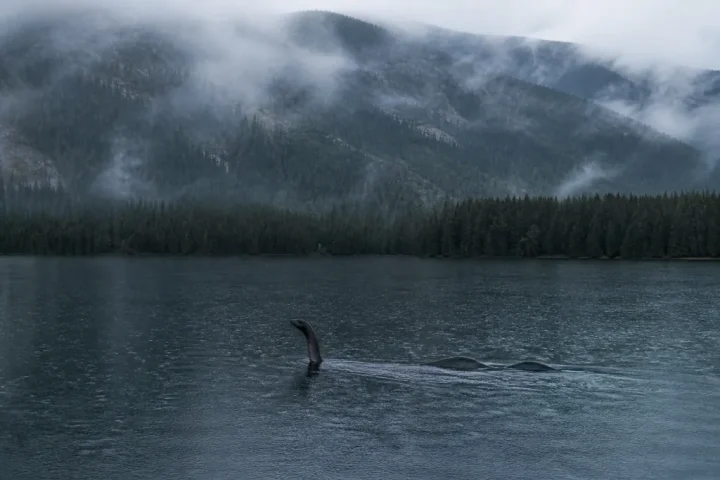
For this feast, an extraordinary ox is brought from Karelia. The creature is described through deliberate mythic exaggeration. Its horns are said to extend for a hundred fathoms, while a swallow requires an entire day to fly from one horn-tip to the other. A squirrel travels along its enormous body for weeks without reaching the end. Its back rises towards the clouds, and hundreds of men are needed to hold its horns and guide its head.
The ox is not merely a large animal. It is a creature of cosmic proportions, resembling a living landscape. Its body unites distant regions of Finland, while its immense size places it somewhere between an earthly beast and a primordial monster.
No Mortal Can Kill the Bull
Once the bull reaches Pohjola, another problem emerges. No one can be found who is capable of slaughtering it.
A renowned old figure named Virokannas approaches with confidence, declaring that he will strike the animal down with his weapon. Yet when the bull turns its head and flashes its terrible eyes, the would-be slayer leaps into the trees and hides among the bushes.
Messengers search throughout Karelia, Finland, Estonia, Sweden, Lapland and the distant northern lands. They even seek a butcher in Tuonela, the Finnish realm of the dead. Nevertheless, nobody can be found who possesses the courage and power required to face the creature.
The failed search establishes the bull as something beyond ordinary human strength. Kings, warriors and giants are powerless before it. The creature can only be defeated through the intervention of a being who comes from outside the familiar human world.
The Small Hero from the Sea
At last, a mysterious figure rises from the ocean.
He is described as an old, iron-fisted hero with a copper-coloured face. He wears a helmet of stone and sandals made from rock. In his hand he carries a golden blade with a copper handle. Yet despite his supernatural equipment, he is astonishingly small. He can sleep inside a bowl and stand beneath a sieve.
The contrast is deliberate. The largest creature imaginable is confronted by one of the smallest heroes in Finnish mythology.
The sea-born figure attacks without hesitation. He forces the enormous bull onto its knees, breaks its neck and brings the mighty animal crashing to the earth. From its body comes enough meat, blood and fat to supply the entire wedding feast of Pohjola.
In the surviving Kalevala text, this mysterious slayer is not directly called Pajainen. The identification appears primarily in later mythological reference works and interpretations. It is therefore possible that the name Pajainen preserves a regional identity for the divine bull-slayer, while the epic poetry retained only the supernatural description of the figure.
The Meaning of the Great Bull
The bull has long represented physical power, fertility, wealth and the untamed force of nature. In an agricultural society, cattle were also a visible sign of prosperity. A bull large enough to cover the landscape naturally becomes an image of almost unlimited abundance.
Its death is therefore more than the defeat of a monster. The bull is transformed into nourishment. Its immense and potentially uncontrollable power is converted into food for a communal celebration.
The story can be understood as a myth of ritual transformation. Something wild and overwhelming must be brought under control before society can feast, celebrate marriage and continue the cycle of life. The death of the bull releases the abundance contained within its gigantic body.
The slayer’s small size adds another meaning. Pajainen does not triumph because he is physically larger than his opponent. He succeeds because he possesses a concentrated supernatural power that the many human heroes lack. The myth suggests that true power is not always visible and that the smallest force, when connected with the divine world, may overcome the greatest obstacle.
Pajainen and the Power Above
The possible association between Pajainen and Ukko introduces another layer to the story. Ukko governed the sky, weather, fertility and the forces that caused the earth to produce its harvest. In some Finnish traditions, the killing of an enormous ox or pig was associated with seasonal feasting and agricultural abundance.
Under this interpretation, Pajainen may represent the heavenly power that strikes down the great animal so its vitality can pass into the community. The act resembles the thunderbolt descending from above: sudden, irresistible and capable of breaking what no mortal can move.
The sea-born appearance of the bull-slayer does not necessarily contradict this celestial connection. Finnish mythology frequently allows supernatural beings to cross the boundaries between sky, water, earth and the underworld. The ocean is not simply a physical location but a threshold from which ancient powers, magical tools and mysterious helpers may emerge.
The Forgotten God
Pajainen remains a shadowy presence within Finnish mythology. No surviving temple, cult image or complete cycle of stories can confidently be attributed to him. He stands at the edge of the recorded tradition, where regional names, oral poetry and later interpretations overlap.
Yet this very uncertainty makes him fascinating.
He is remembered not through a family of gods or a catalogue of divine responsibilities, but through a single overwhelming act. When every celebrated warrior fails, Pajainen confronts the impossible. He brings down the creature whose body appears to cover the world and releases the abundance hidden within it.
Pajainen is therefore the mysterious power that masters excess, transforms chaos into nourishment and proves that divine strength cannot be measured by outward size.
Enter the Occult World Mystery School
Pajainen is only one of countless forgotten gods, spirits and supernatural beings whose stories survive in fragments. Their names remain scattered through ancient poems, regional folklore, magical traditions and half-remembered rituals. Most people will never discover them because they stop with the short definitions found in ordinary mythology books.
The Occult World Mystery School takes you beyond those surface descriptions.
Enter a growing world of mythology, demonology, ancient grimoires, ritual magic, divination, spirits, forbidden history and practical occult knowledge. Discover the traditions hidden behind the names, understand the symbols concealed within the legends and explore the mysteries that conventional education refuses to teach.
Do not remain an observer standing outside the gates.
Join the Occult World Mystery School and begin your initiation into the deeper mysteries of the unseen world.


Follow