

Hidden behind walls and heavy gates in Mexico City’s Colonia Doctores stands one of the capital’s strangest architectural relics. The Posada del Sol was conceived as a magnificent hotel, cultural centre and monument to Mexican identity, filled with courtyards, murals, fountains, gardens, ceremonial spaces and hundreds of rooms. Instead of becoming the celebrated landmark its creator imagined, however, the complex slipped gradually into failure, government occupation and abandonment. Over the decades another identity grew around it, darker than the original dream. Stories began to circulate of apparitions, underground passages, strange rituals and a young girl’s spirit that was said to haunt the building’s subterranean chambers.
The Posada del Sol was the creation of engineer Fernando Saldaña Galván, who began developing the complex during the early 1940s. Saldaña was not interested in constructing an ordinary hotel. His ambition was to create an enormous cultural environment where foreign travellers, artists, intellectuals and members of Mexico City’s elite might encounter an idealised vision of the country itself. The project eventually consisted of fourteen interconnected buildings and was intended to contain around 400 guest rooms together with restaurants, bars, salons, shops, banquet halls, an auditorium, gardens, terraces and a chapel-like space known as the room of meditation.
Its architecture was deliberately theatrical. Rather than adopting the severe modernist forms increasingly fashionable in the twentieth century, Saldaña embraced ornamental neocolonial design and drew inspiration from Mexican colonial, regional and popular traditions. Stone, carved wood, tezontle, decorative plaster, stained glass, fountains, sculpture and murals transformed the complex into something closer to an enclosed symbolic world than a conventional hotel. Passages opened unexpectedly into courtyards, stairways connected different levels, and enclosed spaces seemed to multiply behind the external walls. Even when the building was functioning, there was something labyrinthine about it.
Contemporary publicity presented the Posada del Sol as an extraordinary destination, and the artistic ambitions of the project were considerable. Murals and decorative works throughout the complex celebrated Mexican identity, history and nationalism, while Saldaña attempted to create a place that would stand apart from the increasingly international character of luxury hotels elsewhere in the city.
For many years, one of the most repeated stories claimed that the hotel opened in 1945 and survived for only eight months. Archival research has shown that this was almost certainly wrong. Contemporary advertising indicates that the Posada del Sol was already operating in 1944 and continued functioning for roughly six years. The failure was therefore not an instantaneous catastrophe, but a slower collapse. Despite the scale of Saldaña’s investment and his determination to make the project succeed, the hotel struggled to compete with more established establishments in better locations.
By 1950 the Federal Government had acquired the property. Saldaña’s great experiment as a hotel had effectively ended.
The Suicide That Never Happened
From this failure emerged the most famous ghost story associated with the Posada del Sol.
According to the legend, Saldaña invested everything he possessed in the hotel and was financially destroyed when it failed. Overcome by the collapse of his dream, he supposedly entered the abandoned building and hanged himself inside. Different versions place the suicide near a bell, the chapel or a statue of Saint Francis of Assisi. His spirit, unable to leave the monument that had consumed his life, was then said to remain within the complex, walking through the corridors and courtyards of the hotel he had lost.
The story has been repeated so often that it has become almost inseparable from the Posada del Sol.
It is also false.
Historical research has located Fernando Saldaña’s civil death record. He remained alive for several years after the government took possession of the hotel. In 1953 he suffered an asthma attack at his home in Lomas de Chapultepec and was taken to the Hospital Central Militar, where he died of natural causes. He did not hang himself inside the Posada del Sol.
Yet correcting the history has not erased the ghost.
Stories of a male apparition identified as Saldaña have continued to circulate, and this creates one of the more curious aspects of the building’s mythology. The historical Fernando Saldaña died elsewhere, but the supernatural version of Saldaña appears to have developed an existence entirely independent of the man himself. In the folklore of the Posada del Sol, he still belongs to the building.
Perhaps this should not be surprising. Haunted places do not always preserve history accurately. Sometimes they preserve emotion instead. Saldaña’s obsession with the project, its financial failure and the eventual abandonment of his dream provided everything necessary for the creation of a ghost story. The suicide may never have happened, but the idea of a creator eternally trapped inside his failed masterpiece proved too powerful to disappear.
The Little Girl Beneath the Hotel
The second great haunting of the Posada del Sol is stranger still because no one seems to know exactly who the ghost is supposed to have been.
Somewhere within the darker areas of the complex, an improvised altar became associated with the spirit of a young girl. Visitors have reported seeing sweets, toys and other small offerings left there. According to the legend, these gifts are intended to appease the child so that she does not follow visitors through the building or bring misfortune upon those who disturb her.
The details change depending upon who tells the story. One version claims that the girl died while the complex was being used by government institutions. Another says that a nursery once existed inside the Posada del Sol and that the child wandered away before dying somewhere within the building. Other accounts connect her with a particular chamber, sometimes identified as Room 103.
No reliable historical record has yet established that such a child actually died there.
The altar, however, has been seen and photographed, and the underground areas associated with the legend are real. Journalists and visitors who have gained access to the property have described descending beneath the main complex into dark passageways containing doors that open into abandoned rooms and chambers. Somewhere within this subterranean environment lies the place traditionally associated with the mysterious girl.
That physical reality gives the legend much of its power. It is easy to dismiss a story told about an ordinary room. It becomes considerably harder to ignore when the story leads underground, beneath an enormous abandoned hotel, through corridors that were never intended to become part of a ghost legend.
Whether the offerings began because someone genuinely believed that a child’s spirit haunted the building, or whether the altar itself gradually created the legend around it, may now be impossible to determine. What matters is that people continue to treat the site as though something must be acknowledged there.
In many cultures, offerings to the dead are not merely acts of remembrance. They are negotiations. Something is given because something is expected in return, even if what is expected is simply that the spirit remain quiet.
From Hotel to Government Labyrinth
After the hotel failed, the Posada del Sol entered another phase of its long decline. The Instituto Nacional Indigenista began using part of the complex in 1951, followed several years later by the Instituto Nacional de la Vivienda. Other government organisations subsequently occupied portions of the property, turning former guest rooms and public spaces into offices and administrative areas.
The transformation was never comfortable. The Posada del Sol had been designed as a sprawling hotel and cultural environment, not as a government complex. Rooms were adapted, sections were closed, and parts of the enormous property gradually fell out of regular use.
By the early 1980s, large portions of the complex were empty. It was later assigned to the Procuraduría General de Justicia, while proposals to redevelop or demolish parts of the site appeared periodically. A demolition plan during the late 1990s was never completed, partly because of the architectural and artistic value of the surviving complex. Some murals and decorative elements were restored, but the Posada del Sol as a whole remained caught between preservation and abandonment.
That condition created an ideal environment for darker stories to accumulate.
Rumours spread of murders, suicides, occult ceremonies, secret societies and torture chambers. Some accounts linked the property with notorious episodes from Mexico City’s political and criminal history. Others claimed that strange rituals had been performed inside abandoned rooms or beneath the building. Evidence for most of these stories is weak or nonexistent, but they became attached to the Posada del Sol because the building itself seemed capable of containing them.
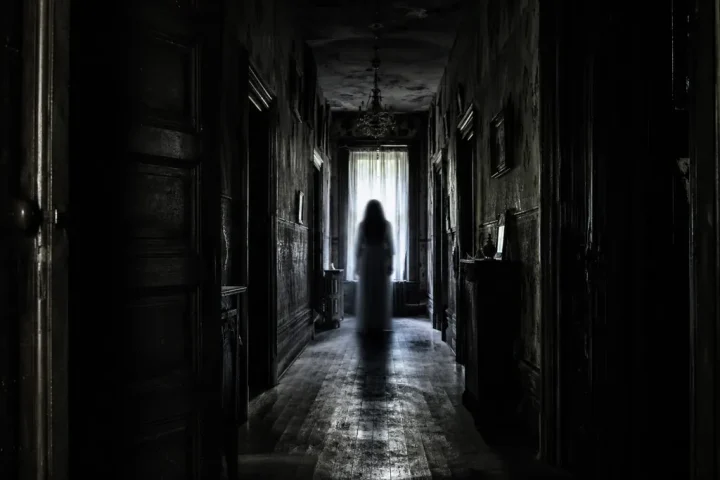
The physical surroundings encouraged imagination. Long corridors disappear into darkness. Empty windows overlook silent courtyards. Murals deteriorate on walls built for guests who never came in sufficient numbers. Doors open into rooms whose original purposes have been forgotten. Beneath everything lie underground passages where visitors speak of a child’s altar.
The Posada del Sol did not need to be invented as a haunted location. Abandonment transformed it into one.
A Building Haunted by Its Own Legend
What makes the Posada del Sol particularly fascinating is the way documented history and supernatural folklore have become entangled.
The most famous death associated with the building never happened there. Fernando Saldaña died in a military hospital, not hanging from a bell inside his hotel. No reliable evidence confirms that a young girl died within the underground chambers. Many of the more spectacular stories surrounding the complex cannot be traced beyond rumour.
Yet the legends survive.
Perhaps the Posada del Sol demonstrates something fundamental about haunted places. A ghost story does not always begin with a ghost. Sometimes it begins with architecture, failure, abandonment and memory. A building becomes empty, people begin asking what happened there, and eventually the unanswered spaces acquire inhabitants of their own.
Saldaña attempted to create a monument that would celebrate Mexico. Instead, his unfinished dream became something more unpredictable. Government officials occupied its rooms, murals faded behind locked doors, underground spaces disappeared from ordinary public life, and generations of storytellers gradually transformed the complex into one of Mexico City’s most mysterious locations.
The real Fernando Saldaña may never have haunted the Posada del Sol, but the version of him created by the city’s imagination has now walked those corridors for decades. The identity of the little girl may be even more elusive. Perhaps she never existed at all, or perhaps somewhere in the forgotten history of the building lies an event that gave birth to the story. Either way, the sweets and toys left in the darkness remain a peculiar testimony to the belief that something beneath the hotel is still listening.
Behind the gates of the Posada del Sol, the great hotel that was supposed to represent prosperity and cultural ambition remains suspended between ruin and preservation. Its creator is gone, its original purpose has disappeared, and much of its history has become buried beneath layers of rumour. Yet somewhere below the courtyards and abandoned rooms, visitors still leave offerings for a child whose name no one seems to know.
Perhaps that is where the true haunting begins.
If places like the Posada del Sol fascinate you because you sense that history becomes far stranger once you leave the safe version behind, then stop consuming mysteries as entertainment and start studying them seriously. Enter the Occult World Mystery School and descend deeper into haunted locations, spirits, witchcraft, grimoires, demonology, forgotten religions and the hidden traditions that survive beneath ordinary history. There are thousands of mysteries waiting beyond the locked door, but they reveal nothing to the spectator standing safely outside.
Sources
- Leal Menegus, Alejandro and Daniela Alemán Ramos. “El Hotel Posada del Sol en Ciudad de México, un patrimonio popular testimonio del fracaso.” Revista Historia y Patrimonio, University of Chile, 2025.
- Historical and archival material concerning Fernando Saldaña Galván, including his civil death record and documentation relating to the Posada del Sol.
- La Jornada. Reporting on the history, condition and legends surrounding the Posada del Sol, including the alleged child apparition and offerings left within the complex.
- VICE. Investigative visit to the Posada del Sol documenting its abandoned interior, subterranean spaces and the altar associated with the legend of the young girl.


Follow