
Radovan Forest and the Bride of Lake Fântânele
Radovan Forest and nearby Lake Fântânele, in Dolj County in southern Romania, are associated with one of the country’s most persistent modern ghost legends. The story centres on a young woman whose violent death in the late 1940s became the foundation of a much darker tradition involving a spectral bride, mysterious roadside encounters, fatal accidents and repeated drownings in the lake. Over the decades the original tragedy has been retold in several different forms, but at the heart of the legend appears to be the memory of a real teenage girl whose death occurred in the forest in 1948.
Lake Fântânele lies within the commune of Radovan, not far from Craiova, surrounded by woodland and agricultural countryside. Although the area is known today for fishing and recreation, local tradition has long treated the lake and forest with unease. Stories describe people disappearing in the water, motorists encountering a woman dressed as a bride beside the road and travellers being warned never to follow strange voices or apparitions into the trees. The supernatural figure blamed for these dangers is usually known simply as the Bride of Radovan.
The Woman Behind the Legend
Romanian sources referring to the Radovan civil death register identify a young woman named Eleana Padomianu, whose name also appears in later retellings as Elena, Ileana or Podomianu. She was reportedly born in 1931 in Ghergheasa, in the historical region of Râmnicu Sărat, and was only sixteen years old when she died on 3 February 1948 in the state forest at a place known as Vlădășel. The death was recorded as violent, and the circumstances were serious enough for the Dolj authorities to become involved.
Those surviving details are important because they give the Bride of Radovan legend a historical foundation that many ghost stories lack. A young woman from eastern Romania appears genuinely to have died violently in the forest during exactly the period in which local tradition places the origin of the haunting. The surviving record, however, does not establish that she was actually a bride, nor does it confirm the dramatic circumstances later attached to her death. The transformation of Eleana into the supernatural Bride belongs to folklore rather than documented history.
Two Versions of the Bride’s Death
The best-known version of the story describes the girl as a young Moldovan woman who arrived in Oltenia with her family during the difficult years surrounding the Second World War. After settling in the region, she supposedly met a local man and fell in love with him. Their relationship eventually led to marriage, but the wedding ended catastrophically when the groom was attacked and beaten to death on the wedding night. Unable to endure the sudden destruction of her future, the young woman is said to have entered Radovan Forest and hanged herself.
A second version changes the nature of the tragedy. In this account she was not yet married but was working for a wealthy local landowner or agricultural employer. The man became sexually interested in her and, according to the legend, raped her shortly before her intended wedding. Overwhelmed by shame, trauma and despair, she went into the forest and took her own life. Some later versions add rumours that she may have believed herself pregnant, although these details cannot be verified and appear to belong to the developing folklore surrounding her death.
The existence of competing versions is characteristic of supernatural tradition. Rather than weakening the legend, the contradictions reveal how the memory of a violent death can be reshaped by successive generations. In one story the young woman becomes a grieving bride whose husband is murdered; in another she becomes the victim of sexual violence. Both narratives preserve the same underlying idea: a young woman whose life was destroyed just as she was approaching marriage, leaving behind a spirit unable or unwilling to rest.
Other local traditions complicate the story further. One version from the Fântânele area tells of two lovers who were forbidden to marry and killed themselves together, while later accounts sometimes describe a ghostly woman appearing suddenly in front of vehicles or even manifesting inside cars. These overlapping stories suggest that several local motifs may eventually have fused around the single figure of the Bride of Radovan.
The Bride on the Forest Road
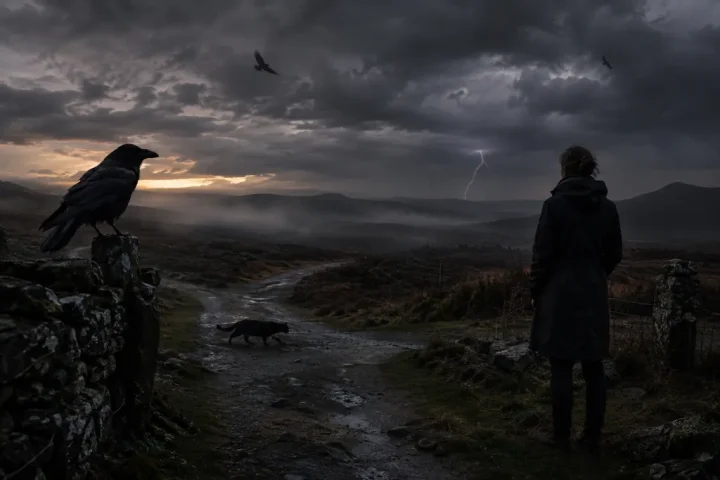
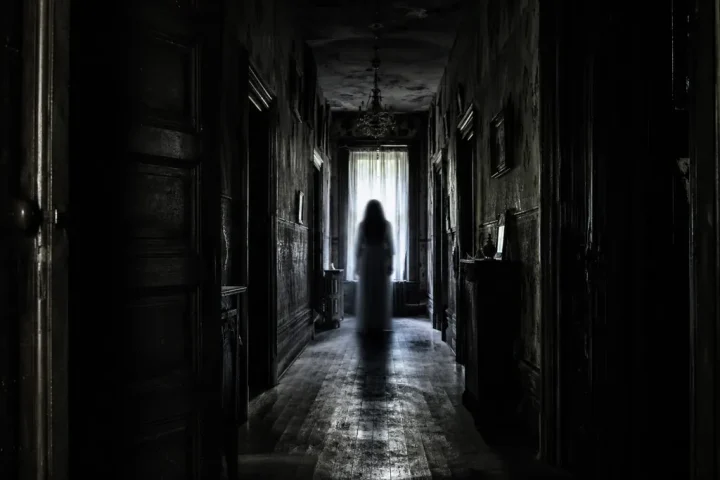
According to local folklore, the young woman did not remain where she died. Her spirit began appearing on the road near Radovan Forest, most often after nightfall, dressed in white or in the clothing of a bride. Travellers occasionally report seeing a pale female figure standing beside the road, while others speak of unexplained sounds coming from the trees or of a woman appearing suddenly in places where no pedestrian should reasonably have been.
The traditional warning associated with the apparition is unusually specific. Anyone passing through the area is advised to keep moving and ignore whatever they hear or see. Travellers who stop, investigate strange sounds or attempt to approach the Bride are said to risk being drawn away from the road and deeper into the forest. According to the most ominous versions of the legend, those who follow her may never find their way back.
This aspect of the story places the Bride of Radovan within a much wider family of European supernatural traditions involving mysterious women encountered along lonely roads. Such figures often appear at boundaries between inhabited territory and wilderness, particularly near forests, bridges, crossroads or bodies of water. They may ask for assistance, lure travellers away from safety or simply appear without explanation before vanishing. What distinguishes the Radovan apparition is the extent to which local memory has given the ghost an identity and connected her with a particular historical tragedy.
The forest itself therefore becomes more than a backdrop. It is the place where the young woman supposedly died, the place from which her apparition emerges and the threshold beyond which travellers are warned never to follow her. The landscape and the ghost have become inseparable.
The Curse of Lake Fântânele
As the legend developed, the supernatural territory of the Bride expanded beyond the forest to the nearby waters of Lake Fântânele. Romanian press reports and local retellings repeatedly refer to numerous drownings in the lake, often emphasising that many of the victims were men. Over time these deaths became incorporated into the Bride’s story and were interpreted as evidence that her spirit was taking revenge upon the male sex for whatever violence or betrayal had caused her death.
The frequently repeated claim that dozens of people have drowned in the lake is difficult to verify as a precise historical total. No comprehensive official list covering the entire history of the reservoir has been located, and the number should therefore be treated as part of the local reputation rather than as an established statistic. There is no doubt, however, that genuine drownings have occurred there, and several fatal incidents have received substantial Romanian press coverage.
One of the most striking happened in April 2010, when Emilian Marius Bondrescu, a thirty-six-year-old officer with the Dolj Inspectorate for Emergency Situations, died while diving in Lake Fântânele. Bondrescu was an experienced diver who had participated in rescue and recovery operations involving drowning victims. When he himself failed to return from the water, a difficult search followed and specialist divers were required to recover his body.
For believers in the legend, the death of an experienced rescue diver in a lake already associated with unexplained drownings appeared almost impossible to ignore. The tragedy was rapidly absorbed into the supernatural narrative, reinforcing the belief that the lake was dangerous in ways that ordinary explanations could not fully account for.
There is, of course, no evidence that a supernatural force caused Bondrescu’s death or any other drowning at Fântânele. Deep or unpredictable water can be lethal without the intervention of ghosts, and accidents that occur in lakes frequently acquire supernatural explanations after the event. Yet folklore operates through interpretation rather than forensic proof. Once a landscape has acquired a reputation for being cursed, every subsequent tragedy becomes capable of strengthening the older story.
From Eleana Padomianu to the Bride of Radovan
Perhaps the most fascinating element of the legend is the transformation of a real human being into a supernatural figure. If the historical information preserved in Romanian sources is correct, the woman at the centre of the story was not an ageless ghostly bride but a sixteen-year-old girl who died violently in the forest in February 1948.
Within a few generations, however, her personal identity became increasingly obscured. Her age shifted in some tellings, the circumstances of her death changed, and the distinction between engagement and marriage disappeared. One story gave her a murdered husband, another a predatory employer, and still others blended her fate with separate legends of doomed lovers. Eventually the personal name Eleana or Ileana mattered less than the title by which the apparition became known: the Bride.
That change is significant. A named girl belongs to history, but a Bride belongs to mythology. Once transformed into an archetypal figure, she could absorb new deaths, accidents and supernatural experiences without the legend collapsing under their contradictions. Her white clothing became the visual mark by which she could be recognised, her interrupted marriage explained her inability to rest, and the violence associated with her death supplied the motive for her hostility towards the living.
The Bride of Radovan therefore occupies the uncertain territory between ghost and folklore spirit. She may preserve the memory of a particular dead woman, but the supernatural being described today has become far larger than the original life from which the story emerged.
The Forest, the Road and the Lake
The power of the Radovan legend comes partly from the way it occupies an entire landscape rather than a single haunted building. The forest represents the original tragedy, because it is there that the young woman is said to have died. The road represents supernatural encounter, where travellers may unexpectedly see or hear the Bride. Lake Fântânele represents death itself, because its drownings have gradually been interpreted as the physical manifestation of the curse.
Together these places create a coherent haunted geography. Someone travelling through the area does not merely pass one supposedly supernatural site and then leave it behind. The story follows the traveller from the trees to the road and finally to the water, making the entire district part of the same supernatural narrative.
This merging of geography and folklore is one of the reasons legends such as the Bride of Radovan can survive for decades. A story attached to a real forest, a real road and a real lake is constantly reinforced by the landscape. Every accident provides another reason to tell it, every unexplained sighting gives the ghost renewed visibility, and every new generation receives the same warning not to follow the woman in white.
The historical truth behind Eleana Padomianu’s death may never be completely reconstructed. The documentary evidence appears to confirm the violent death of a very young woman in Radovan Forest in 1948, but the circumstances that transformed her into a bride, a roadside apparition and eventually the alleged mistress of a cursed lake belong to oral tradition. The legend therefore survives not because every detail can be proven, but because a real tragedy became embedded so deeply within the landscape that later deaths and fears could be interpreted through it.
More than seventy years after the young woman entered the historical record, her original life has almost disappeared behind the supernatural figure created from it. The girl was mortal, local and tragically young. The Bride of Radovan is something else entirely: a white figure beside the road, a presence among the trees and, according to those who still believe the stories, a spirit waiting beside the dark waters of Lake Fântânele.
Enter the Occult World Mystery School
The Bride of Radovan is more than another chilling tale for people who enjoy haunted places. Beneath the legend lies the ancient and persistent belief that violent death can bind a spirit to the place where its life ended, that emotional trauma can transform the dead into dangerous supernatural beings and that repeated tragedy can turn an ordinary landscape into cursed territory. These ideas lead directly into the deeper occult study of restless spirits, death magic, necromancy, curses, spirit attachment, haunted landscapes and the traditions through which human beings have attempted to understand the dead for thousands of years.
If all you want are entertaining ghost stories, the internet will give you thousands of them for free. If you actually want to understand the hidden traditions behind those stories, then stop skimming the surface and enter the Occult World Mystery School. There are thousands of spirits, gods, demons, magical systems, grimoires and forgotten traditions waiting beyond it, and none of them will reveal themselves to someone satisfied with shallow paranormal entertainment. Join the Occult World Mystery School, go deeper than the ghost hunters and legend collectors, and start learning the occult systems that explain why humanity has feared, summoned, honoured and attempted to control the dead since the beginning of civilisation.



Follow