
Republic Ghost Train: The Woman in White and the Wreck of 1887
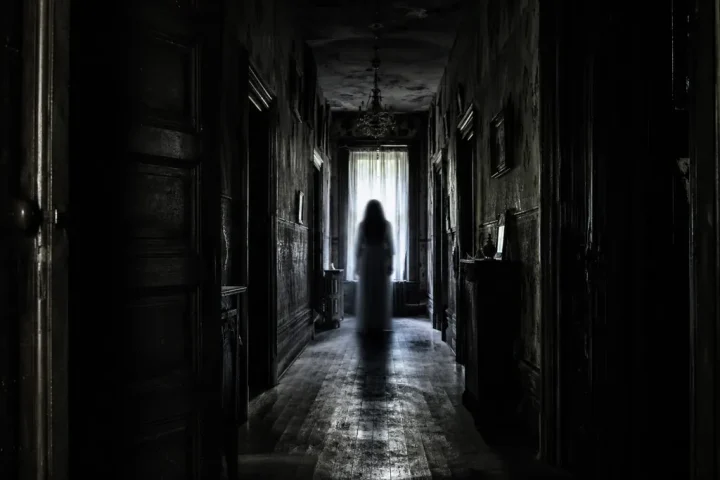
Along the old Baltimore and Ohio Railroad near the small town of Republic, Ohio, there survives one of the most disturbing early railway hauntings recorded in the state. The legend centres upon a catastrophic head-on collision that occurred in the darkness of January 4, 1887, when a speeding passenger express struck a freight train west of Republic and transformed the frozen railway into an inferno of twisted iron, burning timber and human remains. Within only a few weeks, railway workers began reporting something inexplicable at almost exactly the same place: a mysterious woman dressed in white carrying a red danger lantern beside the tracks, apparently signalling trains to stop before they reached the scene of the disaster.
The apparition is particularly remarkable because the story cannot simply be dismissed as a ghost legend invented generations after the wreck. Newspaper reports describing the mysterious signal were circulating in Ohio by March 1887, scarcely two months after the collision. The dead had only recently been buried, the wreck was still fresh in local memory, and railway crews travelling the line were already speaking of a spectral warning appearing in the darkness.
Over the decades, the haunting expanded. Later generations told of strange lights moving along the railway and of a phantom train following the route of the doomed express, as though the disaster itself had somehow become trapped upon the tracks. Yet the oldest and most compelling element remains the woman in white, standing beside the railway with the warning that came too late on the night so many people died.
The Night of the Wreck
During the bitterly cold early hours of January 4, 1887, a westbound Baltimore and Ohio passenger express was travelling through northern Ohio on its journey towards Chicago. Contemporary reports placed its speed at approximately sixty miles per hour as it approached Republic shortly after two o’clock in the morning.
On the same line, an eastbound freight train was attempting to reach Republic and clear the main track before the express arrived. The freight had already experienced difficulty maintaining steam in the severe winter weather and eventually stopped roughly half a mile west of the station, dangerously close to a curve that concealed the line ahead.
The situation became desperate. The freight conductor moved forward carrying a warning lantern, hoping to signal the approaching express before it reached the stalled train. When the light of the passenger locomotive finally appeared around the bend, however, there was almost no distance remaining between the two trains.
The express engineer saw the danger and attempted to reverse the locomotive while braking, but the train was moving too quickly. The two engines collided head-on with tremendous force.
Contemporary descriptions claimed that the locomotives rose under the violence of the impact and became crushed into one another. Passenger cars telescoped and shattered behind them as timber, iron and human bodies were thrown together inside the wreckage. Almost immediately, fire broke out from the heating stoves used inside the railway cars, and the collision became something far worse than an ordinary derailment.
Fire Among the Dead
The fire consumed portions of the wreck before rescuers could reach everyone trapped inside. A smoking car carried many of the passengers who died, and some victims were burned so completely that identification became impossible. Early reports disagreed over the final number of deaths, and the destruction of human remains made an exact count difficult.
Approximately twenty-two or twenty-three people are generally believed to have died in the catastrophe. Some bodies were recovered intact enough to identify, while others were reduced to burned fragments that revealed almost nothing about the people they had once been.
One of the most horrifying individual deaths was that of the fireman, William Fredericks. The collision trapped him among iron beams and reportedly left him suspended roughly ten feet above the wreckage. He remained alive for several hours before dying from his injuries, while rescuers were unable to free him in time.
The violence of the accident was followed by an equally terrible confusion as survivors, railway employees and local residents attempted to determine who had lived and who had vanished inside the flames. Personal belongings disappeared into the fire, families became separated, and the identification of some of the dead was never completely resolved.
For a community as small as Republic, the disaster transformed an ordinary stretch of railway into a place associated immediately with death.
The Postlethwaite Family
Among the families caught inside the wreck were Joseph Postlethwaite, his wife Mary and their children. Joseph had recently sold the family’s farm in West Virginia and was travelling west with his family while carrying approximately $1,500 from the sale, a substantial amount of money in 1887.
Joseph died in the wreck together with two of his sons, Spencer, aged eighteen, and Henry, aged eleven. Mary and several younger children survived, but the money from the sale of the farm disappeared in the fire.
The tragedy left the surviving members of the family not only bereaved but financially devastated. Their story became one of the most frequently repeated human tragedies associated with the wreck because the family had apparently been travelling towards a new beginning when the collision destroyed both lives and fortune in a matter of moments.
Unidentified victims of the disaster were later mourned in Republic, where funeral proceedings were held for those whose remains could not be confidently named. The uncertainty surrounding some of the dead would later become part of the atmosphere of the haunting, because railway workers and residents knew that not every person who died beside the tracks had been restored to an individual identity.
The Woman with the Red Lantern
The supernatural history of the Republic wreck began almost immediately.
In early March 1887, Ohio newspapers reported a strange incident involving railway workers travelling through the same area. As a train approached the location of the January disaster, the engineer suddenly saw what appeared to be a red danger signal ahead.
A red lantern on a nineteenth-century railway demanded immediate attention because it warned the crew to stop. The engineer applied the brakes and reversed the locomotive, bringing the train to a halt close to the site of the fatal collision.
When the train stopped, the signal had disappeared.
Both the engineer and fireman reportedly believed that the red light had been carried by a woman dressed in white. The conductor walked along the railway searching for the person who had displayed the warning, but no woman could be found and there appeared to be no legitimate reason for anyone to have been standing beside the tracks signalling the train.
The disappearance transformed an unusual railway incident into something much more disturbing. If an ordinary person had been carrying the lantern, she should have remained somewhere nearby. Instead, both woman and light seemed to vanish into the darkness immediately after the train stopped.
A Warning That Came Too Late
The symbolism of the apparition is impossible to ignore.
On the night of January 4, the doomed passenger express desperately needed a warning before it entered the curve and encountered the stalled freight train. The freight conductor attempted to provide exactly such a signal, but the approaching express was already too close for the engineer to prevent the collision.
Only weeks later, railway workers began seeing a woman in white carrying the warning that had been needed before the wreck.
There is no surviving evidence revealing who the apparition was supposed to represent. No contemporary report identifies her as the ghost of a particular victim, and calling her a guardian spirit would impose an explanation upon something the original witnesses themselves did not understand.
Yet her behaviour is unmistakably protective. She does not lure trains towards destruction or appear to threaten railway workers. Instead, she displays the railway’s symbol of danger and causes trains to stop before reaching the place where the earlier express had been destroyed.
Within the supernatural logic of the legend, the woman in white appears to be repeating the warning that history failed to deliver soon enough.
Three Apparitions at the Wreck Site
The March newspaper reports did not describe the incident as an isolated occurrence. Railway workers were said to have encountered the mysterious warning on three separate occasions, each involving the same area around the wreck.
Repeated appearances transformed the event from a strange mistake into a developing haunting. Engineers working the line knew exactly what had happened there in January, and the sight of an unexplained red lantern near the wreck site would have carried an immediate and terrible meaning.
Reports of the ghost apparently became widespread enough that local residents organised a group to investigate the mysterious signals. Contemporary accounts referred almost humorously to a posse of ghost hunters from Republic preparing to search for the source of the apparition.
Whether they ever discovered anything is unknown.
What remains important is that the haunting had already become local news within weeks of the catastrophe. People were not looking back at an old disaster through the romantic imagination of later generations. They were attempting to understand strange reports while the wreck itself still belonged to living memory.
Why a Woman in White?
The identity of the woman remains one of the great unanswered questions surrounding the Republic haunting.
Women in white appear throughout European and American ghost folklore, often in stories associated with sudden death, mourning, dangerous roads, bridges and places where travellers have died. Sometimes they are interpreted as victims repeating the circumstances of their deaths, while in other traditions they function as supernatural warnings.
Nothing in the surviving contemporary accounts proves that Republic’s apparition belonged to either category. She may have been a misidentified living person, an unusual optical effect, a railway misunderstanding or something that witnesses simply interpreted through the emotional shock surrounding the wreck.
Yet the detail of the red lantern makes the story unusually specific. This was not merely a vague pale figure glimpsed beside the line. The apparition appeared to perform a recognisable railway action that forced the engineer to stop.
If the story is accepted as paranormal, the implication is haunting. Something at the crash site had learned the meaning of the signal that failed to save the people who died there.
The Ghost Train of Republic
As the decades passed, the supernatural tradition surrounding the wreck expanded beyond the woman in white. Later local folklore began describing a ghost train travelling along the old Baltimore and Ohio route around Republic.
Witnesses have spoken of mysterious lights resembling an approaching locomotive and of a spectral train appearing to repeat the journey towards the place of the disaster. Some versions describe lights moving along sections of track before disappearing without the sound or physical presence expected from a real train.
These accounts appear considerably later than the newspaper reports concerning the woman with the lantern, and they should therefore be treated as a later layer of the haunting rather than as part of the earliest documented tradition.
The development is nevertheless characteristic of railway ghost lore. Violent train disasters frequently generate stories in which the doomed locomotive continues to travel after destruction, eternally approaching the point where history ended its journey.
In Republic, the legend transformed the railway itself into a supernatural pathway. The tracks no longer merely marked where the accident occurred but became the route upon which the tragedy could supposedly repeat.
A Residual Haunting on the Rails
Modern paranormal terminology might describe the Republic ghost train as a residual haunting, a supernatural repetition of an event that does not necessarily possess consciousness or awareness of observers. According to this theory, intense emotional or traumatic events may somehow leave an imprint upon a location, allowing fragments of the past to replay under particular circumstances.
There is no scientific evidence establishing that such psychic recordings exist, but the concept appears repeatedly in paranormal literature because it offers an explanation for apparitions that behave in predictable ways. A phantom train travelling along the same track, repeating the same approach without reacting to witnesses, would fit this interpretation.
The woman in white presents a different problem because she appears to interact with living people. Her red signal causes engineers to stop, suggesting awareness and purpose rather than simple repetition.
If the two traditions represent the same supernatural phenomenon, Republic would contain both the echo of the disaster and something apparently attempting to prevent its recurrence.
The Dead Beside the Railway
The uncertainty surrounding the victims adds another layer to the haunting. Because some remains were burned beyond recognition, contemporary authorities could not always determine exactly who had died inside the wreck.
Funeral services were held in Republic for unidentified victims, and local tradition has long associated the area with those who died anonymously in the disaster.
In ghost folklore, unidentified and improperly mourned dead are particularly likely to become restless because they lack the complete rituals of remembrance normally associated with death. Whether such beliefs have any supernatural reality cannot be established, but the Republic disaster provided all the conditions from which such legends traditionally grow: violent death, fire, dismemberment, unidentified remains and a landscape permanently associated with the moment of catastrophe.
The railway became more than a transportation route. It became the place where several lives ended so suddenly that even the identities of some victims were consumed along with their bodies.
The Tracks Today
The old Baltimore and Ohio route through Republic did not disappear when steam locomotives vanished. The corridor remains associated with modern railway operations, and anyone interested in the history or folklore of the wreck should remember that active railway property is dangerous and should never be entered without permission.
The survival of the railway gives the legend an unusual continuity. Unlike abandoned haunted stations or vanished tracks reclaimed by forests, trains continue to travel through the region where the disaster occurred.
Modern locomotives pass over ground where nineteenth-century railwaymen reported the woman in white.
For those who know the story, the ordinary red, white and yellow lights associated with railway operations can acquire a different character after darkness. A distant light moving along the tracks may be perfectly explainable, but Republic’s history ensures that some observers will always wonder whether the next light belongs to a locomotive approaching through the present or something travelling from January 1887.
One of Ohio’s Earliest Railway Ghost Stories
The Republic haunting deserves attention because of the unusually short distance between catastrophe and supernatural report. Many celebrated ghost stories first appear decades or even centuries after the historical events to which they are attached, allowing folklore to accumulate until separating fact from invention becomes almost impossible.
Republic is different.
The collision occurred in January 1887, and stories about the woman with the red lantern were already appearing in newspapers by March. The haunting therefore belongs directly to the generation that witnessed the disaster and travelled the railway while the memory of burning cars and unidentified bodies remained fresh.
This does not prove that the railwaymen encountered a ghost. It does, however, prove that people believed something strange was happening at the wreck site almost immediately.
For paranormal history, that distinction matters.
The Signal in the Darkness
The most unsettling element of the Republic story is not the later phantom locomotive but the meaning of the red light.
Railway signalling exists to prevent catastrophe. A red lantern is an ordinary human device intended to warn an approaching engineer that danger lies ahead.
At Republic, the warning became supernatural only because no living signalman could be found.
The apparition’s behaviour seems almost painfully connected to the tragedy. A passenger express once entered the curve too quickly to stop and carried more than twenty people into fire and death. Afterwards, a woman in white began appearing beside the same railway carrying the signal that might have prevented everything.
Whether she was an optical illusion, an unknown woman, a product of exhausted railwaymen haunted by what had happened, or an actual apparition cannot now be determined. The witnesses themselves are gone, the locomotives have vanished and the world of nineteenth-century rail travel has disappeared.
The warning remains.
According to the legend, somewhere beside the tracks outside Republic, a woman in white still belongs to the darkness surrounding the wreck, forever associated with a red light raised against an approaching train and a disaster that can never truly be stopped because it has already happened.
Enter the World Where the Dead Refuse to Stay Silent
If you are satisfied with ghost stories as harmless entertainment, then keep reading them from a safe distance and convincing yourself that the world contains nothing beyond what ordinary perception allows you to see. If you are serious about the occult, enter the Occult World Mystery School and begin studying hauntings, spirits, Witchcraft, ritual, forbidden traditions and the hidden systems through which generations of occultists have attempted to understand the forces operating beyond the visible world. Stop consuming fragments of paranormal folklore without understanding what lies behind them, because knowledge without depth leaves you exactly where you began. Learn how occult traditions interpret the dead, spiritual manifestation, supernatural power and the unseen structures believed to surround human existence, and decide whether you intend to remain a passive observer of mysteries or become someone prepared to enter them.
Sources and Further Reading
Contemporary and near-contemporary newspaper reports of the Baltimore and Ohio wreck at Republic, Ohio, January 1887.
Frank Leslie’s Illustrated Newspaper, January 15, 1887, coverage of the Republic railway disaster.
Ohio newspaper reports from March 1887 concerning unexplained red danger signals and the apparition of a woman dressed in white near the wreck site.
Historical railway research concerning the Baltimore and Ohio line through Republic and the victims of the January 4, 1887 collision.
Local Seneca County historical material concerning Republic, the wreck and funeral arrangements for unidentified victims.
Encyclopedia of Haunted Places -Ghostly Locales from around the World – Compiled & Edited by Jeff Belanger – Copyright 2005 by Jeff Belanger





Follow