
Irish philosopher, writer, and secret society member, 1670–1722. One of the most remarkable figures of his age, John Toland was born and raised in Ardagh, on the Inishowen peninsula, and educated in Irish Catholic schools until his teen years, when he converted to the Protestant religion. In 1688 he received a scholarship to the University of Glasgow to study theology. Returning to Ireland, he published his first book, Christianity Not Mysterious, which dismissed the idea that any religion had sole possession of the truth and argued that anything in Christianity that offended against reason and common sense should be discarded. The book was burned by the public hangman in Dublin, and Toland had to flee to London, where he took up a career writing controversial books and pamphlets about politics and religion.
Toland invented the word “pantheism” for his own religious beliefs, and was apparently the first person ever to be called a freethinker. The sources for Toland’s ideas, however, reach straight back into the radical Hermeticism of the late Renaissance. Toland was a close student of the Corpus Hermeticum – the writings then credited to Hermes Trismegistus, the legendary sorcerer-sage of ancient Egypt – and the works of Giordano Bruno (1548–1600), the great Renaissance magus and master of the art of memory. Toland himself prepared the first English translation of Bruno’s Expulsion of the Triumphant Beast and had a central role in sparking a revival of interest in Bruno among English and Dutch radicals at the beginning of the eighteenth century. See Bruno, Giordano; Hermeticism.
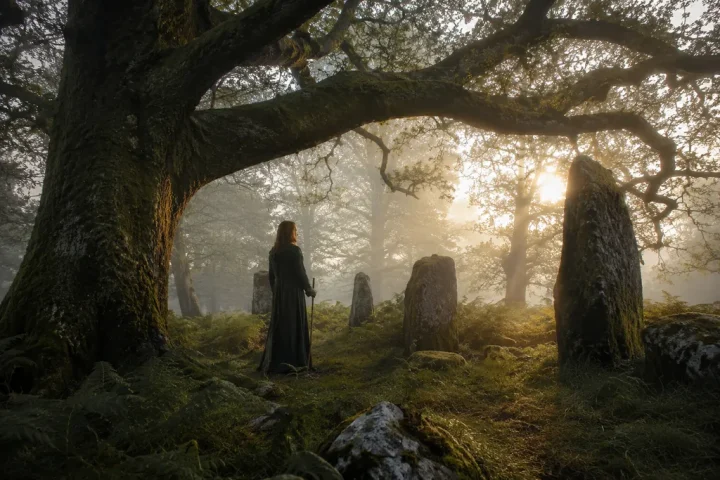
Like many progressive intellectuals of his time, Toland was fascinated by the ancient Druids, the learned caste of the pre-Christian Celtic peoples of Britain, Ireland, and Gaul. He drew up a prospectus for a history of the Druids that was partly a vindication of his own pantheist beliefs and partly an extended satire on the Anglican Church, and tried to find a noble patron to pay for its writing and publication; not surprisingly, none appeared, and the prospectus was not published until after his death. According to several accounts Toland was involved in founding the Ancient Druid Order, the parent body of the Druid Circle of the Universal Bond, at the Apple Tree Tavern in London in 1717, though no documentation has surfaced to support this claim. See Druid Revival; Druid Circle of the Universal Bond.
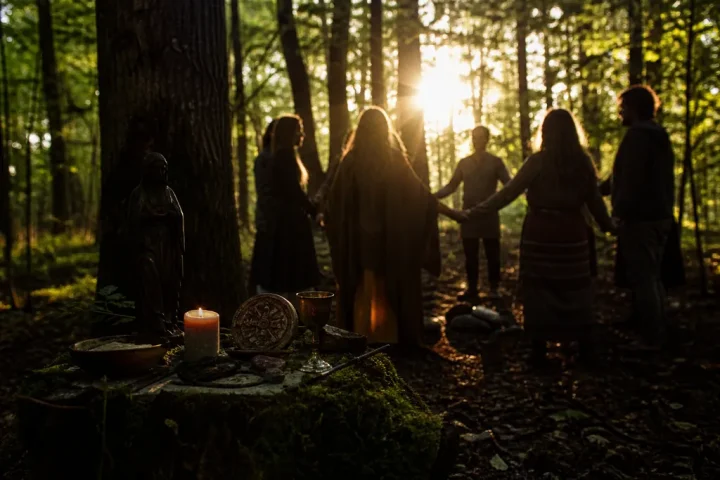
Toland’s involvement with two other secret societies is less speculative. During a stay in the Netherlands in 1708–10, he became a member of, and probably helped found, a secret society of freethinkers called the Chevaliers of Jubilation. Most of the Chevaliers were liberal French intellectuals in exile from the Catholic absolutism of Louis XIV, and shared Toland’s disdain for dogmatic religion. Later, sometime before 1720, Toland wrote and circulated privately the Pantheisticon, a book of ceremonies for the meetings of a pantheist secret society; one of Toland’s friends commented after Toland’s death that at least one organization using the Pantheisticon as its ritual actually existed. See Chevaliers of Jubilation.
Toland’s radical ideas and his abrasive personality made it difficult for him to find paying literary work as the Whig establishment in early eighteenth-century Britain grew more conservative. His health failed, and he had to sell most of his library to put food on the table in his final years. His beloved Corpus Hermeticum was one of the few books left to him when he died in 1722.
SOURCE:
The Element Encyclopedia of Secret Societies : the ultimate a-z of ancient mysteries, lost civilizations and forgotten wisdom written by John Michael Greer – © John Michael Greer 2006



Follow