
Tuatha Dé Danann: Lords of the Hidden Mounds
The Tuatha Dé Danann are the great supernatural race of Irish mythology, a people of gods, warriors, sorcerers, healers and craftsmen who ruled Ireland before the coming of the Milesians. Their name is traditionally interpreted as the “People of the Goddess Danu”, although the identity of Danu and even the precise origin of the name remain uncertain. What survives in the medieval Irish texts is a far stranger picture than a simple family of gods: the Tuatha Dé Danann belong to an Otherworld that exists beside the human world, hidden behind mist, beneath ancient hills and within places where the boundaries of reality grow thin.
Their story is preserved principally in the Irish Mythological Cycle, especially the Lebor Gabála Érenn, the “Book of Invasions”, and Cath Maige Tuired, the account of the Battles of Mag Tuired. Medieval Christian writers attempted to fit these ancient beings into a historical chronology of Ireland, but beneath that framework remain unmistakable traces of an older divine mythology.
The Arrival Through Mist
According to Cath Maige Tuired, the Tuatha Dé Danann came to Ireland after learning magic, knowledge and supernatural arts in mysterious northern lands. Tradition speaks of four cities, Falias, Gorias, Murias and Findias, where they studied under masters of wisdom before bringing four great treasures into Ireland.
From Falias came the Stone of Fál, which was associated with rightful kingship. From Gorias came the sword of Nuada, from which no enemy could escape once it was drawn. From Findias came the terrible spear of Lugh, while from Murias came the inexhaustible cauldron of the Dagda, from which no company ever departed unsatisfied.
Their arrival itself was surrounded by mystery. They burned their ships after landing so that retreat would be impossible, while smoke and magical mist concealed their presence. Later tradition transformed this strange arrival into something even more supernatural, claiming that the Tuatha Dé Danann had descended upon Ireland through the clouds.
The Battles for Ireland
The Tuatha Dé Danann first fought the Fir Bolg at the First Battle of Mag Tuired. They won possession of Ireland, but victory came at a terrible price when their king Nuada lost his hand to the warrior Sreng. Because a king was required to be physically whole, Nuada could no longer rule. He was eventually given a miraculous silver hand and later restored completely through supernatural healing.
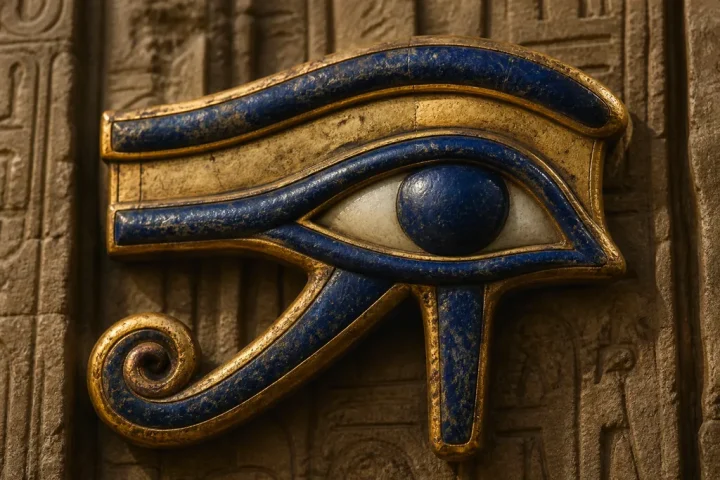
A darker enemy soon emerged in the Fomorians, beings associated with destructive and chaotic powers. Their king Bres oppressed the Tuatha Dé Danann, while the monstrous Balor possessed an eye capable of annihilating those upon whom its gaze fell.
The Second Battle of Mag Tuired became the great supernatural war of Irish mythology. Lugh, master of many arts, assumed command of the Tuatha Dé Danann and confronted the Fomorian host. Nuada was slain by Balor, but Lugh destroyed Balor by striking his deadly eye with a sling stone, turning its destructive force back upon the Fomorians and breaking their power.
The Gods of the Tuatha Dé Danann
Among the Tuatha Dé Danann are some of the most powerful figures in Irish mythology. The Dagda is the great father, magician and possessor of the inexhaustible cauldron. Lugh is the brilliant master of arts, warfare and skill. Brigid is associated with poetry, healing and sacred fire, while the Morrígan moves through battle, prophecy, sovereignty and death. Aengus belongs to love and the mysteries of the Otherworld, while Nuada embodies sacred kingship, mutilation and restoration.
These beings should not be reduced to the small winged fairies of later fantasy. They are rulers, warriors and supernatural powers capable of shaping the land, destroying armies, controlling weather, practising enchantment and passing between worlds.
The Coming of the Milesians
The rule of the Tuatha Dé Danann ended with the arrival of the Milesians, the legendary ancestors of the Irish Gaels. After conflict and magical struggle, the Milesians took possession of the visible surface of Ireland.
Yet the Tuatha Dé Danann did not simply disappear.
Later tradition describes them withdrawing into the síd, the ancient hills, mounds and supernatural dwellings scattered throughout the Irish landscape. The Dagda divided these Otherworld residences among his people, creating a hidden kingdom existing alongside the human world.
From this point onward, Ireland belonged to two races at once. Mortals walked beneath the open sky, while the older powers continued to inhabit the land beneath them.
The People of the Síd
The beings associated with these hidden dwellings became known as the Aos Sí, the People of the Mounds. Over centuries, the Tuatha Dé Danann became deeply entangled with Irish fairy tradition, but the word “fairy” can be dangerously misleading if it suggests harmless little nature spirits.
The older beings of the síd were beautiful, dangerous and extraordinarily powerful. They could grant wealth, inspiration or supernatural knowledge, but they could also bring sickness, madness, disappearance or death when offended. Time itself behaved differently within their realm, and a mortal who entered one of their feasts might return to discover that years had passed in the human world.
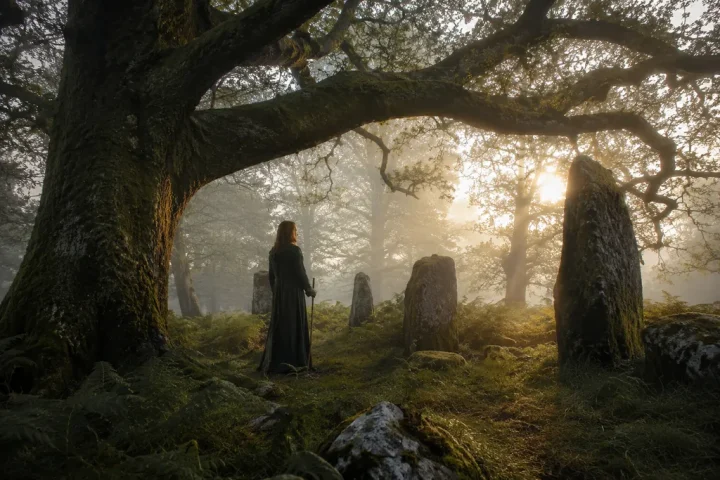
Ancient burial mounds, hills and other places associated with the síd were therefore treated with caution. These were not simply archaeological remains but possible entrances into another reality where the old inhabitants of Ireland still possessed their own laws.
The Hidden Ireland
The deepest mystery of the Tuatha Dé Danann lies in the fact that they were never truly defeated within the imagination of Ireland. The Milesians gained the visible land, but the divine race withdrew rather than vanished. Beneath hills, within ancient mounds and beyond the boundaries of ordinary perception, their kingdom continued.
This transformation created one of the most powerful ideas in Celtic mythology: the old gods are not necessarily dead simply because new people and new religions have taken possession of the land. They may retreat into hidden places, becoming invisible without becoming powerless.
The Tuatha Dé Danann therefore stand between mythology and fairy tradition, between gods and spirits, and between the mortal landscape and the Otherworld concealed within it. Their Ireland still exists beneath the familiar one, accessible through dreams, enchantment, ancient places and those dangerous moments when the barrier between worlds becomes thin.
Enter the Hidden World
If you are satisfied with treating Celtic mythology as harmless stories about fairies and forgotten gods, then remain on the surface and never discover what those traditions were actually saying about power, magic and the unseen world. Enter the Occult World Mystery School and go deeper into Witchcraft, Paganism, spirits, ritual, magical traditions and the ancient systems through which occultists have attempted to understand and influence the forces surrounding them. The occult is not decoration and it was never designed for passive spectators. Study the structures behind the myths, understand how power is encoded in symbol and ritual, and stop allowing the mysteries of the world to remain mysteries simply because you were never taught how to approach them.
ORIGIN:
Ireland
SEE ALSO:
Encyclopedia of Spirits: The Ultimate Guide to the Magic of Fairies, Genies, Demons, Ghosts, Gods & Goddesses– Written by Judika Illes Copyright © 2009 by Judika Illes.

Follow