

Hexenkopf – The Witch’s Head
Hexenkopf, meaning “Witch’s Head”, is a rocky hill near Easton, Pennsylvania, in the Lehigh Valley. It is steeped in witchcraft superstitions and folklore introduced by German immigrants who settled in the region during the eighteenth and nineteenth centuries.
The Hexenkopf rises approximately 1,030 feet above sea level and is the highest peak in Northampton County. It forms part of a group of rocky hills containing some of the oldest exposed rock formations in the United States.
The Saylor Family and Powwowing
Originally, the Hexenkopf was known as Groggy Rustic. One of the earliest landowners around the hill was Johann Seiler, whose family name was later anglicised as Saylor.
Johann became famous as a powwower, a traditional healer whose remedies combined herbal treatments, magical formulas and supernatural “power”. His son, Peter Saylor, became even more renowned as a powwower.
Peter used the Hexenkopf in his magical cures, believing that illnesses could be cast out of a suffering person and transferred into the ancient rock of the hill.
German Witchcraft Traditions
German settlers brought with them beliefs concerning witchcraft, witches, Demons and magical healing. Witchcraft was known as hexerei, while the system of magical healing was called braucherei in Germany and later became known as powwowing in America.
Many of the settlers had come from the Harz Mountains, a region where belief in witches and supernatural forces was especially strong.
The Harz Mountains were traditionally regarded as the dwelling places of witches. Their tallest peak, the Brocken, was believed to be the location of witches’ Sabbats and wild nocturnal revelries, particularly during Walpurgisnacht.
In the Lehigh Valley, the Hexenkopf gradually assumed a similar reputation.
The Witches of Hexenkopf
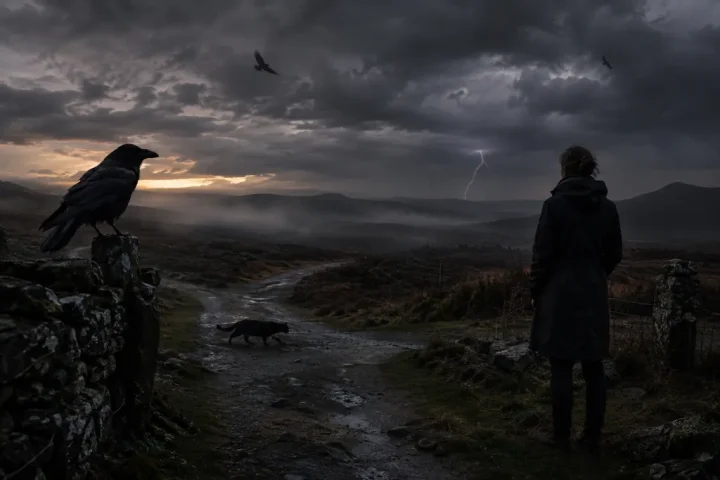
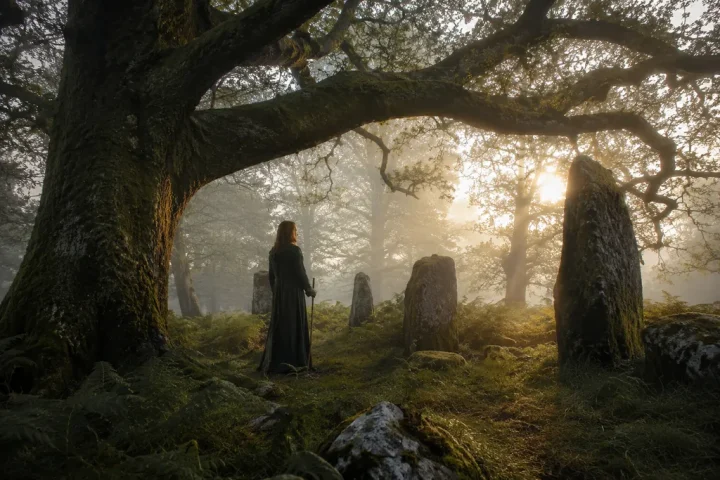
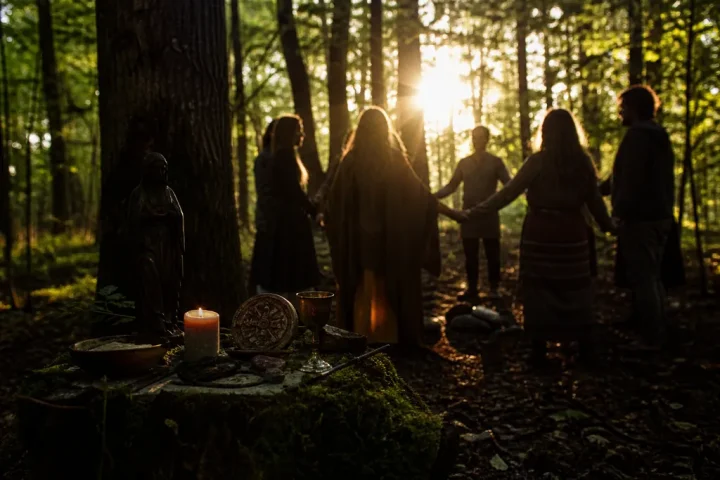
Local people feared that witches gathered on the summit of the Hexenkopf. According to folklore, the only way to kill a Hexenkopf witch was to chase her from the hill so that she fell to her death in the valley below.
Numerous stories were told about the evil deeds supposedly committed there. The witches were often said to be ordinary local wives who deceived their husbands by placing sticks in their beds before escaping on broomsticks to attend their nocturnal gatherings.
One story from the period following the First World War concerns a man who attempted to sue his wife for divorce after claiming that he had discovered she was a witch.
One night, while pretending to sleep, he watched his wife rise from their bed and rub her face with a magical ointment. She then mounted a broom, spoke the incantation “Über Stock und über Stein”, and flew out through the window.
The curious husband followed her example. He rubbed his face with the ointment, mounted another broom and repeated the same incantation.
He claimed that he was carried through the air to the summit of the Hexenkopf, where an unholy celebration was taking place around a bonfire.
His wife appeared unsurprised to see him. She led him through the dancers to a table where black men with long tails were distributing a hot drink. After taking several sips, the husband lost consciousness.
When he awoke at dawn, he found himself lying in a neighbour’s pigpen.
He insisted that this was sufficient reason for divorce. However, the dispute was settled privately and never reached the court.
Local tradition holds that whenever the Hexenkopf glows at night, witches and Demons are gathering on the hill.
The Mysterious Glow
The strange glow surrounding the Hexenkopf may have a natural explanation. The rock contains a high concentration of mica, which can glitter or reflect light under certain moonlit conditions.
Nevertheless, generations of residents believed that the glow revealed supernatural activity taking place on the summit.
Misery Mountain
The Hexenkopf has also been called “Misery Mountain” because of its association with bad luck, accidents, suicides, murders, mysterious fires, crop failures and unexplained misfortunes.
One recurring legend concerns travellers who climb the steep hill but never descend on the other side.
An old story tells of a violent and abusive man who mistreated his family and animals. One night, he stormed away from home in a rage and set out for a tavern in his horse-drawn wagon.
He mercilessly beat the horses throughout the climb, refusing to allow them to rest.
When the wagon reached the summit, a thick mist descended around the man, the horses and the cart. None of them was ever seen again.
The Poisonous Wind
The Hexenkopf was also feared for its supposedly poisonous wind.
Powwowing traditions taught that diseases and illnesses were caused by the Devil, Demons and witches, who constantly tormented humanity. These evil forces could create a “contagion wind” that carried illness to both people and animals.
Such winds were believed to emerge from swamps, marshes, graveyards, caves and cellars. However, the wind blowing from the Hexenkopf was considered the most dangerous of all.
Peter Saylor described it as an “evil poisoning of the air” and believed that it represented Satan punishing the sinful.
The Charmed White Fox
Mysterious and magically protected animals were also said to roam the Hexenkopf.
During the nineteenth century, a strange white fox reportedly appeared one winter. As long as the fox remained in the area, hunters were unable to kill any game.
They were also unable to kill the fox itself. Bullets seemed to miss it, and even poisoned bait had no effect.
Local people believed that the white fox embodied all the evil spirits dwelling upon the hill.
Ghosts and Hauntings
The Hexenkopf is associated with numerous ghosts and hauntings. Apparitions of witches and of people who died mysteriously or tragically on or near the hill have reportedly been seen and heard.
On dark and windy nights, witnesses have described seeing a headless man accompanied by a headless dog.
Fiery balls of spectral vapour are said to roll across the landscape. According to local tradition, these lights are the ghosts of two farmers who fought bitterly over property rights.
Another apparition is the ghost of a peg-legged farmer named Brown, who reportedly fell to his death while chasing a witch.
On moonless nights, Brown is said to approach people from behind, the heavy stump of his wooden leg striking the ground as he runs. He is described as having grey hair, a beard and a terrifying face.
Hexenkopf Today
The Hexenkopf remains privately owned. Ruins of old and abandoned homes can still be found on and around the hill, adding to its mysterious atmosphere.
Although many of its legends can be traced to German immigrant folklore, the Hexenkopf continues to be associated with witches, ghosts, strange lights, vanished travellers and supernatural misfortune.
Explore the Haunted Landscapes of Witchcraft
The legends of Hexenkopf reveal how European witchcraft traditions crossed the Atlantic and became rooted in the mountains, forests and rural communities of America.
But the Witch’s Head is only one of countless places shaped by magical beliefs, hauntings, curses and unexplained phenomena.
Enter the Occult World Mystery School
Inside the Occult World Mystery School, you can explore more haunted locations, historical witchcraft traditions, strange supernatural cases and forgotten magical practices from around the world.
Members gain access to an expanding library of occult books, exclusive articles, practical courses and deeper studies covering witchcraft, spirits, demonology, grimoires, divination, mythology and ceremonial magic.
Do not remain at the edge of the mystery.
Join the Occult World Mystery School today and continue your journey into the hidden history of witches, spirits and the supernatural.
SEE ALSO:
FURTHER READING:
- Heindel, Ned D. Hexenkopf: History, Healing & Hexerei. Easton, Pa.: Williams Township Historical Society, 2005.
SOURCE:
The Encyclopedia of Witches, Witchcraft and Wicca – written by Rosemary Ellen Guiley – Copyright © 1989, 1999, 2008 by Visionary Living, Inc.






Follow