

Ouroboros: The Serpent of Eternity, Alchemy, and the Eternal Return
The ouroboros, also spelled uroboros, is one of the oldest and most powerful symbols in occult tradition. It is usually depicted as a serpent or dragon biting, swallowing, or devouring its own tail, forming a perfect circle. The name comes from the Greek words oura, meaning “tail,” and boros, meaning “devourer.” The ouroboros is therefore the “tail-devourer,” the serpent that consumes itself and is reborn from itself.
At its deepest level, the ouroboros represents the eternal cycle of birth, death, decay, transformation, and rebirth. It is the circle of life, the turning of time, the endless return of nature, the mystery of destruction becoming creation. Nothing truly disappears; everything changes form. The serpent eats itself, yet it also sustains itself. It dies and is renewed. It is both ending and beginning.
For this reason, the ouroboros became an important symbol in alchemy, magic, Hermetic philosophy, Gnosticism, mystery traditions, and later occult orders. It speaks to one of the oldest truths of the esoteric path: transformation is not linear. It is circular, cyclical, and often born through dissolution.
Origins of the Ouroboros
The origins of the ouroboros may be traced to ancient lunar cults and early serpent symbolism. The Moon was one of humanity’s first great timekeepers. Its waxing and waning revealed the rhythm of growth, fullness, decline, disappearance, and return. Because the Moon appeared to die and be reborn each month, it became a symbol of regeneration, fertility, and cyclical time.
In many ancient cultures, lunar deities were associated with serpents or dragons. The devouring snake became an image of the darkness that swallowed the Moon, while the Moon’s return symbolised rebirth from the belly of the cosmic serpent. In this sense, the serpent was not only a destroyer, but also a womb, a guardian of renewal, and a force of hidden regeneration.
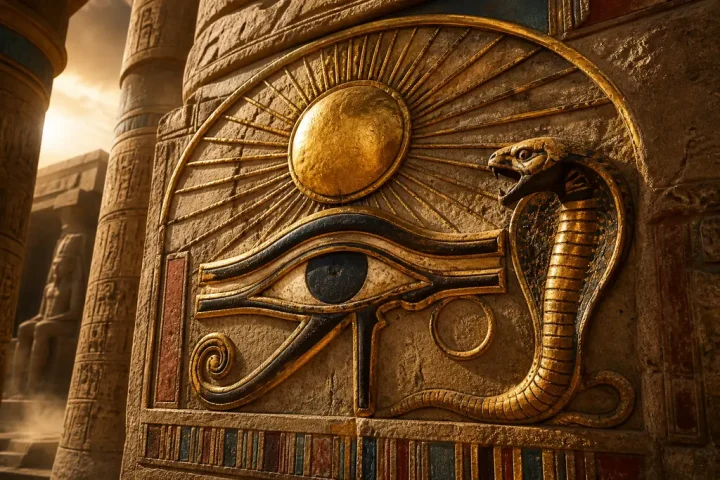
In ancient Egypt, serpent symbolism was especially powerful. The goddess Buto was depicted as a cobra, and the hieroglyph for “goddess” was itself a cobra. Buto protected Isis and her son Horus, the solar god. Every individual in Egypt was believed to be protected by a personal snake spirit, representing their lifetime and their survival into the afterlife.
As part of the pharaoh’s crown, Buto became the uraeus, the sacred cobra symbol of royal power. She was often shown as a serpent surrounding a solar disk. She was also associated with the shen, a circular hieroglyph representing the Sun’s orbit and eternal life. These Egyptian images already contain the essential meaning of the ouroboros: protection, solar power, immortality, and the endless circuit of life.
One of the earliest true Egyptian depictions of the ouroboros appears in the tomb of Seti I, where a carving shows the sun god lying within a house surrounded by a serpent biting its tail. Such imagery was intended to ensure immortality and the renewal of the deceased in the afterlife. The third shrine of the sarcophagus of Tutankhamen also shows the deceased with one ouroboros encircling his head and another encircling his feet, marking the body as held within the sacred circle of eternal return.
The World Egg and the Serpent of Creation
In Greek myth, the ouroboros appears in connection with creation itself. The oldest Greek creation myth, the Pelasgian myth, tells that Eurynome, goddess of all things, emerged from Chaos. The north wind created Ophion, the great serpent. Eurynome mated with Ophion and then took the form of a dove, creating the world egg. Ophion encircled the egg seven times, and from it all things in creation were hatched.
The image is deeply symbolic. The serpent encircles the egg of creation. Time coils around potential. Life is born from a closed vessel guarded by the serpent. Here, the ouroboros is not merely a symbol of death and rebirth, but of creation contained within the circle of eternity.
The Orphics, who flourished in the sixth and seventh centuries B.C.E. and believed in reincarnation, developed variations of the Orphic egg myth. Their teachings aimed to free the divine element of the soul from imprisonment in the body. These beliefs helped prepare the way for Western mystery cults, in which death, rebirth, initiation, and the liberation of the soul became central themes.
In classical Greek thought, Chronos, or Time, was sometimes identified with Oceanos, the Earth-encircling river that surrounded the universe. This cosmic river was also imagined as a serpent bearing the zodiac on its back. The serpent thus became an image of cosmic time itself: the living boundary of the universe, the turning wheel of fate, and the circular movement of the heavens.
The Ouroboros in Hermetic and Gnostic Thought
In the Hermetic philosophy that developed in Hellenistic Egypt, the ouroboros became a symbol of the underlying unity of spirit. It represented the truth that the many visible forms of existence arise from one hidden source. The serpent devouring its tail expressed a mystery that later alchemists would summarise as: All is One.
For the Gnostics, the ouroboros carried both cosmic and spiritual meanings. Some Gnostics believed that the world serpent marked the boundary between the created world and the pleroma, the fullness of heaven. It guarded the edge between ordinary reality and the divine realm beyond.
In some Gnostic systems, the world serpent was associated with the demiurge, the lesser creator who fashioned the material world and guarded the gate of escape. This demiurge was sometimes equated with the God of the Old Testament, the Alpha and Omega. The shape of the Greek letter omega also resembles the Egyptian shen, strengthening the link between the circle, eternity, and divine boundary.
For the Naassenes and Ophite Gnostic sects, the serpent of the Garden of Eden was not a villain but a bringer of gnosis. In their interpretation, the serpent helped Adam and Eve defy the demiurge and obtain knowledge by eating from the Tree of Knowledge. Later, the serpent also came to represent the guardian of the Tree of Life and therefore the gatekeeper to immortality.
This reversal is important. In one tradition, the serpent is tempter and deceiver. In another, it is liberator, revealer, initiator, and guardian of hidden wisdom. The ouroboros contains both possibilities. It devours and renews. It imprisons and protects. It destroys illusion, but it may also guard the threshold that must be crossed.
Saturn, Time, and the Devouring Serpent
In Roman mythology, the ouroboros was associated with Saturn, the god of time. Saturn joined together the first and last months of the year, just as the serpent joins mouth and tail. He ruled over cycles, limits, mortality, endings, and the devouring nature of time.
Saturn famously swallowed his children, and his scythe became a symbol of harvest, death, and the cutting down of life. In Renaissance Europe, Saturn continued to be linked with the ouroboros, and his scythe became firmly associated with death. This imagery survived into modern culture, where Father Time and the Grim Reaper both inherit something of Saturn’s dark and cyclical power.
The ouroboros therefore became not only a sign of eternal life, but also a reminder that time consumes all forms. Everything born into the world is eventually devoured by time. Yet the cycle continues. Death feeds life. Endings become beginnings.
The Ouroboros in Alchemy
In alchemy, the ouroboros became one of the most important symbols of transformation. Its fundamental message is that one thing changes into another, and that all apparent opposites are secretly part of one reality. The ouroboros symbolises Mercurius, the union of opposites, and the hidden unity of matter and spirit.
One of the oldest alchemical texts, preserved in the eleventh-century Codex Marcianus and drawing from Hellenistic Egyptian material, contains an image of the ouroboros. This serpent symbolises the underlying unity of the elusive prima materia, the original substance from which all things arise. The prima materia is both the beginning and the goal of the Great Work. It is the raw material to be transformed and the mystery to be discovered.
The ouroboros also represents the Philosopher’s Stone, the vehicle of immortality and spiritual perfection. It shows the cyclical nature of the alchemical process: union, dissolution, death, purification, resurrection, and reunification. The alchemical work is not a straight path. It is a repeated process of breaking down and recombining, darkening and illuminating, separating and joining.
In the Codex Marcianus, the ouroboros is half black and half white, resembling the yin-yang symbol in Taoism. This black-and-white serpent expresses the union of opposites: male and female, light and dark, sulphur and mercury, fixed and volatile, body and spirit. Later alchemical images show two serpents devouring one another’s tails, or two dragons fighting at each other’s throats, each feeding the transformation of the other through shared blood.
An ancient Greek alchemical text describes the mystery of the ouroboros as the composition in which the Work is devoured, melted, dissolved, and transformed. The serpent becomes dark green, from which the golden colour arises. Its body contains the imperfect metals, and its ears represent the sublimated vapours of sulphur, mercury, and salt. The passage concludes with the famous alchemical idea that nature rejoices in nature, charms nature, triumphs over nature, and masters nature — not through opposition, but through one nature transforming itself.
This is the heart of the ouroboros: the Work feeds upon itself. The seeker is both the material and the alchemist. The poison is also the medicine. The darkness contains the gold.
Go Deeper into Alchemy, Symbolism, and Occult Wisdom
The ouroboros is not merely a decorative occult symbol. It is a key to understanding alchemy, magic, Hermetic philosophy, Gnosticism, initiation, transformation, and the hidden architecture of spiritual rebirth. If symbols like the ouroboros speak to you, then your path should not stop at one article.
Inside the Occult World Mystery School, you can explore alchemy, ancient grimoires, demonology, spirit work, symbolism, ritual traditions, tarot, Kabbalah, magical philosophy, and the deeper meanings behind the great occult symbols. You will find courses, teachings, discussions, and fellow occultists who take these mysteries seriously. Join the community and continue your journey into the living current of occult knowledge, where symbols are not treated as decoration, but as gateways into transformation.
The Ouroboros in Magic and Mystery Traditions
From alchemy, the ouroboros passed into European magical and mystical philosophy. It became important to groups such as the Rosicrucians and the Hermetic Order of the Golden Dawn. In these traditions, the ouroboros continued to represent wholeness, initiation, eternity, transformation, and the reconciliation of opposites.
For magicians, the circle is one of the most fundamental ritual forms. The magic circle marks sacred space, separates the ordinary world from the ritual field, and creates a boundary between the magician and the forces being invoked or evoked. The ouroboros can be seen as a living version of the magical circle: a serpent-boundary, self-contained, protective, eternal, and charged with power.
It also represents magical self-renewal. The magician enters the Work, is broken down by it, transformed by it, and reborn through it. The old self is consumed by the deeper self. The serpent that devours its tail is also the magician who devours illusion.
In dreams, the ouroboros often appears in symbolic forms: a snake, a dragon, an egg, a circle, a wheel, a ring, or a creature coiled around something precious. Such dreams may point to cycles in the dreamer’s life, unresolved patterns, deep transformation, spiritual initiation, or the need to complete what has been left unfinished.
Psychological and Spiritual Meaning
In modern esoteric psychology, the ouroboros can symbolise the unconscious, the totality of the self, and the process of psychic integration. It represents the self-contained psyche, the endless recycling of experience, and the return of buried material into consciousness.
The ouroboros asks: what are you repeating? What must be dissolved? What is dying in you so that something greater may be born? Where are you still devouring yourself unconsciously, and where are you consciously transforming yourself?
Spiritually, the ouroboros teaches that every ending contains a beginning. Every descent into darkness may become part of a larger ascent. Every spiritual death may hide the seed of rebirth. The serpent does not merely consume itself; it completes itself.
The Eternal Serpent
The ouroboros survives because it speaks to a universal truth. All life moves in cycles. The seasons return. The Moon waxes and wanes. The Sun rises and sets. Civilisations rise and fall. Bodies are born, decay, and return to the earth. Souls descend, learn, transform, and ascend.
In alchemy, the ouroboros reveals that the Work begins and ends in the same mystery. In magic, it marks the sacred circle of power. In Gnosticism, it guards the boundary between the created world and divine fullness. In dreams, it appears as the symbol of the self seeking completion. In occult philosophy, it whispers the secret of eternity:
All is One.
The serpent devours its tail, and the circle is never broken.
See also:
- Alchemy
- Rosicrucians
- Hermetic Order of the Golden Dawn
- Serpent
- Dragon
- Gnosticism
- Philosopher’s Stone
- Prima Materia
FURTHER READING:
- Hauck, Dennis William. The Emerald Tablet: Alchemy for Personal Transformation. New York: Penguin/Arkana, 1999.
- Jung, C. G. Mysterious Coniuntionis. 2d ed. Princeton, N.J.: Princeton University Press, 1970.
SOURCE:
The Encyclopedia of Magic and Alchemy Written by Rosemary Ellen Guiley Copyright © 2006 by Visionary Living, Inc.


Follow