
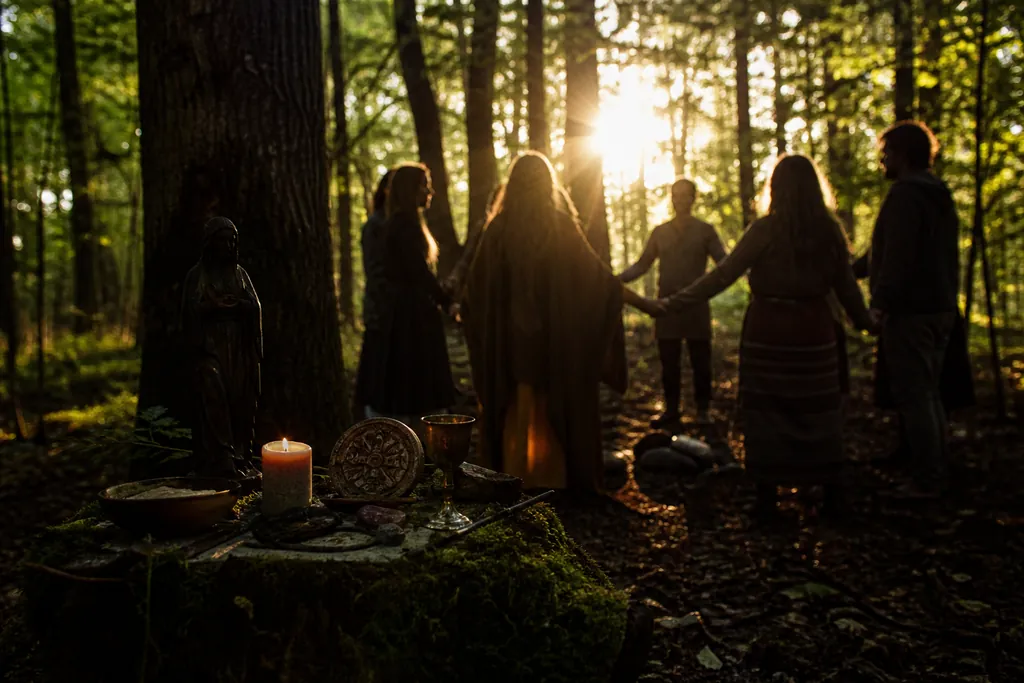
Paganism is one of the most misunderstood words in the history of religion.
For some people, it simply means “old gods.”
For others, it suggests witchcraft, nature worship, folklore, magic, seasonal rituals, or anything outside the boundaries of Christianity, Judaism, and Islam. In popular culture, the word is often used carelessly, as if Paganism were one single religion with one belief system, one holy book, and one universal doctrine.
That is not accurate.
Paganism is not one religion.
It is a broad term used to describe a wide family of spiritual traditions, ancient and modern, that often honour nature, the divine within the world, ancestral memory, seasonal cycles, multiple deities, spirits, sacred places, ritual practice, and the unseen forces that move through life.
To understand Paganism seriously, we must begin by removing the modern stereotype.
Paganism is not merely “witchy aesthetics.”
It is not simply crystals, moon phases, or romantic images of forests and candles.
It is not automatically the same as Wicca, witchcraft, polytheism, or occultism — although it may overlap with all of these.
At its deepest level, Paganism is a worldview in which the sacred is not distant from the world.
The sacred is here.
In the land.
In the seasons.
In the body.
In the ancestors.
In the gods.
In the hearth.
In the sky.
In the rites that connect human beings to the greater pattern of life.
The Meaning of the Word Pagan
The word “Pagan” comes from the Latin paganus, a term that originally referred to a country-dweller, villager, or civilian. In the later Roman and Christian context, it gradually became associated with those who continued to follow older, non-Christian religious practices.
This historical shift is important.
The word “Pagan” was not originally the name of one organised religion. It was a label applied from the outside, especially as Christianity expanded through the Roman Empire and later Europe. People who worshipped the old gods, kept local customs, honoured sacred groves, made offerings to household spirits, or maintained seasonal festivals were increasingly grouped together under one broad term.
But these people did not all believe the same things.
A Roman devotee of Jupiter, a Greek worshipper of Athena, a Celtic priestess honouring local river spirits, a Norse farmer offering to Freyr, and an Egyptian initiate of Isis would not have considered themselves members of one universal “Pagan religion.”
They belonged to different cultures, different temples, different languages, different myths, different ritual systems.
The word Paganism, therefore, is best understood as an umbrella term.
It includes many traditions rather than one doctrine.
Paganism Before Christianity
Before the dominance of Christianity in Europe and parts of the Mediterranean world, most religious systems were not based on exclusive belief. A person could honour many gods, household spirits, local deities, ancestors, and civic cults without feeling a contradiction.
Religion was not always about private belief in the modern sense.
It was woven into daily life.
The gods were connected to agriculture, childbirth, war, healing, kingship, prophecy, love, death, the sea, the underworld, craftsmanship, justice, fertility, and the protection of the home. Ritual was not separate from society. It marked planting and harvest, birth and burial, marriage and kingship, crisis and renewal.
In ancient Greece, gods such as Zeus, Athena, Apollo, Artemis, Demeter, Dionysus, and Hekate were honoured through temples, festivals, sacrifices, mystery rites, oracles, and household observances.
In Rome, Jupiter, Juno, Mars, Venus, Saturn, Vesta, Mercury, and countless local and household spirits were woven into public and private religion. Roman religion was deeply concerned with correct ritual action, civic order, divine favour, and maintaining peace between humans and gods.
In the Norse world, deities such as Odin, Thor, Freyja, Freyr, Frigg, Loki, Hel, and the Norns formed part of a mythic structure concerned with fate, honour, war, wisdom, kinship, death, and cosmic struggle.
In Celtic cultures, the sacred was often connected to land, wells, rivers, groves, sovereignty, animals, warriors, poets, healers, and the Otherworld. Many Celtic deities are known only through later inscriptions, Roman sources, medieval literature, and folklore, which means serious study requires caution.
This is essential: ancient Paganism was not a single system. It was plural, local, embodied, ritualised, and deeply tied to culture.
Paganism and Nature
Many modern people describe Paganism as “nature-based spirituality.” This is partly true, but it can also become too simplistic.
Pagan traditions often recognise nature as sacred, alive, or spiritually meaningful. The moon, sun, rivers, mountains, trees, animals, seasons, storms, fertility, decay, and harvest may all carry religious significance. But ancient Paganism was not always gentle, soft, or purely ecological in the modern sense.
Nature was not only beautiful.
Nature was powerful.
Unpredictable.
Generous.
Dangerous.
Creative.
Destructive.
Worthy of reverence.
The sacred world included birth and death, abundance and famine, protection and plague, sunlight and storm, love and war. Paganism does not always divide reality into “good spiritual things” and “bad earthly things.” It often sees life as a living field of forces that must be honoured, negotiated, respected, and understood.
This is why Pagan ritual often concerns relationship.
Relationship with the land.
Relationship with gods and spirits.
Relationship with ancestors.
Relationship with the dead.
Relationship with the cycles of time.
Relationship with one’s own place within the cosmos.
For the serious student, Paganism is not merely about “believing in nature.”
It is about learning how human beings stand within a sacred, living world.
Polytheism, Animism, and the Many Forms of the Sacred
Many Pagan traditions are polytheistic, meaning they honour multiple gods. These gods may be understood as distinct divine beings, archetypal powers, cultural symbols, cosmic principles, or living intelligences, depending on the tradition and the practitioner.
Some Pagans are hard polytheists: they believe the gods are real, individual beings with their own agency.
Some are soft polytheists: they see different gods as expressions of one divine source, psychological archetypes, or symbolic faces of deeper spiritual forces.
Others approach Paganism through animism, the belief or perception that the world is alive with spirit. In animistic worldviews, rivers, trees, stones, animals, places, winds, ancestors, and objects may possess presence, agency, or sacred significance.
This animistic dimension is very old. It reminds us that Paganism is not always centred on distant heavenly gods. Sometimes the sacred is local and immediate: a spring, a grave mound, a forest path, a threshold, a hearth flame, a family ancestor, a field, a hill.
Modern Paganism often includes both polytheistic and animistic elements.
The gods may be honoured.
The ancestors may be remembered.
The land may be listened to.
The seasons may be ritually marked.
The unseen may be approached through offerings, prayers, divination, meditation, or ceremonial practice.
Paganism Is Not the Same as Witchcraft
One of the most common misunderstandings is the idea that Paganism and witchcraft are the same thing.
They are not.
Paganism is a religious or spiritual umbrella.
Witchcraft is a magical practice or craft.
A person can be Pagan and practise witchcraft.
A person can practise witchcraft without being Pagan.
A person can be Pagan and never cast spells.
A person can honour Pagan gods through devotional ritual, study, prayer, offerings, and seasonal festivals without identifying as a witch at all.
This distinction matters.
Witchcraft focuses on magical practice: energy, intention, spellwork, ritual tools, folk methods, charms, protection, divination, healing, and transformation.
Paganism focuses more broadly on spiritual worldview, sacred relationship, gods, spirits, nature, ritual time, myth, ancestry, and religious identity.
Of course, they often overlap. Many modern witches are Pagan. Many Pagans use magical practices. But the two words should not be used carelessly as if they mean exactly the same thing.
A serious student must learn the difference.
The Decline of Ancient Pagan Religions
The spread of Christianity across the Roman Empire and Europe transformed the religious landscape. Pagan temples were closed, old rites were condemned, traditional festivals were reinterpreted, and many local practices were absorbed, suppressed, or transformed.
This process did not happen overnight.
For centuries, older customs continued in rural areas, household traditions, folk healing, seasonal celebrations, charms, local saint veneration, agricultural rites, and folklore. Some ancient practices disappeared. Others survived in altered form. Some were demonised. Some were Christianised. Some continued quietly beneath official religion.
This is one reason Paganism is difficult to study.
The ancient world did not hand us a neat, complete Pagan manual. Much of what we know comes from archaeology, inscriptions, classical texts, Christian polemics, medieval manuscripts, folklore, comparative mythology, and later reconstruction.
This means serious Pagan study requires discipline.
Not every modern claim about “ancient Pagan tradition” is historically reliable. Some practices are old. Some are reconstructed. Some are modern inventions inspired by older material. Some are romantic fantasies.
The serious student must be willing to ask:
What is ancient?
What is medieval?
What is folklore?
What is reconstruction?
What is modern spirituality?
What is personal gnosis?
What is marketing?
This does not make modern Paganism less meaningful. But it does require honesty.
The Pagan Revival
Modern Paganism began to emerge more visibly in the nineteenth and twentieth centuries, influenced by Romanticism, folklore studies, archaeology, occult revival movements, nationalism, feminism, ceremonial magic, spiritualism, environmental awareness, and dissatisfaction with institutional religion.
The modern Pagan revival did not simply “restore” ancient religion exactly as it once was. It created new traditions inspired by older mythologies, ritual patterns, seasonal cycles, magical systems, and esoteric philosophies.
One of the most influential figures in modern Paganism was Gerald Gardner, often associated with the public emergence of Wicca in the mid-twentieth century. Gardner presented Wicca as a surviving witch-cult tradition, although scholars have debated the historical accuracy of this claim. What is clear is that Wicca became one of the most important modern Pagan religions, combining ritual magic, goddess and god symbolism, seasonal festivals, initiation, coven structure, and ceremonial influence.
Doreen Valiente was another major figure. She helped shape Wiccan liturgy, poetry, and theology, and is often regarded as one of the most important voices in the development of modern witchcraft and Pagan spirituality.
Aleister Crowley, although not properly a Pagan in the simple modern sense, influenced modern occultism, ritual magic, and magical thought. His ideas affected the wider esoteric environment in which modern Pagan and magical movements developed.
Dion Fortune also played an important role in twentieth-century Western esotericism. Her writings on magic, psychic protection, mysticism, and the inner planes influenced many later occult and Pagan practitioners.
Margaret Murray, an Egyptologist and folklorist, shaped early twentieth-century ideas about a surviving European witch-cult. Her theories are now largely rejected by mainstream historians, but they had enormous influence on the imagination of modern witchcraft and Pagan revival movements.
Robert Graves, author of The White Goddess, also influenced modern Pagan thought, especially through poetic ideas about the Goddess, myth, inspiration, and sacred language. His work is not a straightforward historical source, but it became deeply influential in modern Goddess spirituality.
Later figures such as Starhawk helped shape feminist, ecological, and activist forms of Paganism, especially through works that connected ritual, earth-based spirituality, magic, community, and political consciousness.
These figures matter not because they represent one united doctrine, but because they show how modern Paganism developed through a mixture of scholarship, imagination, ritual experimentation, occult practice, feminism, poetry, environmentalism, and the search for spiritual alternatives.
The Wheel of the Year
Many modern Pagans observe the Wheel of the Year: a cycle of eight seasonal festivals often associated with solstices, equinoxes, and cross-quarter days.
These festivals usually include Samhain, Yule, Imbolc, Ostara, Beltane, Litha, Lughnasadh, and Mabon.
The Wheel of the Year is now central to many Wiccan and Pagan traditions, but it should not be mistaken for a single ancient calendar used uniformly by all pre-Christian peoples. It is a modern structure that brings together older seasonal themes, Celtic-influenced festival names, Germanic and European folk customs, agricultural rhythms, and modern ritual interpretation.
This does not make it false or meaningless.
It means it should be understood properly.
The Wheel of the Year gives modern practitioners a ritual map of time. It allows them to mark darkness and return, death and renewal, planting and harvest, fertility and decline, fire and frost, growth and release.
For many Pagans, this cycle becomes a spiritual discipline.
Time is no longer merely mechanical.
The year becomes sacred.
The seasons become teachers.
Nature becomes scripture.
Paganism and the Occult
Paganism and occultism often overlap, but they are not identical.
Occultism refers to hidden knowledge, esoteric systems, symbolic correspondences, magical practice, initiation, divination, ritual, astrology, alchemy, ceremonial magic, spirit work, and the study of unseen forces.
Paganism refers more broadly to religious and spiritual traditions that may honour gods, spirits, nature, ancestors, and sacred cycles.
Some Pagan paths are deeply magical and occult. Others are devotional, reconstructionist, philosophical, or earth-centred without much interest in spellwork or ceremonial magic.
A Hellenic polytheist may focus on offerings to Greek gods.
A Heathen practitioner may honour Norse gods and ancestors.
A Druid may focus on land, poetry, wisdom, and seasonal ritual.
A Wiccan may practise circle casting, spellwork, deity invocation, and sabbat rites.
An animist Pagan may focus on relationship with place, spirits, and the living world.
The serious student should avoid forcing all Pagan paths into one model.
Paganism is not one road.
It is a landscape.
Reconstructionist Paganism
Some modern Pagans follow reconstructionist paths. These traditions attempt to rebuild ancient religious practices as carefully as possible using historical sources, archaeology, mythology, linguistics, and comparative study.
Examples include Hellenic polytheism, Roman polytheism, Kemeticism, Heathenry, Celtic reconstructionism, and other culturally specific revivals.
Reconstructionist Pagans often place strong emphasis on historical accuracy, proper terminology, cultural context, traditional offerings, calendar observances, and avoiding fantasy-based claims.
This approach is valuable because it reminds modern seekers that ancient religions belonged to real peoples, real languages, real temples, real landscapes, and real social structures.
However, reconstruction is never perfect. Ancient religion cannot be recovered completely. Gaps remain. Modern life is different. Ethical values have changed. Many sources are fragmentary. Some traditions were never written down by their own practitioners.
So reconstructionist Paganism often lives in the tension between scholarship and practice.
It asks: how can we honour the old gods in a modern world without pretending we live in the ancient past?
Paganism for the Serious Student
For the serious student, Paganism should not be approached as a costume, trend, or aesthetic identity.
It deserves study.
That study includes mythology, history, ritual, folklore, theology, archaeology, ethics, cultural context, and personal discipline. It also requires humility. Paganism is vast, and no one person can master all of it quickly.
A serious approach asks deeper questions:
What tradition am I studying?
Which culture does this deity or practice belong to?
What sources support this claim?
Am I confusing modern invention with ancient religion?
Am I treating spirits, gods, and ancestors with respect?
Am I practising with discipline, or merely collecting symbols?
Am I seeking power without responsibility?
Am I romanticising the past instead of understanding it?
These questions separate the serious student from the consumer of spiritual aesthetics.
Paganism is not about pretending to be ancient.
It is about learning how the ancient and the modern can meet with integrity.
What Paganism Really Is
So what is Paganism really?
Paganism is a family of spiritual paths rooted in the sacredness of the world.
It may honour many gods.
It may honour one divine source through many forms.
It may honour spirits, ancestors, land, seasons, and the unseen.
It may be devotional, magical, reconstructionist, ecological, mystical, or philosophical.
It may be ancient in inspiration and modern in practice.
It is not one church.
It is not one book.
It is not one doctrine.
It is not automatically witchcraft.
It is not merely rebellion against Christianity.
It is not fantasy.
At its best, Paganism is a disciplined return to sacred relationship.
It teaches that the world is not dead matter.
The land is not just property.
The body is not shameful.
The seasons are not decorative.
The ancestors are not irrelevant.
The gods are not merely literary characters.
Ritual is not performance.
Symbol is not empty.
For the serious student, Paganism opens a doorway into one of humanity’s oldest religious instincts: the recognition that life is surrounded by powers greater than the individual self.
Some call them gods.
Some call them spirits.
Some call them archetypes.
Some call them forces of nature.
Some call them the living intelligence of the world.
But the Pagan impulse begins when a person looks at the world and senses that it is not spiritually silent.
It is speaking.
The task of the student is to learn how to listen.
Continue Your Path with Occult World
If you are beginning your study of Paganism, do not stop at the surface.
Do not reduce the old gods to symbols you barely understand. Do not treat seasonal festivals as decoration. Do not confuse Paganism, witchcraft, Wicca, animism, polytheism, folk magic, and ceremonial magic as if they are all the same path.
Serious students go deeper.
Inside the Occult World Mystery School, you can continue your study through structured lessons, courses, and deeper discussions on witchcraft, ancient religions, spirits, ritual practice, magical traditions, sacred symbolism, and the hidden history of the old world.
This is where you begin to understand the roots behind the symbols, the power behind the festivals, the spirits behind the myths, and the difference between simply being interested in Paganism and actually studying it with respect.
Paganism is not a trend.
It is a doorway into the ancient relationship between humanity, nature, spirit, and power.
Join the Occult World Mystery School and begin your deeper path into Paganism, witchcraft, ritual, old gods, seasonal magic, and the sacred traditions that still speak beneath the modern world.



Follow