

The Banshee: Celtic Messenger of Death
The Banshee is one of the most feared and misunderstood spirits in Celtic folklore. She is traditionally described as a female death-omen spirit who attaches herself to a particular person or family and appears when one of its members is approaching death.
Most closely associated with Ireland and the Scottish Highlands, related traditions are also found in Wales and Brittany. Belief in the Banshee travelled to the United States with Irish and Scottish immigrants, where it developed new forms in Appalachian, West Virginian and Southern folklore.
Names and Regional Variations
The Banshee is known by many names and regional titles, including:
- Ban Sith
- Bean Chaointe
- Bean-Nighe
- Bean Si
- Bean Sidhe
- Beansidhe
- Caoineag
- Cointeach
- Cyhiraeth
- Cyoerraeth
- Eur-Cunnere Noe
- Gwrach y Rhibyn
- Kannerez-Noz
- Washer at the Banks
- Washer at the Ford
- Washer of the Shrouds
In Irish Gaelic, bean sidhe means “Fairy Woman” or “Woman of the Fairy Mound”. In Scots Gaelic, Ban Sith has a similar meaning: “woman of the fairies”. The Welsh gwrach y Rhibyn is commonly translated as “the witch of Rhibyn”.
The Fairy Mounds and the Otherworld
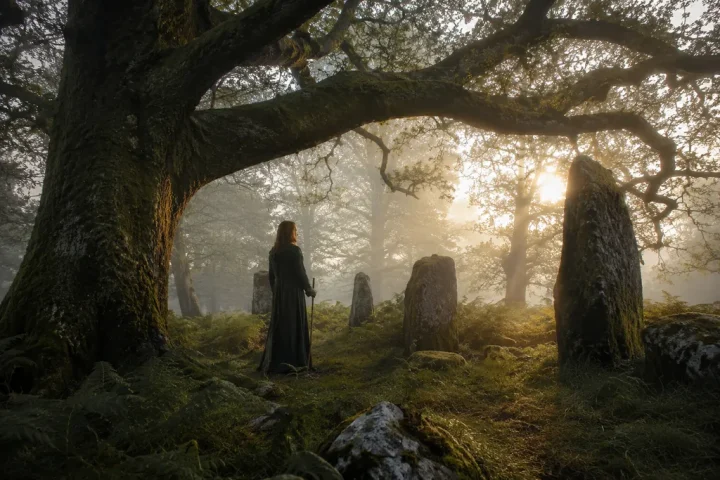
The Irish word sidhe refers to the ancient burial mounds found throughout Ireland. Similar structures appear across Europe and Asia and are also known as barrows or kurgans. Some were believed to contain treasure, while others were regarded as entrances to the Otherworld.
The spirits associated with these mounds are also called the sidhe. They occupy an uncertain position between fairies, ancestral spirits and beings of death.
No member of the sidhe is more strongly associated with death than the Banshee.
The Ancestral Banshee
The Banshee may originally have been understood as a singular ancestral spirit who announced approaching death among five prominent Irish families:
- The Kavanaghs
- The O’Briens
- The O’Connors
- The O’Gradys
- The O’Neills
Later tradition expanded her role. Individual Banshees became associated with particular old Irish families, especially those whose surnames began with Mac or O.
The Banshee did not ordinarily cause the death. She watched over the family, awaited the appointed moment and mourned for the person who was about to leave the world.
She could therefore be understood as the family’s personal psychopomp or escort into the realm of the dead.
The Cry of the Banshee
The Banshee is most often heard rather than seen.
Her supernatural voice may resemble crying, singing, shrieking, screaming or the traditional Celtic mourning cry known as keening. Some accounts state that her sounds can only be heard at night and are intended to warn both the doomed person and their loved ones.
Traditions differ over whether her cry should properly be called a wail. Some descriptions insist that the Banshee cries or sings rather than wails, while others explicitly describe her voice as a mourning wail or keening lament.
Whatever name is given to it, the sound is said to be unmistakable: mournful, unearthly and filled with the certainty of approaching death. Some believe that a person will die the following night after the cry is heard.
The familiar expression “scream like a Banshee” reflects her place in modern popular culture. However, the Hollywood image of a spirit whose scream itself causes death misrepresents the older tradition. The family Banshee does not kill indiscriminately, nor does she cry for just anyone.
She appears because death is already approaching.
The Banshee’s Many Appearances
Descriptions of the Banshee vary dramatically. She may appear as:
- A beautiful woman with long, streaming hair
- A woman wearing a grey cloak over a green gown
- A figure dressed entirely in white
- A figure dressed entirely in red
- An old woman in green with wild white hair and glowing red eyes
- A deathly pale woman in white with long red hair
- A beautiful woman veiled in white
- A shimmering silver woman with abundant silver-grey hair
- A shrouded woman
- A woman singing
- A flying figure crying beneath the moon
- A headless woman, naked from the waist upwards
Her eyes are sometimes described as fiery red from continually weeping for those who are about to die.
One traditional attribute of the Banshee is a basin filled with blood.
The Bean-Nighe: Washer at the Ford
The Bean-Nighe, or Little Washer at the Ford, is a closely related spirit found in both Irish and Scottish Highland tradition.
She appears beside a river, ford or stream, washing bloodstained shirts, shrouds or grave-clothes belonging to someone who is destined to suffer an imminent and often violent death.
The Bean-Nighe is traditionally believed to be the spirit of a woman who died prematurely during childbirth. Because her life ended before its destined time, she must remain beside the water washing clothes until the date upon which she would naturally have died.
Unlike the beautiful Bean Si, the Bean-Nighe is usually described as small, malicious and deformed. She may wear green and possess:
- One nostril
- A large protruding front tooth
- Red, webbed feet
- Long, pendulous breasts
She is also sometimes depicted naked while washing the shrouds, with her breasts obstructing her work.
Gaining Knowledge from the Washer
Folklore describes several dangerous methods of obtaining favours or information from the Bean-Nighe.
A courageous person who encounters her should not immediately run away. According to one tradition, the observer must wait until she throws one breast over her shoulder, approach her from behind and place the nipple in their mouth as though nursing.
The person then declares the Bean-Nighe to be their foster mother. If she accepts them as her foster child, she may grant a wish or truthfully answer their questions.
A less intimate method involves capturing her and threatening her at sword point.
These actions belong to folklore and should be understood as part of the strange ritual logic of older supernatural tales rather than as practical instructions.
The Shirt of an Enemy
Another story warns of what may happen when the Bean-Nighe sees a traveller before the traveller can approach her.
She may announce that she is washing the shirt of an enemy and demand that the witness name one of their own enemies. The witness must then allow her to finish washing the garment. The named person will supposedly die.
If the witness refuses to give her a name, the Bean-Nighe may attack, kill and drain the person’s blood.
The Vampiric Banshee
One later interpretation classifies the Banshee as a type of fairy with vampiric tendencies.
In this form, she hunts in hills near lakes and running water, seeking young men. She wears a grey cloak over a green gown, while her long white hair streams freely in the wind.
She attempts to lure a victim into an isolated place and drink his blood.
This predatory figure differs sharply from the traditional family Banshee, who merely announces and mourns a death. The two traditions demonstrate how several supernatural beings and regional legends gradually became combined under the name “Banshee”.
Vampiric beings compared with this darker Banshee include:
- La Diablesse
- Langsuir
- Leanhaum-Shee
- Mati-Anak
- Pontianak
- Skogsfru
- Veles
- The White Ladies
The Rossmore Banshee
One of Ireland’s best-known family spirits is the Rossmore Banshee of County Monaghan.
According to tradition, she has cried before the death of every Rossmore heir since 1801.
The first recorded member of the family associated with her warning was General Robert Cunningham, the first Baron Rossmore. While he lay ill in bed, members of the household heard strange keening and shrieking outside the estate, followed by cries of:
“Rossmore! Rossmore!”
Within half an hour, the Baron was dead.
The Banshee in Written Tradition
Banshee beliefs formed part of oral tradition in the British Isles for centuries before they were recorded by folklorists and writers.
Important early literary discussions include Thomas Crofton Croker’s Fairy Legends and Traditions of the South of Ireland, published between 1825 and 1828, and Sir Walter Scott’s Letters on Demonology and Witchcraft, published in 1830.
These works helped bring local traditions concerning family spirits, fairies and supernatural death omens to a wider audience.
The Banshee Comes to America
Irish and Scottish immigrants carried their Banshee traditions across the Atlantic.
Many settled in the Allegheny and Appalachian Mountains and throughout the mid-Ohio Valley. There, the older beliefs blended with local ghost stories, historical events and American landscapes.
Several distinctive American Banshee legends emerged from this cultural mixture.
The Coach-a-Bower of West Virginia
The coach-a-bower of Mineral Wells and Elizabeth, West Virginia, derives from the Gaelic coiste bodhar.
In the older tradition, this supernatural vehicle is a black hearse carrying a coffin upon its roof and drawn by two headless white horses. It serves as a death omen and arrives at the home of someone who is about to die, sometimes preceding the appearance of the Banshee.
The modern West Virginian version takes the form of a black motor hearse with tightly closed velvet curtains.
The vehicle is associated with the 1950s and is said to travel along Route 14.
The Banshee of Marrtown
Marrtown, West Virginia, was home to many Scottish immigrants who arrived during the early nineteenth century.
Its Banshee appears as a shrouded rider upon a white horse.
According to the legend, she first became associated with Thomas Marr, the Scottish founder of the town, who arrived in 1836, and his West Virginian wife, Mary.
Thomas and Mary operated a farm but, like many people, experienced financial hardship during the American Civil War. After the war, Thomas found work as a night watchman on a bridge near Marrtown.
While travelling to and from work, he repeatedly encountered a mysterious shrouded rider. He could not clearly identify the rider’s sex, although he believed the figure was a woman. Whenever he approached, both rider and horse disappeared.
Thomas told Mary about these encounters.
On the night of 5 February 1876, Thomas left for work and never returned. As Mary waited at their farmhouse, the shrouded rider approached and announced that Thomas was dead.
The exact circumstances of his death remain unknown.
Mary lived to the age of ninety. When she died and her body was laid out inside the house, witnesses reportedly heard the shrieks of a woman nearby and the rattling of chains in the attic.
The Banshee of the Tar River
Another American legend is set during the Revolutionary War beside the muddy Tar River near Tarboro in Edgecombe County, North Carolina.
The local Banshee was said to emerge on misty, moonless nights. With long yellow hair flowing behind her, she moved from one riverbank to the other while crying like a loon.
A rough, powerful man named David Warner operated a mill beside the river. Warner was a Whig who hated the British and supported the revolutionaries by grinding wheat and corn for them.
One hot August afternoon, Warner was warned that British soldiers were approaching and urged to escape. He stubbornly refused.
Five soldiers arrived while he was grinding grain. Warner pretended not to notice them and loudly instructed his assistant to preserve every ounce for General Nathanael Greene, adding that he hated the thought of British soldiers eating food made from American corn.
Enraged, the soldiers seized and beat him. They announced that they intended to drown him in the river.
Warner replied that they should go ahead, but warned that the Banshee would take revenge.
The Murder of David Warner
The soldiers briefly hesitated. One of them, described as having Evil Eyes and a cruel mouth, encouraged the others to continue.
He and two companions tied Warner’s hands behind his back, fastened heavy stones around his neck and feet and threw him into the river.
As Warner disappeared beneath the water, a piercing and agonised female scream rose from somewhere along the banks.
Terrified, the soldiers fled to the mill.
The Banshee’s Revenge
That night, the soldiers’ commander and his officers arrived and made camp.
A new moon appeared, and a rain crow — a cuckoo whose call was believed to predict rain — cried out. The Banshee’s voice suddenly pierced the night.
The commander and his officers rushed outside. Over the river, they saw a cloud of mist assume the form of a veiled woman with long, flowing hair.
The figure disappeared, but her cries continued farther downstream.
The three soldiers confessed what they had done. Their commander sentenced them to remain at the mill and grind grain for the rest of their lives.
They worked during the day, but every night the Banshee tormented them with her cries.
One night, she appeared in the mill doorway and drew back her veil. She lured two of the soldiers towards the river, where they fell into the water and were never seen again.
The soldier with the Evil Eyes gradually lost his sanity. He wandered through the woods calling David Warner’s name, while the Banshee answered him.
His body was eventually found floating at the precise place where Warner had been drowned.
The Banshee is still said to emerge from the mist on August nights when the moon is new and the rain crow predicts rain. From the place where Warner died, her cry once again travels across the river.
Death Messenger, Guardian or Predator?
There is no single description that accounts for every Banshee tradition.
In the oldest family legends, she is an ancestral guardian and death messenger. She does not murder anyone. She watches, warns, mourns and accompanies the dead towards the Otherworld.
As the Washer at the Ford, she foretells violent death by washing bloody grave-clothes.
In later and darker traditions, she may become a predatory fairy who seduces young men, drinks blood, attacks those who disobey her or pursues murderers until they receive supernatural punishment.
These contradictory roles are not necessarily errors. They reveal how Celtic beliefs changed as stories travelled between regions, generations and cultures.
The Banshee may be guardian and terror, mourner and avenger, beautiful Fairy Woman and grotesque washer of shrouds.
In every form, however, she remains inseparable from death.
Classification and Associations
Origin: Ireland
Classification: Sidhe, fairy, ancestral spirit, ghost, death omen and psychopomp
Primary attribute: A basin of blood
Associated traditions and spirits include:
- Baobhan Sith
- Caointeach
- Cyhyraeth
- Nemhain
- Psychopomps
- Sidhe
- White Ladies
- Human ghosts
Enter the World of Celtic Spirits
The Banshee is not merely a screaming ghost from horror films. Her traditions lead into an immense world of Fairy mounds, ancestral guardians, death omens, spirit families, haunted rivers, Otherworld journeys and supernatural beings whose legends crossed the Atlantic with immigrant communities.
Inside the Occult World Mystery School, you can explore these traditions beyond simplified internet summaries.
Discover deeper teachings on:
- Fairies, the sidhe and the Celtic Otherworld
- Banshees, death messengers and psychopomps
- Irish, Scottish, Welsh and Breton folklore
- Ghosts, hauntings and ancestral spirits
- Vampiric fairies and supernatural predators
- Sacred wells, rivers, mounds and haunted landscapes
- Spirit communication, protection and discernment
- Mythology, witchcraft and traditional magical belief
Join the Occult World Mystery School
Reading about the Banshee allows you to hear one voice from the Otherworld. Joining the Occult World Mystery School gives you access to the wider chorus of spirits, gods, fairies, demons, ghosts and magical traditions that have shaped occult belief for centuries.
Enter our Digital Coven and meet witches, occultists, magicians, paranormal researchers and serious seekers from around the world.
Inside, you will find structured courses, members-only teachings, practical occult material, an expanding digital library and a community where you can ask questions, exchange discoveries and investigate the hidden world with others who share your fascination.
The cry of the Banshee warns that every threshold must eventually be crossed.
Do not remain standing outside the Fairy mound.
Join the Occult World Mystery School and continue your journey into Celtic folklore, spirit lore, witchcraft and the mysteries of the Otherworld.
MANIFESTATIONS:
The Banshee’s many forms include:
• An old woman dressed in green with glowing red eyes and long, wild, white hair
• A deathly pale woman dressed in white with long, wild red hair
• A beautiful woman, veiled in white
• A shimmery, silvery woman with long, beautifully abundant silver-grey hair
• A headless woman, naked from the waist up
ALSO KNOWN AS:
Bean Sidhe
ORIGIN:
Ireland
CLASSIFICATION:
Sidhe
ATTRIBUTE:
A basin of blood
SEE ALSO:
FURTHER READING:
- Briggs, Katherine. An Encyclopedia of Fairies: Hobgoblins – Brownies – Bogies and Other Supernatural Creatures. New York: Pantheon Books, 1976.
- Leach, Maria, and Jerome Fried, eds. Funk & Wagnalls Standard Dictionary of Folklore, Mythology, and Legend. San Francisco: Harper & Row, 1979.
- Lysaght, Patricia. The Banshee: The Irish Supernatural Death Messenger. Dublin: The Glendale Press, 1986.
- McNeil, W. K., comp. and ed. Ghost Stories from the American South. New York: Dell, 1985.
- Sheppard, Susan. Cry of the Banshee: History & Hauntings of West Virginia and the Ohio Valley. Alton, Ill.: Whitechapel Productions Press, 2004.
SOURCES:
- The Encyclopedia of Ghosts and Spirits– Written by Rosemary Ellen Guiley– September 1, 2007
- The Greenhaven Encyclopedia of Paranormal Phenomena – written by Patricia D. Netzley © 2006 Gale, a part of Cengage Learning
- Encyclopedia of Spirits: The Ultimate Guide to the Magic of Fairies, Genies, Demons, Ghosts, Gods & Goddesses– Written by Judika Illes Copyright © 2009 by Judika Illes.
- Encyclopedia of Vampire Mythology Written by: Theresa Bane ©2010 Theresa Bane. All rights reserved



Follow