
50 Berkeley Square: London’s Most Haunted House
For more than a century, 50 Berkeley Square has occupied an extraordinary place in British supernatural folklore. Standing amid the wealth and elegance of Mayfair, the Georgian townhouse acquired a reputation during the Victorian period as a place where something so terrifying inhabited an upper room that merely encountering it could destroy the mind or kill the witness outright.
Unlike many traditional hauntings, however, the entity at Berkeley Square was never given a convincing identity. There was no universally accepted murdered owner whose spirit returned after death, nor was there a single tragedy from which the haunting could easily be dated. Instead, stories accumulated around the house until an ordinary London address became associated with madness, inexplicable deaths and an apparition so difficult to describe that later writers simply called it the Nameless Thing of Berkeley Square.
The history becomes even stranger when those stories are examined against contemporary evidence. Some elements of the haunting were genuinely circulating in Victorian London, while others seem to have appeared considerably later. Real occupants became entangled with fictional victims, and stories originally attached to other places may have migrated to Berkeley Square. By the twentieth century, separating the history of the house from the mythology surrounding it had become extremely difficult.
That uncertainty is precisely what makes 50 Berkeley Square one of England’s most fascinating haunted houses.
An Elegant House in Mayfair
Number 50 stands on the western side of Berkeley Square, surrounded by one of London’s most prestigious neighbourhoods. Historic England dates the townhouse to around 1750, while surviving architectural details preserve much of its Georgian character despite later alterations. The building has been protected as a Grade II listed property since 1958, recognising its architectural and historical significance as part of one of the finest surviving terraces around the square.
Nothing in the documented origins of the house suggests anything sinister. It was constructed as a fashionable residence in an area increasingly associated with London’s aristocracy, and its early history resembles that of many substantial Georgian houses in the West End.
Among its most distinguished residents was the statesman George Canning, who became Prime Minister in 1827. His connection with the property remains commemorated by a blue plaque outside Number 50, but the supernatural stories sometimes retrospectively attached to Canning are considerably less secure. Later writers occasionally claimed that unexplained disturbances occurred during his residence, although contemporary evidence supporting such claims remains elusive.
After Canning’s period there, the house eventually became the home of the Honourable Elizabeth Curzon, who lived to an advanced age and died at Number 50 in April 1859. Her long occupation is important because people who later claimed familiarity with the house during Curzon’s lifetime did not describe the spectacular supernatural horrors that would eventually make the address famous.
The transformation appears to have begun after her death.
Thomas Myers and the Birth of a Haunted House
The man most closely associated with the beginning of the Berkeley Square legend was Thomas Myers, who occupied the house during the following years.
His story has often been presented like a Gothic romance. Myers supposedly prepared Number 50 for his forthcoming marriage, purchasing furnishings and arranging the house for the woman who was expected to become his wife. Shortly before the wedding, however, she abandoned him and married another man.
There is unusually good evidence behind at least part of this story because Myers was related to Lady Dorothy Nevill, who discussed him in her memoirs. She remembered him as profoundly eccentric and suggested that the collapse of his engagement had affected him severely. According to her account, he continued living amid the preparations that had been made for the marriage, leaving parts of the house essentially frozen in the state they had occupied when his hopes collapsed.
His behaviour became increasingly strange. During daylight hours he secluded himself, while at night he moved through the rooms of the large townhouse. Nevill recalled that lights could sometimes be seen inside the building after dark, creating an eerie impression for anybody watching from Berkeley Square.
The appearance of the property reinforced the effect. What should have been an immaculate Mayfair residence became increasingly neglected, and the contrast between Number 50 and the fashionable houses surrounding it inevitably attracted attention.
Imagine the scene in Victorian London. Behind dirty windows stood a decaying mansion whose occupant was seldom seen in daylight, yet at strange hours illumination appeared inside as the reclusive Myers wandered through its rooms.
To Nevill, this provided the explanation for the haunting. People observing Myers’s nocturnal behaviour had transformed an unhappy eccentric into a supernatural presence, while repeated gossip did the rest.
Whether that fully explains what happened is impossible to establish, but something unquestionably occurred during these years: 50 Berkeley Square acquired a reputation.
Victorian London Begins to Talk
By the early 1870s, the rumours had become sufficiently widespread to reach the pages of Notes and Queries, the Victorian journal in which readers exchanged historical information, antiquarian puzzles and curious traditions.
In 1872 a correspondent asked whether a house in Berkeley Square was really believed to be haunted. George William Lyttelton, 4th Baron Lyttelton, responded that such a reputation did indeed exist and identified the property as Number 50.
This is an important moment in the history of the case because it proves that the haunting was not simply invented by twentieth-century ghost writers. Londoners were discussing the property as a haunted house during the Victorian era itself.
The correspondence also reveals something far less convenient for believers.
People with direct experience of the house challenged the rumours. Former servants stated that they had spent considerable periods inside Number 50 without encountering anything supernatural, while a man who had served Elizabeth Curzon during the 1850s similarly denied the existence of the horrors being attributed to her former home.
This division between rumour and direct testimony would follow the Berkeley Square haunting throughout its history. The most spectacular accounts almost invariably arrived through somebody who had heard the story from somebody else, whereas people who could actually confirm that they had lived or worked inside the building tended to tell a much less dramatic story.
Yet scepticism did little to stop the legend.
The Room Nobody Could Safely Enter
By 1879 the mythology surrounding Number 50 had become darker.
An article published in Mayfair described the neglected house and repeated stories concerning a particular upstairs room. The atmosphere associated with this chamber was supposedly so dreadful that entering it could produce mental collapse or death.
One account concerned a maid who had been given the room as her bedroom. During the night, screams brought other members of the household rushing upstairs, where they found her in a state of extreme terror. She was unable to explain coherently what she had experienced, and later versions of the story intensified her fate until she was said either to have gone permanently insane or to have died shortly afterwards.
The room was supposedly abandoned after the incident, but eventually a visitor heard the story and dismissed it as superstition. Confident that there was nothing supernatural to fear, he volunteered to spend the night there.
Because his hosts remained uneasy, an arrangement was made involving the service bell. During the night the bell suddenly began ringing with such urgency that people rushed to the room, only to discover that their guest had encountered something terrifying.
The details change according to the version being told. Sometimes he is discovered already dead, while elsewhere he survives briefly but cannot reveal what he saw. What remains consistent is the implication that the room contained a presence capable of producing overwhelming terror without ever clearly revealing what that presence actually was.
This uncertainty became central to the legend.
The Nameless Thing of Berkeley Square
If Number 50 had merely been associated with the ghost of a former resident, its story might have remained one among hundreds of London hauntings. Instead, the entity inhabiting the upper room gradually developed into something considerably more disturbing.
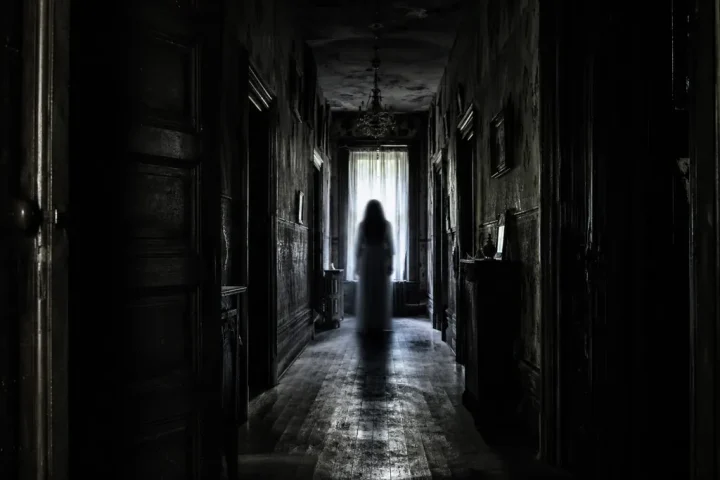
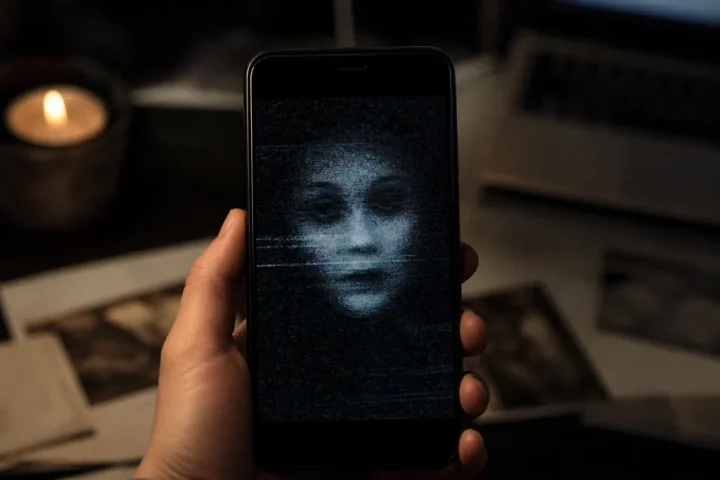
Writers struggled to describe it because the accounts themselves never agreed upon its appearance. Some versions suggested an indistinct human form, while others transformed the apparition into something barely human at all. As the story moved through later supernatural literature, the presence became increasingly monstrous and was described as something that could emerge from darkness before moving towards whoever had dared enter its territory.
The resulting legend resembles a supernatural predator more than an ordinary ghost.
That quality explains why the expression Nameless Thing of Berkeley Square became so effective. The horror was not terrifying because people knew who it was. It was terrifying because nobody knew.
Later occult and paranormal writers sometimes interpreted the entity as a particularly violent poltergeist or as an elemental presence attached to the house rather than the spirit of a dead human being. Such interpretations belong to speculation rather than established history, but they demonstrate how unusual the Berkeley Square tradition became. Its central apparition resisted the conventional explanation that a ghost must correspond to somebody who had once lived and died at the location.
The unknown itself became the haunting.
Sir Robert Warboys and the Fatal Challenge
One of the most famous versions of the fatal-bedroom story eventually identified the sceptical visitor as Sir Robert Warboys.
According to the familiar account, Warboys heard about the terrifying reputation of Number 50 while drinking with companions and dismissed the stories as nonsense. He accepted a challenge to spend the night in the haunted room, apparently believing that doing so would expose the entire affair as superstition.
The story again involves a bell through which he could call for assistance. After initially signalling that everything was well, he suddenly summoned help in desperation, after which those waiting below heard a gunshot or the violent ringing of the bell.
When the room was entered, Warboys was found dead, supposedly with an expression of unbearable terror frozen upon his face.
It is an excellent ghost story, but its historical foundation is remarkably weak. Researchers have struggled to establish the existence of a Sir Robert Warboys matching the supposed victim, while earlier Victorian discussions of the Berkeley Square mystery do not securely identify such a man.
This suggests that a nameless victim from earlier versions gradually acquired an identity as the legend developed. Giving the unfortunate visitor a title and a name made the story sound more historically precise, even though that precision may actually have moved it further away from demonstrable fact.
Lord Lyttelton and the Silver Ammunition
Another celebrated episode involves Lord Lyttelton, but here the development of the legend reveals just how easily historical identities can become distorted.
The Lord Lyttelton who contributed to the 1872 Notes and Queries discussion was George William Lyttelton, 4th Baron Lyttelton, who lived between 1817 and 1876. He clearly knew the house’s reputation and was therefore genuinely connected with the Victorian discussion surrounding it.
Later paranormal accounts transformed this connection into a dramatic confrontation in the haunted room. Lyttelton supposedly entered armed with firearms loaded not only with ordinary shot but with silver coins, apparently because silver possessed traditional supernatural properties. During the night an apparition appeared and he fired at it, but when morning came there was no body to be discovered.
A persistent complication appears because some later accounts identify the participant as Thomas Lyttelton, 2nd Baron Lyttelton. That man died in 1779, almost a century before the events usually described, which makes his participation impossible.
The confusion does not automatically mean that George Lyttelton never investigated Number 50, but it illustrates how paranormal literature can blur historical people together until later readers encounter a seemingly precise story that cannot survive chronological scrutiny.
The Woman at the Window
As the reputation of the house expanded, storytellers attempted to provide an origin for its supernatural evil.
One tradition claimed that a young woman had been trapped inside the house with an uncle whose sexual advances she feared. Desperate to escape him, she supposedly climbed through an upper window and fell to her death.
Her ghost was then said to remain connected with the place of her final terror. Witnesses allegedly saw her at the window or heard her scream as the tragedy repeated itself supernaturally.
Later accounts occasionally named her Adeline, giving the apparition a more complete identity than the older Berkeley Square stories had provided. Yet historical evidence for such a death at Number 50 remains elusive.
The story nevertheless reveals how folklore attempts to explain itself. Once people accepted that a house possessed an evil presence, a tragedy was needed to account for it, and the doomed woman supplied exactly the sort of emotional history that a haunted house was expected to possess.
The Madman in the Garret
Another explanation abandoned ghosts almost completely.
Charles G. Harper recorded a tradition according to which a former owner named Du Pre had kept a violently disturbed brother imprisoned in the upper portion of the house. The unfortunate man supposedly screamed from his confinement and hurled objects violently around the room.
If true, such circumstances could have produced exactly the kind of noises that neighbours later interpreted as paranormal. Cries from an upper floor, unexplained impacts and violent disturbances would require no ghost if somebody secretly confined inside the building was responsible.
Unfortunately, the historical evidence for this story is also problematic. The imprisoned brother functions almost too perfectly as an explanation for the legend, yet convincing documentation linking the episode to Number 50 has not emerged.
Like the suicidal woman, he may represent another attempt to impose a recognisable origin upon a haunting whose earliest traditions offered very little explanation.
The Sailors of HMS Penelope
Perhaps the most dramatic Berkeley Square story concerns two sailors who supposedly entered the apparently empty house looking for somewhere to spend the night.
Later versions identify them as crewmen from HMS Penelope and frequently place the incident on Christmas Eve in 1887. After settling inside an upstairs room, they were awakened by sounds in the corridor before an inexplicable presence entered.
The entity they encountered became increasingly grotesque as the story was retold. What begins in some versions as an indistinct shape develops elsewhere into a horrifying figure whose appearance drives the sailors into desperate flight.
One man supposedly escaped from the house, while his companion attempted to flee through a window and fell onto the railings below, where he was found dead.
Despite becoming one of the most repeated elements of the Berkeley Square haunting, the sailors do not appear convincingly in the earliest accounts. Modern folklore research has found no reliable contemporary documentation for the spectacular death, while the familiar version seems to owe much of its popularity to later supernatural writers, particularly Elliott O’Donnell.
That does not diminish its importance as folklore. It simply changes the question from whether two sailors really encountered a supernatural monster to understanding how a story absent from the earliest record eventually became one of the defining legends of the house.
Did Victorian Fiction Help Create the Haunting?
The boundary between fiction and supposed fact becomes particularly intriguing when the literature of the period is considered.
Victorian novelist Rhoda Broughton wrote The Truth, the Whole Truth, and Nothing but the Truth, a supernatural story containing striking parallels with the Berkeley Square tradition. Her narrative also involves a terrifying room and victims who encounter something so dreadful that the experience proves fatal.
Broughton acknowledged the resemblance when the Berkeley Square controversy developed, but maintained that the story she had heard concerned a country house rather than the London property.
This does not prove that fiction created the haunting. What it demonstrates is that haunted-room narratives were already circulating through Victorian culture, moving between oral storytelling and literature in ways that made their origins increasingly difficult to reconstruct.
A compelling fictional motif could attach itself to an existing rumour, after which subsequent retellings might treat both as parts of the same historical event. Once repeated often enough, literary invention could acquire the authority of folklore.
Number 50 became an ideal vessel for that process because its strange occupant and deteriorating appearance had already prepared Londoners to believe that something was wrong inside.
When Reputation Becomes Evidence
The most revealing aspect of the entire case may be the way the reputation of Number 50 began generating its own evidence.
Once people believed the house was haunted, an unusual sound no longer remained merely an unusual sound. A light behind an upper window became an apparition, while the eccentric behaviour of its occupant became evidence that something supernatural influenced the property.
Stories then fed upon stories. A person hearing that someone had died in the upper room could repeat the claim without ever knowing the victim, and the next storyteller might supply the missing name. What began as uncertain gossip could eventually return in print dressed as historical fact.
This mechanism explains why the contradictory versions of the Berkeley Square haunting do not necessarily weaken its importance as folklore. Instead, the contradictions reveal the process through which the legend grew.
Number 50 was not simply a place where people claimed to see ghosts.
It became a place where people expected ghosts to exist, and that expectation altered every subsequent story told about the building.
Maggs Bros. and the Quieting of the House
The strangest development occurred when the supposedly lethal building returned to ordinary use.
During the late 1930s, the antiquarian booksellers Maggs Bros. acquired a long lease on 50 Berkeley Square and transformed the old townhouse into premises filled with rare books and manuscripts. The firm remained associated with the address for decades, and Number 50 became almost as famous among bibliophiles as it had been among ghost enthusiasts.
The expected supernatural catastrophe never arrived.
Generations of booksellers worked inside the building without reproducing the dramatic horrors described by Victorian rumour. The company itself has treated the ghost story with dry scepticism, even acknowledging that its status as the supposed most haunted house in London brought an endless stream of curious visitors.
There have been occasional later claims of strange sensations or unexplained phenomena within the building, but nothing remotely comparable to the lethal entity of nineteenth-century legend has been convincingly documented.
Maggs eventually moved to Bedford Square, completing the relocation in 2016. The firm’s own modern history still remembers the Berkeley Square ghost, although largely as part of the folklore surrounding an extraordinary former home.
The books left.
The legend did not.
50 Berkeley Square in the Twenty-First Century
The latest chapter in the story is almost surreal when compared with its Victorian reputation.
The property has stood vacant since February 2020, according to the current redevelopment project associated with Numbers 49 and 50 Berkeley Square. The buildings are now the subject of a heritage-led scheme intended to restore the historic townhouses and incorporate them into a private members’ wellness destination called Life.
Westminster planning records show that proposals encompass the restoration of the existing buildings together with substantial new works designed to support the club. Listed-building consent for the larger scheme involving 49 and 50 Berkeley Square was permitted in June 2025.
The plans emphasise preservation of the historic fabric while creating a radically different future for the address. A building once said to drive people insane with terror may ultimately become dedicated to health and wellbeing.
Few haunted houses could have devised a more ironic afterlife.
Was 50 Berkeley Square Really Haunted?
There is no evidence strong enough to establish that a lethal supernatural entity ever inhabited the upper rooms of Number 50.
There is, however, abundant evidence that Victorian London genuinely believed something was wrong with the house.
That distinction matters.
The early Notes and Queries correspondence proves that the haunted reputation existed during the nineteenth century rather than being a modern invention. At the same time, testimony from people familiar with the property challenged the sensational stories almost as soon as those stories appeared.
Thomas Myers provides a plausible starting point because his nocturnal behaviour and deteriorating house could easily have generated rumours. Once those rumours circulated, contemporary fascination with haunted houses supplied an environment in which new stories could attach themselves to the address.
The later history shows how powerful that process became. Characters who cannot be satisfactorily documented entered the legend, while historically real people acquired supernatural adventures that became increasingly elaborate with every retelling. Fictional motifs began to resemble supposed eyewitness reports so closely that distinguishing one from the other became nearly impossible.
The supernatural mystery of 50 Berkeley Square therefore lies not only in asking whether a ghost existed.
It lies in discovering how belief itself can haunt a place.
The Real Horror of Berkeley Square
Perhaps the Nameless Thing never crawled from the darkness of an upstairs room. Perhaps Sir Robert Warboys never died beneath its gaze, while the doomed sailor of HMS Penelope may never have fallen onto the railings below.
Yet something survived inside Number 50.
The story survived.
It passed through Victorian conversation before entering magazines and books, where each generation reshaped it for the next. The crumbling mansion that frightened nineteenth-century London eventually became a respectable antiquarian bookshop, yet the supernatural identity created around it proved far harder to renovate away.
Even today, the address remains inseparable from its reputation.
The building has changed occupants and purposes while Mayfair transformed around it, but somewhere behind that elegant Georgian façade people still imagine an upper room where the darkness becomes slightly too deep and where something waits that no witness has ever successfully described.
For a ghost whose existence has never been proved, the Nameless Thing of Berkeley Square has demonstrated remarkable powers of survival.
Perhaps that is the final lesson of Number 50.
A haunting does not always need a ghost.
Sometimes it only needs a story powerful enough to refuse to die.
Go Deeper Than Ghost Stories
Most people will read about 50 Berkeley Square, enjoy the terror and move on to the next haunted house.
Do not be most people.
The occult begins where casual curiosity ends. If you want to understand how spirits become part of folklore, how supernatural belief survives across generations and why certain places acquire an almost autonomous magical identity, then enter the Occult World Mystery School.
There are thousands of spirits, gods, demons, magical systems, grimoires and forgotten traditions waiting beyond it. You can keep scrolling through second-hand mysteries for the rest of your life, or you can finally start studying what lies behind them.
Stop watching the occult from the outside. Join the Occult World Mystery School and claim the knowledge that spectators will never possess.
FURTHER READING:
- Brooks, J. A. Ghosts of London: The West End, South and West. Norwich, England: Jarrold Colour Publications, 1982.
- Harper, Charles G. Haunted Houses: Tales of the Supernatural With Some Accounts of Hereditary Curses and Family Legends. Rev. and enlarged ed. London: Cecil Palmer, 1924.
- Whitaker, Terence. Haunted England. Chicago: Contemporary Books, 1987.
SEE ALSO:
SOURCES:
Haunted England : The Penguin Book of Ghosts – Written by Jennifer Westwood and Jacqueline Simpson -Copyright © Jennifer Westwood and Jacqueline Simpson 2005, 2008
The Encyclopedia of Ghosts and Spirits – Written by Rosemary Ellen Guiley – September 1, 2007



Follow