

Crow
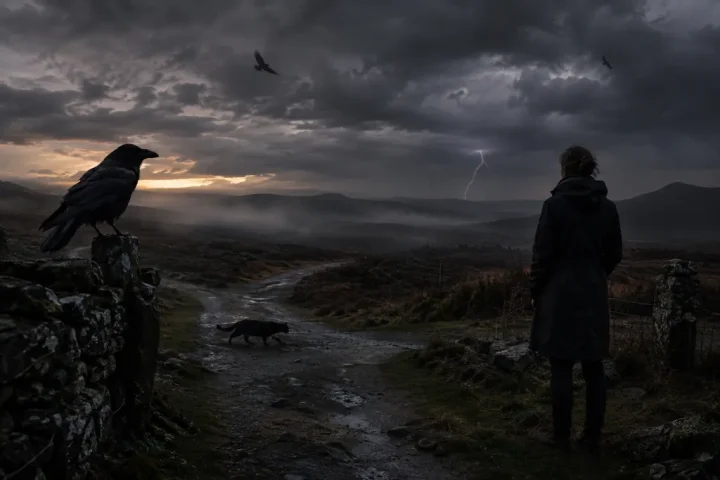
The crow is one of the oldest and most ambiguous birds of omen, a creature that has inhabited the borderlands of mythology, divination, death and hidden knowledge for thousands of years. Its black plumage, harsh voice, intelligence and familiarity with carrion have given it an enduring reputation as a messenger of things human beings would rather not know. Yet the crow has never belonged solely to evil. Across different traditions it may announce misfortune, carry divine messages, reveal secrets, guard thresholds or warn that something concealed is about to enter the visible world.
To the occult imagination, the crow is a bird of boundaries. It moves comfortably between wilderness and civilisation, feeds where death has occurred and watches human activity with an intelligence that has long seemed almost unnatural. This ability to inhabit several worlds at once has helped transform it into a symbolic intermediary between the ordinary and the unseen.
Messenger and Bird of Omens
Long before the crow became an emblem of Gothic darkness, its cries and movements were interpreted as signs from supernatural powers. In ancient Greek and Roman traditions, birds were observed for indications of divine will, and both crows and ravens played important roles in augury. The meaning of an encounter could depend upon the direction from which the bird appeared, the nature of its call and the circumstances surrounding the omen.
The appearance of a crow therefore did not automatically predict death. It demanded interpretation.
This distinction is important because later folklore often simplified the bird into a symbol of catastrophe. Earlier divinatory traditions were subtler. A crow might warn, announce, reveal or confirm something. Its message could be favourable or unfavourable depending upon the omen.
Variations of this idea occur far beyond the classical Mediterranean world. In different European and Asian traditions, the crow may announce approaching visitors, carry news, warn of danger or signal death. The details vary enormously, but the underlying belief remains remarkably persistent: when the crow behaves unusually, something beyond ordinary perception may be speaking through it.
The Crow and Prophecy
The crow’s connection with prophecy is particularly strong in traditions surrounding Apollo, the Greek god associated with prophecy, divination and oracles. Classical mythology frequently blurs the distinction between crow and raven, but black corvids repeatedly appear as birds connected with Apollo and with the transmission of dangerous knowledge.
In one famous story preserved by Ovid, Apollo’s bird discovers that Coronis, whom the god loves, has been unfaithful. The bird carries the information to Apollo, and the revelation ends in tragedy. According to the myth, the messenger bird had originally been white, but Apollo transformed its feathers to black.
The symbolism is striking. The bird becomes black because it carries a truth that causes suffering.
That theme survives throughout later occult symbolism. The crow does not necessarily create misfortune. It sees what others have not yet seen and reveals what someone might prefer to remain hidden. Its darkness therefore becomes associated not simply with evil but with knowledge that has crossed a forbidden boundary.
Crow, Death and the Unseen
The crow’s association with death is easy to understand. Crows and ravens are scavengers, and throughout history they have appeared wherever human beings left bodies exposed. Battlefields, execution grounds and places of violent death naturally attracted corvids, creating a powerful visual connection between black birds and mortality.
European folklore consequently filled the crow with sinister significance. A crow near a house might be interpreted as a warning of death. Its cry could be heard as an announcement from the spirit world, while flocks of black birds appearing unexpectedly might be regarded as evidence that disaster was approaching.
Such beliefs helped establish the crow as a creature capable of moving symbolically between the living and the dead. It became associated with ghosts, battlefields, restless spirits and places where the normal boundary separating worlds had become dangerously thin.
Yet death in occult symbolism rarely signifies extinction alone. Death may also represent initiation, transformation and the destruction of an old state before another can emerge. This darker meaning becomes especially important when the crow enters the imagery of alchemy.
The Crow and the Nigredo
In Western alchemy, the black corvid is closely associated with the nigredo, the Blackening that marks the beginning of the Great Work. Historical alchemical texts more commonly identify this bird specifically as the raven, although crow and raven symbolism frequently overlap in translations and later occult literature. The Latin term corvus itself has contributed to this ambiguity.
The alchemical expression caput corvi, the Raven’s Head or Crow’s Head, refers to the blackened state of matter produced during the early stages of transformation. This darkness represents decomposition, dissolution and putrefaction. Before the alchemist can purify, unite and perfect the material of the Work, its existing form must first be broken apart.
The black bird therefore appears at the beginning of the process because the Great Work begins with symbolic death.
Matter becomes dark. Structures collapse. What appeared stable begins to decay. The old form must enter corruption before something new can emerge from it.
For the alchemist, this blackness was not failure. It was evidence that transformation had begun.
The crow or raven consequently became one of the most powerful symbols of the dark stage that precedes illumination. It represents the moment when the practitioner enters a territory in which familiar forms have dissolved but the new state has not yet revealed itself.
This is why the bird belongs so naturally to occult symbolism. It waits precisely where one world has ended and another has not yet begun.
Hidden Knowledge and the Shadow
Modern occult and psychological interpretations have expanded the crow’s symbolism into the territory of the unconscious and the shadow. The bird may represent thoughts, memories, desires or truths that remain hidden beneath ordinary awareness.
This is a later interpretation rather than a single ancient doctrine, but it corresponds remarkably well with the crow’s older reputation as a revealer of concealed things.
The crow watches.
It remembers.
It notices what others ignore.
Its supernatural reputation is strengthened by the very real intelligence of corvids, which are capable of complex social behaviour, memory and problem solving. To earlier peoples, a black bird that seemed to observe human beings, remembered threats and appeared repeatedly around scenes of death could easily acquire an aura of uncanny awareness.
Within occult interpretation, the crow may therefore appear when something buried is demanding recognition. It can symbolise the arrival of uncomfortable knowledge, the emergence of something previously hidden or the necessity of confronting an aspect of oneself that has been pushed into darkness.
The message is not necessarily pleasant, but neither is it automatically destructive.
Some truths arrive wearing black feathers.
The Crow as a Threshold Creature
One of the strongest ways to understand the crow is as a threshold creature. It stands between life and death, civilisation and wilderness, prophecy and ordinary perception, corruption and transformation.
This helps explain why its symbolism is so contradictory. The crow can be fortunate in one tradition and disastrous in another because threshold beings rarely belong completely to one side. They cross boundaries, and anything capable of crossing a boundary can carry something with it.
A crow may therefore become a messenger between worlds, but this should not be understood as a universal doctrine attached to every crow in every culture. Rather, it is the result of a recurring symbolic pattern in which black corvids become associated with communication from beyond ordinary human awareness.
The same principle explains their relationship with magic. Magical traditions are themselves concerned with crossing boundaries between visible and invisible, conscious and unconscious, human and spirit. The crow already appears to inhabit precisely those borders.
Seeing a Crow as an Omen
Occult folklore contains countless interpretations of encounters with crows, but there is no universal rule declaring that a particular number of crows, a particular cry or a bird appearing at a particular window must predict one specific event. Much of the modern material circulating about crow omens combines regional folklore, later superstition and newly invented symbolism.
Historically, context mattered.
Where did the crow appear? What was happening when it arrived? Was its behaviour unusual? From which direction did it approach? Was it alone or among others? Did the encounter immediately follow a question, dream, ritual or disturbing event?
Traditional divination frequently depended upon patterns such as these rather than upon rigid modern lists of meanings.
The occult significance of the crow therefore lies less in automatically declaring every sighting supernatural and more in recognising the bird’s ancient symbolic role as an observer and announcer. When the crow appears in myth, vision, dream or ritual symbolism, its presence often suggests that something hidden deserves attention.
The Black Bird at the Beginning
Perhaps the deepest occult meaning of the crow is found in the strange relationship between death and knowledge.
The crow gathers where something has ended, yet in alchemy the black bird appears when the Work has only just begun. It carries messages that may bring grief, but those messages reveal truths that were previously concealed. It belongs to darkness, yet darkness itself may contain the first stage of transformation.
The crow therefore represents something more complex than evil.
It is the intelligence within darkness, the watcher at the boundary and the messenger that arrives before the meaning of its presence is understood. It reminds the occultist that revelation does not always descend in light. Sometimes knowledge appears from a ruined field, settles silently upon a dead branch and waits for someone willing to understand why it has come.
Stop Watching the Mystery From Outside
If the crow is nothing more to you than a black bird that means death, then you have barely touched the surface of occult symbolism. The Occult World Mystery School is for people who are finished with shallow definitions, recycled social media mythology and endless fragments pretending to be esoteric knowledge. Go deeper into alchemy, divination, demonology, spirits, grimoires, ritual magic and the hidden systems that gave these symbols their power. Stop standing outside the temple collecting curiosities while convincing yourself that you are studying the occult. Enter, learn the traditions properly and claim the knowledge that passive spectators will never possess.
Sources
- Guiley, Rosemary Ellen. The Encyclopedia of Magic and Alchemy. Visionary Living, 2006.
- Ovid. Metamorphoses, particularly the traditions concerning Apollo, Coronis and the blackening of the prophetic bird.
- Classical sources on Roman augury and the interpretation of crows and ravens as birds of omen.
- Encyclopaedia Iranica, material concerning crow folklore and divinatory beliefs.
- Concannon, Joan. “Symbolism of the Crow and Raven in Mythology, Alchemy, and Sandplay.”
- Historical alchemical material concerning Corvus, caput corvi and the nigredo stage of the Great Work.



Follow