

African Witchcraft: Ancestral Power, Sorcery and the Invisible World
African witchcraft cannot be understood as one single system of belief. Africa contains thousands of communities, languages and spiritual traditions, each with its own understanding of ancestors, spirits, healing, sorcery and supernatural power. Nevertheless, certain themes appear repeatedly across the continent: the presence of an unseen world, the continuing influence of the dead, the destructive force of jealousy and anger, and the belief that spiritual power may be used either to protect life or to cause harm.
These traditions also provide important cultural foundations for African diasporic religions such as Vodou, Santería and Candomblé. Although these religions developed under very different historical circumstances, they preserved and transformed African ideas concerning divine power, spirit communication, ritual offerings, sacred medicines and ancestral relationships.
The Supreme Creator and the Spirit World
Many traditional African religions recognise a supreme creator associated with light, brightness, the heavens or the forces of nature. This divine power may be imagined through the brilliance of a snow-covered mountain, sunlight entering a sacred grove, thunder rolling across the sky or lightning dividing the darkness.
The supreme creator is frequently regarded as immense, awe-inspiring and distant from ordinary human concerns. Communication with this power may therefore take place through priests, elders, diviners, spirits or ancestral intermediaries.
Unusual natural events and extraordinary births can also be understood as signs of divine activity. In some communities, the birth of twins has traditionally been surrounded by special rituals because twins are believed to possess an unusual relationship with the supernatural world. Depending on the culture, they may be revered, protected, feared or separated from ordinary social life.
The ancestors, by contrast, remain much closer to the living.
The spirits of the dead are not necessarily believed to have disappeared from the community. They may continue to observe their descendants, participate in family affairs and communicate through dreams, divination, illness or unusual events in nature. The movement of leaves, the appearance of a dust spiral or a sudden change in the current of a river may be interpreted as evidence of an unseen presence.
Among some southern African peoples, ancestral spirits are divided into family ancestors and the founding figures associated with a larger community, chiefdom or territory. These founders may be remembered as culture heroes, guardians or spiritual representatives of the land.
Honouring the Ancestors
The relationship between the living and the dead must be maintained. Food, drink and animal offerings may be presented to the ancestors as signs of gratitude, respect and continuing kinship.
An ancestral feast is more than a symbolic meal. It creates communion between the living family and those who came before them. Because the ancestors represent family continuity, unresolved disputes between living relatives can threaten the spiritual balance of the household.
For this reason, quarrels may need to be discussed before an ancestral ceremony begins. Anger that remains concealed is particularly dangerous because jealousy, resentment and hatred are frequently viewed as openings through which destructive spiritual power can enter.
In this worldview, witchcraft does not emerge from nowhere. It is often linked with the darker emotions that human beings recognise within themselves and others. Envy of another person’s prosperity, resentment over an inheritance, rivalry between relatives or hatred caused by humiliation can all become spiritually dangerous.
Witchcraft, Sorcery and Harmful Magick
The English word witchcraft is often used to translate many different African concepts, even when those concepts are not truly equivalent. In some traditions, witchcraft is believed to be an inner power or inherited condition. In others, harmful magick must be consciously performed through medicines, poisons, charms or ritual actions.
A person may therefore be considered dangerous without deliberately practising sorcery. Elsewhere, guilt requires clear intention, preparation and malice.
Descriptions of witchcraft also differ dramatically between communities. Among the Nyakyusa, it has been described metaphorically as a python within the belly. Among the Pondo, it has been associated with a female serpent. Other traditions imagine harmful supernatural power in the shape of a baboon or a strange, hairy creature.
These images should not always be interpreted literally. They can express the hidden, predatory or uncontrollable nature of destructive power. The creature within the body represents something concealed inside an apparently ordinary person.
Historical accounts frequently state that accusations were directed towards women, socially marginalised men, outsiders and younger people. This resembles patterns seen in European witch trials, where suspicion often fell upon those who lacked social protection.
Confession could play an important role in healing. When illness was blamed on witchcraft, the accused person might be asked to acknowledge resentment towards the victim and withdraw the harmful influence. Recovery was believed to depend not only on medicine but also upon reconciliation and the restoration of goodwill.
Mangu Among the Azande
One of the best-known anthropological studies of African witchcraft was conducted by E. E. Evans-Pritchard among the Azande during the 1920s.
The Azande concept commonly translated as witchcraft is called mangu. It was described as an inherited substance located inside the body of a witch, traditionally near the stomach or liver. Accounts referred to a dark swelling or sac containing small objects. Evans-Pritchard suggested that these descriptions may have been influenced by observations of the gall bladder, although the spiritual meaning of mangu extended far beyond physical anatomy.
Among the Azande, mangu could be inherited through the family line. Sons were said to receive it from their fathers, while daughters inherited it from their mothers. Children were not usually treated as dangerous witches because their power was believed to be too immature to cause serious harm.
Most importantly, a person possessing mangu might not know it. The witch’s spiritual power could leave the body at night and attack another person while the witch remained asleep. Nightmares, sudden terror or unexplained illness could consequently be interpreted as encounters with hostile witchcraft.
Mangu was also believed to appear as a small light moving through the darkness. Ordinary people could not always see it, but witches, diviners and specialists trained to recognise witchcraft might perceive its glow. This mysterious illumination resembles the phenomenon sometimes called witches’ light.
Azande witchcraft did not simply replace practical explanations. A collapsed building might have been weakened by termites, but witchcraft explained why it collapsed at the exact moment a particular person was sitting beneath it. The material cause and the supernatural cause could exist together.
Oracles and the Identification of Witches
When witchcraft was suspected, divination could be used to identify its source.
One method involved a rubbing-board oracle operated with a wooden instrument. The names of possible suspects were presented to the oracle, which indicated the person whose power might be responsible for the victim’s suffering.
The result could then be tested through the famous poison oracle, commonly known as benge. Poison was administered to a chicken while questions or names were spoken aloud. The survival or death of the animal provided an answer.
Once a suspect had been identified, a representative might be sent to confront the accused. This confrontation did not always lead to punishment. A person could deny consciously causing harm while still asking any unknown witchcraft within them to leave the victim alone.
The suspected witch’s sincerity was considered important. An apology, a peaceful response or the withdrawal of resentment might be enough to restore balance. When the accused was a respected member of the community, the victim’s family might avoid naming the person publicly. Instead, they could announce that witchcraft had been discovered and request that it cease. This allowed the suspected individual to withdraw the influence without suffering public humiliation.
Day Sorcerers and Night Witches
Among Tswana-speaking peoples, harmful magick has sometimes been divided into the activities of day sorcerers and night witches.
Day sorcerers deliberately prepare medicines, herbs or poisons to attack a particular enemy. Their actions are conscious and directed towards a specific purpose. The expression go jesa, meaning “to feed,” refers to the secret placing of a harmful substance into someone’s food or drink.
Some supernatural accounts describe this substance transforming inside the body into a miniature crocodile that slowly consumes the victim from within. Other descriptions are far more practical and may reflect genuine cases of poisoning. A substance could be administered in small quantities, allowing the victim’s health to decline gradually without immediately revealing the cause.
Night witches were imagined very differently. They were said to travel after dark, gather in secret groups and enter houses by supernatural means. Some traditions claimed that they covered their bodies with ashes or substances associated with the dead. They were also accused of disturbing graves, removing parts from corpses and using them in powerful medicines.
Initiation into such a group was believed to demand a terrible demonstration of loyalty, sometimes involving the sacrifice of a close relative. Magical ointments or medicines were then said to allow the initiate to awaken instantly whenever the other witches called.
These stories belong to a world of supernatural terror and should not automatically be treated as descriptions of actual events. Even within communities where such beliefs circulated, people could distinguish between frightening legends and practices they considered genuinely observable.
Familiars, Hyenas and Nocturnal Spirits
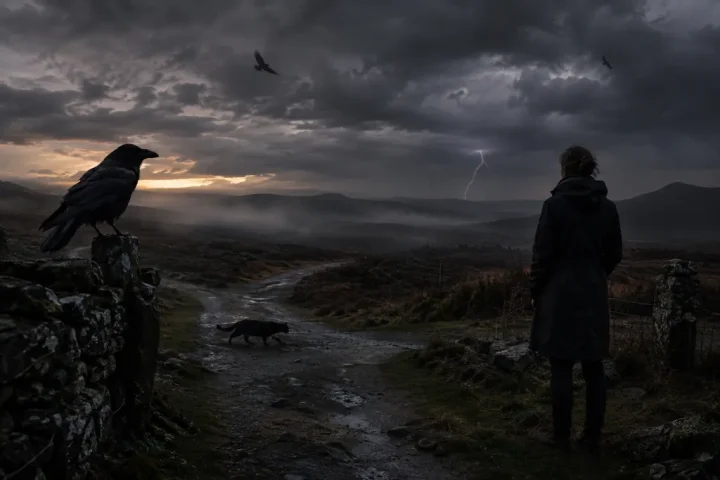
Stories of African witches frequently involve animal companions. Owls, bats, hyenas and baboons appear as familiars, messengers or vehicles of supernatural travel.
The owl’s nocturnal nature and silent flight made it an especially powerful symbol of hidden activity. Hyenas were associated with graveyards, scavenging and the dangerous spaces beyond the safety of the village.
Some witches were said to ride hyenas through the night, balancing with one foot upon the animal and the other touching the ground. Among the Bakgatla, stories claimed that witches could create artificial hyenas from porridge and awaken them with magical medicines.
Other accounts speak of zombies, revived corpses and mysterious hairy beings that served those who practised harmful magick. Such creatures embodied the fear that the natural order could be reversed: the dead might be forced to work, animals might become servants of human malice and the boundaries between the visible and invisible worlds might collapse.
Witchcraft as a Social and Spiritual Reality
Witchcraft beliefs have often been dismissed as superstition, yet they perform complex social and spiritual functions. They provide a language through which people can discuss jealousy, unexplained illness, family conflict, sudden death and misfortune.
At the same time, accusations can cause serious harm. Those labelled as witches may face exclusion, violence or even death. A responsible study of African witchcraft must therefore recognise both the spiritual importance of these beliefs and the human consequences that accusations can create.
African traditions also distinguish between destructive sorcery and legitimate spiritual practice. Diviners, healers, priests and herbal specialists may work with ancestors, spirits, sacred objects and magical preparations without being considered witches. Their task is often to identify spiritual imbalance, protect the community and reverse harmful influences.
This distinction is essential. Magick is not automatically evil, and spirit work is not automatically witchcraft. Power is judged according to its purpose, the methods used and the consequences it produces.
Enter the World of Witchcraft and Magick
African witchcraft reveals a universe in which emotions possess spiritual weight, the ancestors remain close to their descendants and the invisible world continually interacts with everyday life. It is a subject filled with mystery, fear, healing, protection, divination and supernatural power.
Yet this is only one doorway into the vast history of witchcraft.
Inside the Occult World Mystery School, you can explore witchcraft and magick beyond shallow social-media trends. Discover the traditions, spirits, symbols, rituals and forbidden texts that have shaped occult practice across cultures and centuries. Study practical spellcraft, black magick, demonology, Hoodoo, Vodou, necromancy, ancient grimoires, divination and the hidden forces that influence the visible world.
This is a place for serious seekers who want more than fragments of information. It is a community where you can deepen your knowledge, develop your practice, ask questions and connect with others who are equally fascinated by the mysteries of magick.
Do not remain outside the circle, merely reading about the hidden world. Enter it. Join the Occult World Mystery School and begin transforming occult knowledge into living practice.
SEE ALSO:
FURTHER READING:
- Evans-Pritchard, E. E. Witchcraft, Oracles and Magic Among the Azande (abridged). Oxford: Clarendon Press, 1983.
- Mair, Lucy. Witchcraft. New York: McGraw-Hill World University Library, 1969.
- Middleton, John, ed. Magic, Curing & Witchcraft. Austin: University of Texas Press, 1967.
- Parrinder, Geoffrey. Witchcraft European and African. London: Faber & Faber, 1970.
SOURCE:
The Encyclopedia of Witches, Witchcraft and Wicca written by Rosemary Ellen Guiley – Copyright © 1989, 1999, 2008 by Visionary Living, Inc.



Follow