

Belenus
Belenus is the Latinised name of the Celtic deity known as Bel or Belen. His name is usually connected with a Celtic root meaning “brilliant,” “bright,” “shining,” “luminous” or “effulgent.” This makes Belenus a god of radiance, light, vitality and possibly the healing force of the sun.
Very little is known about Belenus with certainty. The Celts did not preserve their sacred knowledge in written form in the same way as the Greeks and Romans, so much of what we know comes from inscriptions, archaeology, place names and Roman interpretation. The Romans identified Belenus with Apollo, which suggests that they recognised in him qualities of light, healing, beauty, prophecy or divine brilliance.
Although his myths have not survived, the evidence shows that Belenus was once among the most widely venerated and beloved deities of the Celtic world.
The Shining God
The meaning of Belenus’ name gives us one of the clearest clues to his nature. He is the bright one, the shining one, the luminous god whose presence may have been felt in sunlight, warmth, healing, fertility and sacred vitality.
This solar quality does not necessarily mean that Belenus was only a sun god in a simple sense. Celtic deities often had wide and overlapping functions. Belenus may have been a god of healing light, reproductive power, sacred springs, livestock, brightness, prosperity and divine protection.
His radiance may have been both physical and spiritual. The sun warms the body, ripens crops, strengthens animals and brings the world into visibility. In the same way, Belenus may have been understood as a god who restores life-force, awakens fertility and illuminates what has become weak, hidden or stagnant.
Belenus and Apollo
The Romans identified Belenus with Apollo, one of the most important gods of the Roman and Greek world. Apollo was associated with healing, prophecy, music, beauty, light, purification and divine order. This identification tells us that Roman observers saw Belenus as more than a local tribal deity. They recognised him as a god of significant power.
The pairing of Belenus with Apollo also reflects the blending of Roman and Celtic religion. Rather than completely replacing native deities, the Romans often interpreted them through their own divine figures. In this case, Belenus became Apollo Belenus, a Romano-Celtic form that preserved the name and sacred identity of the Celtic god while connecting him with Roman religious symbolism.
Yet Belenus was not merely Apollo under another name. He remained rooted in Celtic landscapes, sacred springs, local shrines and regional devotion.
A Widely Venerated Celtic Deity
Belenus was venerated across a broad area of the Celtic world. The centre of his worship seems to have been in what is now France, where the greatest number of artefacts and inscriptions have been found. However, dedications to him have appeared across a wide geographical range, from the British Isles to Slovenia.
This wide distribution shows that Belenus was not an obscure or minor figure. He was a major deity whose cult travelled across regions, tribes and cultural boundaries. His popularity suggests that he answered deep and practical human needs: healing, fertility, protection, light, strength and prosperity.
The fact that his name appears in so many places also suggests that Belenus may have taken slightly different forms depending on the region. In one place he may have been most strongly connected with springs, in another with livestock, in another with solar healing or fertility. This flexibility is typical of many ancient gods whose worship spread across large territories.
Belenus and Healing Springs
Many shrines of Belenus incorporated therapeutic springs. This connection places him among the great healing deities of the Celtic and Romano-Celtic world. Sacred springs were understood as places where divine power rose from the earth in living form. The water healed because it belonged to the god.
Belenus may have ruled over the healing power of the sun, but his worship also united solar and watery forces. This combination is powerful. The sun gives warmth, strength and illumination, while water cleanses, restores and renews. Together, they create a complete image of healing: light entering the body, water carrying away suffering, warmth returning life to what has grown cold.
Devotees may have approached Belenus for physical healing, vitality, fertility and renewed strength. His sacred springs were places where the body could be restored and the spirit could be refreshed.
Lord of Flocks
Belenus is sometimes called the Lord of Flocks. This title suggests that he may have been a protector of livestock, fertility and agricultural prosperity. In the ancient world, flocks were wealth. Sheep, cattle and other animals provided food, clothing, labour, trade goods and social stability.
A god who protected flocks was therefore a god of survival and abundance. He guarded not only animals, but the prosperity of households and communities.
This title also deepens Belenus’ fertility associations. He may have been invoked for the reproductive health of both people and livestock. Fertility was not an abstract concept in ancient life. It meant healthy children, strong animals, successful breeding, full fields and the continuation of the community.
Belenus as an Erotic and Fertility Spirit
Belenus may also have been an erotic spirit connected with reproductive fertility. His shining, solar nature may have been associated with virility, attraction, life-force and generative power.
In this aspect, Belenus is not simply a god of warmth and light, but of the passionate force that causes life to multiply. His fertility may extend to humans, animals and the land itself. The sun awakens growth, stirs the blood, ripens fruit and strengthens living beings. Belenus may have embodied this bright, erotic current of nature.
This makes him a powerful figure for understanding Celtic fertility religion. Fertility was sacred because life itself depended upon it. The god who bestows fertility is the god who ensures continuity, wealth and survival.
Belenus, Beli and Other Theories
Some scholars and occult writers have suggested that Belenus may be the same spirit as Beli, the father of Arianrhod in Welsh tradition. This possible connection places Belenus within a wider Celtic mythological framework, linking him with divine ancestry, sovereignty and the old gods of Britain and Wales.
Other theories are more speculative. Some have proposed that Belenus may be connected with Ba’al, possibly brought to France by Phoenician traders and later adapted into Celtic religion. This idea remains uncertain, but it reflects the long history of cultural contact around the ancient Mediterranean and Atlantic worlds.
Another theory suggests that Belenus may have originated in what is now Slovenia and travelled westward through Europe. This would help explain the broad geographical spread of his worship. Whether this theory is correct or not, the distribution of inscriptions shows that Belenus was honoured across a remarkable range of Celtic and Romano-Celtic territory.
Places Connected with Belenus
Many places in France still seem to echo the name of Belenus. Beaune in Burgundy may preserve his memory. Tombelen, now better known as Mont Saint-Michel, has been interpreted by some as meaning “tomb of Belenus.” Bollène in southern France may also carry traces of his name.
Other possible place-name connections include Ballon near Le Mans, as well as nearby Saint-Mars-sous-Ballon and Souligné-sous-Ballon. These names suggest that Belenus may have left a deep imprint on the sacred geography of France.
Place names are important because they often preserve traces of older religious landscapes long after direct worship has disappeared. Even when temples fall and myths are forgotten, the name of a god may remain hidden in the land itself.
Belenus and Saint Bonnet
After the Christianisation of Europe, Belenus was assimilated to Saint Bonnet. Places named in honour of Saint Bonnet may once have been sacred to Belenus.
This kind of transformation was common. Older gods and goddesses did not always vanish abruptly. Their sacred places, functions and local importance were sometimes transferred to saints. A healing god might become a healing saint. A solar deity might be reinterpreted through Christian imagery. A sacred spring might become associated with a holy figure rather than the ancient god who once presided there.
In this way, Belenus may have survived in disguised form. His name faded, but some of his places and powers may have continued beneath a Christian mask.
Belenus and Witchcraft
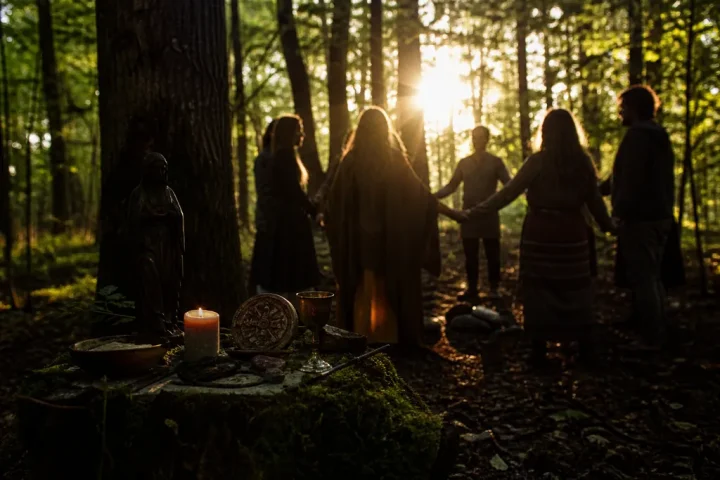
For modern witches and occultists, Belenus is a powerful god to explore in connection with solar magic, healing, fertility, prosperity, animal blessing, sacred springs and manifestation. His energy is bright, vital and restorative. He is the shining god who brings warmth, strength and renewal.
He may be honoured through solar rites, offerings of spring water, candles, flowers, golden objects, herbs of healing, prayers for fertility, and rituals for the protection of animals or livestock. His presence may be invoked when seeking vitality, confidence, reproductive strength, prosperity or the return of inner light after a dark period.
Belenus is especially meaningful for those working with the connection between light and healing. His magic teaches that radiance is medicine. To receive light is to receive life-force.
Belenus and Manifestation
Belenus carries a powerful message for manifestation. His name means brightness, and manifestation often begins when the inner world becomes bright enough to attract a new outer reality.
To work symbolically with Belenus is to call back vitality, confidence and the power to grow. The sun does not beg the world to bloom. It shines, and life responds. This is one of Belenus’ deepest lessons.
Manifestation is not merely about wanting. It is about becoming luminous with the state you wish to embody. When you carry the energy of abundance, health, fertility and confidence, you begin to move differently. You speak differently. You choose differently. The world responds to that inner radiance.
Belenus teaches that healing and manifestation are connected. When the life-force returns, the path opens.
The Occult Meaning of Belenus
Belenus is the shining god of Celtic Europe: luminous, healing, fertile and widely beloved. His name survives in inscriptions, sacred places, springs and possible echoes in French geography. The Romans identified him with Apollo, and his worship stretched from the British Isles to Slovenia.
He is a god of light, but not light in a shallow sense. His light heals, warms, ripens, protects and gives life. He is connected with therapeutic springs, reproductive fertility, livestock, prosperity and sacred vitality.
Belenus reminds us that ancient gods often survive in fragments: a name carved on stone, a spring once visited by pilgrims, a town whose name still whispers the old deity, a saint who carries a hidden inheritance.
He is the bright one, the Lord of Flocks, the healer of the spring, and the god whose radiance still shines through the remnants of Celtic memory.
Explore Belenus, Celtic Mythology and Witchcraft with Occult World
If Belenus, the shining Celtic god of healing, fertility and sacred light, speaks to you, then you are already sensing the deeper connection between mythology, witchcraft, manifestation, solar magic and the old gods of Europe. Belenus is not merely a forgotten name from inscriptions. He is a powerful symbol of radiance, vitality, prosperity, fertility and the healing force of divine light.
Inside the Occult World Mystery School, you can explore gods like Belenus in a deeper and more magical way. You can learn how Celtic mythology connects with witchcraft, manifestation, ritual practice, healing work, sacred springs, solar energy, animal symbolism and the transformation of the self.
You will also find courses and discussions on Witchcraft, Ancient Grimoires, Kabbalah, Demonology, Angels, Hoodoo, Voodoo, Practical Tarot, Necromancy, Black Magick, the Illuminati and many other occult traditions. More importantly, you can meet fellow witches, occultists, magical practitioners and serious seekers who understand that mythology is not just something to read about. It is something to work with, embody and awaken within your own magical life.
If the name Belenus calls to your need for light, healing, prosperity and renewed power, do not ignore it.
Join the Occult World Mystery School today and step into a living circle of mythology, witchcraft, manifestation, occult study and fellow seekers walking the hidden path together.
ORIGIN:
Celtic
Feast:
1 May
PLANET:
Sun
Elements:
Fire, water
Animal:
Horse
Sacred day:
Belenus is feted at Beltane or May Eve; beginning the night of 30 April with festivities continuing on 1 May; also 15 January, the feast of Saint Bonnet
OFFERINGS:
Votive offerings found at his shrine at Sainte-Sabine include terra-cotta horses and stone carvings of swaddled infants.
SEE ALSO:
- Apollo
- Arianrhod
- Ba’al (1)
- Michael
SOURCE:
Encyclopedia of Spirits: The Ultimate Guide to the Magic of Fairies, Genies, Demons, Ghosts, Gods & Goddesses– Written by Judika Illes Copyright © 2009 by Judika Illes.




Follow